25+ years of IT software development experience in different domains like Business Automation, Healthcare, Retail, Workflow automation, Transportation and logistics, Compliance, Risk Mitigation, POS, etc. Hands-on experience in dealing with overseas clients and providing them with an apt solution to their business needs.
Key Takeaways
Agentic AI advances prior authorization automation through adaptive workflow coordination and exception handling.
Intelligent task routing reduces delays by prioritizing urgent requests and streamlining escalations.
AI-driven documentation review improves accuracy and helps minimize denials and rework.
Electronic prior authorization improves efficiency through connected EHR, RCM, and payer systems.
Automation reduces administrative costs while improving staff productivity and operational scalability.
Successful adoption requires secure integration, human oversight, and measurable ROI.
What happens when prior authorization delays begin affecting patient care, staff productivity, and revenue cycle performance?
For healthcare organizations, manual documentation reviews, fragmented payer systems, repeated follow-ups, and inefficient task routing create operational bottlenecks that slow approvals and increase administrative costs.
Agentic AI brings a more coordinated approach to prior authorization automation by enabling intelligent case prioritization, clinical documentation triage, automated task assignments, and timely exception handling. Rather than simply automating repetitive steps, AI agents can coordinate workflows across connected systems while keeping complex decisions under human oversight.
Why Traditional Prior Authorization Workflows Create Operational Bottlenecks
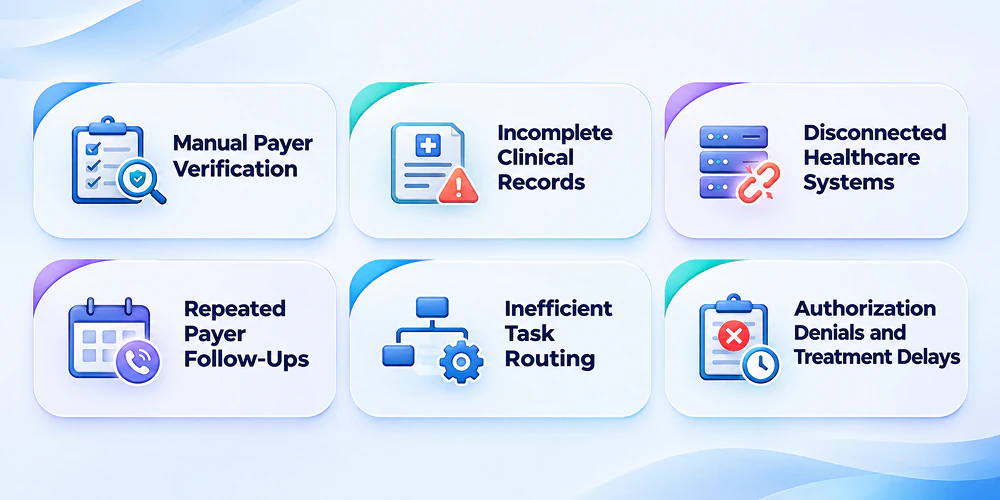
Manual verification, disconnected systems, and repetitive administrative tasks contribute to prior authorization delays, increased costs, and disrupted patient care. Without effective prior authorization automation, healthcare organizations struggle to manage growing request volumes efficiently. As per reports around 95% of physicians reported that prior authorization delays access to necessary care.
Manual Payer Verification
Varying payer policies and coverage requirements force staff to perform repetitive checks, increasing processing time, submission errors, and administrative workload.
Incomplete Clinical Records
Missing diagnosis codes, treatment histories, or medical necessity evidence trigger repeated reviews, delaying authorization submissions and scheduled treatments.
Disconnected Healthcare Systems
Poor interoperability creates duplicate data entry, inconsistent records, and limited visibility, reducing the efficiency of electronic prior authorization workflows.
Repeated Payer Follow-Ups
Manual status checks and insurer communications consume staff time, delay case resolution, and create uncertainty around treatment scheduling.
Inefficient Task Routing
Poor case prioritization and uneven task distribution create backlogs, delay urgent requests, and reduce authorization team productivity.
Authorization Denials and Treatment Delays
Incomplete submissions and missed payer requirements increase denials, administrative rework, reimbursement delays, and disruptions to patient care.
Where Are Your Prior Authorization Requests Getting Stuck?
DITS helps healthcare teams pinpoint where missing documentation, manual payer checks, and repeated handoffs slow requests down.
How Agentic AI Extends Traditional Prior Authorization Automation?
Traditional prior authorization automation handles repetitive tasks through predefined rules but struggles with complex workflows and disconnected systems. Agentic AI enables adaptive workflow coordination, intelligent task routing, and faster processing, helping healthcare organizations reduce prior authorization delays while maintaining human oversight.
Key Aspect
Rule-Based Automation
Task-Specific AI Agents
Agentic AI Orchestration
Workflow Execution
Executes predefined authorization tasks.
Handles specific activities such as documentation, extraction or classification.
Coordinates multi-step workflows and adapts actions based on authorization status.
Intelligent Operations
Uses fixed processing rules and workqueues.
Identifies case urgency, complexity, or missing information.
Coordinates case prioritization, task routing, and escalation across teams.
Healthcare Interoperability
Exchanges information through configured integrations.
Retrieves and processes information from connected systems.
Orchestrates activities across EHR, RCM, and payer platforms using available integrations.
Electronic Prior Authorization
Automates configured request submissions.
Supports documentation review and request preparation.
Coordinates submissions, payer responses, and subsequent workflow actions.
Exception Management
Flags predefined errors.
Detects potential documentation gaps or processing exceptions.
Coordinates follow-ups, reassignment, and escalation when cases require intervention.
AI Governance & Human Control
Follows predefined execution permissions.
Operates within assigned task boundaries.
Requires explicit autonomy limits, approval checkpoints, audit trails, and human oversight.
Operational Scalability
Scales predictable, repetitive tasks.
Reduces manual effort within individual activities.
Coordinates higher authorization volumes across interconnected workflows.
Business Value
Reduces repetitive administrative work.
Improves task-level processing efficiency.
Targets coordination costs, processing delays, and operational bottlenecks.
How Agentic AI Improves Authorization Accuracy and Workflow Efficiency?
Agentic AI enhances prior authorization automation by coordinating complex workflows across clinical, administrative, and payer systems. With intelligent task routing and automated exception handling, healthcare organizations can reduce processing delays, lower administrative costs, and improve operational efficiency while maintaining human oversight. An estimated 45% reduction in prior authorization handling time was ensured with handling time decreased from approximately 11 minutes to 6 minutes per request.
Clinical Documentation Review and Coordination
Coordinates the retrieval of diagnosis codes, treatment histories, and clinical records from EHR systems, reducing manual documentation efforts.
Identifies missing medical necessity evidence and initiates information requests to prevent incomplete authorization submissions.
Routes documentation gaps to appropriate clinical teams, improving first-pass submission completeness and reducing costly rework.
Payer Requirement and Eligibility Verification
Coordinates payer-specific coverage checks and authorization requirements across connected systems, reducing repetitive verification tasks.
Identifies eligibility discrepancies and missing authorization criteria before submission, helping prevent avoidable denials and processing delays.
Escalates complex payer requirements for staff review, improving verification accuracy and reducing administrative workload.
Electronic Prior Authorization Submission and Tracking
Orchestrates electronic prior authorization submissions through supported payer APIs and existing healthcare platforms, reducing repetitive data entry.
Monitors payer acknowledgments, pending decisions, and documentation requests to improve authorization visibility and response times.
Coordinates subsequent actions based on payer responses, helping reduce manual follow-ups and prevent avoidable treatment scheduling delays.
Intelligent Task Routing and Case Prioritization
Evaluates case urgency, authorization deadlines, documentation completeness, and complexity to prioritize requests requiring immediate attention.
Coordinates task assignments based on staff expertise, availability, and workload, reducing unnecessary handoffs and improving resource utilization.
Escalates time-sensitive and complex cases to appropriate specialists, helping prevent authorization backlogs and improve turnaround times.
Payer Follow-Ups and Exception Escalations
Coordinates timely payer follow-ups based on authorization status and response timelines, reducing repetitive administrative tracking.
Detects stalled requests, missing documentation, and unresolved payer responses to prevent cases from remaining unattended.
Routes exceptions requiring clinical judgment or additional verification to qualified personnel, accelerating issue resolution while preserving human oversight.
Authorization Workqueue Management
Maintains visibility across verification, documentation, submission, and approval stages, helping teams identify processing bottlenecks early.
Flags duplicate authorizations, overdue requests, and outdated tasks to reduce unnecessary processing and improve workqueue accuracy.
Coordinates workload redistribution based on case priority and staff capacity, supporting higher authorization volumes without proportionally increasing administrative costs.
How Agentic AI Orchestrates Prior Authorization from Intake to Resolution?
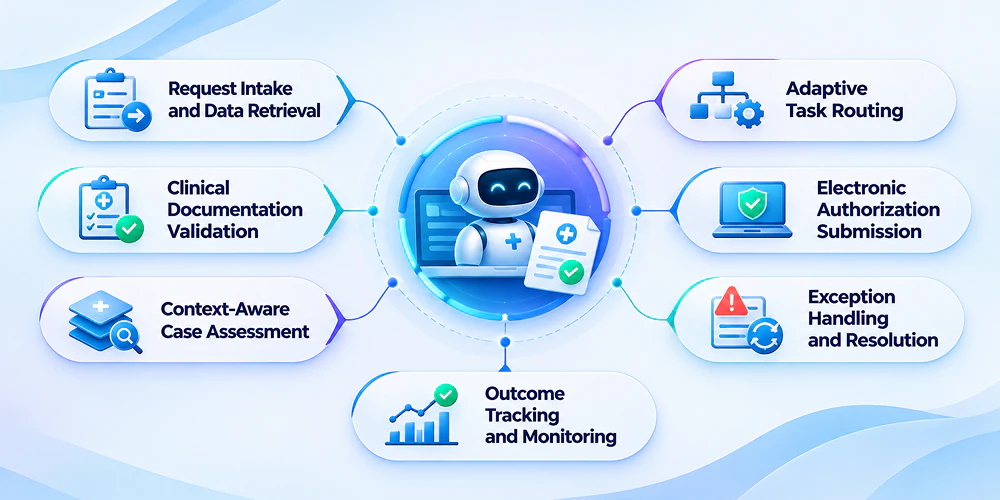
Prior authorization delays often arise not from individual tasks but from poor coordination between clinical teams, administrative systems, and payers. Agentic AI addresses these gaps by connecting activities into a coordinated workflow, enabling healthcare organizations to reduce manual handoffs, accelerate case resolution, and improve operational visibility. Here's how prior authorization automation works across the authorization lifecycle.
Request Intake and Data Retrieval
AI agents retrieve patient, procedure, and payer information from connected EHR and administrative systems. This reduces duplicate data entry, improves information consistency, and helps authorization teams process requests without repeatedly switching between platforms.
Clinical Documentation Validation
The system checks clinical documentation against available payer requirements and identifies missing medical necessity evidence before submission. Addressing these gaps early helps reduce repeated information requests, administrative rework, and avoidable authorization denials.
Context-Aware Case Assessment
Agentic AI evaluates authorization urgency, case complexity, documentation readiness, and scheduled treatment dates to determine processing priorities. This helps teams focus on time-sensitive requests, reduce backlogs, and allocate resources more effectively.
Adaptive Task Routing
Routine administrative activities are directed through approved automation workflows, while complex cases are escalated to qualified personnel. This human + AI operating model reduces unnecessary manual intervention while preserving clinical judgment, accountability, and AI governance.
Electronic Authorization Submission
Through supported payer integrations, agentic AI coordinates electronic prior authorization submissions and tracks acknowledgments, pending decisions, and information requests. This improves status visibility, reduces repetitive payer follow-ups, and helps prevent authorization issues from disrupting treatment schedules.
Exception Handling and Resolution
When requests are stalled, rejected, or require additional documentation, agentic AI identifies the next permitted action and coordinates follow-ups or escalations. This adaptive approach helps prevent cases from remaining unresolved, reducing prior authorization delays and improving exception resolution efficiency.
Outcome Tracking and Monitoring
Once payer responses are received, the system synchronizes authorization statuses across connected platforms and maintains auditable workflow records. Healthcare leaders can track turnaround times, manual intervention rates, and processing costs to identify bottlenecks, evaluate automation ROI, and improve future authorization performance.
How to Bring Agentic AI Into Existing Prior Authorization Workflows?
Successful prior authorization automation depends on reliable system integration, accessible clinical data, and secure workflows. Agentic AI can strengthen existing healthcare platforms through interoperability and controlled automation without requiring complete system replacements.
EHR, RCM, and Payer Integration
Integrates clinical, billing, and payer data to reduce duplicate entry and fragmented authorization workflows.
Improves data accessibility and synchronization, enabling accurate information exchange and better operational visibility.
API-Based Prior Authorization
Uses supported APIs and HL7 FHIR standards to enable electronic prior authorization and payer interoperability.
Coordinates submissions, documentation exchange, and payer responses to reduce manual processing and follow-ups.
Legacy Workflow Modernization
Introduces agentic workflow orchestration into existing platforms, minimizing costly replacements and operational disruptions.
Prioritizes high-impact automation opportunities to improve processing efficiency, scalability, and long-term technology value.
AI Governance and Security
Protects sensitive patient information through role-based access, HIPAA-aligned safeguards, and auditable workflows.
Establishes agent autonomy limits and human approval checkpoints to maintain accountability, security, and operational control.
Can Your Existing Systems Support Prior Authorization Automation?
DITS helps you assess how your EHR, billing, and payer systems can share data, route tasks, and keep complex cases with the right reviewers.
Business Benefits of Agentic AI in Prior Authorization Automation
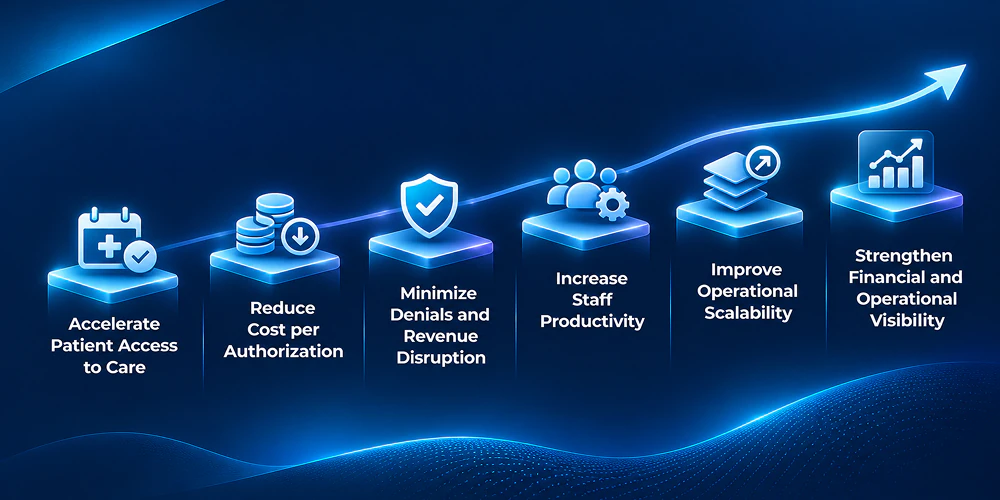
Agentic AI helps healthcare organizations reduce authorization costs, protect revenue, and improve patient access by addressing inefficiencies across complex workflows. Its business value extends beyond faster processing to better resource utilization, fewer administrative bottlenecks, and scalable prior authorization automation.
Accelerate Patient Access to Care: Shorten authorization turnaround times by identifying stalled requests and coordinating timely follow-ups, helping prevent avoidable treatment and procedure delays.
Reduce Cost per Authorization: Automate repetitive verification, documentation, and payer coordination tasks to lower administrative processing costs and improve operating margins.
Minimize Denials and Revenue Disruption: Identify missing clinical documentation and payer requirement gaps before submission, reducing avoidable denials, rework, and potential reimbursement delays.
Increase Staff Productivity: Reduce manual interventions and authorization backlogs, allowing RCM and administrative teams to process higher request volumes and focus on complex cases.
Improve Operational Scalability: Handle growing authorization workloads through coordinated AI agents without proportionally increasing administrative staffing or operational overhead.
Strengthen Financial and Operational Visibility: Track authorization costs, turnaround times, exception resolution, and staff workload to identify inefficiencies, evaluate ROI, and guide future automation investments.
How DITS Helps Healthcare Organizations Implement Agentic AI?
DITS helps healthcare organizations move beyond isolated automation toward coordinated, outcome-driven authorization workflows. We assess operational gaps, identify where agentic AI adds value over conventional automation, and prioritize solutions that reduce processing costs, minimize delays, and improve resource utilization.
With experience in healthcare software solutions, DITS combines intelligent workflow design, document intelligence, EHR and payer integrations, and responsible AI implementation. Our approach helps organizations modernize prior authorization processes while maintaining operational continuity, security, and long-term scalability.
Take a closer look at how DITS's healthcare projects address demanding industry requirements through thoughtful system design and practical execution.
Start With One Prior Authorization Workflow
DITS helps you choose a workflow to pilot, such as documentation checks or stalled-case escalation, and define what to measure before expanding.
Traditional automation follows predefined rules for repetitive tasks, while agentic AI coordinates multi-step workflows, adapts to changing conditions, and manages exceptions across connected healthcare systems with appropriate human oversight.
Dinesh Thakur
25+ years of IT software development experience in different domains like Business Automation, Healthcare, Retail, Workflow automation, Transportation and logistics, Compliance, Risk Mitigation, POS, etc. Hands-on experience in dealing with overseas clients and providing them with an apt solution to their business needs.