With more than 20 years of experience - I represent a team of professionals that specializes in the healthcare and business and workflow automation domains. The team consists of experienced full-stack developers supported by senior system analysts who have developed multiple bespoke applications for Healthcare, Business Automation, Retail, IOT, Ed-tech domains for startups and Enterprise Level clients
Key Takeaways
The substance abuse EMR software enables rehab centers to get rid of disconnected systems since patient admission, documentation, billing, compliance, care and recovery management are all managed through a single solution.
Substance abuse software development helps rehab centers to streamline workflows, reduce paperwork, improve documentation accuracy and enhance operational visibility.
Key features of substance abuse software include patient assessment, treatment plan, clinical documentation, MAT management, claims management, patient portal, reporting and compliance tools, making the substance abuse EMR software beneficial for both clinical and business purposes.
AI is used to make substance abuse EMR workflows more intelligent by generating intake response summaries, identifying gaps in documentation, pinpointing workflow bottlenecks, conducting documentation audits for billing and helping establish priorities for follow-up tasks.
What would you expect from patient intake, therapy documentation, treatment plans, medications, billing, compliance and recovery management, all happening across different platforms? In rehab facilities, mental health centers and addiction treatment centers, it would mean increased workload and inefficiencies.
With substance abuse EMR software development, all such problems are addressed by consolidating these tasks into a single application. Designed specifically for rehab centers and addiction treatment organizations, it streamlines their processes and increases the efficiency of care delivery.
What is Substance Abuse EMR Software?
Substance abuse EMR software is a custom healthcare platform specifically built for the addiction treatment facilities, rehab facilities and behavioral health organizations. In contrast to standard medical recordkeeping software, it is workflow-oriented, taking into account the unique requirements of processes such as patient intake, substance abuse evaluation, treatment planning, clinical documentation, group therapy notes, medication management, scheduling, billing, reporting and compliance management.
Well-designed software for substance abuse helps care providers organize and access all patient data within a single system. For rehab facilities, it will be easy to organize daily routines, while addiction treatment software will assist in efficient cooperation between all involved parties i.e. care providers, counselors, physicians, admin and patients.
Market Scope and Business Opportunities in Addiction Treatment Software
By 2035, the substance abuse EMR software is expected to grow by $5 Bn with a CAGR of 7.8% (2026-2035).
Research shows that around 45% of those in recovery reported that they use apps/websites which help them recover from their addiction.
Some of the top-rated software are EHRYourWay, SimplePractice, Tebra, Opus, Kipu Health, Sevocity and Alleva.
Substance abuse software development is skyrocketing as people are accepting such platforms as a rational treatment method. For business players, this reflects long-term opportunities across the overall healthcare system and digital care solutions.
Need Better Care Coordination For Rehab Centers?
Develop customized EMR solutions that improve patient management, staff collaboration, and treatment planning across rehabilitation facilities.
Why Businesses Are Investing in Substance Abuse Software Development?
Businesses are investing in substance abuse software since there is a need for addiction treatment facilities to have more advanced means of managing patients. The manual way of recording data and using multiple applications hinders the ability to track progress and to be compliant and efficient in billing and coordination. It will help rehab facilities and behavioral health facilities in many aspects.
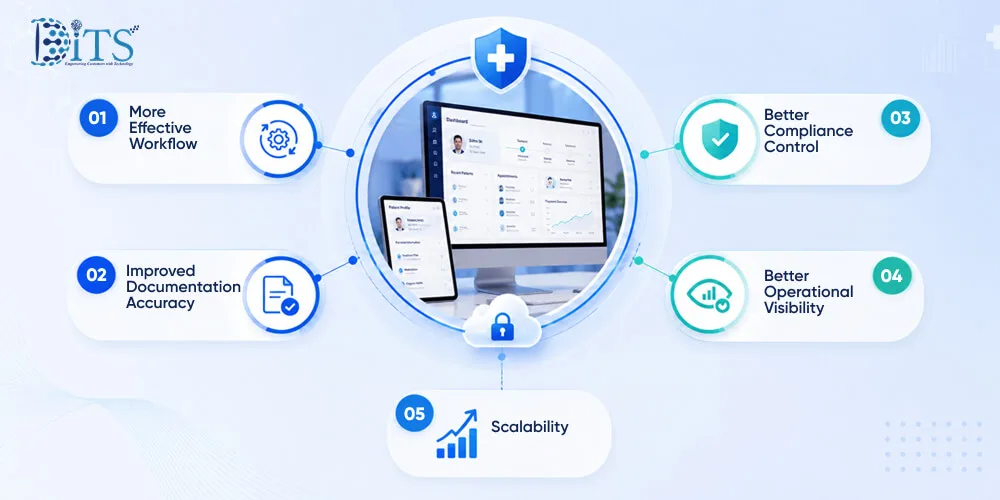
More Effective Workflow
Helps save massive time that gets wasted on manual paperwork, follow-ups, record-keeping and scheduling, providing staff with the opportunity to concentrate more on patient support. It helps businesses to gain higher staff productivity, lesser workflow delays followed with swift patient onboarding.
Improved Documentation Accuracy
Templates and digital note-making help minimize the risk of inaccurate or lost data. It will be easier to write down therapy notes and plan the treatment. It introduces much smoother billing, lower claim issues, enhanced operational efficiency and superior clinical continuity.
Better Compliance Control
With its built-in access control, audit logs, consent management and encrypted data, custom rehab EMR software can minimize the risk of compromising patient privacy. This shields the businesses from hefty errors along with ensuring much safer handling of sensitive patient details thus ensuring trust.
Better Operational Visibility
The dashboards will provide insights into the number of patients in a rehab program, billing, staff workload, program effectiveness and treatment outcomes. Businesses are able to utilize these insights to detect gaps in terms of revenue, make better decisions, track program efficiency and enhance resource planning.
Scalability
A custom rehabilitation EMR system can accommodate more users, rehab programs, integration with other systems and many locations. Eventually the rehab facilities will be able to scale their operations, expand their core services and handle patients in extremely large volumes.
Core Rehab Workflows Improved by Substance Abuse EMR Software
The operations in a rehab facility do not consist of standalone processes. Each department relies on the other, from patient inquiries until after discharge. A custom substance abuse EMR software connects all these components to enable more streamlined coordination and cooperation without delay or redundancy.
Rather than viewing admissions, care plans, documentation, billing and reporting as individual processes, the software can facilitate a continuous flow of data. This is how rehab facilities will be able to avoid gaps in handoffs, maintain consistency in documentation and make sure that all clinical and administrative teams are up-to-date regarding the patient's data:
Helps the clinical team create care plans using structured information gathered during the assessment process, enabling easier decision-making regarding patient treatment.
Integrates information about administered therapies into the overall patient record for easy follow-up by counselors, physicians and case managers.
Cuts back on billing problems by ensuring that service delivery is tied to the proper documentation and enables the preparation of bills that contain fewer information gaps.
Improves communication throughout the treatment process by providing the patient with information on appointments, reminders, online access and other forms of assistance outside the face-to-face consultations.
Makes it easier to conduct audits and reviews by recording information on access, consents, documentation changes and patient records in a single system.
Provides insight into program performance based on clinical, operational and billing processes.
Salient Features of Substance Abuse EMR Software That Simplify Workflows
Substance abuse EMR software should be able to facilitate both clinical processes and business operations. In other words, it should make it easier for treatment facilities to handle patients, documentation, billing, compliance issues and recovery process in general without creating additional difficulties for the users.
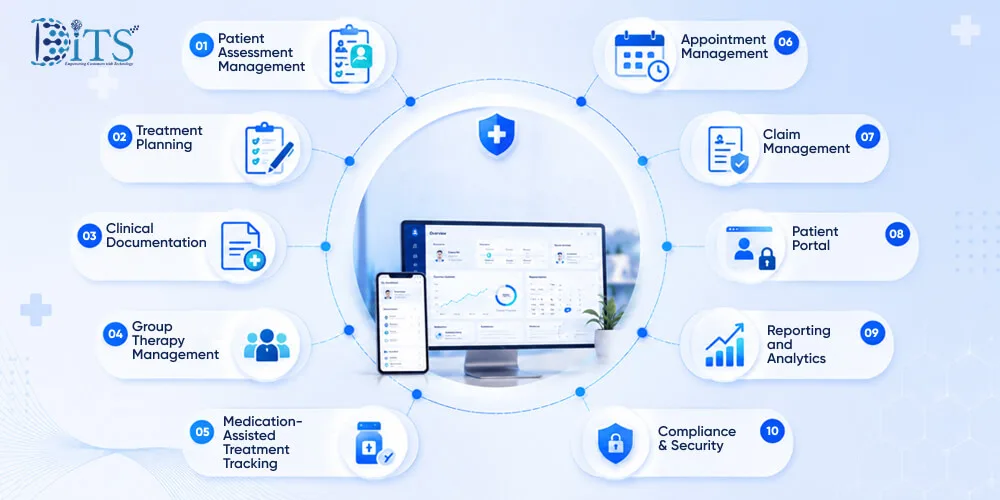
Patient Assessment Management
Enables providers to gather all the necessary patient data, referral information, drug use/medical history, consent forms, screening results and risk assessment information in one place.
Treatment Planning
With treatment planning capabilities, care teams can develop individualized care plans for each patient and set up specific recovery objectives.
Clinical Documentation
The EMR for substance abuse allows you to create therapy notes, counselor notes, psychiatrist notes, case notes, progress notes, discharge notes and customized templates for charting.
Group Therapy Management
Helps providers schedule group therapy sessions, select counselors for those groups, monitor attendance, document participation and track notes on group therapy.
Medication-Assisted Treatment Tracking
MAT monitoring is used to track medication history, dosage information, refill information, adherence and to support alerting and prescription writing processes for patients in medication-assisted treatment.
Appointment Management
Doctors can schedule appointments, manage recurrent meetings, appointment alerts, waiting list management, cancellations and no-shows to maintain their schedule efficiently.
Tools for billing help in managing insurance verification, claims, invoices, payments, coding, denial management and the complete revenue cycle management process.
Patient Portal
Helps access appointment information, complete online forms, send secure messages to their providers, use telehealth options, receive appointment reminders and find support in their recovery.
Reporting and Analytics
Dashboards allow tracking of the patient's evolution, treatment outcomes, program delivery, billing, occupancy, staff productivity, relapse trends and any other measures of importance for operational initiatives.
Compliance & Security
Compliance tools such as role-based access control, audit logs, encryption, consent management, secure exchange of records, data redundancy and record auditing usage are in place to protect sensitive patient information.
AI Capabilities That Make Substance Abuse EMR Workflows Smarter
The aim is not to replace clinicians but to assist them in reducing repetitive tasks, surface important information and keep operations streamlined and organized. AI integration into substance abuse EMR software helps ensure that teams receive prompt alerts, summaries and workflow insights.
The following are some ways in which the addition of AI capabilities in addiction treatment software would benefit the facilities:
Summarizes detailed intake responses into a brief patient summary.
Alerts team members of incomplete documentation fields before documentation is completed.
Surfaces workflow trends such as missed appointments, delayed follow-ups or recurrently incomplete forms.
Alerts team members of task alerts for pending approvals, treatment plan reviews, documentation updates and aftercare follow-ups.
Checks the completeness of billing documentation for the services provided before claims are made.
Reveals trends in operational processes related to admissions, patient engagement, workload and documentation lag.
Summarizes administrative reports from volumes of patient and program data.
Prioritizes follow-up lists based on preset rules, patient activity and engagement.
Ready To Modernize Your Rehab Center With Technology?
Work with experienced healthcare technology experts to build scalable, compliant, and user-friendly rehab center software solutions.
Substance Abuse EMR vs Behavioral Health EHR: Which One Fits Rehab Workflows Better?
Both software packages might look the same, but from a functional and operational standpoint, they have different requirements. Substance abuse software is typically built to optimize rehab-specific workflows, whereas behavioral health EHR software offers support for a much broader range of mental health care. Below, we have clearly depicted the comparison.
Comparison point
Substance Abuse EMR Software
Behavioral Health EHR Software
Target Audience
Drug and alcohol addicts, rehabilitation centers
Individuals with mental illness, behavioral health clinics
Areas of focus
Rehab centers, detox centers
Therapists, psychiatrists,
Workflow depth
Providing treatment to individuals with structured treatment plans
Group Counseling sessions, Discharge Planning
Best Fit
Addiction treatment operations
General behavioral health practices
Why Opt Ditstek Innovations for Substance Abuse EMR Software Development?
At DITS, we deliver custom software solutions tailored to organizations' business processes. For substance abuse EMR software development, our professionals can assist you with everything from designing the process flow to development, integration, automation and future-proofing. Our advanced EMR solutions are designed for rehab facilities, behavioral healthcare providers and health technology companies that need more than out-of-the-box software can provide.
Healthcare Software Solutions: Our developers create secure healthcare software that drives productivity, shares sensitive data, manages daily operations and complies with regulations.
AI Integration: Our skilled developers implement AI functionality, including documentation aid, process descriptions, task recommendations and business insights.
SaaS product development: We help businesses build and deploy scalable SaaS solutions for rehabilitation centers, behavioral health providers and addiction treatment centers in the SaaS development space.
HIPAA-Compliant Practices: We have implemented secure development practices, including role-based access, encryption and audit logs, in our development activities when working with sensitive healthcare data.
Explore Our Portfolio
Rehab Center Workflow Solutions with EMR Integration
Read our portfolio to know how we have delivered the accurate & high-end addiction & substance abuse software for a business.
Rehab centers should invest in substance abuse EMR software when their current manual systems, spreadsheets, or unconnected software are hampering the process of admissions, documentation, billing, reporting and coordination of care. The customized software can help improve workflow efficiency and provide better patient management solutions.
Nidhi Thakur
With more than 20 years of experience - I represent a team of professionals that specializes in the healthcare and business and workflow automation domains. The team consists of experienced full-stack developers supported by senior system analysts who have developed multiple bespoke applications for Healthcare, Business Automation, Retail, IOT, Ed-tech domains for startups and Enterprise Level clients