With more than 20 years of experience - I represent a team of professionals that specializes in the healthcare and business and workflow automation domains. The team consists of experienced full-stack developers supported by senior system analysts who have developed multiple bespoke applications for Healthcare, Business Automation, Retail, IOT, Ed-tech domains for startups and Enterprise Level clients
Key Takeaways
Behavioral health workflow automation should start with pinpointing operational bottlenecks rather than choosing yet another software solution.
Processes which are repetitive, rule-driven, and time-consuming should be targeted where delays make business sense.
Existing technology should be reviewed before considering replacement; it might be that its optimization, integration, modernization, or automation could do the job.
Data readiness, integration capabilities, security and compliance, and human oversight are essential before introducing mental health workflow automation software.
Complex decisions, clinical judgment, and human interaction with sensitive patients should stay with clinicians even when all other administrative processes are automated.
The benefits of automation should be assessed by efficiency gains, capacity, patient access, revenue cycle performance, workflow consistency, and scalability, rather than just reduced staffing hours.
Behavioral health companies should decide whether to automate, integrate, modernize, build, or replace their technology, depending on the underlying business problem.
Why do behavioral health workflows still rely on manual effort despite multiple digital systems?
There may be EHR systems, scheduling, billing, and patient engagement solutions that provide capabilities to handle the essential processes, but gaps in the workflows and redundant activities may persist.
Behavioral health workflow automation needs to start with recognizing where bottlenecks lie and how they interfere with efficiency, profitability, staff capacity, and patient access. It’s not about creating one more solution. It’s about choosing which process needs to be automated, integrated, updated, preserved, or abandoned.
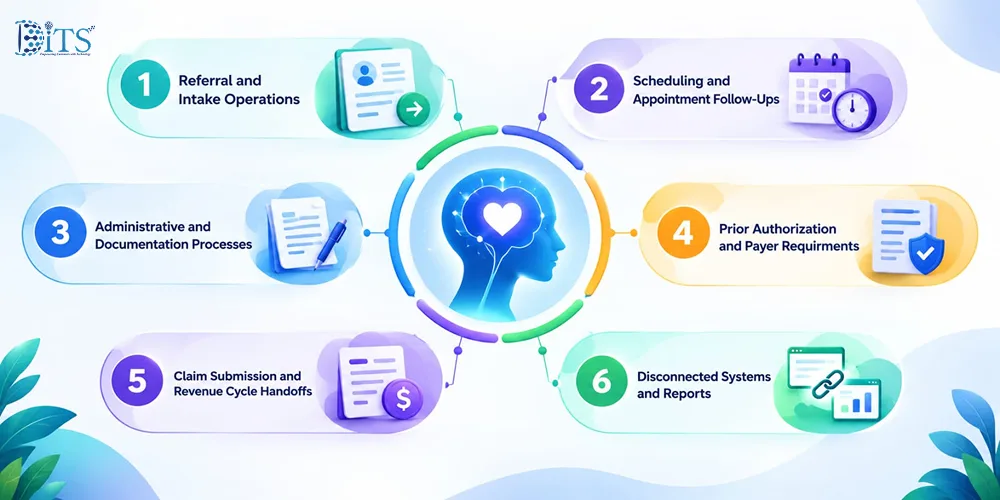
Where Behavioral Health Workflows Create Operational Friction
Operational workflows of behavioral health operations may be quite complex as they comprise multiple teams, systems, and payers' requirements. Disconnected workflows result in process inefficiencies and generate operational problems in daily basis. Behavioral health process automation can be considered where these inefficiencies involve repetitive and manual activities.
Referral and Intake Operations
Referrals may come via calls, forms, emails, and other disconnected systems.
Lack of information leads to delays in patient intake and further follow-ups.
Manual routing prolong the process of assigning patients to providers/care teams.
Behavioral health practice automation supports repetitive referral and intake activities where manual coordination creates delays.
Scheduling and Appointment Follow-Ups
Manual confirmations and follow-ups increase the workload of staff.
It is hard to manage cancellations and waitlists.
Lack of communication leads to unutilized appointment capacities.
Mental health workflow automation software supports routine scheduling and follow-up processes when existing systems require significant manual effort.
Administrative and Documentation Processes
Repetitive data entry increases administrative overhead.
Document routing in a manual way generates delays and missed tasks.
The process of task completion tracking may be quite time-consuming.
Behavioral health process automation helps streamline repetitive administrative and documentation activities.
Prior Authorization and Payer Requirements
Authorization requests usually consist of several steps.
It may be needed to check the status of authorization manually via different payer systems.
Such delays may negatively impact access to services and increase administrative effort.
Behavioral health workflow automation reduces manual effort across suitable authorization and payer-related processes.
Claim Submission and Revenue Cycle Handoffs
Incomplete or inaccurate information can result in delayed claims submissions.
Disjointed clinical and billing processes may lead to more rework.
Manual chasing can be a reason for delayed payments and revenue loss.
Limited visibility of workflows can make it hard to determine which parts of the revenue cycle are being delayed.
Disconnected Systems and Reports
Operational data is distributed across EHR, billing systems, scheduling platforms, and spreadsheets.
Teams lack a unified view of workflow status and bottlenecks.
Manual report generation may slow down the process of decision-making.
Disconnected systems prevent benefits from behavioral health workflow automation projects.
Automate Your Behavioral Health Workflows
Identify repetitive processes, reduce operational friction, and improve capacity with workflow automation tailored to your needs.
Which Behavioral Health Workflows Should Be Prioritized for Automation?
Not all manual tasks are suitable for automation. The most beneficial ones are repetitive, rules-based, time-consuming, and impactful enough to the organization when delayed. The pivotal ones are;
Eligibility and verification tasks: Frequent checks will decrease the number of routine operations performed manually.
Data synchronization between systems: Automation will minimize redundant entries and manual transfer of information between applications.
Task management within the organization: Assignments, reminders, and escalations can be automated using rules.
Form and consent management: Routing and status tracking will help to avoid losing information and delaying the workflow process.
Care Coordination follow-up activities: Automatic reminders and task assignments are possible to be done without making clinical judgments.
Patient questionnaires and assessments: Distribution, collection, and routing can be automated while clinical interpretation remains with care teams.
The last thing to consider in terms of prioritization will be the frequency of the process, manual effort required, business impact, integration difficulty, and human/clinical judgment involvement.
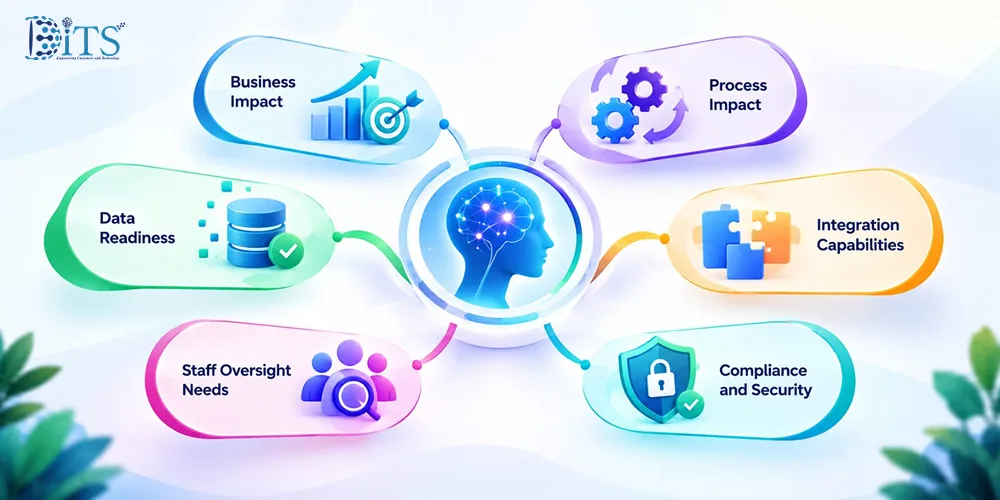
What Should You Evaluate Before Selecting Mental Health Workflow Automation Software?
Selection of mental health workflow automation software should start with the assessment of how well the software is suited to your organization’s needs, existing infrastructure and long-term goals.
Business Impact
Assess whether automation would help you increase efficiency, capacity, revenue performance, patient access or save money on operations.
Focus on benefits that can be assessed after deployment.
Process Impact
Check if the process is sufficiently described before you try to automate it.
Automation of an inefficient process will only speed up problems.
Data Readiness
Analyze whether data needed for automation is valid, accessible, and present in all relevant systems.
Detect gaps in automation readiness.
Integration Capabilities
Analyze dependencies between EHR, billing, scheduling, payers, CRM, and other systems.
Ensure that the software is able to function in your current IT environment.
Staff Oversight Needs
Identify decisions, exceptions, and clinical tasks that should remain under human control.
Define scenarios when staff intervention is required to enable the workflow.
Compliance and Security
Review the management of patient information, permissions, access control, and data sharing.
Ensure the solution complies with all applicable privacy and regulatory policies.
The correct solution should do more than just automate the process today. It should integrate seamlessly into your environment and scale to accommodate future needs without adding yet another isolated system.
Modernize Your Behavioral Health Technology
Evaluate your existing systems and discover where integration, modernization, or automation can improve workflow performance.
Automate, Integrate, Modernize, or Replace? Choosing the Appropriate Technology
The technology used in behavioral health practices to automate operations does not always need to be replaced. The decision about choosing one technology versus another relies on the source of the problem and the ability of the current technology to support the organization's goals.
Optimize Current Technologies
Configure workflows and use existing features when the current platform has the capabilities necessary for supporting the process.
Do not consider replacement of systems when a solution to the problem is achievable within the existing technological environment.
Integrate Different Technologies
Connect EHR, billing, scheduling, payer, or other systems if the problem stems from poor data connectivity.
Cut down data duplication and gaps in information.
Implement Workflow Automation
Automate routine tasks without changing the existing platform.
Concentrate efforts on those activities when automation can save time.
Modernize Current Technologies
Upgrade platforms that still bring value to the business but are outdated in terms of architecture, integration, and usability.
Increase the scalability of the application without starting the development process from scratch.
Develop Custom Features
When behavioral health workflows are highly unique such that there are no solutions available off the shelf, consider custom development.
Build only in cases where unique operational needs justify building.
Replace Strategically
Where there are issues related to maintainability, scalability, integration, or technical debt, replace.
Replace only in consideration of long-term business value rather than technology alone.
The goal is not to automate further but to figure out how one technology solution can create less friction and help you grow.
How to Measure ROI From Behavioral Health Practice Automation
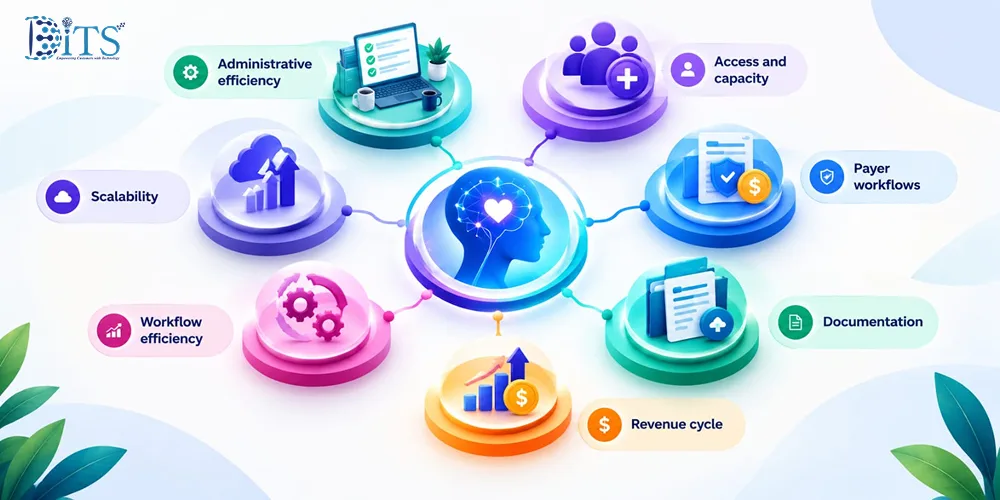
ROI for behavior health practice automation can be calculated based on the business problems that were targeted by implementing such automation. Saving time is important; however, more significant benefits may be obtained by increasing capacity, decreasing delays, boosting revenue cycle performance, and enabling growth.
Some of the metrics that need to be monitored are as follows:
Administrative efficiency: Hours spent on repetitive work and data entry
Access and capacity: Time from referral to intake, appointment utilization, and number of patients that can be served
Payer workflows: Time spent on prior authorizations and follow-ups
Documentation: Time spent on documentation completion and number of tasks pending completion
Revenue cycle: Claim processing time, denials, and reworks
Workflow efficiency: Number of manual handoffs and delays
Scalability: Ability to serve more patients, sites, or services with a relatively small increase in staffing
The most convincing ROI will not only be achieved through manual hours saved. It will be achieved if automation improves process consistency, increases capacity, boosts revenue performance, and increases the scalability of the organization.
Find the Right Path for Workflow Automation
Assess your workflows, data, integrations, and business goals to determine what to automate, integrate, modernize, or replace.
How DITS Approaches Behavioral Health Workflow Automation
DITS starts with the workflow and business objective rather than the automation tool. The process begins by assessing operational friction, prioritizing the right opportunities, deciding the most suitable technology path, and then measuring outcomes before scaling further.
This approach is beneficial because it allows organizations to deal with operational friction by making sure that no unnecessary technology and systems are used while making sure that those systems that are currently valuable and provide some useful functionality are not disrupted.
These priorities are also important to consider when attending the HIMSS event in San Diego, where healthcare leaders are looking at ways to use automation, AI, interoperability, and connectivity, and move beyond pilot projects and make them more operational.
Frequently asked questions
Not necessarily. In some cases, optimization of the current systems, improvements to integrations, and the addition of automation capabilities are more reasonable approaches compared to replacing the existing platform.
Nidhi Thakur
With more than 20 years of experience - I represent a team of professionals that specializes in the healthcare and business and workflow automation domains. The team consists of experienced full-stack developers supported by senior system analysts who have developed multiple bespoke applications for Healthcare, Business Automation, Retail, IOT, Ed-tech domains for startups and Enterprise Level clients