How to Create IoT Applications – A Practical Guide for U.S. Businesses
Table Of Content
Published Date :
15 Apr 2026
The Internet of Things (IoT) is transforming business operations throughout the United States at an accelerating pace. The combination of smart manufacturing floors in Detroit and precision agriculture technology in the heartland shows how connected devices bring about major industrial changes.
At this moment United States companies encounter difficulties with their operations because they have yet to develop proper procedures. The absence of a definitive strategy will lead to IoT projects which show potential to fail because of technical difficulties and security risks and financial constraints.
The purpose of this guide is to provide better understanding about our topic. We will break down the entire IoT application development process into clear, actionable steps which will guide you through every stage.
What IoT Application Actually Includes
The development environment for IoT applications achieves successful design by creating a unified ecosystem which connects physical devices with communication networks and cloud infrastructure and business software systems. Companies achieve ongoing operational monitoring through the seamless operation of these components.
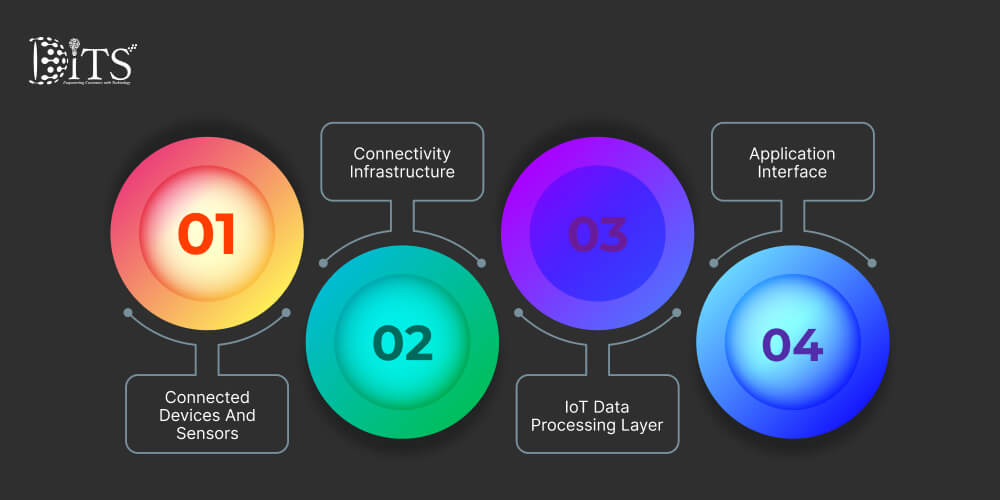
The four components below form the backbone of most enterprise IoT platforms.
2.1 Connected Devices and Sensors
The basic physical structure of IoT systems starts with sensors and connected devices which collect actual information from the physical world. The devices transform environmental and operational conditions into digital signals which software platforms use for analysis.
Typical sensor deployments include:
- Temperature sensors monitoring cold storage facilities
- GPS trackers following fleet vehicles and delivery shipments
- Vibration sensors detecting equipment wear in manufacturing plants
- Smart meters measuring energy usage in commercial buildings
The success of IoT application projects depends on their sensor selection because the collected data quality determines the success of business insights.
2.2 Connectivity Infrastructure
The devices must send data to backend platforms for processing and analysis after they complete their data collection. The communication layer functions as the essential connectivity component that allows systems to create IoT applications.
Several connectivity technologies are commonly used:
- Wi-Fi networks inside buildings or facilities
- Cellular networks for fleet vehicles and remote assets
- LPWAN technologies enable organizations to deploy their sensor systems across long distances while maintaining low power consumption.
- Bluetooth enables short-range communication between devices.
- Manufacturing equipment uses industrial communication protocols as its primary communication system.
Companies that develop IoT application platforms need strong connectivity planning because their systems require continuous device operation to transmit correct data.
2.3 IoT Data Processing Layer
The system processes incoming device information through its processing layer which converts raw sensor signals into valuable insights.
This stage usually includes:
- Data ingestion pipelines collecting device signals
- Filtering systems removing noise or duplicate readings
- Storage systems for high-volume time-series data
- Analytics engines identifying trends or anomalies
Organizations may process some data directly at the device level using edge computing. This approach allows quick decisions without waiting for cloud systems.
For example, a utility company tracks thousands of smart meters which generates local alerts but sends its usage data to the cloud for extended analysis.
2.4 Application Interface
The application interface serves as the final component of an IoT platform which enables users to connect with the system. The most advanced sensor network becomes unusable without proper dashboards and alerts which provide users with essential information.
Enterprise IoT applications typically provide:
- Operational dashboards for managers
- Mobile apps for field technicians
- Automated alerts when abnormal conditions appear
- Reports that provide summaries of operational trends
Organizations that create IoT application platforms with user-friendly interfaces transform their data into usable information instead of overwhelming users with excessive data.
The successful operation of IoT systems depends on their ability to unify four distinct system components into one complete operational setup. The system starts with devices that detect signals which pass through networks to reach platforms that process data before applications show results to users.
Are You Ready to Build Your IoT Strategy?
Get a tailored roadmap aligned to your operations, infrastructure, and long-term scalability goals with expert-driven insights specific to your business needs.
Step-By-Step Process for How to Create IoT Applications
To build dependable IoT systems, engineers need to work together on three areas of expertise which include embedded firmware and cloud infrastructure and enterprise integrations. Most businesses lack the internal resources to manage all these elements simultaneously.
That's where DITS comes in.
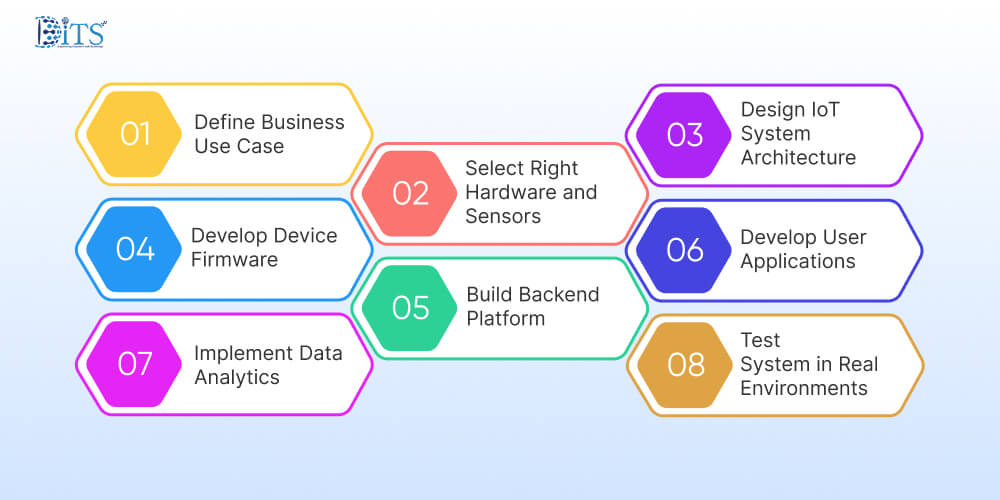
Our full-stack development services allow us to handle the entire IoT development lifecycle, from initial strategy to post-deployment support. Below is how we approach IoT projects for our clients.
Discovery & Business Use Case Definition
We begin every engagement by understanding your operational challenges and business objectives.
Our approach includes:
- Collaborative workshops with your stakeholders
- Process mapping to identify where IoT creates value
- Defining measurable success metrics (cost reduction, efficiency gains, downtime prevention)
- Feasibility assessment and ROI analysis
Through our IT consulting services, we ensure your IoT initiative aligns with broader business strategy before a single line of code is written.
IoT System Architecture Design
Once we understand your requirements, our architects design a scalable, secure system that supports both immediate needs and future growth.
Architecture planning covers:
- Device and sensor layer design
- Connectivity infrastructure (MQTT, cellular, LPWAN)
- Cloud platform selection and configuration
- Data processing pipelines
- Enterprise system integration points
Our enterprise software development expertise ensures your IoT platform integrates seamlessly with existing ERP, CRM, and operational systems.
Hardware Integration & Firmware Development
We handle all technical aspects of device connectivity, including:
- Sensor selection and procurement guidance
- Custom firmware development for embedded devices
- Device authentication and security protocols
- Over-the-air (OTA) update capabilities
Our backend development services ensure devices communicate reliably with cloud platforms while maintaining security standards.
Cloud Platform & Backend Development
The backend infrastructure is where IoT data becomes actionable intelligence.
Our development includes:
- Scalable cloud architecture (AWS IoT, Azure IoT Hub, Google Cloud IoT)
- Device management systems
- Real-time data ingestion pipelines
- Time-series data storage
- RESTful APIs for enterprise integration
Leveraging our cloud computing services and SaaS product development.
capabilities, we build platforms that scale from hundreds to millions of devices.
Data Analytics & AI Integration
Raw sensor data only becomes valuable when transformed into insights.
We implement:
- Real-time monitoring dashboards
- Automated anomaly detection
- Predictive maintenance algorithms
- Custom reporting tools
Through our AI software development and AI consulting services, we provide intelligent analytics solutions which we integrate into IoT platforms. These solutions enable users to receive predictive alerts and identify patterns and make automated decisions which human monitoring cannot achieve.
Many clients enhance IoT capabilities through our AI integration services, where machine learning models analyze sensor patterns and generate early warnings.
User Interface Development
We create intuitive interfaces that make complex IoT data accessible to your teams.
Deliverables include:
- Web-based operational dashboards
- Mobile applications for field technicians
- Automated alert systems
- Executive reporting tools
Using our cross-platform development expertise, we ensure your IoT applications work seamlessly across devices and operating systems.
Quality Assurance & Testing
Before deployment, every component undergoes rigorous testing.
Our QA process includes:
- Device connectivity validation
- Network performance testing
- Data accuracy verification
- Security penetration testing
- Load testing for high-volume scenarios
Through our QA software testing services, we identify and resolve issues before they impact operations.
Deployment & Ongoing Support
We don't just build and disappear. Our team manages deployment and provides continuous support.
Post-launch services include:
- Phased rollout management (pilot to full-scale)
- Performance monitoring
- System optimization
- Feature enhancements
- Technical support
Our dedicated development team model allows clients to maintain ongoing development partnerships, ensuring IoT platforms evolve alongside business needs.
Legacy System Modernization
Many organizations already have existing IoT implementations that need upgrading.
Our legacy modernization services help companies:
- Migrate outdated IoT platforms to modern cloud infrastructure
- Improve security in aging deployments
- Add AI capabilities to existing systems
- Integrate legacy devices with new enterprise software
For businesses exploring IoT for the first time, our MVP Development services allow rapid prototyping and validation before committing to full-scale implementations.
Technology Stack Used in IoT Application Development
When organizations plan how to create IoT applications, selecting the right technologies early helps avoid scalability issues later.
The table below outlines common technology layers used in enterprise IoT environments.
| Technology Layer | Typical Components | Business Purpose |
| Device Firmware | Embedded C, C++, MicroPython | Controls sensor behavior and device communication |
| Connectivity | MQTT, HTTP, CoAP, cellular networks | Transmits data from devices to backend systems |
| Cloud Infrastructure | AWS IoT, Azure IoT Hub, Google Cloud IoT | Handles device communication and system scaling |
| Data Storage | Time-series databases, NoSQL databases | Stores high-volume sensor data efficiently |
| Analytics & Visualization | Data analytics platforms, monitoring dashboards | Converts sensor signals into actionable insights |
| API Integration | REST APIs, enterprise integration services | Connects IoT platforms with ERP, CRM, or operations systems |
The companies need to build their platforms through a properly designed technology stack. A system that starts with 100 devices should reach a capacity of 10,000 devices without needing major system changes.
Businesses use AI-based intelligent analytics to improve their IoT platforms which provide predictive alerts and operational forecasting and automated decision support.
Security Considerations When Building IoT Applications
Connected systems bring significant operational benefits, but they create additional security obligations. The organization faces risk exposure through installing 500 devices at facilities without implementing a proper security plan because this security gap affects more than just the IoT system.
Security must become part of IoT application system design from the initial stage of development.
Key security measures typically include:
Device Authentication
Every device connecting to the platform must be uniquely authenticated. This ensures unauthorized hardware cannot send data or access systems.
Secure Data Transmission
All communication between sensors, gateways, and cloud platforms should be encrypted. This prevents interception or manipulation of operational data.
Firmware Update Mechanisms
Devices must support remote firmware updates. Security patches and feature improvements should be deployable without physically accessing each device.
Access Control Systems
Different users require different levels of access. Operations teams, administrators, and analysts should only see the data relevant to their roles.
Enterprise System protection
IoT platforms often integrate with enterprise software systems. Security design must ensure connected devices cannot expose internal business systems to threats.
Organizations that plan security carefully during IoT application development protect not only their connected devices but also the broader digital infrastructure supporting their business.
Want to Turn IoT Data Into Real Outcomes?
Discover how connected systems can drive efficiency, reduce downtime, and unlock actionable insights across your operations through a customized approach.
Best Practices for Successful IoT Application Development
After observing hundreds of IoT initiatives across different industries, certain patterns consistently separate successful deployments from stalled projects. These best practices may appear simple, yet they make a substantial difference when organizations build IoT application platforms.
Start with focused pilot deployments
Rather than launching large-scale implementations immediately, successful companies begin with smaller pilot programs. Deploying 20 to 50 devices allows teams to validate system reliability before full expansion.
Design scalable architecture early
Even pilot systems should be designed with future growth in mind. Infrastructure capable of supporting thousands of devices prevents costly redesigns later.
Prioritize device security from day one
Security should be embedded directly into device firmware, communication protocols, and backend systems. Retrofitting security controls later becomes far more difficult.
Use modular system architecture
Breaking the system into modular components allows individual features to evolve independently. Device management, analytics, and dashboards can scale without disrupting the entire platform.
Align insights with operational workflows
Data alone does not create value. Successful systems deliver insights directly into operational processes such as maintenance scheduling, supply chain planning, or facility management.
When organizations follow these practices while building IoT applications, the technology becomes part of everyday operations rather than a disconnected experiment.
How DITS Helps Businesses Create IoT Applications
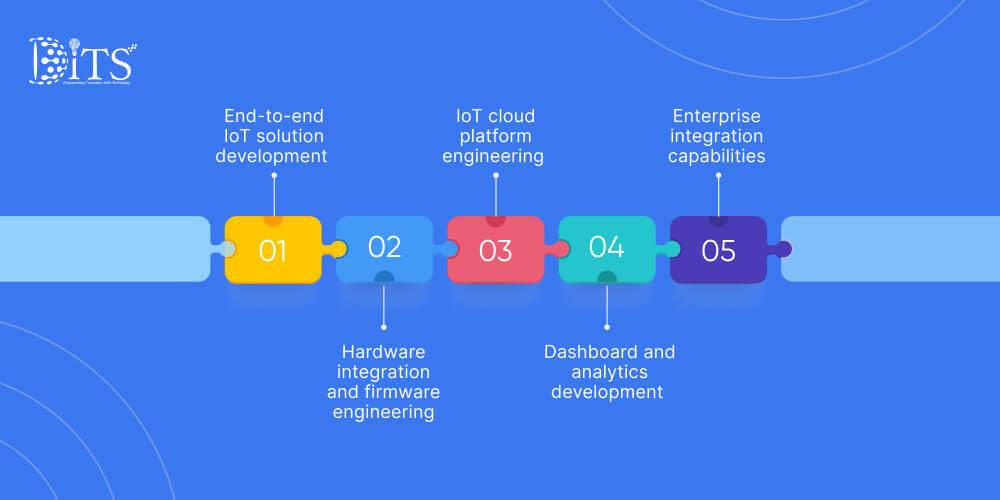
Building connected systems requires expertise across hardware engineering, cloud infrastructure, data analytics, and enterprise software integration. Coordinating all these elements internally can be challenging for many organizations.
DITS supports companies across the entire lifecycle of IoT development initiatives.
Our capabilities include:
End-to-end IoT solution development
From initial architecture design to full-scale deployment, our teams design systems that connect devices, cloud platforms, and enterprise applications.
Hardware integration and firmware engineering
We integrate sensors, gateways, and embedded systems to ensure devices operate reliably in real-world environments.
IoT cloud platform engineering
Scalable backend platforms support high-volume device communication, secure data storage, and real-time analytics.
Dashboard and analytics development
Operational dashboards transform sensor data into meaningful insights that managers can act on immediately.
Enterprise integration capabilities
IoT platforms often connect with ERP, logistics systems, and facility management tools to support automated workflows.
At DITS, intelligent technologies play a central role in our engineering process. Artificial intelligence assists our teams in software development, strengthens quality assurance processes, maintains code quality, and enables deeper system customization. This approach allows us to deliver robust IoT platforms tailored to specific operational environments.
Organizations looking to build IoT application ecosystems benefit from combining strong engineering expertise with intelligent automation.
Looking to Speak With IoT Implementation Experts?
Connect directly with specialists to discuss your use case, technical challenges, and the best approach to building a scalable IoT platform.
Conclusion
IoT technologies are no longer experimental innovations reserved for technology companies. They have become practical operational tools used across manufacturing plants, logistics fleets, healthcare facilities, and commercial buildings throughout the United States.
When organizations understand how to create IoT applications strategically, they unlock new levels of operational visibility. Equipment performance becomes measurable. Supply chains become trackable. Facilities become manageable in real time.
But success requires thoughtful planning, reliable architecture, and a clear understanding of business goals. Companies that approach IoT as long-term infrastructure rather than short-term experimentation gain the greatest advantages.
In the coming years, connected systems will quietly power many of the most efficient businesses. Those who invest early will be the ones shaping that future.
FAQs
How long does it take to build an IoT application?
The timeline depends on the complexity of the system, number of connected devices, and integration requirements. A small pilot project with 20 to 50 devices can typically be completed in 8 to 12 weeks. Larger enterprise deployments involving hundreds of sensors, advanced analytics, and integration with business systems may take 4 to 8 months. Most organizations begin with a pilot and then gradually scale the platform across operations.
What industries benefit most from IoT applications?
Many industries gain measurable value from connected systems. Manufacturing companies use sensors to monitor machine performance and reduce downtime. Logistics firms track fleet vehicles and cargo in real time. Healthcare providers monitor medical equipment and facility environments. Commercial building operators use connected systems to optimize energy consumption and equipment maintenance.
What factors influence cost of IoT application development?
Several factors influence the overall investment required. These include hardware selection, number of devices, connectivity infrastructure, cloud platform design, analytics capabilities, and integration with existing enterprise systems. Projects that require advanced analytics, predictive monitoring, or large-scale deployments generally involve higher development investment compared to small operational pilots.
How can DITS support IoT application development for businesses?
DITS provides end-to-end IoT application development services designed for enterprise environments. Our teams support device integration, firmware engineering, backend platform development, and dashboard creation. We also help businesses scale connected platforms across facilities, fleets, and equipment while ensuring reliable connectivity, secure data handling, and seamless enterprise system integration.
Why should companies choose DITS for IoT app development projects?
DITS brings deep experience in IoT app development combined with strong engineering practices and intelligent automation. Our development teams design scalable architectures, integrate hardware devices, build secure cloud platforms, and deliver operational dashboards that support real business workflows. We also integrate AI-driven tools during development and quality assurance processes to maintain code quality, improve customization, and accelerate deployment timelines.

Dinesh Thakur
21+ years of IT software development experience in different domains like Business Automation, Healthcare, Retail, Workflow automation, Transportation and logistics, Compliance, Risk Mitigation, POS, etc. Hands-on experience in dealing with overseas clients and providing them with an apt solution to their business needs.
Recent Posts
Explore how intelligent document processing for insurance helps businesses automate document workflows, reduce processing costs, improve accuracy, and strengthen operational efficiency across insurance functions.
Discover how automated medical claims processing reduces delays, manual rework, claim denials, and administrative costs while improving reimbursement speed and operational efficiency.
Learn how to build medical billing software with essential features, integrations, security, and development costs.