Chatbots vs Conversational AI: What’s the Difference?
Table Of Content
Published Date :
29 May 2026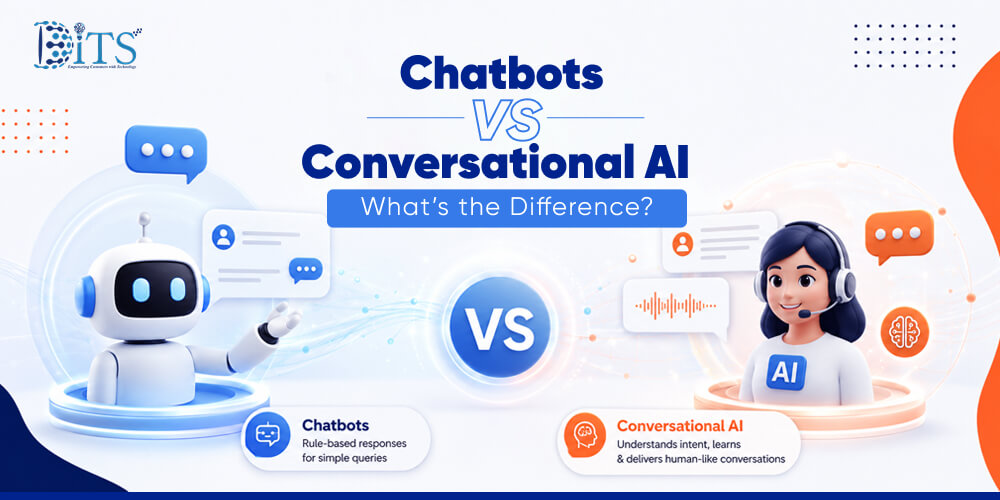
The difference between conversational artificial intelligence (AI) and chatbots lies in their degree of intelligence and the flexibility they offer. Chatbots tend to work best when users have simple, repetitive, and essentially rule-governed interactions, whereas conversational AI allows a deeper level of interactions.
Key Highlights
- The global chatbot market size is estimated to be around USD 41,244.2 million by 2033, with a CAGR of 19.6% (2026 to 2033).
- The global conversational AI market size is anticipated to be around USD 41.39 billion by 2030, with a CAGR of 23.7% (2025 to 2030)
- Conversational AI offers instant query resolution and hyper personalized user experiences whereas chatbots offers 24* 7 customer support and drives sales.
- The main difference between chatbots and conversational AI is that later one simulates conversations while the former one powers those interactions.
- Chatbots follow predefined decision tree, on the other hand, conversational AI uses ML and NLP.
Modern businesses are associated with real-time responsiveness, personalized interactions, and offer support across digital touchpoints. Considering these requirements, conversational AI and chatbots have become integral parts of the customer's experience, sales, marketing, and internal processes.
There are still businesses that are confused about whether to use them interchangeably. But the fact is that they are not the same.
In this blog, we will help you understand the definition and dive straight into the world of chatbots and conversational AI, highlighting the differences in a clear way. Avail our AI chatbot development services to build intelligent, scalable, and business-ready chatbot solutions.
What is a Chatbot and How Does it Work?
A chatbot is like a virtual assistant which understands what a user has typed or said, and provides a fitting response with the assistance of AI or predefined rules. It holds a conversation with users via text or speech, responds, performs actions, and guides users through tasks such as booking appointments and answering customer queries.
Workflow
- The chatbot engages with users through a chat window, mobile app, web-based chat or voice assistant through a chat window.
- The user will first communicate with the chatbot through a message.
- The chatbot processes the message received from the user to understand what it means, and retrieves the right answer from its knowledge bases, databases, business rules or AI algorithm.
- In addition, the chatbot can connect to other systems like CRM or a payment gateway to retrieve personalized data.
- Once it has the right answer, the chatbot sends the message to the chat window.
- The user receives this response in text or voice, depending on which medium the user has used to receive the response.
- If necessary, the system is able to save enough information for further improvement to future interactions.
Avail our AI chatbot development services to build intelligent, scalable, and business-ready chatbot solutions to build intelligent, scalable, and business-ready chatbot solutions.
Want To Choose The Right AI Communication Platform?
Compare chatbot and conversational AI technologies to identify the best solution for automation, scalability, and customer engagement goals.
What is Conversational AI and How Does it Work?
Conversational AI is a more advanced technology which enables machines to interpret and interact using human language effectively. It is often built as part of broader AI software solutions for enterprises that need smart and automated, communication systems.
It is not confined to predefined scripts or button clicks but makes use of other advanced technologies like natural language processing, natural language understanding, Gen AI, machine learning, large language models, speech recognition, intent detection, sentiment analysis, context handling, data integration, and workflow automation.
Some applications of conversational AI include chatbots, virtual assistants, voice assistants, AI copilots, intelligent helpdesks, and automated customer service systems.
Workflow
- Automatic Speech Recognition (ASR) converts speech or typing by the user to text.
- The user's intent and key details are identified through Natural Language Understanding (NLU).
- Dialogue Management (DM) is responsible for history of the conversations and deciding which next action will be taken (answer the user, clarify what was said, or execute a task).
- Natural Language Generation (NLG) generates a human-readable reply, most frequently with the use of Large Language Models (LLMs).
- The reply will be sent out as text or converted to speech using Text-to-Speech (TTS).
- Continual improvement of the overall process for each type of communication is driven by machine learning algorithms that study previous interactions to enhance accuracy.
- The entire process takes place in fraction of seconds, ensuring smooth and real-time conversations.
Chatbots vs Conversational AI
At the surface level, chatbots and conversational AI look similar, but they are actually not. With this comparison, the businesses will be able to choose the right solution based on use case, complexity, and the right AI software development approach.
| Aspect | Chatbots | Conversational AI |
| Definition | Rule-based software applications that utilize predefined scripts and decision trees to execute decision making | Computer systems powered by artificial intelligence that emulate natural human-like conversations using advanced forms of intelligence |
| Technology | Mostly rule-based, use a key word matching process, have very simple 'if' and 'then' logic | Use of natural language processing (NLP) machine learning (ML), deep learning (DL), large language models (LLMs) and intent recognition |
| Level of Intelligence | Low (limited to responses programmed into them prior) | High (they can understand the context of the conversation, learning from the data provided to them and adapting) |
| Contextual Understanding | Poor (because chatbots generally do not have an ongoing context of the conversation) | Excellent (have a consistent history of the conversation as well as the context) |
| Natural Language Processing | Basic (None and/or only Very basic natural language processing ability) | Advanced (can process various forms of slang, sentiment and multiple meanings) |
| Learning Ability | Cannot learn on their own (they require manual programming changes to change behaviors) | Continuously learn and evolve from their interaction with each user |
| Ability to Handle Complexity | Good for simple repetitive tasks | Capable of handling complex, multi-turn, open-ended conversations |
| Ability to Provide Personalization | Limited ability to provide personalization (based on predetermined scripts) | Highly personalized based on users' data and behavior |
| Response Generation | Generate responses based on predetermined answers/templates | Dynamically generate responses that simulate human conversation |
| Fallback Mechanism | Often state ""I don't understand"" when they cannot resolve requests | Can clarifying questions, ask follow-up clarifying questions or gracefully recover from issues they are not able to resolve. |
| Use Cases | FAQs, Low Level customer care, and booking forms | Virtual assistants, High level customer care, sales bots and therapy bots. |
| Examples | Menu based bots for websites/simple WhatsApp bots | ChatGPT, Google Assistant, Amazon Alexa and high level enterprise bots |
| Development Effort | Easier | More complex |
| Scalability | Limited | Highly scalable |
| Cost | Lower initial cost | Higher initial investment |
Planning To Modernize Customer Support With AI Technology?
Implement advanced conversational AI platforms that deliver personalized interactions, intelligent automation, and improved customer satisfaction across channels.
Use Cases of Conversational AI and Chatbots Across Industries
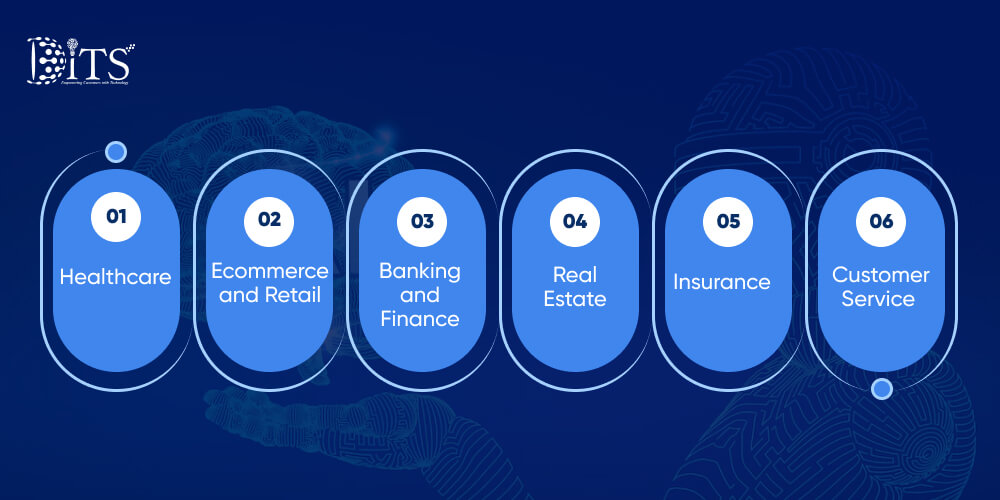
Most chatbots are used for simple, repetitive tasks, while conversational AI is a more sophisticated way to interact with customers and employees in a personalized, context-sensitive way. Here, we have enlisted the use cases/applications for both; have a look below
Healthcare
Chatbots in Healthcare:
- Answer patient FAQs
- Support appointment booking
- Send basic reminders
- Share clinic or service information
- Reduce front-desk workload
Conversational AI in Healthcare:
- Support care coordination
- Manage post-discharge engagement
- Assist with remote patient monitoring workflows
- Handle insurance-related queries
- Provide personalized patient communication
Read more: AI in healthcare industry
Ecommerce and Retail
Chatbots:
- Track order status
- Answer return policy questions
- Handle product FAQs
- Collect customer feedback
- Manage repetitive customer queries
Conversational AI in eCommerce:
- Improve product discovery
- Offer personalized recommendations
- Support return management
- Understand customer preferences
- Improve engagement across multiple channels
Banking and Finance
Chatbots:
- Answer basic banking questions
- Share branch or service information
- Support card activation queries
- Provide loan status updates
- Share document requirements
Conversational AI:
- Support transaction assistance
- Send fraud alerts
- Help with dispute handling
- Manage loan inquiries
- Enable secure customer verification
Read more: AI in Fintech Market
Real Estate
Chatbots:
- Collect property inquiries
- Qualify basic leads
- Schedule site visits
- Share property availability
- Route users to agents or brokers
Conversational AI:
- Understand buyer preferences
- Recommend suitable properties
- Answer financing-related queries
- Automate follow-ups
- Support personalized buyer journeys
Read more: AI in Real Estate Industry
Insurance
Chatbots:
- Answer questions regarding policies
- Provide information regarding premium payments
- Collect information regarding claims (e.g., how to make a claim)
- Provide customers with lists of documents that may be needed to complete a claim
- Ensure customers are directed to their appropriate insurance company.
Conversational AI:
- Update customers on pending claims
- Help customers determine what policies meet their needs
- Walk customers through complex claim-filing processes
- Tell customers what their needs require
- Improve the customer experience throughout the policy lifecycle
Customer Service
Chatbots:
- Provides immediate answers to common support inquiries
- Updates about orders, tickets, or requests.
- Basic troubleshooting information
- Capture the customer's details prior to passing them on to an agent
- Direct calls to the correct department within customer service
- 24/7 availability to respond to all service requests
Conversational AI:
- Ascertain customer intent beyond simply identifying keywords
- Handles complicated multi-step support calls
- Maintain context for customers throughout the entirety of the customer journey
- Provides customers with personalized experiences/answers
- Assists customers with complaint resolution and escalations
- Improve agent efficiency with proposed answers and follow-up actions
How Conversational AI and Chatbots Add Value to Businesses?
Conversational AI and chatbots enable businesses to communicate faster, reduce manual labor costs, and improve customer experiences. Chatbots are employed for straightforward, repeated processes where conversational AI is best for complex, unique and contextual interactions.
Benefits from Chatbots
- Answering common customer queries quickly
- Handing repeated questions without human interaction
- Allowing appointment booking, order tracking, and completing forms
- Gathering details of customer interactions prior to assigning to an agent
- Relieving pressure on support and sales staff
- Allowing a 24/7 customer service via websites, apps and messenger services
Benefits from Conversational AI
- Understanding context, intent and previous conversation history
- Handling multi-stage conversations with the customer
- Voice and text based conversational platforms
- Enhanced customer engagement through various digital channels
- Generating data and insights from interactions with customers
- Automating work between CRM, ERP, support, and other services
Bottom Line!
AI and chatbots are moving forward into becoming more intelligent and task-performing, as well as personalized digital assistants. It is no longer enough for businesses to rely on ordinary answering machines; instead, they want an AI that can understand people, do things for them, assist with decision-making, and be platform-independent.
Future conversational AI systems will likely focus on AI agents who can take action on behalf of businesses. These provide voice-enabled help, enable multilingual conversations, offer industry-specific assistants, and deliver real-time personalization, with deeper enterprise workflow integration.
When you're thinking of a business deciding on a chatbot vs conversational AI, the choice really comes down to the problem that the business is looking to solve. Start with your users to understand their requirements and what problems they face. Once your users are fully identified and their needs are fully categorized, then it will be easier for you to select what type of technology you will want to use.
FAQs
1. What’s the Difference Between Conversational AI and Chatbots?
The main difference lies in intelligence. Chatbots tend to have a fixed set of answers and responses whereas conversational AI employs various technologies such as natural language processing and intent recognition.
2. Can Conversational AI replace Chatbots?
No, conversational AI can't replace Chatbots. Rather, it enhances chatbots' overall capabilities and makes them much more intelligent than before.
3. Is Conversational AI more costly to develop than a Chatbot?
Yes, because Conversational AI is more costly to develop than a chatbot. The reason for this is the effective use of ultra-modern technologies, continuous integration, data training, and optimization.
4. Is conversational AI a chatbot?
Not necessarily. Some chatbots are actually conversational AI, while some are not. A basic chatbot will not have an intelligent engine behind it, but a conversational AI will have.
5. What are the industry applications for chatbots and conversational AI?
Logistics, education, Healthcare, banking, insurance, and transportation are some of the industry applications of chatbots and conversational AI.

Dinesh Thakur
21+ years of IT software development experience in different domains like Business Automation, Healthcare, Retail, Workflow automation, Transportation and logistics, Compliance, Risk Mitigation, POS, etc. Hands-on experience in dealing with overseas clients and providing them with an apt solution to their business needs.
Recent Posts
Explore how intelligent document processing for insurance helps businesses automate document workflows, reduce processing costs, improve accuracy, and strengthen operational efficiency across insurance functions.
Discover how automated medical claims processing reduces delays, manual rework, claim denials, and administrative costs while improving reimbursement speed and operational efficiency.
Learn how to build medical billing software with essential features, integrations, security, and development costs.