25+ years of IT software development experience in different domains like Business Automation, Healthcare, Retail, Workflow automation, Transportation and logistics, Compliance, Risk Mitigation, POS, etc. Hands-on experience in dealing with overseas clients and providing them with an apt solution to their business needs.
Software development teams, the unseen forces behind the apps we use, consist of individuals with diverse skill sets. They work together to coordinate, develop, test, and launch new software and modules. It is crucial for managers and C-suite executives to effectively organize their teams in order to meet stakeholders' expectations and deliver projects on time.
This article explores the software development team structure, roles, and responsibilities that characterize a high-performing software development team.
What Is a Software Development Team?
A software development team is a strategically aligned, cross-functional unit responsible for designing, building, deploying, and continuously improving digital products. When every member of the development team works in a well-organized manner, they ensure maximum effectiveness.
In order to communicate and perform tasks effectively, all team members should contribute and fulfill their duties.
To achieve effective team synergy, development teams must have the following characteristics:
Self-Organization: Teams are empowered to make decisions, manage workloads, and optimize processes autonomously driving agility and faster execution without heavy dependency on top-down control.
Cross-Functionality: A blend of diverse skill sets ranging from development and design to QA and DevOps enables seamless progression across the entire software development lifecycle.
Shared Accountability: Ownership is collective. While roles may differ, the responsibility for product success, quality, and timelines is distributed across the team, ensuring alignment and commitment at every stage.
A successful software development team includes members who:
Enhance codebase with their contributions.
Share and understand customer interests.
Focus on critiquing ideas, not individuals.
Share experiences to offer fresh insights.
Build trust; work well together.
Software Development Team Structure
Software development team structure impacts the projects' success. So hiring the right technical professionals with specific skills and experience is necessary. If you don't choose the right software development team structure, your project may not get the attention it deserves. To explain our point, suppose you hire only User Interface designers but not UX experts, your app or software may have visually appealing designs, menus or animations but the app's UX will not meet the users' needs.
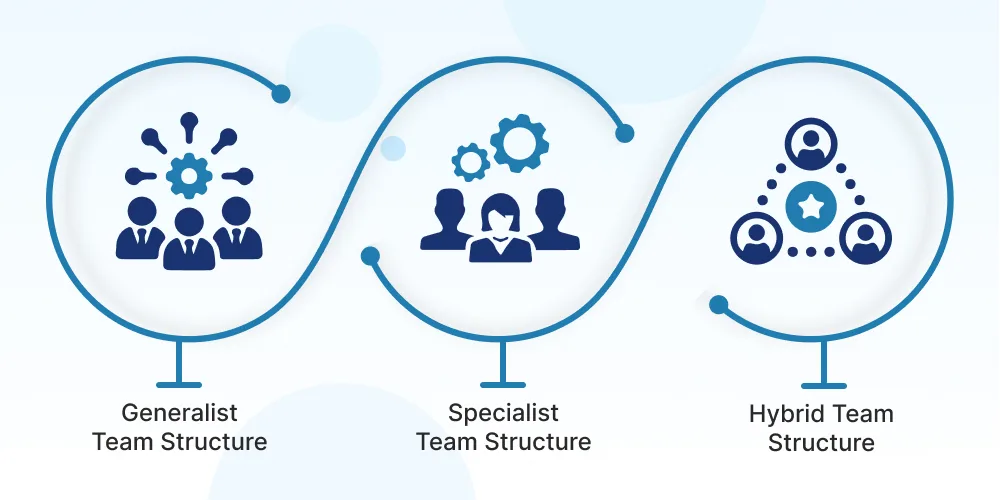
There are most commonly three types of software development team structures:
Generalist Team Structure
Specialist Team Structure
Hybrid Team Structure
Generalist software development team understands the software product as a whole. Each member in the team has experience of software development in many fields, but not in particular niche or type. Consider hiring a generalist if you are in need of a team lead with multiple industry knowledge and understanding.
Specialist teams, composed of professionals with expertise in particular niches, lack the broad knowledge of general development but are highly proficient in areas like C++ or Java. Hiring such teams can speed up the development process.
Software development companies often rely on hybrid teams composed of generalists and specialists. Generalists handle broad development issues and keep projects on schedule, whereas specialists manage highly specific tasks within their expertise. This team model is often preferred by software development companies.
Software Development Team Roles and Responsibilities
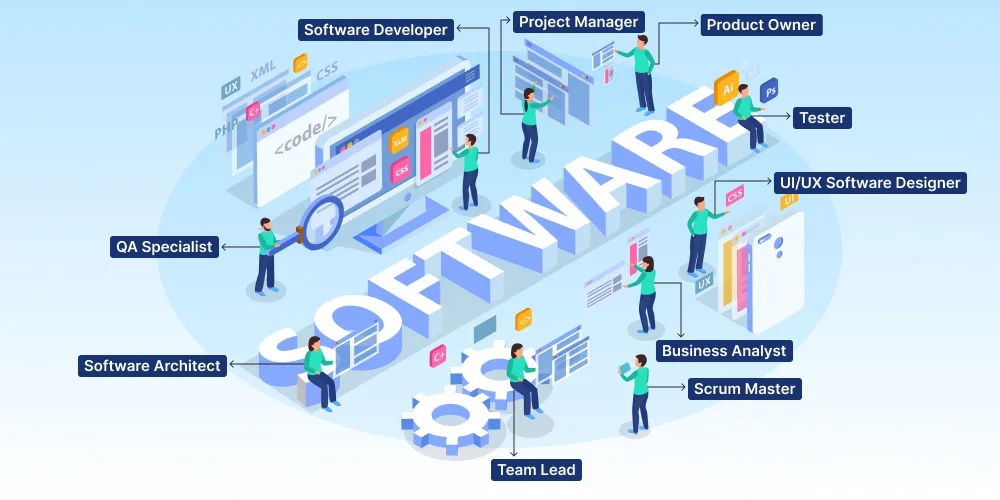
The software development lifecycle isn't complete without a dedicated team with specific roles and skills. In this section, we will discuss the various roles within a software development team, responsibilities of each team member, and essential skills required for each position.
#1. Product Owner
Product owners play a crucial role in bridging the gap between software engineers and project stakeholders by effectively communicating the goals and objectives of the project. They have deep knowledge of the problem-space that this product is supposed to solve and what value a company needs in order for it to be valuable. To ensure that the team's work aligns with customer needs and business objectives, the Product Owner collaborates closely with them. They prioritize the backlog, define user stories, and monitor progress.
Tasks and Responsibilities
Product owners are responsible for:
Gather and define detailed requirements and user stories for clarity with the development team.
Conduct market research to understand industry trends, competition, and customer preferences.
Define acceptance criteria for user stories to ensure deliverables meet requirements and quality standards.
Act as a point of contact between the development team and stakeholders.
Create, prioritize, and maintain the product backlog to reflect customer needs and business goals.
Participate in sprint planning meetings to provide insights and set development priorities.
And more.
Required Skills and Experience
Product owner should have the following skills and experience:
Expertise in the specific industry or domain the product serves.
Experience in product management and lifecycle, including roadmapping and release planning.
Proficiency in software development methodologies.
Excellent communication and collaboration skills.
Ability to define and prioritize product features and requirements.
And more.
#2. Project Manager
Software development teams depend on their project managers to ensure effective communication and coordination. They work closely with developers, business analysts, product owners, and other team members to collaborate effectively. Project managers play a crucial role in ensuring that software projects are completed on schedule and within budget. They oversee the entire development process, making sure that everything runs smoothly and efficiently.
Tasks and Responsibilities
Project managers are responsible for:
Define project scope, objectives, and deliverables.
Develop detailed project plans and timelines.
Coordinate and allocate resources effectively.
Monitor and track project progress against milestones.
Manage project budgets and control costs.
Identify and mitigate project risks and issues.
And more.
Required Skills and Experience
Project Manager should have the following skills and experience:
Strong understanding of project management methodologies (e.g., Agile, Waterfall).
Proven experience in managing projects from initiation to completion.
Excellent communication and interpersonal skills.
Ability to develop and manage detailed project plans.
Proficiency in project management software (e.g., Microsoft Project, Asana).
Strong organizational and time-management abilities.
And more.
#3. Business Analyst
Business Analysts (BAs) act as a bridge between business requirements and technical solutions to align with business goals. They understand the company's needs and convey them to developers for comprehensive understanding.
Tasks and Responsibilities
Business Analysts are responsible for:
Gather and analyze business requirements.
Document functional specifications.
Facilitate communication between stakeholders and technical teams.
Conduct market research and analysis.
Identify opportunities for process improvement.
Create use cases and user stories.
Validate solutions against business needs.
Support project management and planning.
Conduct stakeholder interviews and workshops.
Develop and maintain project documentation.
Required Skills and Experience
Business Analysts should have the following skills and experience:
Strong analytical and problem-solving skills.
Experience in gathering and documenting business requirements.
Proficiency in data analysis and visualization tools.
Excellent communication and interpersonal skills.
Knowledge of business processes and workflows.
Familiarity with Agile methodologies.
Ability to facilitate meetings and workshops.
Experience with project management software.
Strong attention to detail.
Ability to work collaboratively with technical teams.
Streamline your project with expert guidance. Contact DITS now for the perfect software solution tailored to your needs.
Software architects carefully plan the overall structure of a software system to ensure that it meets all functional and technical criteria. In order to ensure the system's scalability, maintainability, and security, they work closely with the development team.
Tasks and Responsibilities
Software Architects are responsible for:
Design high-level architecture for software systems.
Define technical standards and guidelines.
Evaluate and select appropriate technologies.
Ensure system scalability and performance.
Collaborate with stakeholders to gather requirements.
Lead architectural reviews and design discussions.
And more.
Required Skills and Experience
Software Architects should have the following skills and experience:
Strong knowledge of software architecture patterns and principles.
Proficiency in multiple programming languages and frameworks.
Experience in designing scalable and maintainable systems.
Familiarity with cloud services and deployment strategies.
Excellent problem-solving and analytical skills.
Strong communication skills for collaborating with stakeholders.
And more.
#5. Software Developer
Software developers are the professionals who are responsible for developing software systems. They build custom solutions based on project specifications through the process of writing, testing, and maintaining code. Software developers collaborate with the software architect to ensure the success of a project.
Tasks and Responsibilities
Software developers are responsible for:
Write clean, maintainable code.
Design software applications based on specifications.
Collaborate with team members to define project requirements.
Debug and troubleshoot software issues.
Conduct code reviews to ensure quality standards.
Test software to ensure functionality and performance.
Document code and development processes.
And more.
Required Skills and Experience
Software Developer should have the following skills and experience:
Proficiency in programming languages (e.g., Java, Python, C++).
Experience with software development methodologies (e.g., Agile, Scrum).
Strong problem-solving and analytical skills.
Familiarity with version control systems (e.g., Git).
Knowledge of databases and SQL.
Understanding of software testing and debugging processes.
Experience in web development frameworks (e.g., React, Angular).
Strong communication and teamwork skills.
Ability to learn new technologies quickly.
#6. UI/UX Software Designer
Specializing in user interfaces and user experience (UI/UX), designers play a crucial role in creating software that is both intuitive and visually appealing. Their responsibility is to design the visual interface of the system, ensuring that users can interact with it effortlessly and have a pleasant experience.
Tasks and Responsibilities
UI/UX Software Designers are responsible for:
Create wireframes and prototypes for design concepts.
Design user interfaces that are visually appealing and intuitive.
Collaborate with developers to ensure design feasibility.
Conduct usability testing to gather feedback and improve designs.
Develop style guides and design systems for consistency.
Analyze user feedback and analytics to inform design decisions.
Stay updated on design trends and best practices.
Required Skills and Experience
UI/UX Software Designers should have the following skills and experience:
Proficiency in design tools (e.g., Sketch, Adobe XD, Figma).
Strong understanding of user-centered design principles.
Experience in creating wireframes, prototypes, and user flows.
Familiarity with HTML, CSS, and front-end development.
Excellent visual design skills and attention to detail.
Strong communication and collaboration abilities.
Experience in conducting user research and usability testing.
Knowledge of accessibility standards and best practices.
Hire the Best UI/UX Designers with Proven Technical Skills
Choose us for effective execution, quicker ROI, and exceptional client recognition. Our dedicated UI/UX designers are highly trained and passionate about crafting stunning designs and responsive experiences.
Testers play a crucial role in any skilled software development team. They ensure the smooth operation of the software without any glitches or bugs.
Tasks and Responsibilities
Testers are responsible for:
Design and execute test cases.
Identify and report bugs.
Verify bug fixes.
Perform regression testing.
Conduct performance testing.
Review requirements for testability.
Collaborate with developers and stakeholders.
Ensure software meets quality standards.
Create and maintain test documentation.
Automate repetitive tests.
Required Skills and Experience
Tester should have the following skills and experience:
Strong knowledge of testing methodologies and tools.
Experience in manual and automated testing.
Proficiency in writing clear and concise test cases.
Familiarity with bug tracking software (e.g., JIRA).
Attention to detail and analytical thinking.
Ability to execute test plans and report findings.
Understanding of software development life cycle (SDLC).
#8. Quality Assurance Specialist
QA experts carefully monitor all aspects of software testing to ensure its quality meets the highest standards. Working alongside the software development team, they ensure that the software system has undergone thorough testing and is free of any bugs.
Tasks and Responsibilities
Quality Assurance Specialists are responsible for:
Develop and implement quality assurance standards and procedures.
Conduct regular software testing to identify defects.
Create and maintain test plans and test cases.
Collaborate with developers to resolve bugs and issues.
Ensure products meet quality and performance standards.
Perform root cause analysis of defects.
And more.
Required Skills and Experience
Quality Assurance Specialist should have the following skills and experience:
Proficiency in software testing methodologies and tools.
Strong analytical and problem-solving skills.
Experience with automated testing frameworks.
Excellent attention to detail.
Ability to write clear and concise test cases.
Knowledge of software development lifecycle (SDLC).
Familiarity with bug tracking systems (e.g., Jira).
#9. Scrum Master
The Scrum Master's role is to ensure that the team adheres to the Scrum process and principles, which aim to facilitate the swift and efficient delivery of value. In addition, they are skilled at recognizing and resolving any obstacles that may hinder the team's progress. Good scrum masters are dedicated to the core principles of scrum while also being adaptable and receptive to chances for the team to enhance their workflows.
Tasks and Responsibilities
Scrum Masters are responsible for:
Assists with product backlog.
Implement agile methodologies.
Host daily standups to review progress.
Ensures team performance improvement and productivity.
Tracks project at regular intervals.
Eliminates external blocker and internal roadblocks.
Required Skills and Experience
Scrum Masters should have the following skills and experience:
Deep knowledge of Agile and Scrum methodologies.
Proven experience as a Scrum Master or in a similar role.
Excellent facilitation and coaching skills.
Strong communication and interpersonal skills.
Ability to remove obstacles and manage team dynamics.
Proficiency with Scrum tools (e.g., Jira, Trello).
Certification in Scrum (e.g., CSM, PSM).
Strong problem-solving and conflict-resolution abilities.
#10. Team Lead
In software development, a team lead or tech lead plays a crucial role in overseeing the team, ensuring everyone is aligned, and maintaining the project's financial and schedule objectives.
Tasks and Responsibilities
Team Lead is responsible for:
Guide and mentor team members.
Allocate tasks and manage workload.
Ensure project deadlines are met.
Facilitate effective team communication.
Resolve team conflicts and issues.
Monitor team performance and progress.
Provide technical expertise and support.
Conduct performance reviews and feedback.
Coordinate with other departments.
Ensure adherence to quality standards.
Required Skills and Experience
Team Lead should have the following skills and experience:
Strong leadership and team management skills.
Excellent communication and interpersonal abilities.
Proven experience in leading and mentoring teams.
Technical expertise in relevant domains.
Strong problem-solving and decision-making skills.
Ability to manage multiple tasks and priorities.
Proficiency in project management tools and methodologies.
Experience in performance evaluation and feedback.
Ability to foster a collaborative and productive work environment.
Strong organizational and time-management skills.
Things to Consider When Structuring a Software Development Team
Every product's success starts with the right people. The way you align your business goals with the roles in your software development team will significantly impact your project's success or failure. Therefore, when structuring a software development team, consider key factors like:
Type and Complexity of Your Project
Before diving into the recruitment process, it's essential to define the scope of your project. If your objective is to develop a product prototype, a small team of four members may be enough to accomplish the task. However, if your goal is to launch a new application with extensive features and third-party integrations, you'll require a larger team. Here's how the scope of your project can influence the structure of your software development team:
Product owner (client’s side), project manager, business analyst, UI/UX designer, software engineers, test engineers
Product Development
Agile: typically up to 9 specialists; large projects may involve several Agile teams.
Product owner (client’s side), project manager, business analyst, UI/UX designer, software architect, software engineers, test engineers. Optionally: test automation engineers, performance engineers, DevOps engineers, security engineers
Time Required for Project Completion
Your project's turnaround time will determine the size and structure of your team. With fewer members on the team, it may take longer to complete the project. So, if you have a cutting-edge product idea with a strict deadline, you might need to form a larger team of senior engineers or full-stack engineers who can cover all project needs and deliver results rapidly and effectively.
Budget Constraints
Budget will significantly impact your decision while managing a software development team. It will help you decide the number of team members you can recruit, their experience level, specialization you bring on board and more. We recommend using Agile development methodology and prioritizing features to reduce software development cost during initial stages.
Software Development Approach
Whether you choose Waterfall or Agile, methodology will directly impact the software development team structure and workflow of team members. Let us have a look at both the development methodologies to know the unique features they offer, their fundamental aspects and how they influence the overall cost.
Aspect
Agile Methodology
Waterfall Methodology
Approach
Iterative and incremental
Linear and sequential
Flexibility
Highly flexible and adaptable to changes
Rigid, changes are difficult to implement
Project Phases
Multiple sprints or iterations
Distinct and separate phases
Customer Involvement
Continuous customer involvement
Customer involvement mainly at the beginning
Documentation
Minimal, focus on working software
Extensive documentation
Testing
Continuous testing throughout development
Testing only after development is complete
Risk Management
Easier to manage risks with ongoing feedback
Risky due to late testing and inflexibility
Team Collaboration
High collaboration and communication
Limited communication after initial phase
Deliverables
Frequent, small releases
Single final deliverable
Best Suited For
Projects with uncertain or evolving requirements
Projects with well-defined, stable requirements
Pricing Models
Works well with time & material
Lower risks with fixed price
Benefits of Hiring Software Development Team From DITS
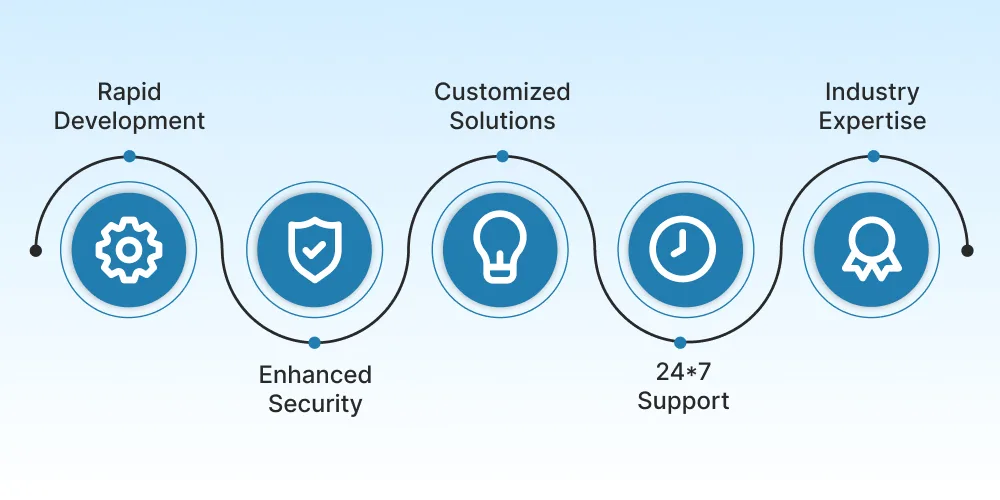
DITS, a leading software development company, has a team of expert engineers skilled in various technologies. Benefits of working with us include:
Rapid Development: We can help minimize the development time and hiring process. Get ahead of your competitors with faster turnaround and deployment.
Enhanced Security: Our top priority is ensuring software security through comprehensive quality assurance testing. We also prioritize the security of your intellectual property by implementing strict non-disclosure agreements and maintaining robust security measures for code repositories and employee devices.
Customized Solutions: We specialize in creating custom solutions for companies across a wide range of industries for your business needs, encompassing cutting-edge technologies such as cloud computing, AI, and IoT.
24*7 Support: Our software development team is available to work with you despite different time zones. We ensure transparent communication, project management, and collaboration to help enhance workflows and boost productivity.
Industry Expertise: From healthcare to transportation, we've successfully completed more than 100 projects. Our software development team has extensive experience of various technologies like AI, IoT, Machine Learning, Cloud Computing and more.
Conclusion
Building the right team can be challenging, especially if you lack the resources to find and hire talent. DITS can simplify this process by helping you build a team from scratch or adding developers to your existing team. As a leading offshore software development company, we offer access to a vast pool of developers, rigorously screened for English proficiency and over 100 skills, including Ruby, React.js, React Native, iOS development, and advanced technologies like AI, IoT, and LLMs. After you interview and hire our developers, we take care of onboarding, payroll, and benefits, allowing you to focus on team management and business growth. Contact us to hire experienced developers and boost your software development team's performance today.
Frequently asked questions
A software development team structure defines how roles, responsibilities, and workflows are organized within a team. It ensures efficient collaboration, clear accountability, and streamlined execution. Common structures include generalist, specialist, and hybrid models, each suited to different project needs and business objectives.
Dinesh Thakur
25+ years of IT software development experience in different domains like Business Automation, Healthcare, Retail, Workflow automation, Transportation and logistics, Compliance, Risk Mitigation, POS, etc. Hands-on experience in dealing with overseas clients and providing them with an apt solution to their business needs.