With more than 20 years of experience - I represent a team of professionals that specializes in the healthcare and business and workflow automation domains. The team consists of experienced full-stack developers supported by senior system analysts who have developed multiple bespoke applications for Healthcare, Business Automation, Retail, IOT, Ed-tech domains for startups and Enterprise Level clients
Key Takeaways
Behavioral health scheduling software helps organizations reduce scheduling conflicts, administrative workload, and unused clinical capacity while improving patient access.
Effective staff management depends on coordinating therapist availability, credentials, caseloads, and patient needs to improve workforce utilization and care continuity.
Autism and ABA scheduling requires coordinated recurring sessions, RBT and BCBA supervision, authorization management, and multi-location care delivery.
EHR-integrated scheduling connects appointments with patient intake, clinical documentation, authorizations, and billing to reduce manual handoffs and improve operational visibility.
AI-enabled workflows can streamline intake document processing, care coordination, task routing, and operational reporting while keeping clinical decisions under human oversight.
The right technology strategy should prioritize integration, modernization, customization, or replacement based on existing system limitations, scalability needs, and long-term business value.
How autism and behavioral health organizations manage complex schedules without increasing administrative burden?
Behavioral health scheduling software helps coordinate recurring therapy sessions, therapist availability, patient needs, staff credentials, authorization limits, and multi-location care. It reduces scheduling conflicts, improves workforce visibility, and supports more consistent autism care delivery as organizations scale.
How Manual Behavioral Health Scheduling Affects Staff Utilization and Patient Access?
Manual scheduling can become a major operational constraint as behavioral health organizations grow. When staff availability, patient needs, authorizations, locations, and recurring appointments are managed across disconnected systems, scheduling teams spend more time resolving conflicts than improving capacity and access.
Scheduling Conflicts and Double-Booking
Limited visibility across clinician, patient, and location calendars increases the risk of overlapping appointments, missed availability, and avoidable rescheduling.
Underutilized Clinical Capacity
Open therapist hours can remain unused when schedulers cannot quickly identify the right patient-provider match, reducing staff utilization and available care capacity.
High Administrative Workload
Teams often spend significant time comparing availability, credentials, locations, caseloads, and patient requirements manually, increasing coordination effort and slowing scheduling decisions.
Disruptions from Cancellations
Last-minute cancellations can create unused appointment slots and require schedulers to rebuild schedules quickly, affecting productivity and continuity of care.
Authorization and Billing Risks
Scheduling services outside approved authorization limits can create downstream billing issues, reimbursement delays, and additional administrative follow-up.
Difficulty Scaling Across Locations
As organizations add clinicians, patients, programs, and locations, manual scheduling becomes harder to manage consistently, making growth more operationally complex.
How Behavioral Health Scheduling Software Improves Staff and Patient Coordination
Behavioral health scheduling software brings staff availability, patient needs, recurring appointments, supervision requirements, and location constraints into one coordinated workflow. For growing ABA and behavioral health organizations, this reduces manual scheduling effort, improves workforce visibility, and helps care teams respond faster to changes without disrupting patient access.
Centralized Staff Availability: Behavioral health scheduling software for staff management gives schedulers better visibility into clinician availability, helping reduce gaps, overlaps, and unnecessary coordination.
Therapist and RBT Scheduling: Aligning providers with caseloads, availability, and service needs helps organizations use clinical capacity more effectively.
Client-Provider Matching: Matching patients with the right provider based on skills, credentials, availability, and location supports better care continuity and resource allocation.
Recurring Therapy Scheduling: Structured recurring appointments reduce repetitive administrative work while helping maintain consistency across ongoing ABA and behavioral health programs.
Cancellation and Replacement Management: Faster reassignment of open slots helps minimize unused capacity and reduce disruption from last-minute schedule changes.
Multi-Location Scheduling: Coordinating staff and patients across clinics, homes, schools, and community settings helps organizations scale scheduling operations more efficiently.
Make Behavioral Health Scheduling More Efficient
Reduce scheduling conflicts, improve staff utilization, and streamline patient coordination with connected scheduling solutions.
How Autism and ABA Scheduling Supports Care Continuity and Staff Utilization?
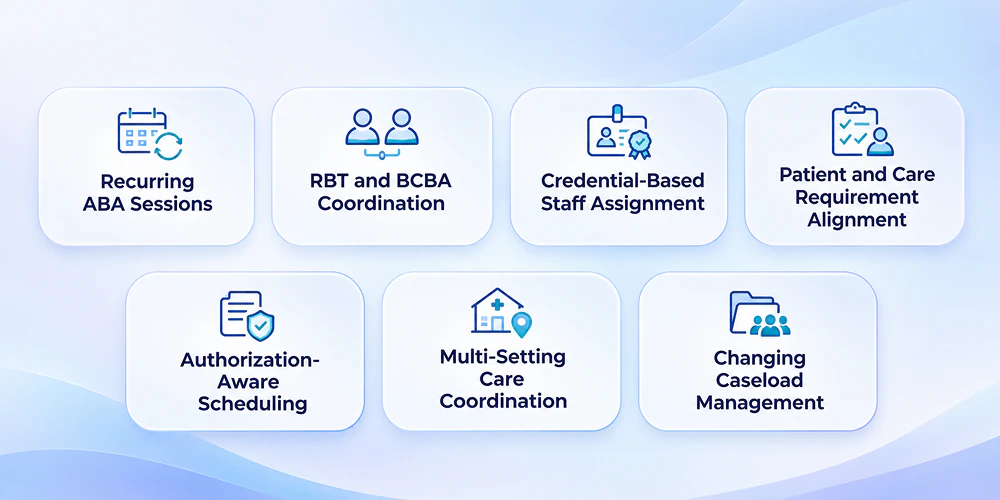
Autism & Behavioral Health Scheduling must account for recurring therapy, supervision, staff credentials, patient needs, authorization limits, and multiple care settings. A more connected scheduling approach helps ABA providers maintain consistent care while improving how clinical capacity is assigned and used.
Recurring ABA Sessions: Structured recurring schedules help maintain treatment consistency while reducing repetitive administrative effort.
RBT and BCBA Coordination: Aligning therapy sessions with supervision needs helps protect continuity of care and reduces avoidable scheduling disruption.
Credential-Based Staff Assignment: Matching clinicians by qualifications, skills, availability, and service requirements helps improve workforce utilization and assignment accuracy.
Patient and Care Requirement Alignment: Scheduling around individual patient needs and care requirements supports more reliable service delivery and fewer unnecessary changes.
Authorization-Aware Scheduling: Aligning appointments with approved service limits helps reduce billing friction and lowers the risk of unused authorized hours.
Multi-Setting Care Coordination: Managing home, clinic, school, and community-based sessions in one workflow improves visibility and helps teams account for location and travel constraints.
Changing Caseload Management: Flexible scheduling helps organizations respond to new patients, staffing changes, cancellations, and evolving treatment needs without disrupting established care.
How Behavioral Health Scheduling Connects Patient Appointments with EHR Workflows
Behavioral health EHR scheduling software can connect appointment management with the clinical and administrative systems that support care delivery. This helps reduce duplicate data entry, improve visibility across teams, and keep patient, provider, authorization, and billing information aligned throughout the scheduling process.
Intake and Registration: Link appointment booking with patient demographics, insurance, and intake information to reduce repeated administrative work.
Patient and Provider Scheduling: Coordinate individual, group, recurring, telehealth, and in-person appointments around availability and care requirements.
Clinical Documentation: Connect completed appointments with notes and patient records to support smoother clinical workflows.
Authorization Management: Align scheduled services with approved care limits to reduce avoidable administrative and billing issues.
Billing and Claims: Pass accurate appointment and service details into downstream billing workflows with fewer manual handoffs.
Cancellations and Rescheduling: Update appointments while maintaining visibility into open provider capacity and patient demand.
Reporting and Analytics: Use scheduling data to monitor utilization, cancellations, appointment trends, and operational performance.
Core Capabilities That Amplify Staff and Patient Scheduling Performance
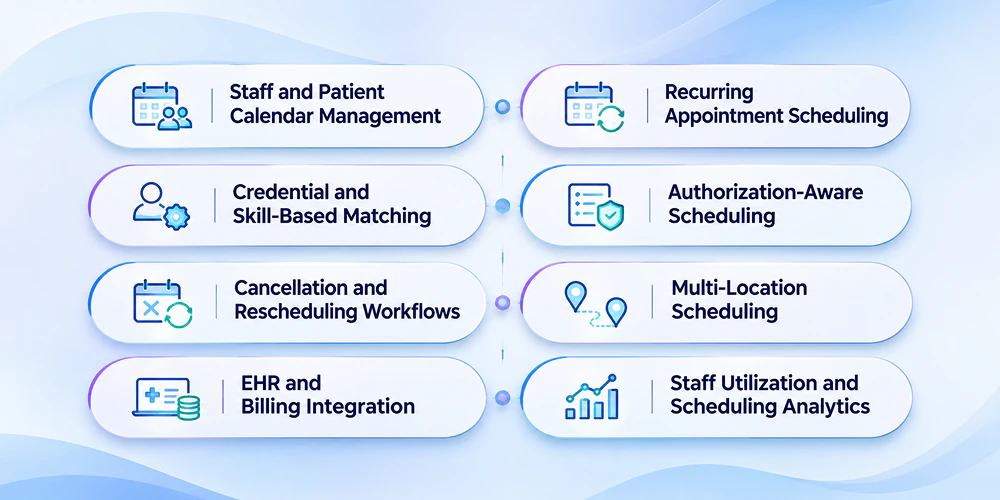
The right behavioral health scheduling software should do more than fill appointment slots. It should help organizations coordinate staff, patients, authorizations, locations, and connected clinical workflows while improving utilization and reducing administrative friction.
Staff and Patient Calendar Management
Centralized calendars give scheduling teams a clearer view of clinician availability, patient appointments, and location-based commitments, helping reduce overlaps and improve day-to-day coordination.
Recurring Appointment Scheduling
Recurring scheduling supports ongoing ABA and mental health care without requiring teams to recreate appointments manually, helping maintain consistency and reduce repetitive administrative work.
Credential and Skill-Based Matching
Behavioral health scheduling software for staff management should help align patients with providers based on qualifications, credentials, skills, availability, and service requirements.
Authorization-Aware Scheduling
Connecting schedules with authorization limits helps teams plan services more accurately, reduce billing friction, and lower the risk of unused authorized hours.
Cancellation and Rescheduling Workflows
Faster schedule adjustments help organizations refill open slots, reduce lost clinical capacity, and maintain continuity when patients or staff cancel.
Multi-Location Scheduling
Organizations delivering care across clinics, homes, schools, and community settings need scheduling visibility that accounts for location, travel, and provider availability.
EHR and Billing Integration
Behavioral health EHR scheduling software can connect appointments with intake, documentation, billing, and patient records, reducing duplicate data entry and manual handoffs.
Staff Utilization and Scheduling Analytics
Utilization insights help leaders identify open capacity, recurring gaps, cancellation patterns, and scheduling bottlenecks so they can make better workforce and operational decisions.
How AI Streamlines Patient Intake and Behavioral Health Workflows?
AI can strengthen behavioral health scheduling by reducing administrative effort, structuring patient information, improving task routing, and giving teams better operational visibility. The strongest use cases are those that support staff and patient workflows without removing human oversight from clinical decisions.
As per report AI-Powered Scheduling has successfully reduced weekly scheduling workload from approximately 360 hours to 120 hours, while expanding operations from 9 to 15 clinics.
Clinical Form Structure Extraction: AI can analyze intake forms and patient documents, extract relevant information, and map unstructured inputs into structured fields. This reduces repetitive data entry and helps administrative teams prepare patient records more efficiently.
PDF & Intake Document Processing: Uploaded PDFs and historical records can be processed to identify key patient information and associate it with the correct electronic health record, improving continuity between intake, scheduling, and clinical workflows.
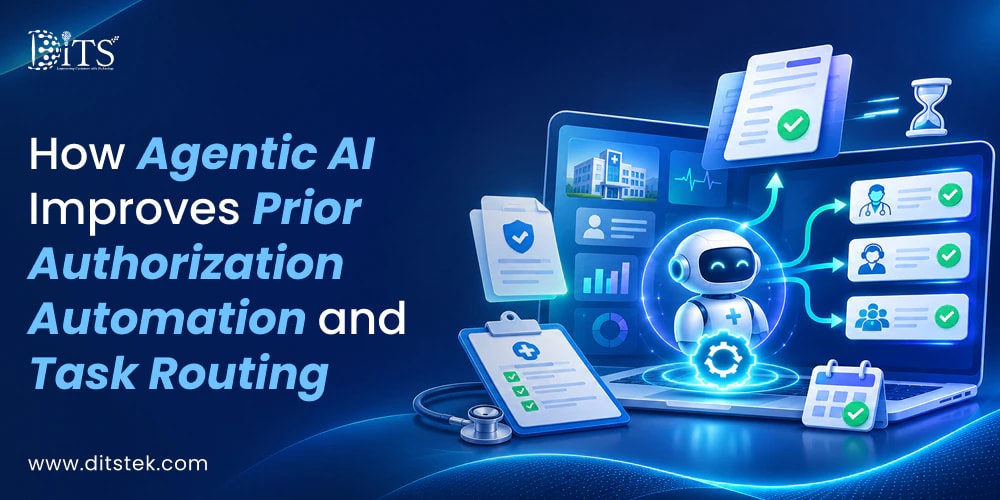
Care Coordination Task Routing: Patient requests, follow-ups, scheduling issues, and administrative tasks can be categorized by urgency and subject matter, helping teams prioritize work and reduce delays in care coordination.
Role-Based Escalation: Scheduling exceptions, patient requests, and care-related tasks can be routed to the appropriate clinician, coordinator, or administrative team based on role and workflow rules, helping reduce unnecessary handoffs.
Operational Visibility: AI-supported dashboards can help leaders monitor response times, scheduling bottlenecks, care-team workload, and administrative delays, providing better insight into where operational improvements are needed.
Build Scheduling Software Around Your Care Needs
Develop tailored scheduling workflows for ABA therapy, therapist coordination, recurring sessions, and multi-location care.
How to Align Behavioral Health Scheduling with Growth and Operational Needs
As behavioral health organizations grow, scheduling needs often change faster than existing processes can support. The right behavioral health scheduling software should align with workforce demands, care delivery models, system integrations, and future growth so scheduling remains efficient rather than becoming an operational constraint.
Identify Current Scheduling Gaps
Review where manual coordination, disconnected calendars, recurring appointment changes, and limited visibility are creating delays. This helps determine whether the issue is workflow-related, technology-related, or both.
Plan for Provider and Location Growth
Scheduling processes should support additional therapists, RBTs, BCBAs, programs, and locations without increasing administrative effort at the same pace. Scalable workflows make expansion easier to manage.
Improve Workforce Utilization
Behavioral health scheduling software for staff management should provide visibility into availability, caseloads, credentials, open capacity, and location requirements so leaders can make better staffing decisions.
Strengthen Patient and Appointment Scheduling
Mental health appointment scheduling software and patient scheduling software for behavioral health should support individual, group, recurring, telehealth, and in-person appointments while improving coordination between patients, providers, and care teams.
Connect Scheduling with EHR and Billing Workflows
Behavioral health EHR scheduling software should work within the broader clinical and financial environment. Connecting appointments with intake, documentation, authorizations, and billing helps reduce duplicate work and fragmented data.
Prioritize Integration Requirements
Organizations should assess how scheduling needs to connect with EHRs, patient portals, telehealth platforms, billing systems, and workforce tools. Better integration reduces manual handoffs and improves workflow continuity.
Build for Scalability and Visibility
As patient volume and staffing needs grow, leaders need clearer reporting on utilization, cancellations, capacity, and scheduling demand. Stronger visibility supports more informed operational planning.
Apply Automation Where It Adds Value
Automation can support recurring appointments, conflict detection, reminders, provider matching, and rescheduling. The goal should be to reduce administrative effort without adding unnecessary technology complexity.
When Behavioral Health Scheduling Needs Integration, Modernization, or Customization
Not every behavioral health organization needs to replace its scheduling platform. The right approach depends on where the current environment is limiting staff coordination, patient access, interoperability, or growth. A focused assessment can help determine whether behavioral health scheduling software should be integrated, modernized, customized, or replaced.
Integrate Disconnected Systems
When scheduling is separated from EHR, billing, telehealth, or workforce systems, integration can reduce duplicate data entry, improve information flow, and give teams a more complete view of patient and provider activity. This is especially important for behavioral health EHR scheduling software environments where appointments, documentation, authorizations, and billing need to stay aligned.
Modernize for Scale
If current systems are slowing scheduling decisions, limiting reporting, or making multi-location operations harder to manage, modernization can improve usability, visibility, and scalability without requiring a complete platform replacement.
Customize ABA Workflows
Autism & behavioral health scheduling often involves recurring sessions, RBT and BCBA coordination, credential requirements, authorization limits, and multiple care settings. Customizing existing scheduling workflows can help organizations support these requirements while preserving systems that already work well.
Strengthen Staff and Patient Scheduling
Behavioral health scheduling software for staff management should make it easier to align provider availability, credentials, caseloads, and patient needs. At the same time, Patient Scheduling Software for Behavioral Health should support recurring, individual, group, telehealth, and in-person appointments without creating additional administrative effort.
Replace When Needed
Replacement may be the better option when outdated architecture, poor integration, persistent workflow inefficiencies, security concerns, or high maintenance costs prevent the organization from improving operations or scaling effectively.
Business Outcomes of a More Connected Behavioral Health Scheduling Environment
A more connected behavioral health scheduling environment can improve both operational efficiency and care coordination by giving teams better visibility across staff, patients, locations, and clinical workflows.
Better Staff Utilization: Match provider availability with patient demand more effectively and reduce unused clinical capacity.
Less Administrative Work: Reduce repetitive coordination, manual schedule updates, and duplicate data entry.
Faster Cancellation Response: Reassign open slots more quickly and minimize lost capacity when schedules change.
Greater Scheduling Visibility: Give teams a clearer view of appointments, staffing, authorizations, and location-based commitments.
More Consistent Patient Access: Improve appointment coordination and reduce avoidable disruptions in recurring care.
Stronger Multi-Location Coordination: Manage providers, patients, and schedules more consistently across clinics and care settings.
Fewer Manual Handoffs: Connect scheduling with EHR, billing, and related systems to reduce fragmented workflows and data inconsistencies.
How DITS Helps Behavioral Health Organizations Improve Scheduling Operations
DITS helps behavioral health organizations assess where scheduling workflows, staff coordination, patient access, and system dependencies are limiting efficiency or growth. Through our HealthTech software development services, we evaluate scheduling processes alongside EHR, billing, workforce, and clinical systems to identify whether the priority should be integration, modernization, or targeted workflow improvement.
Moreover, DITS supports healthcare interoperability, application modernization, API enablement, custom scheduling functionality, and selective automation to create a more connected operating environment. The goal is to reduce manual coordination, improve workforce visibility, support scalable patient scheduling, and strengthen long-term system performance without replacing technology that still delivers value.
See how our real-world healthcare projects bring together connected systems, smarter workflows, and scalable technology to address complex operational challenges.
Frequently asked questions
Leaders should assess scheduling delays, staff utilization, patient access, cancellation rates, integration gaps, reporting limitations, and whether current workflows can support future growth.
Nidhi Thakur
With more than 20 years of experience - I represent a team of professionals that specializes in the healthcare and business and workflow automation domains. The team consists of experienced full-stack developers supported by senior system analysts who have developed multiple bespoke applications for Healthcare, Business Automation, Retail, IOT, Ed-tech domains for startups and Enterprise Level clients