25+ years of IT software development experience in different domains like Business Automation, Healthcare, Retail, Workflow automation, Transportation and logistics, Compliance, Risk Mitigation, POS, etc. Hands-on experience in dealing with overseas clients and providing them with an apt solution to their business needs.
Why do cargo insurance claims take longer than they should? Very often, the delay can be connected to heavy paperwork processes, which include bills of lading, commercial invoices, inspection reports, proof of loss, and insurance certificates.
The claims process is usually slow because the claims department spends too much time gathering, checking, and entering information. Document Processing Automation helps solve the problem through capture, classification, data extraction, and validation of document information.
Where Do Document Bottlenecks Create Delays in Cargo Claims?
For a cargo insurance claim to be assessed, it must first have adequate, precise, and properly organized documentation. If this documentation is lacking, poorly organized, or done manually, delays become inherent in the process. Below are some of the most prevalent ones.
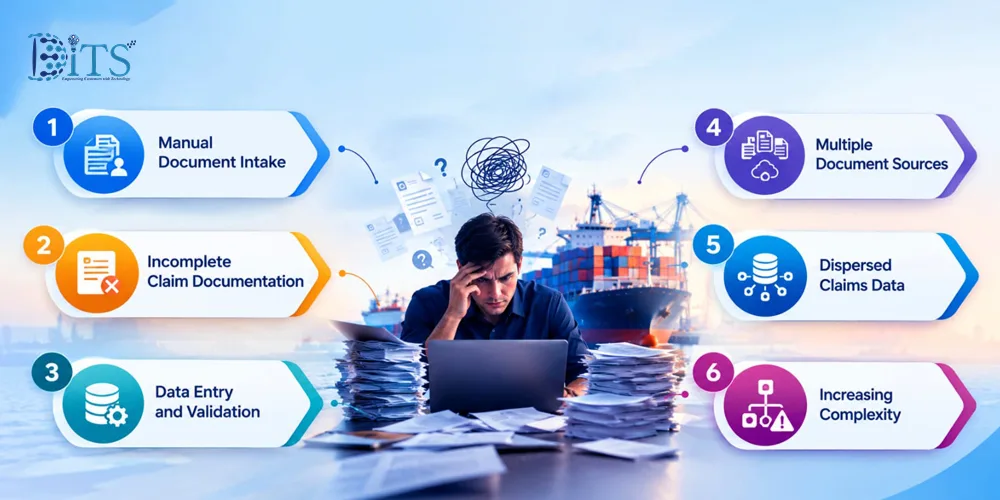
Manual Document Intake
In most cases, claims documents come through emails, portals, shared folders, and other channels, and people must identify and classify each document and attach it to the relevant claim. Therefore, it would result in result in time-taking processes for collecting and consolidating information.
Incomplete Claim Documentation
Claims can remain pending if required invoices, survey reports, proof of loss, or shipments are not available. This causes more follow-ups from the shippers, carriers, brokers, and others.
Data Entry and Validation
The policy number, shipment details, value of goods, date and loss details will have to be entered into the claims system and validated against the corresponding documents. This is repetitive and consumes time and also increases the risk of discrepancies.
Multiple Document Sources
The claims documents could be provided by the shippers, carriers, brokers, surveyors, emails, portals, and any other system that would result in time-taking processes for collecting and consolidating information.
Dispersed Claims Data
With document and claims details spread across various places like e-mail, ERP, TMS, portals, and claims applications, teams spend time retrieving and reconciling information. This further complicates the claims process.
Increasing Complexity
With growing numbers of claims, using the automation in document processing insurance workflows can significantly reduce the number of manual operations.
Automation should not begin with choosing a tool. It should begin by identifying which document-related delays are repetitive, measurable, and suitable for automation.
Assess Your Claims Workflow
Identify where manual document handling is slowing down your cargo insurance claims. Talk to DITS about assessing your current workflow and identifying practical automation opportunities.
What Needs to Be Assessed Before Automating Cargo Claim Documents?
Prior to implementing any level of automation, insurers need to figure out what exact parts of the process involve document-related delays and can be automated without compromising claim accuracy and management.
High document volume alone does not justify automation. Businesses should also consider exception rates, document variability, integration readiness, and the cost of existing manual processes.
This assessment also helps determine whether existing systems can support the required automation or whether insurance software development services are needed to address workflow, integration, or platform limitations.
Area to Evaluate
Aspect to Focus On
Current claim-document workflows
For claim documents received, evaluated, validated and processed in the claims management process
Volume of documents/claims
To evaluate if there is enough volume of documents to justify automation
Types/formats of claim documents
For determining the number and types of invoices, bills of lading, survey reports and other documents that come for claim processing
Patterns of incomplete claims
To find the most frequent missing documents and data fields delaying claim processing
Data quality
For assessing whether incoming data is reliable and suitable for automated processing
Extraction and validation needs
To identify the data that needs to be extracted from the document and rules to validate it
Exception handling
For determining when manual actions will be required
Human review requirements
To understand the points requiring involvement of claims professionals
Integration readiness
For evaluating claims platform and other systems' capabilities for exchanging data
Security and audit requirements
To assess how to manage access, processing and changes of document data
What Does an Automated Cargo Insurance Claim Workflow Look Like?
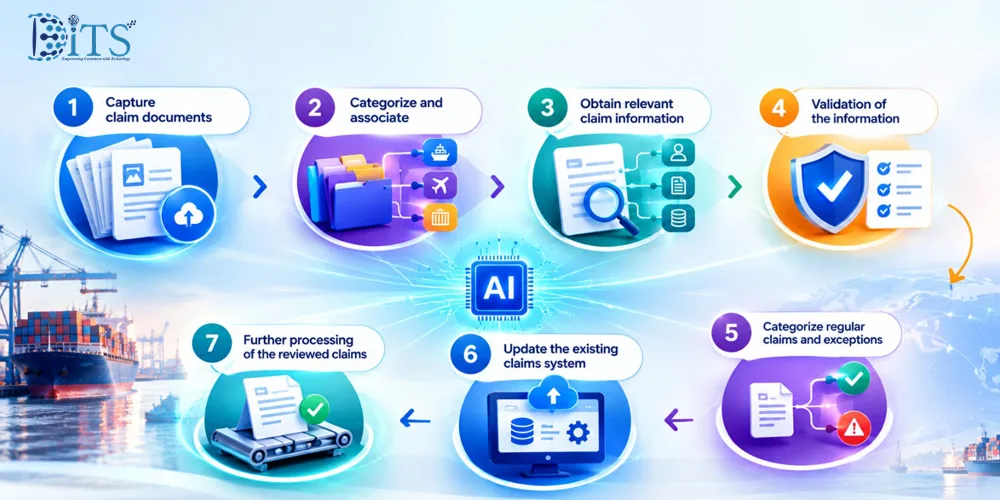
The real value of Automated Document Processing for insurers is the ability to design a workflow where information flows more smoothly; exceptions are caught early, and current systems work better in concert.
Capture claim documents: Claim-related documents are gathered through email, brokers' sites, customer portals, or automated systems, without manual consolidation.
Categorize and associate: Documents such as bills of lading, invoices, survey reports, certificates of insurance, and others are categorized and linked to the correct claim.
Obtain relevant claim information: Important information such as the policy number, shipment details, cargo value, dates, and loss of information is extracted from the documents.
Validation of the information: Extracted information is verified against business rules and available claim information.
Categorize regular claims and exceptions: Regular claims can proceed further in the process, while exceptional claims are set aside for human processing.
Update the existing claims system: Validate the information and enter it into the claims system, ERP, TMS, or any other system to avoid reentry.
Further processing of the reviewed claims: Claims agents receive the organized information, assess it, and make decisions.
The decision is not whether to update the old technology. In many situations, document processing tools can operate in parallel with claims management systems, TMS, ERP solutions, and even brokers' portals. The main point is to identify which document-processing points need improvement without disrupting the overall claims-processing environment.
If you are someone evaluating legacy modernization, DITS can help you identify the complexities, what to modernize, what to retain, and how to move forward with a practical, business-aligned roadmap.
How Can Businesses Measure Whether Automated Document Processing Software Is Reducing Claim Delays?
Automation efforts should deliver efficiency improvements beyond document-handling speed; they should improve the overall efficiency of the claims process. The key metrics that organizations can measure to understand the effectiveness of automated document processing for insurance include the following:
Metric
What It Reveals
Claim document processing time
Faster capture, classification, and validation of documents.
Claim intake to review time
Faster time to get a claim ready for review.
Incomplete submission rate
Early identification of missing documents and data gaps.
Manual data entry volume
Reduction in repetitive administrative activity.
Document exception rate
Number of times intervention is needed.
Claims requiring manual review
Reduced time spent on document handling.
Overall claim turnaround time
Improvement due to faster document processing.
The most important metric is not any one of those, but the combined effect across the entire process. If document handling becomes faster, exceptions are found sooner, and less time is spent on administrative tasks, then the automation project is impacting claim efficiency.
Explore Document Processing Automation
Reduce repetitive document handling, improve validation, and help claims teams get complete information faster with automated document processing.
Why DITS Is the Right Choice for Streamlining Insurance Workflows?
At DITS, we follow a consultant-driven approach that first determines how the current insurance processes work, where bottlenecks appear, and which processes generate excessive manual effort. After analyzing document flows, interdependencies, integration points, and other issues, we recommend a viable technological solution.
Moreover, we help organizations develop and implement technological solutions that fit the existing business environment without requiring major system changes. Whatever solution a business requires, i.e. workflow automation, ERP software development, TMS integration, or claims system integration, we tailor our approach accordingly. The focus remains on optimizing the process and improving overall efficiency.
Frequently asked questions
Delays may occur due to manual document sourcing, missing information, repeated data entry, and the time required to validate data across multiple files and documents.
Dinesh Thakur
25+ years of IT software development experience in different domains like Business Automation, Healthcare, Retail, Workflow automation, Transportation and logistics, Compliance, Risk Mitigation, POS, etc. Hands-on experience in dealing with overseas clients and providing them with an apt solution to their business needs.