With more than 20 years of experience - I represent a team of professionals that specializes in the healthcare and business and workflow automation domains. The team consists of experienced full-stack developers supported by senior system analysts who have developed multiple bespoke applications for Healthcare, Business Automation, Retail, IOT, Ed-tech domains for startups and Enterprise Level clients
Key Takeaways
The use of AI in healthcare helps reduce administrative costs, improve clinical workflows, and support more efficient patient care.
Patient monitoring, claims processing, scheduling, and clinical documentation are among the areas where AI can address recurring operational challenges.
Generative AI offers opportunities to streamline documentation, improve patient communication, and simplify information-intensive healthcare processes.
Successful AI implementation depends on reliable data, system interoperability, clinical oversight, and alignment with existing workflows.
Healthcare organizations should evaluate whether AI, traditional automation, or system modernization offers the most cost-effective solution.
Prioritizing AI investments based on business impact, implementation feasibility, and measurable ROI helps organizations reduce risk and make better technology decisions.
Every delayed authorization, manually processed claim, and missed patient follow-up adds operational costs and strains healthcare resources. AI can help address these challenges, but its value depends on where and how it's applied. The most promising AI use cases in healthcare target measurable improvements in processing efficiency, care coordination, and resource utilization. For healthcare leaders, the priority is identifying opportunities that justify investment without introducing unnecessary complexity.
According to US survey, around 81% of physicians reported using AI in their practices, highlighting how adoption is accelerating while healthcare leaders face growing pressure to demonstrate practical value.
This blog examines practical applications, business value, and key considerations for making informed AI investments. Read on to discover where AI is making a difference and which opportunities are worth pursuing.
Where Are AI Use Cases in Healthcare Delivering Practical Business Value?
The role of AI in healthcare is increasingly tied to solving operational problems that affect costs, staff productivity, and patient care. From reducing manual claims processing to identifying patients who need timely attention, the most valuable applications address specific workflow gaps rather than introducing technology for its own sake.
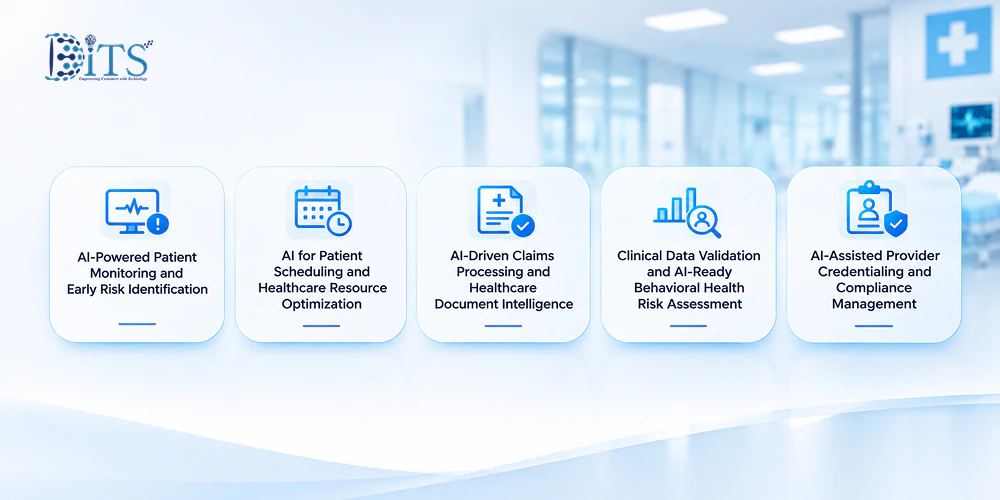
1. AI-Powered Patient Monitoring and Early Risk Identification
Delayed follow-ups after discharge can leave emerging patient risks unnoticed while increasing care teams' workloads. An AI-powered postpartum monitoring platform demonstrates how automated SMS check-ins, AI-assisted response analysis, and EHR-connected escalation can support ongoing patient monitoring. This approach can help healthcare providers prioritize concerning cases, reduce manual coordination, and maintain clinical oversight.
2. AI for Patient Scheduling and Healthcare Resource Optimization
Missed appointments, underutilized resources, and inefficient scheduling directly affect operating costs and patient access. AI can analyze appointment histories, identify potential no-shows, and support scheduling decisions based on patient demand and resource availability. Integrating these capabilities with practice management systems can help healthcare organizations improve appointment utilization, reduce administrative coordination, and make better staffing decisions. The investment case should be established against existing scheduling performance and automation capabilities.
3. AI-Driven Claims Processing and Healthcare Document Intelligence
Manual EOB processing increases administrative effort and creates opportunities for errors that delay billing workflows. AI-powered document intelligence combines OCR and LLMs to extract claims information, apply confidence-based validation, and route exceptions for human review. Converting verified information into standardized EDI formats can reduce repetitive data entry, minimize rework, and improve revenue cycle efficiency.
4. Clinical Data Validation and AI-Ready Behavioral Health Risk Assessment
Incomplete clinical records and inconsistent assessments can create delays in identifying patients who require attention. Behavioral health EHR platforms can use real-time data validation, structured crisis-risk scoring, and automated review flags to support timely clinical assessment. Although these functions rely on predefined rules rather than AI, they can reduce documentation inconsistencies, improve review efficiency, and establish the reliable data foundations needed for future AI-assisted decision support.
5. AI-Assisted Provider Credentialing and Compliance Management
Credentialing delays can postpone provider onboarding, disrupt billing readiness, and increase administrative costs. Healthcare credentialing and enrollment platforms streamlines primary source verification, automate follow-ups, track payer approvals, and maintain compliance records. AI-assisted document extraction and credential expiration detection could further reduce manual effort. For healthcare organizations, the priority is improving verification accuracy, reducing enrollment delays, and helping providers become billable faster without compromising compliance oversight.
Which Generative AI Use Cases in Healthcare Are Worth Investing In?
Generative AI tends to reduce administrative costs, streamline workflows, and improve information accessibility. Healthcare organizations should prioritize use cases that deliver measurable business value, integrate with existing systems, and minimize operational risks.
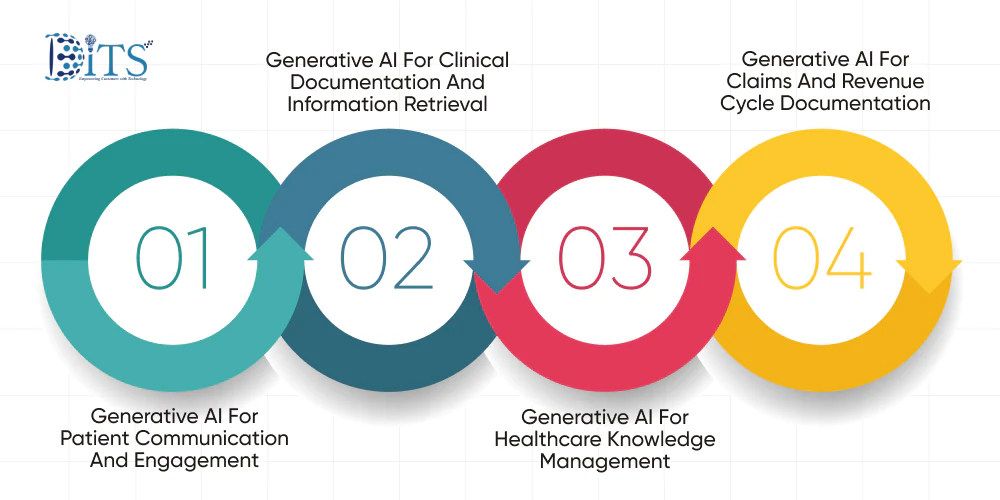
1. Generative AI for Patient Communication and Engagement
Delayed responses and repetitive inquiries increase administrative workloads and affect patient experience. Generative AI in healthcare supports personalized communication, multilingual patient education, and routine inquiries while escalating complex concerns to care teams. This can improve response times, reduce staff workload, and strengthen patient engagement. Healthcare organizations must evaluate response accuracy, privacy safeguards, and escalation effectiveness before investing.
2. Generative AI for Clinical Documentation and Information Retrieval
Fragmented patient records and repetitive documentation can reduce clinicians' time for patient-facing activities. Among the practical Generative AI use cases in healthcare, automated note drafting, medical record summarization, and contextual information retrieval can improve access to clinical information. However, successful adoption depends on reliable data, clinician oversight, and integration with existing behavioral health EHR platforms.
3. Generative AI for Healthcare Knowledge Management
Time spent reviewing scattered clinical guidelines, policies, and operational documents can delay decisions and increase administrative costs. Gen AI use cases in healthcare summarizes complex information, extract relevant details, and organize knowledge into accessible formats. This helps healthcare teams reduce manual review, improve information consistency, and make faster operational decisions while maintaining accuracy, data security, and human oversight.
4. Generative AI for Claims and Revenue Cycle Documentation
Manual review of claim denials, insurance correspondence, and supporting documents increases administrative costs and delays revenue cycle workflows. Generative AI in healthcare summarizes denial reasons, organizes claim information, and draft appeals for human review. This can reduce documentation effort, accelerate processing, and improve billing efficiency, provided accuracy, validation controls, and existing RCM integration are maintained.
Identify the Right AI Opportunities
Discover where AI can improve healthcare workflows, reduce operational costs, and deliver measurable business value.
What Could Prevent Healthcare AI Investments from Delivering Expected Value?
The success of AI in healthcare depends on more than model accuracy or automation capabilities. An application might process claims faster or identify patient risks effectively yet still fail to deliver expected returns if it requires excessive manual review, costly integrations, or changes that disrupt existing operations.
Understanding where healthcare AI investments lose value helps healthcare leaders address underlying limitations before committing resources.
Key Challenges
Impact on Healthcare Operations
What Organizations Should Prioritize
Fragmented Healthcare Data
Inconsistent patient information can lead to unreliable AI outputs, repeated verification, and delayed decisions.
Improve data quality, standardization, and accessibility across systems before implementation.
Legacy System Integration
Poor connectivity with EHRs, billing platforms, and other systems increases integration costs and creates additional manual work.
Assess integration gaps and evaluate whether healthcare interoperability solutions or system modernization can improve data exchange and support AI readiness.
Data Privacy and Security
Inadequate protection of patient information can result in compliance exposure, financial losses, and reduced patient trust.
Establish appropriate security controls, access permissions, and governance requirements.
Clinical Accuracy and Safety
Incorrect recommendations or excessive false alerts can increase clinician workload and introduce patient safety risks.
Validate AI outputs, monitor performance, and retain human oversight for critical decisions.
Poor Workflow Alignment
AI tools that introduce duplicate tasks or additional review steps can reduce productivity rather than improve it.
Evaluate existing workflows and redesign processes where necessary before adding AI.
Unclear ROI
Implementation, licensing, validation, and maintenance expenses can outweigh anticipated efficiency gains.
Define measurable KPIs, estimate total ownership costs, and validate results through controlled pilots.
How Should Healthcare Organizations Prioritize AI Use Cases Before Investing?
Investing in AI without understanding the underlying operational problem can lead to unnecessary costs, integration challenges, and limited returns. Healthcare leaders need to evaluate where the use of AI in healthcare create measurable improvements and whether their existing technology environment can support it.
Five questions can help determine which AI opportunities deserve investment.
1. Is There a Business Problem Worth Solving?
Start with workflows that create recurring delays, high processing costs, or excessive administrative work. For instance, claims processing delays or manual patient follow-ups may present opportunities for AI. Prioritize applications where reduced processing time, improved staff capacity, or lower operational costs can be measured.
2. Can Existing Systems and Data Support AI?
Even a promising AI application can struggle with fragmented records and disconnected systems. Assess data quality, EHR interoperability, and integration requirements before investing. Addressing these limitations early can prevent expensive modifications, deployment delays, and operational disruption.
3. Does the Problem Actually Require AI?
Not every workflow needs an advanced AI solution. Predictable, rules-based processes may be addressed more reliably through conventional automation, while complex document interpretation or predictive analysis may justify AI. Choosing the appropriate approach helps avoid unnecessary spending and maintenance costs.
4. What Could Affect Implementation Success?
Clinical accuracy, data security, regulatory requirements, and staff readiness directly influence implementation feasibility. Evaluate the level of human oversight, system changes, and ongoing monitoring required. Identifying these dependencies early can reduce compliance exposure, prevent costly rework, and protect operational continuity. As per a recent BVP report, surveyed healthcare executives stated an average realized ROI of 3.5 times their AI investment, with revenue cycle management delivering particularly strong returns of 4 times the investment.
5. Will the Expected Value Justify the Investment?
Compare projected efficiency gains and operational savings against development, integration, and maintenance costs. Prioritize use cases with measurable outcomes, manageable risks, and clear pilot success criteria. Validate performance on a limited scale before committing resources to broader deployment.
Make Smarter Healthcare Technology Investments
Evaluate your systems, workflows, and data readiness to prioritize AI investments that deliver meaningful outcomes.
How DITS Helps Healthcare Organizations Make Better AI Investment Decisions
DITS helps healthcare organizations identify high-value AI opportunities by assessing operational challenges, data readiness, integration requirements, and expected ROI. Our consulting-led approach helps determine whether to build, automate, integrate, or modernize existing systems.
Through our healthcare solutions, we support AI implementation, legacy application modernization, and system interoperability while minimizing operational disruption. From initial assessment to performance validation, DITS helps organizations prioritize investments, manage implementation risks, and scale AI capabilities that deliver measurable efficiency gains and long-term business value.
Frequently asked questions
AI applications in claims processing, clinical documentation, patient monitoring, and care coordination offer opportunities to reduce administrative costs and improve productivity. The greatest value comes from addressing high-cost workflows with measurable outcomes.
Nidhi Thakur
With more than 20 years of experience - I represent a team of professionals that specializes in the healthcare and business and workflow automation domains. The team consists of experienced full-stack developers supported by senior system analysts who have developed multiple bespoke applications for Healthcare, Business Automation, Retail, IOT, Ed-tech domains for startups and Enterprise Level clients