With more than 20 years of experience - I represent a team of professionals that specializes in the healthcare and business and workflow automation domains. The team consists of experienced full-stack developers supported by senior system analysts who have developed multiple bespoke applications for Healthcare, Business Automation, Retail, IOT, Ed-tech domains for startups and Enterprise Level clients
Quick Overview
Hospitals have no shortage of communication tools. EHR messaging, secure chat, phone calls, and clinical alerts are embedded across daily workflows. The challenge is getting the right information to the right clinician or provider. It needs to arrive with the right context too, when it's required.
That makes clinical communication and collaboration (CC&C) a broader operational priority. Modern clinical communication solutions connect people, context, alerts, and hospital systems. This helps move information from a clinical event to the right care team more efficiently.
In this blog, we explore clinical communication and collaboration. We also cover seven signs of growing communication gaps and the key elements healthcare organizations should prepare before integrating a more connected platform.
What Is a Clinical Communication and Collaboration Platform?
A clinical communication and collaboration platform brings communication, patient information, alerts, schedules, and workflows into a more connected environment.
Unlike basic messaging tools, it supports the wider communication process. This includes what happens before a message is sent and what follows afterward.
It can identify the appropriate clinician based on role, location, care-team assignment, or on-call schedule. Moreover, it can attach relevant patient context, track acknowledgement, and escalate messages when a response is delayed.
Across areas such as chronic care, maternal health, mental health, and more, clinical communication and collaboration platforms are being used to support more connected care delivery and better communication across the patient journey.
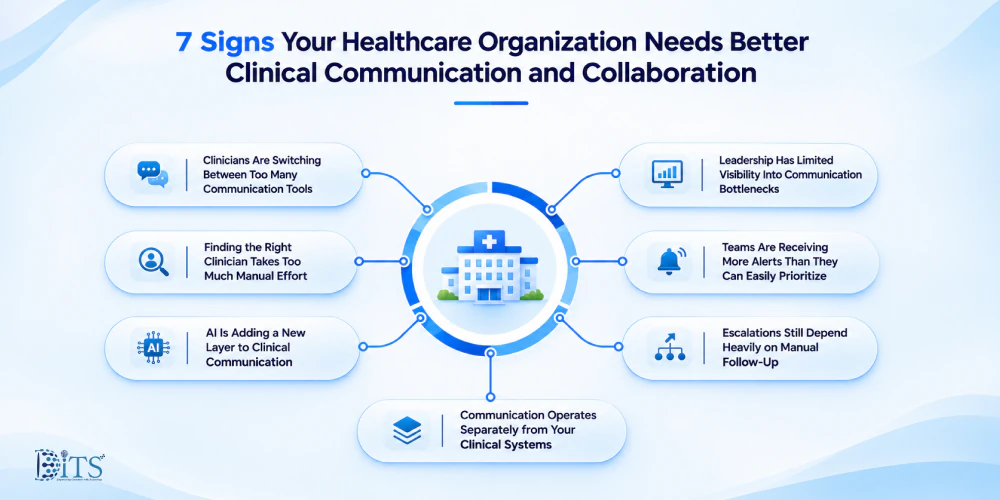
7 Signs Your Healthcare Organization Needs Better Clinical Communication and Collaboration
Most healthcare organizations already have communication tools in place. Problems arise when those tools do not connect well with people, context, and workflows. The following signs can help reveal where clinical communication and collaboration needs improvement.
1. Clinicians Are Switching Between Too Many Communication Tools
When clinicians have to check several channels to understand what is happening, communication becomes fragmented. A nurse may receive an alert in one system, contact a physician through another, and open the EHR separately to retrieve the patient context needed for the conversation.
This constant switching can make it harder to maintain a clear view of communication around a patient or clinical event. It can also create uncertainty about which channel should be used for a particular situation.
2. Finding the Right Clinician Takes Too Much Manual Effort
In a hospital, responsibility can change frequently based on shifts, patient assignments, specialties, location, or on-call schedules. When communication systems do not reflect these changes, staff may need to search directories, check schedules, call another department, or contact several people before finding the appropriate clinician.
This challenge can be particularly noticeable in care settings where responsibility changes often or several disciplines are involved in the same patient journey.
1. Acute Care
In acute care, communication may need to move quickly between emergency teams, hospitalists, nurses, specialists, diagnostic teams, and other departments. Effective clinical communication in acute care should help identify the clinician currently responsible for the patient and support faster routing and escalation as care teams or patient locations change.
2. Rehabilitation
Rehabilitation often involves physicians, nurses, therapists, care coordinators, and other specialists working together over a longer period. Strong clinical communication in rehabilitation can help teams maintain clear ownership, reach the appropriate professional, and coordinate follow-up as responsibilities shift across different stages of recovery.
3. AI Is Adding a New Layer to Clinical Communication
The growing use of AI in healthcare is creating new types of information that clinicians need to review and act on. AI-enabled systems may support areas such as documentation, monitoring, risk identification, clinical decision support, and workflow automation.
The challenge is making sure these outputs do not become another disconnected source of alerts or recommendations. AI-generated information still needs to reach the right clinician with the right patient context, priority, and next step.
4. Leadership Has Limited Visibility Into Communication Bottlenecks
Without appropriate workflow data and auditability, healthcare leaders may struggle to identify recurring communication gaps across teams, departments, and facilities. Better visibility can support workflow assessment, governance, and continuous improvement.
Taken together, these signs point to a broader issue than messaging alone. Effective clinical communication and collaboration requires communication channels, clinical context, routing, escalation, systems, and care-team responsibilities to work as part of a connected workflow.
5. Teams Are Receiving More Alerts Than They Can Easily Prioritize
Clinical teams may receive information from monitoring systems, EHRs, nurse call systems, laboratories, departmental applications, and other sources. When those notifications arrive through separate channels or without clear prioritization, clinicians must determine urgency themselves.
Undoubtedly, technology alone cannot eliminate alert fatigue. Alert rules, escalation policies, workflow design, and clinical governance also need to be reviewed so that communication supports decision-making instead of simply increasing notification volume.
6. Escalations Still Depend Heavily on Manual Follow-Up
In many healthcare environments, escalation still depends on the questions that have gone unanswered.
This creates extra coordination work and can make response times inconsistent. Especially during heavily occupied shifts or urgent situations. A stronger clinical communication and collaboration in the workflow can automate parts of this process. Based on factors such as urgency, clinician role, availability, acknowledgement status, or predefined response times, the system can route the message to the next appropriate person or team.
7. Communication Operates Separately from Your Clinical Systems
A hospital may already have several systems. For instance, EHR, patient monitoring platforms, ADT systems, scheduling tools, on-call directories, and nurse call systems. The problem arises when these systems cannot exchange the information needed to trigger and route communication effectively.
This is where clinical communication integrations become critical. Integrations using APIs, HL7, FHIR, ADT feeds, or other supported interfaces can allow clinical events and system data to initiate the appropriate communication workflow.
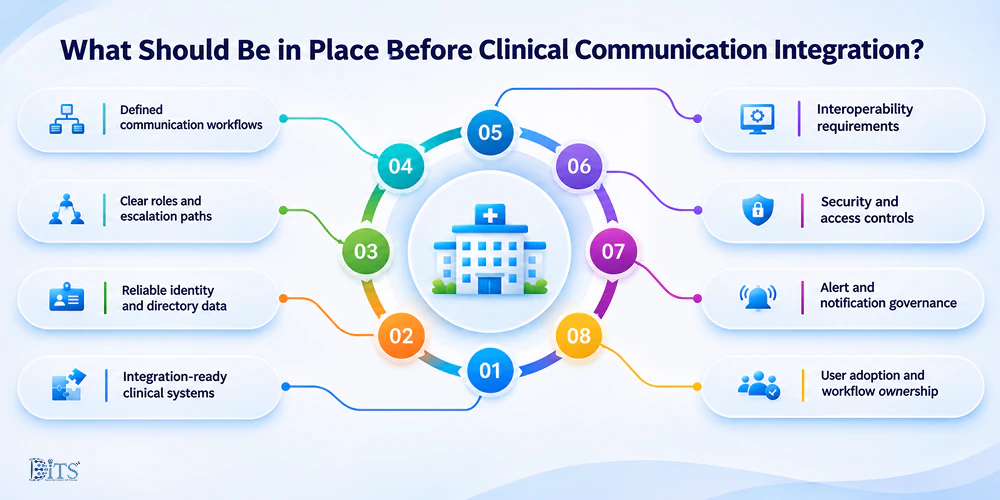
What Should Be in Place Before Clinical Communication Integration?
When clinical communication breaks down, the impact can reach far beyond. A review of Joint Commission reports by the Agency for Healthcare Research and Quality (AHRQ) found that communication failures were implicated at the root of more than 70% of sentinel events. This is the major reason why integrating a clinical communication and collaboration platform should begin with a clear understanding of the current movement of communication across the organization.
Defined communication workflows - Map how alerts, messages, consultations, handoffs, and escalations currently move between teams.
Clear roles and escalation paths - Identify who is responsible for different events, including primary contacts, on-call clinicians, backup roles, and escalation rules.
Reliable identity and directory data - Clinician roles, departments, schedules, locations, and contact information should be accurate enough to support role-based routing.
Integration-ready clinical systems - Review which EHRs, ADT feeds, monitoring systems, scheduling tools, nurse call platforms, and departmental applications need to exchange information.
Interoperability requirements - Determine where APIs, HL7, FHIR, or other interfaces will be required to support clinical communication integrations.
Security and access controls - Define authentication, authorization, auditability, data access, and device-management requirements before sensitive clinical information begins moving between systems.
Alert and notification governance - Review which alerts should trigger communication, how urgency is classified, when escalation should occur, and which notifications may be unnecessary.
User adoption and workflow ownership - Clinical, operational, and IT teams should agree on how the new communication workflow will be used, governed, and improved after deployment.
Assess Your Clinical Integration Readiness
Review your EHR, on-call schedules, monitoring systems, and escalation rules to see what needs to be in place before integration begins.
Building a Better Clinical Communication and Collaboration Environment
Improving clinical communication and collaboration often requires more than introducing a new communication tool. Healthcare organizations may need to modernize existing systems, redesign communication workflows, improve integrations, and create clearer rules for how information moves between teams. Governance is equally important.
At Ditstek Innovations, we help healthcare organizations strengthen clinical communication and collaboration by looking at how clinicians, workflows, and systems connect.
Our experience includes building healthcare platforms that integrate EHRs, monitoring systems, scheduling tools, and communication workflows. We also design routing and escalation capabilities that help information reach the appropriate care team more efficiently. The focus is on creating connected environments where people, clinical events, and technology can work together with less communication friction.
If you are exploring to create a clinical communication platform, connect with our team to discuss the right approach.
Plan Your Clinical Communication and Collaboration Platform
Talk with Ditstek Innovations about connecting your existing systems, routing alerts to the right clinician, and defining how unanswered messages escalate.
Clinical communication in clinical research may involve investigators, study coordinators, clinical teams, laboratories, participants, and other stakeholders. Communication workflows can support participant coordination, study activities, documentation, controlled information access, and collaboration between research and clinical teams.
Nidhi Thakur
With more than 20 years of experience - I represent a team of professionals that specializes in the healthcare and business and workflow automation domains. The team consists of experienced full-stack developers supported by senior system analysts who have developed multiple bespoke applications for Healthcare, Business Automation, Retail, IOT, Ed-tech domains for startups and Enterprise Level clients