How to Build AI-Integrated Insurance Claims Management Software
Table Of Content
Published Date :
05 Jun 2026
Key Takeaways
- AI technology decreases both time and costs required for claim processing.
- The process of handling health insurance claims through manual methods creates problems which result in business losses
- AI-powered systems enable organizations to identify fraudulent activities before they occur.
- AI systems improve both customer satisfaction and operational visibility through their advanced technologies.
- Early adoption enables healthcare businesses to establish a significant advantage over their competitors.
The healthcare insurance claims process has gained a negative reputation because of its operational delays which occur due to excessive documentation. Insurance claim process requires workers to input data manually and multiple rounds of verification. The healthcare insurance industry currently experiences fast transformations in its operations. AI technology helps the insurance industry to manage the documentation process with ease at high speed and accuracy.
Healthcare insurers need to develop new strategies for evolving insurance claims management software systems. Manual verification process and slow software systems are one of the major challenges behind claim delays and user trust.
Artificial intelligence can helps insurance companies solve these challenges. According to a report by Data Intelo health insurance companies using artificial intelligence and intelligent automation has managed to reduce the claim processing time from and industry standard of 14 days to 24 hours.
This blog shares, how to build an AI-powered claims system that aligns with business goals and improves control in healthcare insurance operations.
What Is AI-Integrated Insurance Claim Management Software
AI-integrated claims platforms function as automated systems that use intelligent decision-making capabilities to handle claims processing. The system performs active data analysis which enables it to verify incoming patient data and help expedite claim approvals through automated processing.
The software used in traditional insurance claims processing requires manual verification because it operates on separate database systems and uses predefined rules which cannot handle exceptional cases. AI systems use historical data to develop new capabilities which they use to identify patterns and improve their performance over time. The difference presents itself as a transformation which leads to major operational changes.
Key Components That Define Modern Systems
- Intelligent claim intake that captures structured and unstructured data
- Document processing using OCR and natural language understanding
- Automated validation engines for eligibility and coverage checks
- Fraud detection models trained on historical claim anomalies
- Predictive analytics for faster decision-making
- Real-time dashboards for operational visibility
When a hospital submits a claim with multiple attachments, handwritten notes, and missing fields, the conventional system reaches a standstill. The AI-enabled platform completes document extraction and validation processes while detecting inconsistencies within a few seconds. The system operates without requiring email communication. The system operates without creating any delays in work processes.
Traditional Vs AI-Driven Claims Systems
| Aspect | Traditional Systems | AI-Integrated Systems |
| Data Processing | Manual or rule-based | Automated with learning capability |
| Claim Validation | Time-consuming | Real-time validation |
| Fraud Detection | Reactive | Predictive and proactive |
| Scalability | Limited | Highly scalable |
| Customer Experience | Delayed responses | Instant updates and transparency |
Here’s the real takeaway. AI doesn’t just speed things up. It changes how decisions are made, reducing dependency on manual oversight while improving consistency.
And that’s exactly why more insurers are moving toward advanced insurance claims processing software that can handle both complexity and scale without breaking under pressure.
Why Insurance Businesses Need AI In Claims Management
Most insurers don’t realize where they are losing money until they look closely at their claims process. It is rarely one big issue. Instead, it is a mix of small inefficiencies that quietly pile up over time. Manual reviews, duplicate data entry, delayed approvals. It all adds up.
Now consider this. A mid-sized insurer processing 10,000 claims a month may lose 8 to 12% of operational efficiency due to avoidable delays and errors. That is not just a process gap but a revenue leak.
Key Challenges in Traditional Claim Handling
- High dependency on manual verification and documentation
- Delays due to incomplete or incorrect claim submissions
- Limited visibility across claim lifecycle
- Difficulty in identifying fraudulent patterns early
- Rising operational costs with growing claim volumes
But there’s a catch. Throwing more people at the problem does not solve it. It only increases cost without improving speed or accuracy.
This is exactly where businesses begin to recognize the need of healthcare claim management software, especially when handling high volumes of medical claims that demand accuracy, compliance, and faster turnaround times.
How AI Changes the Equation
AI introduces a different way of handling claims. It does not just automate tasks. It improves decision quality while reducing effort.
- Faster claim validation through intelligent data extraction
- Automated workflows that reduce processing cycles from days to hours
- Early fraud detection using pattern recognition
- Improved accuracy with reduced human intervention
- Enhanced customer experience with real-time updates
Here’s a practical scenario. An insurer dealing with motor claims integrates AI into its workflow. Within three months, claim turnaround time drops by 40%, and customer complaints related to delays reduce sharply. And guess what? Operational teams finally get time to focus on high-value cases instead of routine checks.
On top of that, businesses investing in AI in healthcare ecosystems are seeing stronger alignment between claims, clinical data, and policy validation, especially in medical insurance use cases.
Business Impact That Actually Matters
- Reduced claim processing cost per case
- Improved fraud detection rates
- Faster settlement cycles leading to higher customer retention
- Better scalability without proportional increase in workforce
Key Features of AI-Powered Insurance Claims Management Software
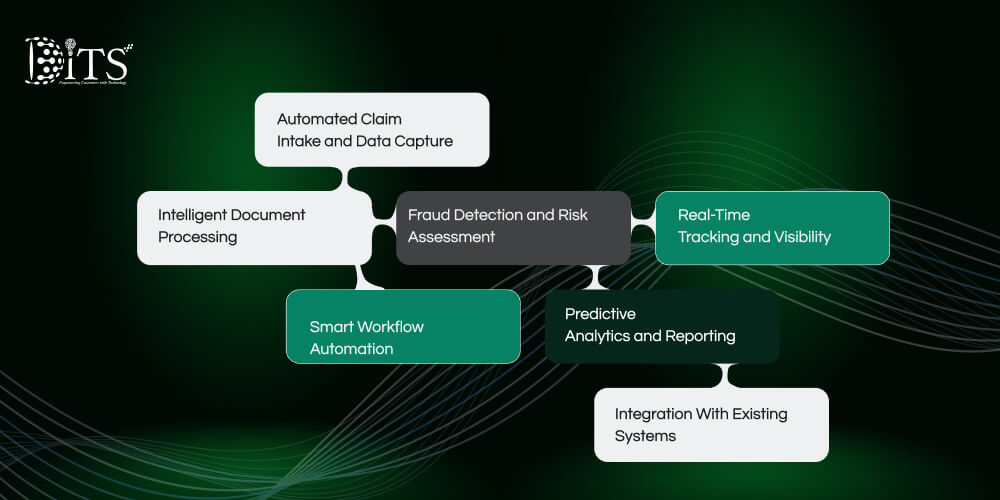
Building a strong system requires developers to select essential features which drive better performance and precise results and improved client experiences. The difference between two options emerges through their actual results instead of their listed characteristics.
Automated Claim Intake and Data Capture
The current system provides an easier method for claims to begin processing within the system. AI systems enable organizations to
- Capture data through automated channels which include web forms, emails and mobile applications.
- The system automatically standardizes all incoming data even when different formatting styles are used by users.
- The system decreases entry errors which create bottlenecks throughout the complete process of case examination.
Intelligent Document Processing
Claims rarely come with clean, structured data. AI-driven document handling capabilities become essential at this point.
- Extracts essential data elements from PDF documents and scanned materials and handwritten notes.
- The system uses natural language understanding to determine the document's meaning.
- Flags missing or inconsistent data instantly
The system provides vital capabilities to health insurance processing software because it enables users to handle diverse document formats which include discharge summaries and prescriptions and other types of documents with various degrees of readability.
Fraud Detection and Risk Assessment
Fraud is not always obvious. In fact, the most costly cases are often the ones that look normal on the surface.
AI models analyze historical data and identify patterns that indicate risk.
- Detect unusual claim frequency or billing patterns
- Compare claims against known fraud indicators
- Assign risk scores for faster decision-making
Here’s the kicker. Instead of reacting after losses occur, insurers can prevent them before payouts happen.
Smart Workflow Automation
A strong workflow engine ensures that every claim moves forward without unnecessary delays.
- Automatically assigns claims based on complexity or priority
- Triggers alerts and approvals without manual intervention
- Reduces dependency on email chains and manual follow-ups
And when workflows are optimized, teams spend less time coordinating and more time resolving.
Real-Time Tracking and Visibility
Executives and operations teams need clarity, not guesswork.
- Live dashboards showing claim status, bottlenecks, and turnaround times
- Alerts for pending approvals or delays
- Centralized view across all claim types
This helps leaders make quick decisions and maintain operational control.
Predictive Analytics and Reporting
Data becomes valuable only when it drives action. AI-powered systems go beyond basic reporting.
- Forecast claim volumes and resource requirements
- Identify trends in claim rejections or delays
- Support strategic planning with data-backed insights
Organizations investing in AI software development are increasingly focusing on these predictive capabilities to stay ahead of operational challenges.
Integration With Existing Systems
No insurer operates in isolation. Systems must connect seamlessly.
- Integration with policy management and billing systems
- APIs for third-party services such as hospitals or verification agencies
- Smooth data flow across platforms without duplication
When implemented correctly, this is exactly where insurance claims management software evolves from a support system into a strategic business asset.
Step-By-Step Process to Build AI-Integrated Claim Management Software
The development of this system requires more than technical skills to build it. The creation of this system will impact three areas: operational efficiency, customer service quality, and future business growth. The process needs clear directions and organized frameworks together with essential tasks which should be established from the beginning.
Define Business Requirements
The team needs to establish complete understanding before they start coding work. The main reason for project failure occurs when project teams fail to establish clear project requirements.
Start by identifying:
- The system needs to work for two user groups: insurers and TPAs and hospitals and agents.
- The system needs to handle three types of claims: health claims and motor claims and property claims.
- The system needs to measure three aspects through key performance indicators: turnaround time and approval rates and cost per claim.
A medical claims company needs to establish connections with hospital systems, while a motor insurer requires the ability to assess damage through image analysis. The new direction brings complete transformation.
Choose Right Technology Stack
Technology decisions should align with long-term scalability, not just immediate convenience.
- Backend frameworks that support high-volume transactions
- Frontend interfaces designed for usability across devices
- Cloud infrastructure for flexibility and performance
- AI and machine learning frameworks for model development
Companies investing in health insurance software development often prioritize secure and compliant environments due to sensitive patient data. That choice impacts architecture significantly.
Design Scalable System Architecture
A well-designed architecture prevents future bottlenecks.
- Modular design to allow feature expansion without disruption
- API-driven approach for seamless integrations
- Dedicated data pipelines to support AI models
Here’s where many systems struggle. They are built for current needs but fail under scale. A forward-looking design avoids that trap.
Develop Core Functional Modules
Once the foundation is set, focus shifts to building essential components:
- Claim submission and intake module
- Document management system
- Workflow and approval engine
- Notification and communication system
Each module should operate independently yet remain tightly connected. That balance ensures flexibility without fragmentation.
Integrate AI Capabilities
This is where the system truly evolves. AI should not be treated as an add-on. It must be embedded into the core workflow.
- Machine learning models for claim validation and prioritization
- Natural language processing for document understanding
- Computer vision for image-based claims
- Fraud detection algorithms based on historical data
At DITS, we take this a step further. We use AI not only in application features but also in development processes, quality assurance, maintaining code quality, and enabling deep customization. Every solution is built with intelligence at its core, not layered on later.
Ensure Compliance and Data Security
The sensitive nature of insurance data requires full compliance with all applicable regulations.
- The organization must comply with HIPAA and GDPR regulations which apply to its operations.
- All data needs encryption for both storage and transmission security.
- The system lets internal users access specific resources according to their designated roles.
Testing and Quality Assurance
A system that looks good on paper must perform reliably under pressure.
- Functional testing across all modules
- Performance testing under high claim volumes
- Validation of AI model accuracy and consistency
- User acceptance testing with real scenarios
And here’s the reality. Even a small flaw in claims processing can create a ripple effect across operations. Thorough testing is not optional.
Deployment and Ongoing Maintenance
The system requires more than just its initial launch.
- The system needs cloud-based deployment to achieve its scalability requirements.
- The organization needs to perform continuous monitoring activities for both system performance and user activity.
- The system requires both regular updates and AI model retraining activities to maintain its functionality.
Businesses that treat deployment as the finish line often struggle later. The actual value of the system achieves its maximum potential through ongoing development work.
Closing Insight on Development Process
The process of developing AI-powered insurance claims processing software requires more than speed. The process requires decision-making at each phase to guarantee system performance and capacity for future development.
The correct execution of the process produces more than software. It develops into a sustainable competitive advantage which grows stronger with each passing day.
Searching For Reliable Insurance Software Development Partner Today?
Work with experienced insurance technology experts to build secure, scalable, and compliant AI-powered claims management platforms efficiently.
Challenges In Building AI-Based Claim Management Systems
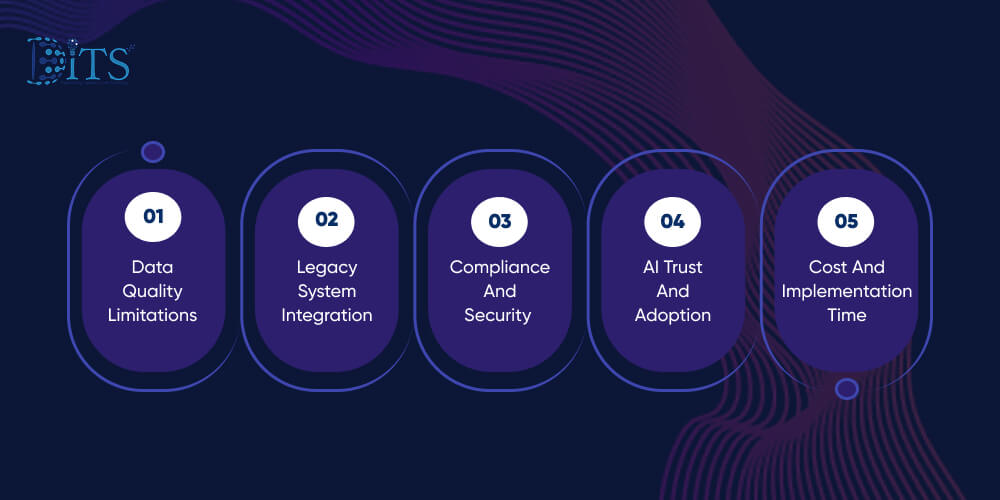
Building an AI-driven claims platform comes with its own set of practical hurdles. Most of them are not technical alone, they are operational and strategic.
Data Quality Limitations
AI depends heavily on clean and structured data, but insurance data is often inconsistent.
- Missing or incomplete claim records
- Multiple document formats across providers
- Duplicate or unstructured data
If not addressed early, this directly impacts model accuracy and delays implementation.
Legacy System Integration
Existing systems rarely align with modern architecture.
- Limited API support in older platforms
- Complex data mapping across systems
- Delays in real-time data synchronization
Without proper integration planning, even advanced insurance claims software can struggle to deliver results.
Compliance and Security
Handling sensitive data requires strict controls.
- Regulatory compliance requirements
- Data encryption and secure access
- Audit trails and monitoring
A single gap here can create significant legal and reputational risks.
AI Trust and Adoption
AI outputs must be understandable and reliable.
- Lack of explainability reduces trust
- False positives can slow operations
- Continuous model updates are required
Teams need confidence in the system before they fully rely on it.
Cost And Implementation Time
AI systems require upfront investment and structured rollout.
- Data preparation and model training take time
- Change management across teams is essential
- ROI depends on proper adoption
Final Insight
The challenge is not just building the platform. It is ensuring it works smoothly within real business environments, integrates well, and gains trust across teams.
Cost to Develop AI-Integrated Insurance Claims Management Software
Cost is often the first question leadership teams ask, and rightly so. But the answer is not a fixed number. It depends on how complex, scalable, and intelligent you want the system to be.
A basic solution may solve immediate needs, but a well-built platform delivers long-term operational savings and competitive advantage.
Estimated Cost Breakdown
| Component | Estimated Cost Range |
| Basic platform development | $25,000 – $50,000 |
| AI feature integration | $30,000 – $80,000 |
| Third-party integrations | $10,000 – $30,000 |
| Testing and compliance | $10,000 – $25,000 |
| Maintenance (annual) | 15% – 25% of total cost |
Ways To Optimize Development Cost
- Start with a minimum viable product and scale gradually
- Focus on high-impact features first, such as automation and validation
- Use cloud infrastructure to reduce upfront investment
- Reuse existing data and systems wherever possible
Here’s something many businesses overlook. Cutting cost at the development stage often leads to higher operational expenses later.
Future Trends In AI For Insurance Claims
The claims landscape is evolving faster than most organizations expect. What worked even two years ago is already starting to feel outdated. AI is no longer just improving processes, it is reshaping how claims are handled from start to finish.
Hyper-Automation Across Claim Lifecycle
Automation is moving beyond basic workflows. Systems are now capable of handling end-to-end processes with minimal human input.
- Automatic claim registration, validation, and approval
- Smart routing based on claim complexity
- Reduced manual touchpoints across the lifecycle
This shift is helping insurers process higher volumes without expanding teams. Efficiency scales without increasing overhead.
AI-Driven Self-Service Platforms
Customers no longer want to wait for updates. They expect instant visibility and control.
- Self-service portals for claim submission and tracking
- AI chat interfaces for real-time support
- Faster resolution without dependency on support teams
And here’s the reality. Businesses that fail to offer this level of convenience often lose customers to competitors who do.
Advanced Fraud Detection Models
Fraud detection is becoming more proactive and precise.
- Real-time anomaly detection during claim submission
- Continuous learning from new fraud patterns
- Reduced false positives with improved model accuracy
This not only protects revenue but also speeds up approvals for genuine claims.
Predictive and Prescriptive Analytics
AI is moving from reactive insights to forward-looking intelligence.
- Predict claim volumes based on historical trends
- Identify potential delays before they occur
- Recommend actions to optimize processing
Organizations using advanced insurance claims processing software are already leveraging these capabilities to improve planning and resource allocation.
The direction is clear. Claims systems are becoming faster, smarter, and more autonomous.
The real question for businesses is not whether to adopt these trends, but how quickly they can adapt before the gap becomes too wide to close.
Why Choose DITS For Building AI-Integrated Insurance Claims Management Software
The selection of an appropriate partner serves as the essential requirement for achieving successful claims transformation. DITS combines its industry knowledge with its technical abilities and its artificial intelligence approach which meets the requirements of contemporary insurance businesses.
The DITS team uses its extensive knowledge of insurance operations to develop systems which accurately depict actual business processes used in health and motor and property insurance claims handling. They create effective solutions through their expertise in managing both structured and unstructured data.
The development process uses artificial intelligence throughout its various stages which leads to improved product delivery speed and enhanced quality testing methods and ongoing system surveillance and customized user experiences. The system creates flexible solutions which change according to the business requirements.
The DITS team develops systems which maintain performance and scalability while their framework systems can process increasing claims volumes and connect with existing systems. The system achieves operational efficiency through its ability to process information in real time.
The organization protects sensitive information through encryption methods and role-based access control together with audit systems which create a secure and compliant environment.
The DITS team creates custom solutions which match business objectives while providing customers with the ability to adapt their systems through ongoing enhancements which produce operational systems that maintain efficiency and scalability for future functionality.
Need Smarter Insurance Claims Software For Business Growth?
Develop intelligent claims management solutions with automated workflows, fraud detection, and real-time decision-making capabilities for insurers effectively.
Conclusion
A complete process which includes handling claims and making decisions about claims can now be completed in a few hours because artificial intelligence enables more accurate results and better operational management.
The business leaders see a clear opportunity because they need to invest in the correct technology which will help them maintain their market position. Technology investment is essential for businesses because it enables them to maintain their market position.
The platform design enables operational efficiency improvements while it decreases risks and delivers better customer service throughout the entire claims process.
Early organizations that adopt new technologies experience measurable advantages. Organizations that wait to adopt new technologies will encounter operational difficulties because they use outdated systems.
The process to create future solutions needs three essential elements which include strategic planning and technological resources and operational implementations.
FAQs
What is AI in insurance claims management software?
AI in insurance claims management software is a tool that handle claims from beginning through processing to final resolution.
How long does it take to build insurance claims software?
The timeline typically ranges from 3 to 6 months depending on features, integrations, and AI complexity involved.
What are key benefits of DITS insurance claims management software development?
The DITS insurance claims management software development process offers organizations three main advantages that include better operational performance and improved customer experience throughout the entire claims process.
Is AI-based claims processing secure?
AI-based claims processing solutions protect data through multiple security measures which include encryption and access control together with compliance with established security protocols.
How does DITS insurance claims management software development help businesses scale?
DITS insurance claims software development enables automation which allows businesses to expand their operations through responsibilities which were handled by human workers.

Dinesh Thakur
21+ years of IT software development experience in different domains like Business Automation, Healthcare, Retail, Workflow automation, Transportation and logistics, Compliance, Risk Mitigation, POS, etc. Hands-on experience in dealing with overseas clients and providing them with an apt solution to their business needs.
Recent Posts
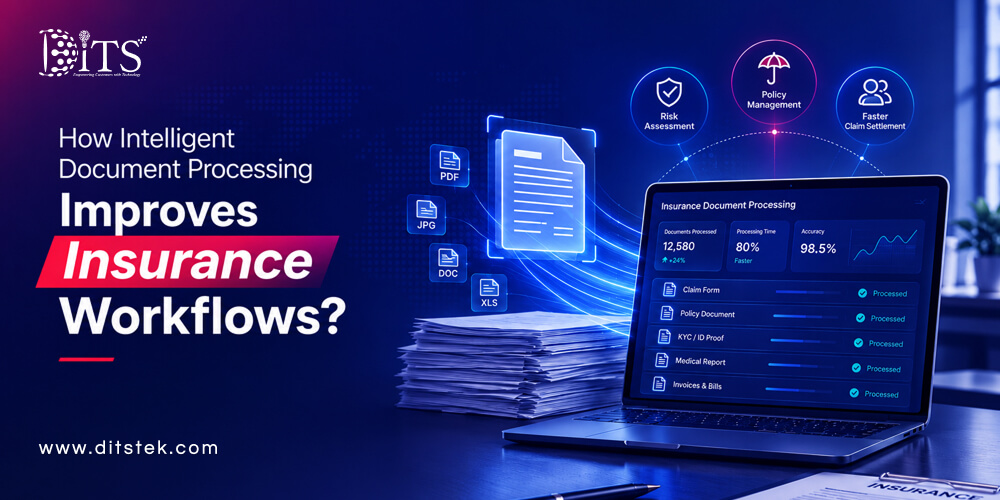
Explore how intelligent document processing for insurance helps businesses automate document workflows, reduce processing costs, improve accuracy, and strengthen operational efficiency across insurance functions.
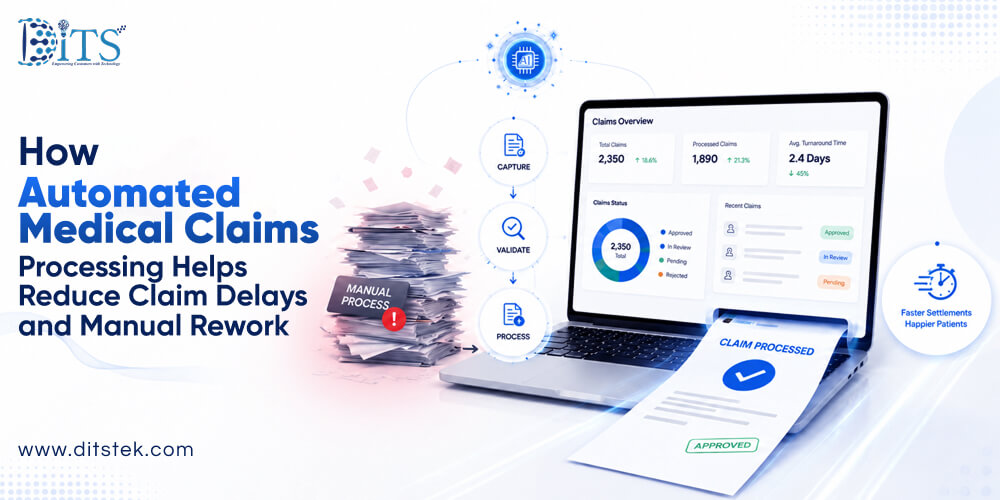
Discover how automated medical claims processing reduces delays, manual rework, claim denials, and administrative costs while improving reimbursement speed and operational efficiency.
Learn how to build medical billing software with essential features, integrations, security, and development costs.