Key Takeaways
Growing medical billing companies face issues while operating as their systems' workflows do not scale at the same speed as their client volume, claim volume, teams, or acquisitions.
The billing platform may still be useful, but many delays happen around the platform through spreadsheets, manual updates, payer portals, exports, and people-dependent processes.
Medical billing workflow modernization does not always mean replacing the existing system. It starts by fixing the biggest workflow gaps while daily operations continue.
Automation creates value when it reduces repetitive billing tasks such as claim status checks, denial follow-ups, reporting, alerts, and task updates.
AI should not be the first step in modernization. It works best when workflows are clear, data is reliable, and decision points are already understood.
DITS helps mid-market medical billing companies improve workflow visibility, reduce manual effort, modernize existing processes, and prepare operations for automation and AI.
Your medical billing company is growing, but the operation behind it is getting complex to control.
Adding new clients drives higher claim volume. Teams handle more payer rules, more follow-ups, more exceptions, and more reporting requests on a daily basis. But instead of productivity improving with growth, managers are spending more time chasing updates, checking spreadsheets, resolving bottlenecks, and depending on experienced staff to keep work moving.
The billing platform may still be useful, but the workflow around it has not scaled with the business.
DITS helps mid-market medical billing companies identify & resolve where the billing process slows down, how to reduce manual effort in billing process, & how to improve medical billing system connectivity, modernize legacy processes, and prepare operations for automation and AI without replacing everything at once.
Talk to a healthcare transformation expert!
What Starts Breaking as Billing Operations Grow
In a smaller billing business, the process works because people remember it. Someone knows which payer usually needs extra follow-up. Someone else knows where to find missing documentation. A senior team member knows which claims need attention before they become a bigger issue.
That worked for a while.
But once the company adds more clients, more teams, or another billing operation through acquisition, that informal way of working gets limited.
Leaders begin losing visibility into the daily workflow. They know the team is busy, but they cannot always see where work is stuck, which claims are waiting, or why certain tasks keep coming back.
Processes also become harder to control. One team may track denials in a spreadsheet. Another may use notes inside the billing platform. Someone else may rely on email follow-ups. The work gets done, but not always in a consistent or measurable way.
Over time, the business becomes too dependent on a few experienced people who “just know” how things work. That creates problems when the company needs to grow, train new people, bring clients onboard faster, or start using automation.
At this point, the issue is clear: the work is moving through too many manual steps, side tools, and people-dependent processes.
Where Medical Billing Workflows Usually Slow Down
When billing volume grows, delays usually do not come from one big problem. They come from small gaps across the workflow.
Eligibility checks take longer because teams have to move between payer portals. Claims get held back because documentation is missing or coding details need another review. Denials stay longer than they should because follow-ups are tracked manually or depend on one person remembering what needs to be done next.
Reporting also becomes tough. Leadership wants to know what is stuck, what is aging, where denials are increasing, and which clients need attention. Clients want clearer updates too. But when the data is spread across billing systems, spreadsheets, exports, and emails, teams spend too much time putting the picture together.
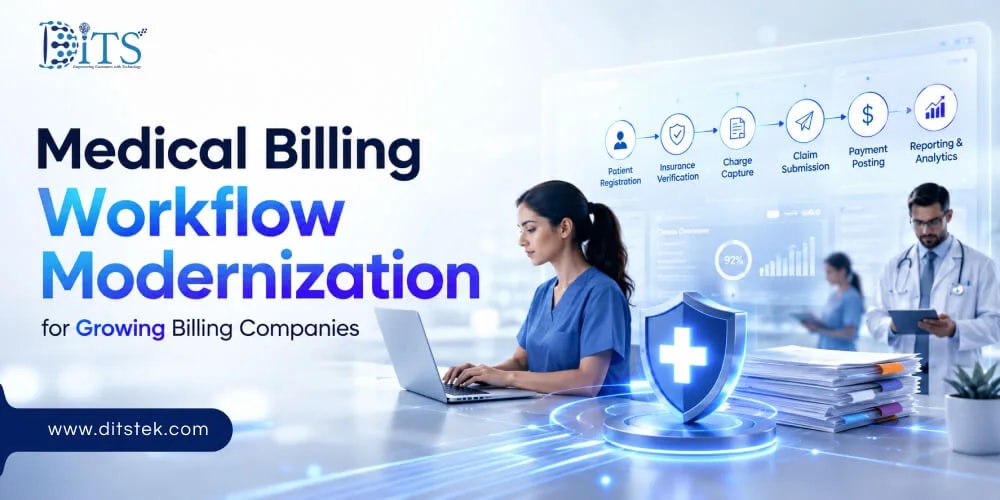
Most billing companies already have the main components of the medical billing workflow in place. The real slowdown often happens between those steps.
This is where things start slipping. Work moves between people, systems, trackers, and spreadsheets. The more the company grows, the harder it becomes to manage those handoffs manually.
Also Read: Key Medical Billing Software Requirements
Why Your Billing Platform Is Not Always the Problem
Most growing medical billing companies already have a billing platform in place. The platform may still be useful. It may handle claims, store patient and payer information, connect with clearinghouses, and support parts of the billing cycle.
But the work around the platform is often where the pressure builds.
What the platform may handle | What still happens outside the platform |
|---|
Claim creation and submission | Manual claim checks before submission |
Denial data | Spreadsheet-based denial tracking and follow-up |
Basic reporting | Custom reports built through exports and manual cleanup |
Patient or payer information | Repeated verification across portals and emails |
Task updates | Follow-ups managed through messages, calls, or individual reminders |
Standard workflows | Client-specific exceptions handled manually |
This is why replacing the platform is not always the right first move.
The better question is: where is the business depending on manual effort because the current workflow does not fully support how the company operates today?
For many mid-market billing companies, modernization starts by fixing the gaps around the system they already use. The goal is not to disrupt daily work. It is to make handoffs cleaner, reports easier to access, systems better connected, and repetitive tasks less dependent on manual effort.
What We Believe at DITS for Workflow Modernization
At DITS, we believe growing medical billing companies often do not need to replace their entire platform to improve operations. They first need a clear workflow architecture around the systems.
Automation should make the team’s daily work lighter. It should not take people away from billing decisions that need experience.
The execution of AI creates value only after workflows become more predictable, accurate & clean data, and decision points are clearly understood.
And we believe modernization should happen in stages, so billing companies can improve operations without putting active billing work, client relationships, or revenue processes at risk.
What Medical Billing Workflow Modernization Really Means
Modernization of medical billing workflow does not always mean replacing your billing platform or rebuilding everything from scratch.
For scaling medical billing companies, modernization usually starts with a more practical question:
Where is the business losing time, visibility, or control because the workflow has not kept up with growth?
Common assumption | What modernization actually means |
|---|
We need a new billing platform | First, identify what is broken around the current platform |
Automation means replacing people | Automation should reduce routine work not the teams. |
AI should be added everywhere | AI works best when workflows, data, and exceptions are understood first |
Modernization will disrupt operations | The right approach improves workflows in stages, without stopping daily billing work |
More hiring will solve the issue | Hiring helps when the system's workflow is clear, measurable, and scalable |
Modernization plan usually looks at below things:
People: Where teams are spending too much time on manual checks, repeated follow-ups, payer portal updates, corrections, or work that depends on a few experienced staff members.
Processes: Where teams, clients, or acquired operations handle the same task.
AI readiness: Where workflows, data, exceptions, and decision points need to be cleaned up before AI can support coding, denial analysis, reporting, prioritization, or operational insights.
Systems: Where billing platforms, clearinghouses, EHRs, payer portals, spreadsheets, and reporting tools do not work together smoothly thus forcing teams to move information manually.
Visibility: Where leaders cannot easily see what is delayed, where denials are increasing, which teams are overloaded, or which clients need attention.
Automation: Where repeated billing tasks can be reduced with automation, better connections, alerts, reports, or simple tools that fit the current workflow.
This is why modernization is different from software replacement.
The goal is not to change everything at once. It is to fix the biggest problems first while daily work continues.
The DITS Workflow Maturity Model
Not every medical billing company is at the same stage of modernization. Some are still managing work manually. Some have software in place but still depend on spreadsheets and workarounds. Others are ready to automate, but not yet ready for AI.
The DITS Workflow Maturity Model helps leadership teams understand where their billing operation stands today.
Level | Stage | What it looks like |
|---|
Level 1 | Manual | Work depends heavily on spreadsheets, email follow-ups, payer portals, and individual staff knowledge. |
Level 2 | Digitized | The billing software is there, but teams still use exports, trackers, and manual updates to get work done. |
Level 3 | Connected | Systems, teams, and reports are better aligned. Leaders have clearer visibility, but some handoffs still need improvement. |
Level 4 | Automated | Automates the repetitive tasks, alerts, queues, reporting workflows, and follow-ups. |
Level 5 | AI Ready | Workflows, data, rules, and decision points are clear enough for AI to support analysis, priorities, and useful insights. |
Most growing medical billing companies are not at Level 1. They already have systems. The real challenge is usually moving from Level 2 to Level 3, and then from Level 3 to Level 4 without affecting daily operations.
Also Read: Key Medical Billing Software Features to Improve Workflow
Where Medical Billing Automation Creates Value
Medical billing automation helps the team when they do the same tasks repeatedly.
For a growing billing company, the goal is not to replace the team or remove human review from important decisions. The goal is to reduce the repetitive work that slows people down every day.
That may include checking claim status, routing tasks, flagging missing information, updating work queues, sending reminders, preparing reports, or helping teams focus on claims that need attention first.
This is where medical billing workflow automation becomes useful. It gives the business a better way to manage repeatable steps without depending on manual tracking at every stage. Automation can create value in areas such as:
Eligibility and Verification Support
Teams often spend time checking payer portals, confirming coverage, and validating patient or insurance details. Automation can help reduce repeated checks and bring important verification data into the workflow faster.
Claims Preparation and Review
Before claims are submitted, teams may need to review documentation, coding details, missing fields, or payer-specific requirements. Automation can help flag incomplete information earlier so claims do not get delayed later.
Denial Tracking and Follow-up
Denials need quick attention. But in many billing teams, the follow-up process is still messy. Some updates are in spreadsheets. Some are in emails. Some are remembered by the person handling the account. Automation helps clean this up by keeping denial work in one place, creating follow-up tasks, and showing which denial issues are happening again and again.
Payment Posting and Reconciliation
Manual payment posting, adjustment checks, and reconciliation steps can take significant time as volume grows. Automation can support cleaner matching, exception handling, and faster review of items that need human attention.
Reporting and Operational Visibility
Leadership teams need to know what is aging, what is stuck, where denials are increasing, and which clients need attention. Automation can reduce manual report-building and help teams work from more reliable operational dashboards.
The real value of medical billing automation is not only speed. It is control.
When routine steps are automated and exceptions are easier to see, billing companies can manage higher volume without adding the same level of manual effort at every stage.
Where AI Fits in Medical Billing Workflows
AI should not be the first step in medical billing modernization.
For many billing companies, that may sound strange because everyone is talking about AI right now. Leaders are hearing about AI coding, AI claim review, AI denial prediction, and automated billing workflows. The interest is real, but the starting point matters.
If the workflow is messy, AI will only sit on top of that mess.
Before using AI in medical billing, companies need to understand how work moves today. Where does a claim slow down? Which denials repeat across clients or payers? What information is missing most often? Which tasks still depend on manual review? Where is data scattered across systems, spreadsheets, portals, and reports?
These questions matter because AI needs clean workflows, reliable data, and clear decision points to create value.
For a mid-market billing company, AI can support useful areas such as coding review, denial pattern analysis, claim prioritization, documentation checks, reporting insights, and exception handling. But it should be introduced carefully. Billing teams still need human review, compliance controls, data privacy, and confidence in how recommendations are made.
This is especially important for HIPAA compliant AI automation for medical billing. AI cannot be treated like a plug-in feature. It has to fit into the way the business handles patient information, payer data, user access, audit trails, and workflow approvals.
AI helps the team see problems earlier, reduce repetitive analysis, and focus attention where human judgment is actually needed.
Also Read: How to Develop Medical Billing Software for Small Business?
DITS Approach to Medical Billing Workflow Modernization
Once the major workflow issues are clear, the next step is to focus on gap.
DITS uses a staged modernization framework to help medical billing companies improve operations without creating unnecessary disruption.
Map the Real Workflow
We document how billing work moves across teams, systems, reports, payer tasks, client requirements, and manual follow-ups. This helps reveal the difference between the process leadership believes is happening and the process teams are managing every day.
Find the Highest-friction Points
We help identify the areas where work gets stuck, repeated, or tracked manually. These friction points may appear in claim preparation, denial follow-up, eligibility checks, documentation review, reporting, or system handoffs.
Prioritize What Should be Fixed First
Not every workflow issue needs the same level of investment. Some problems may need better reporting. Some may need integrations. Some may need automation. Some may need a custom workflow layer around the existing platform. The focus is on the areas creating the most operational pressure.
Improve Workflows Around Existing Systems
DITS helps modernize the workflows that sit around current billing platforms, clearinghouses, EHR connections, payer portals, spreadsheets, and internal tools. This allows billing companies to improve operations without starting with full system replacement.
Add Automation Where the Process is Ready
Automation is introduced only where the workflow is clear enough to support it. This may include task routing, alerts, claim status updates, denial queues, reporting workflows, exception tracking, or other repeatable billing tasks.
Prepare for AI Adoption
AI becomes more useful when workflows, data, rules, and decision points are already understood. DITS helps billing companies identify which areas are ready for AI, which need cleanup first, and how to introduce AI in a controlled and practical way.
This approach helps medical billing companies move forward without taking unnecessary risks. Instead of replacing everything at once, the business can modernize in the right order, with better control over cost, disruption, and long-term scalability.
Business Outcomes of Medical Billing Workflow Modernization
Medical billing workflow modernization should create visible operational improvement, not just add another tool to the stack.
For a growing billing company, the real value is in making the business easier to manage as volume increases. Leaders need fewer blind spots. Managers need cleaner workflows. Teams need less manual chasing. Technology leaders need systems that can support automation and AI without creating more complexity.
When modernization is done in the right order, billing companies can see outcomes such as:
Better operational visibility: Leaders can see where work is delayed, which clients need attention, where denial volume is increasing, and which parts of the workflow are creating pressure.
Less manual dependency: Teams spend less time on repeated checks, spreadsheet updates, status tracking, and follow-ups that can be handled through better workflows, integrations, or automation.
More consistent processes: Billing work becomes easier to standardize across teams, clients, locations, or acquired operations. This helps managers improve quality without depending only on individual experience.
Faster issue resolution: When exceptions, denials, missing documentation, or stalled claims are easier to identify, teams can act earlier instead of waiting for problems to pile up.
Better use of existing systems: Modernization helps companies get more value from the platforms they already use by improving the workflows, reporting, integrations, and automation around them.
Stronger readiness for AI: Clean workflows, better data flow, and clearer decision points make it easier to introduce AI into billing operations in a controlled and useful way.
The end goal is not only faster billing. It is a more scalable operating model where growth does not automatically create more manual effort, more confusion, or more pressure on the same experienced people.
Start With a Medical Billing Workflow Assessment
If your billing company is growing but operations are becoming harder to manage, the safest first step is not to replace everything.
It is to understand where the workflow is slowing down.
A medical billing workflow assessment helps identify the manual steps, system gaps, reporting issues, bottlenecks, and automation opportunities that are creating pressure across your operation.
From there, you can decide what should be improved first, what can be automated, where existing systems need better support, and how your company can prepare for AI in a practical way.
Talk to a Healthcare Transformation Expert