Build AI Chatbot for Healthcare That Delivers Real Business Value
Table Of Content
Published Date :
17 Jul 2026
Key Takeaways
- Answering the phone is the real problem. Most clinics lose bookings not because of bad service, but because the front desk can't answer every call and a missed call usually just becomes someone else's patient.
- Not every clinic/hospital needs the fancy version either. A basic rule-based bot that just routes "appointment" to scheduling and "billing" to payments does the job for plenty of practices.
- Integration makes or breaks adoption. A chatbot that can't talk to the EHR, or scheduling system turns into another app nobody opens the tech only works if it plugs into what's already there.
- Compliance isn't optional. HIPAA-grade data handling, audit trails, and a clean human handoff must be built in from day one, not patched in after something goes wrong.
- Generic templates don't survive contact with real clinics. A bot built for a dermatology office won't fit an urgent care centre the ones that stick around are built around how that specific practice runs.
Let's talk about something every clinic deals with but almost nobody budgets for properly: the phone. It rings all day, and every ring is either a booking, a billing question, or a patient who just needs five minutes of someone's attention. Most front desks can't keep up, and when they can't, patients don't wait around. A missed call is a booking gone to whichever practice picks up first.
This is the gap an AI chatbot for healthcare is built to close. Not as some futuristic add-on, but as a plain, practical fix for a problem every clinic already has.
Of course, the numbers back up. 78% of healthcare organizations are already using conversational AI, or have it planned for the next couple of years this isn't a niche experiment anymore. Money is following that trend too: the healthcare chatbot market is headed past $1.3 billion by 2032, growing more than 20% every year. Patients are on board too about six in ten would take an instant bot answer over sitting on hold for something routine, like checking insurance coverage or grabbing an open appointment slot.
What Is an AI Chatbot for Healthcare?
A patient types or says something, the chatbot figures out what they're asking for, and answers appointment slots, medication reminders, a billing status, basic triage questions. Nobody must be on the other end of a phone call for any of that.
Smaller practices lean on it a bit differently. A healthcare chatbot for clinics usually ends up handling whatever's eating the front desk's day: scheduling, rescheduling, insurance questions, refill requests. Not the most exciting work in the world, but it's what fills up a receptionist's hours, and pulling it off their plate means they can focus on the person standing in front of them.
The different types of healthcare chatbots, where they pay off, which features are worth caring about, and how DITS builds one that fits the clinic instead of forcing the clinic to fit some template.
Losing Patient Bookings Because Calls Go Unanswered?
Automate appointment scheduling, billing questions, and routine patient requests while reducing pressure on busy clinic front-desk teams every day.
Types of AI Chatbots Used in Healthcare
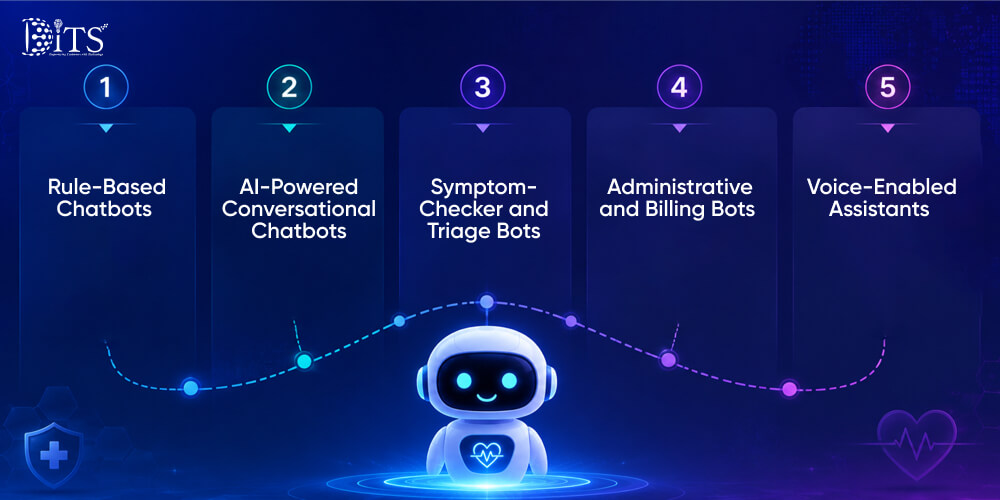
An AI Chatbot for Healthcare can be rule-based, conversational, triage-focused, administrative, or voice-enabled. Each type supports different needs, from FAQs and scheduling to symptom assessment, billing, and phone assistance. A healthcare chatbot for clinics improves patient access, reduces staff workload, and supports faster, more efficient service delivery across care settings.
Rule-Based Chatbots
It follows a fixed path type "appointment" and it drops you into scheduling, type "billing" and it routes you to payment questions. There's no real intelligence behind it, but that's sort of the appeal. It's cheap to build, predictable, and does the job fine for a clinic that mostly needs FAQs and scheduling handled.
AI-Powered Conversational Chatbots
A step above the rule-based version. These rely on natural language processing to figure out intent, not just keywords, so "I need to see someone soon" and "can I get an urgent appointment" get treated the same way even though nothing about the phrasing matches. This is where most modern AI chatbot for healthcare builds are headed these days, mainly because patients don't talk in neat, predictable phrases they never have.
Symptom-Checker and Triage Bots
A different category entirely. These run a patient through a set series of questions and steer them toward the right next step, whether that's self-care, booking a visit, or getting to an ER. Because the stakes are higher here, clinical protocols and medical review usually sit behind every version before it ever goes live.
Administrative and Billing Bots
These stay far away from anything clinical. Insurance checks, co-pay collection, claims status, appointment reminders that's the entire scope. A lot of clinics start their AI journey here, since the ROI is so easy to point to: fewer no-shows, faster payments, numbers that speak for themselves.
Voice-Enabled Assistants
These take the same underlying capability and put it on phone calls instead of a chat window. This ends up mattering a lot more than people assume, particularly for older patients or anyone calling in while driving.
In the real world, clinics rarely stick to just one type. Most end up combining two or three usually a conversational layer handling general questions, with rule-based logic underneath for the parts that need to stay strict and predictable, like anything touching medication.
Benefits of AI Chatbots for Healthcare Business
A healthcare chatbot for clinics reduces front-desk workload, lowers no-shows, improves patient access, speeds up visits, and helps patients receive timely guidance before and after care. AI Chatbot for Healthcare supports appointment scheduling, pre-visit intake, billing queries, medication reminders, follow-ups, symptom triage, and mental health check-ins.
Appointment Scheduling and Reminders
Patients book, reschedule, or cancel without needing to call in, and reminders alone tend to bring no-show rates down which is often the biggest, quietest revenue leak a clinic has and doesn't fully notice.
Pre-Visit Intake
Nobody enjoys filling out forms in a waiting room, and doing that step through the chatbot ahead of time means the actual visit moves faster once the patient walks in.
Insurance and Billing Questions
These eat up a surprising amount of front-desk time, and a healthcare chatbot for clinics can handle most of it instantly checking coverage, explaining a co-pay, answering the inevitable "why was I charged this."
Medication and Follow-Up Reminders
This one matter more for chronic care patients specifically. A quick nudge to refill a prescription or book a follow-up visit tends to support better outcomes and cut down on readmissions.
After-Hours Symptom Triage
This covers what happens once the clinic closes for the day. Patients still get something back maybe not a full answer, but enough to know if it can wait until morning or needs attention now.
Mental Health Check-Ins
This one's newer and still limited. A handful of providers use conversational AI to screen for low-stakes emotional or wellness concerns, mostly just to flag which patients should get bumped up to see a clinician sooner rather than later.
Here's why any of these matters: the time it saves. Say a front desk handles 200 calls in a day, and 60% of those are just scheduling or billing nothing that needs a trained person. Hand that volume to a chatbot and staff suddenly have real hours back in the day for patients who genuinely need a human on the other end.
Essential Features of AI Chatbots for Healthcare
A lot of chatbots look great in a demo and then fall apart once real patients start using them day to day. From what holds up long-term, a few things separate the ones people keep using from the ones that get quietly switched off:
- HIPAA-compliant data handling. Not a nice-to-have encryption, access controls, and audit trails need to be there from day one, no exceptions.
- EHR and practice management integration. If the bot can't pull from or write to the systems already in place, it just turns into another disconnected app nobody bothers opening.
- Medical-grade natural language understanding. Patients don't describe symptoms in clinical terms they say things their own way, and the bot must translate that into something a clinician can use.
- A real human handoff. The moment a conversation goes past what the bot can safely handle, it needs to route to a person right away instead of leaving patients stuck in circles.
- Multilingual support. This one gets overlooked constantly, but for clinics with diverse patient populations, it's often what decides whether people use the bot at all.
- Analytics that mean something. Administrators need to see what patients are asking and where the bot keeps failing raw usage numbers alone don't tell that story.
Skip most of this list and a healthcare chatbot for clinics tends to get abandoned within a few months. Either it trips over a compliance issue somewhere, or it frustrates enough patients that they just start calling again.
Common Challenges with Chatbots Clinics Already Own
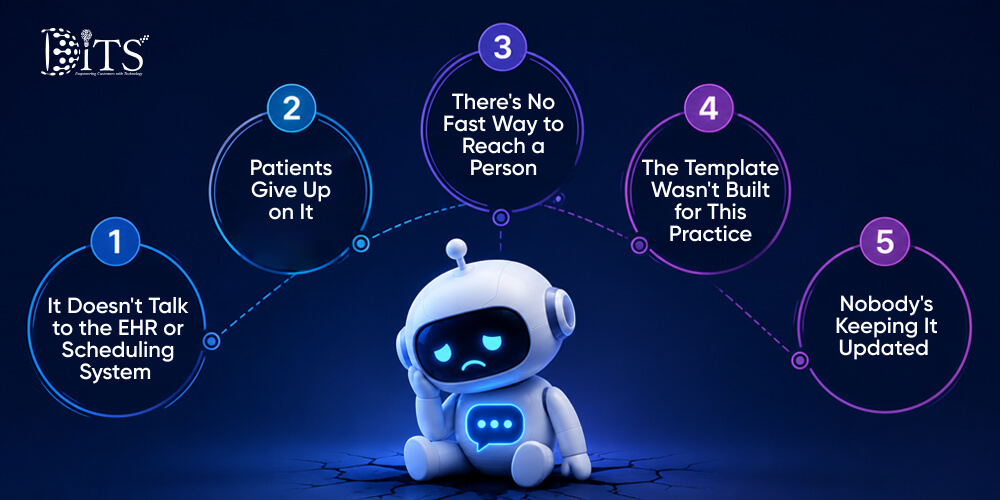
Chances are your practice already runs some version of a chatbot. Doesn't mean it's pulling its weight. Here's where most of these break down, and what tends to fix each one.
It Doesn't Talk to the EHR or Scheduling System
The bot sits disconnected from actual scheduling or records, so staff still re-enter bookings by hand. The fix is a real integration, not a widget floating on top of nothing.
Patients Give Up on It
A couple of wrong answers and people go back to calling that trust is hard to earn back. The fix is scope: know exactly what the bot can answer and hand off when unsure.
There's No Fast Way to Reach a Person
Trapping patients in a menu with no exit is worse than no chatbot. Build the handoff path first, not as an afterthought.
The Template Wasn't Built for This Practice
A one-size-fits-all template fits nobody well. A dermatology office and an urgent care clinic don't run alike.
Nobody's Keeping It Updated
Insurance rules, hours, and services change. Without updates, the bot gives wrong answers within months usually a staffing gap, not a tech one.
Ready To Build A Healthcare Chatbot That Works?
Partner with healthcare AI specialists to develop a scalable chatbot aligned with your systems, users, compliance needs, and business goals.
Partner with DITS to Build Their AI Chatbot for Healthcare
An AI Chatbot for Healthcare helps clinics, hospitals, insurers, and health-tech companies reduce missed calls, no-shows, claim delays, and support workload. From appointment scheduling and triage to discharge assistance and fraud detection, a healthcare chatbot for clinics and larger organizations significantly improves patient access, operational efficiency, scalability, and revenue opportunities.
For Clinics and Small Practices
Fewer missed calls, lower no-shows, and a front desk that spends more time with patients than the phone. That's the real promise of a healthcare chatbot for clinics.
For Hospitals and Health Systems
A chatbot built for real volume thousands of conversations, across departments, without becoming a new headache for IT. Build a high-end healthcare AI chatbots development for appointment scheduling, triage, patient discharge, etc.
For Insurance Providers
Faster claims checks, fewer routine coverage calls, and support that scales without adding headcount. Adding AI into the chatbot also helps to detect false claims, provides users’ claim history and enhance claim processing.
For SaaS and Mid-Market Health-Tech
An AI layer that becomes an actual product edge, not a support-ticket deflection tool. Build AI based chatbots for healthcare to generate revenue through SaaS product by selling it to hospitals, clinics and medical institutions.
Behind all of it is real engineering modernizing the legacy systems underneath instead of working around them, so the chatbot runs on clean data. DITS isn't a chatbot vendor. It's a consulting-led engineering partner, and every engagement is scoped around what the business needs.
Conclusion
Healthcare is one of the few industries where a well-built chatbot pays for itself fast. Fewer missed appointments. Shorter hold times. Billing questions resolved without a call. Staff getting real time back for patients who need them in person. None of that happens automatically, though. It only works when the chatbot is built around how a specific clinic or health system runs, not dropped in as some generic tool everyone gets the same version of. That's the difference between something people rely on every day and something that quietly stops being used within a few weeks.
Building an AI chatbot for healthcare properly takes the same kind of discipline as any real engineering project. You must understand where the operational gaps are before you touch a single workflow. Build around the systems already in place instead of fighting them. Treat this as part of a bigger shift in how the business runs, not just a new feature bolted onto the front end. DITS approaches every engagement this way consulting-led first, engineering second, with outcomes a clinic can point to when someone asks if it worked.
FAQs
What does an AI chatbot take off a clinic's plate?
Mostly scheduling, rescheduling, insurance checks, refill requests the stuff that eats up a receptionist's whole day. Once that's off their desk, they've got more time for the people standing in front of them.
Is patient data safe with these things?
It should be, but only if HIPAA compliance was baked in from the start encryption, access controls, the works.
Why do clinics stop using their chatbot after a few months?
Usually it's disconnected from the actual scheduling system, or patients hit one wrong answer and just go back to calling. Sometimes nobody's updated the bot's info in months either.
Does this only make sense for small practices?
No, hospitals use the same idea at a bigger scale, handling thousands of conversations across departments instead of a few hundred calls a day. The core problem it solves is the same either way.

Nidhi Thakur
With more than 19 years of experience - I represent a team of professionals that specializes in the healthcare and business and workflow automation domains. The team consists of experienced full-stack developers supported by senior system analysts who have developed multiple bespoke applications for Healthcare, Business Automation, Retail, IOT, Ed-tech domains for startups and Enterprise Level clients.
Recent Posts
Explore how intelligent document processing for insurance helps businesses automate document workflows, reduce processing costs, improve accuracy, and strengthen operational efficiency across insurance functions.
Discover how automated medical claims processing reduces delays, manual rework, claim denials, and administrative costs while improving reimbursement speed and operational efficiency.
Learn how to build medical billing software with essential features, integrations, security, and development costs.