25+ years of IT software development experience in different domains like Business Automation, Healthcare, Retail, Workflow automation, Transportation and logistics, Compliance, Risk Mitigation, POS, etc. Hands-on experience in dealing with overseas clients and providing them with an apt solution to their business needs.
Key Takeaways
AI helps real estate businesses make faster and smarter decisions.
It improves lead quality and increases conversion rates.
Property pricing becomes more accurate with data-driven insights.
Customer experience improves through personalization and quick responses.
Automation reduces manual work and operational delays.
Businesses can start small and scale AI gradually.
Data quality plays a critical role in successful implementation.
AI gives early adopters a strong competitive advantage.
Real estate has always been a relationship business, and it still is. But the agents and firms pulling ahead right now aren't necessarily the ones with the biggest networks or the fattest marketing budgets. They're the ones who've figured out how to buy back their time, and redirect it toward the conversations and decisions that actually move the needle.
Here's what's interesting though: most of the AI conversation in real estate still happens at a surface level. "Use ChatGPT for your listings!" Sure. But that barely scratches what's actually possible, or what's already happening inside competitive brokerages and prop-tech forward investment firms.
From predicting property prices to identifying serious buyers before your competitors do, AI is quietly reshaping how deals are made. Considering the improvement in speed and productivity in operations, the use of AI in real estate is growing significantly. According to a research, the AI in real estate market size was $301.58 billion in 2025 and projected to reach $1303.09 billion in 2030.
This shift isn’t just about adopting new tools. It’s about understanding how to use AI in real estate in a way that directly impacts revenue, customer experience, and long-term growth.
In this guide, we're going further than the basics. We'll look at where AI is creating genuine leverage in property businesses: the specific workflows, the honest limitations, and the use cases worth your attention versus the ones that are mostly noise.
What is AI in Real Estate
AI used in real estate applications analyzes unprocessed data to generate useful business results. Businesses now use advanced technologies to analyze numerous data points within seconds which enables them to make better decisions than they could through previous transaction records or their agents' expertise.
A buyer who visits your website and views three properties before leaving without returning creates a situation which results in total lead loss according to traditional practice. The system uses AI to track user behavior and forecast their future actions while delivering personalized content and following up with them at appropriate moments.
The following elements operate in hidden status:
The learning models analyze previous sales interactions and study customer patterns for their development.
The system uses predictive analytics to estimate future prices and market demand while assessing potential hazards.
The automation tools execute repetitive functions which include lead categorization and document verification.
Many organizations begin their AI implementation process in real estate because they underestimate its complete capabilities. Teams do not need to be replaced because they require advanced tools which help them achieve faster results with better operational efficiency.
Why Real Estate Businesses Need AI Today
Real estate has always been competitive. But now, it’s fast. Leads go cold within hours, pricing shifts quickly, and customer expectations have quietly moved higher than most businesses realize.
Consider this. A potential buyer fills out a form at midnight. If your system responds the next morning, chances are they’ve already spoken to someone else. That’s not inefficiency, it’s lost revenue.
This is exactly where AI starts making a visible difference.
It reduces response time from hours to seconds
It identifies serious buyers instead of wasting effort on low-intent leads
It helps teams focus on closing, not chasing
On top of that, managing large volumes of listings, client data, and transactions manually creates bottlenecks. Errors creep in, and decision-making slows down. Nobody plans for these gaps, but they show up anyway.
Businesses that adopt AI early are not just improving efficiency; they are quietly building a competitive edge that compounds over time.
For companies exploring AI in real estate, the goal is not to overhaul everything overnight. It’s about fixing high-impact areas first, then expanding gradually.
Want Better Property Insights Through AI Technology Today?
Create AI-enabled real estate systems that support market analysis, property valuation, and operational decision-making with advanced analytics capabilities efficiently.
Once businesses understand the value, the next step is practical adoption. Below are areas where AI is already making a noticeable difference.
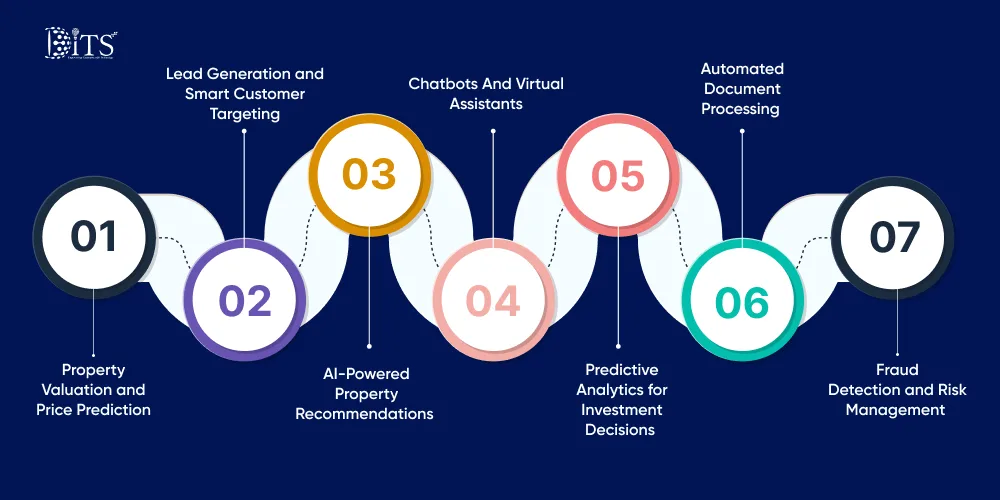
Property Valuation and Price Prediction
Pricing has always been tricky. Set it too high, and the property sits idle. Too low, and you leave money on the table.
AI changes this by analyzing multiple variables at once:
Historical sales data
Location trends and infrastructure growth
Buyer demand patterns
Seasonal fluctuations
Instead of relying on static comparisons, businesses can generate dynamic price estimates that adjust with the market. This becomes especially useful in competitive urban markets where prices shift quickly.
Lead Generation and Smart Customer Targeting
Not every inquiry is worth the same attention. Yet, many teams treat them equally and end up wasting time.
AI helps prioritize:
Identifies high-intent leads based on behavior
Scores prospects automatically
Suggests when and how to follow up
So instead of calling 50 people a day, your team focuses on the 10 that actually matter.
And guess what? Conversion rates improve without increasing effort.
AI-Powered Property Recommendations
Buyers don’t want to scroll endlessly. They expect relevant suggestions, almost instantly.
AI tracks user behavior and preferences:
Budget range
Location interest
Property type and features
Then it delivers personalized listings that feel curated rather than random.
This is where businesses investing in real estate app development gain an edge, because the platform itself becomes smarter with every interaction.
Chatbots And Virtual Assistants
Customers don’t operate on office hours. They ask questions late at night, early morning, or during weekends.
AI-powered chatbots handle:
Property inquiries
Appointment scheduling
Basic qualification questions
This ensures no lead goes unanswered.
It’s simple. Faster responses lead to better engagement. Better engagement leads to more deals.
Predictive Analytics for Investment Decisions
Investors care about one thing. Returns.
AI helps answer critical questions:
Which locations are likely to grow in the next 12–24 months?
What type of properties will see higher demand?
Where are the hidden risks?
By analyzing patterns across markets, businesses can guide clients with confidence rather than assumptions.
This is where many firms start exploring AI consulting services to build models tailored to their specific markets.
Automated Document Processing
Paperwork slows everything down. Contracts, agreements, verification steps, compliance checks. It adds friction to every deal.
AI can:
Extract data from documents automatically
Verify details against records
Flag inconsistencies
What used to take hours can now happen in minutes, with fewer errors.
And fewer errors mean fewer disputes later. Something every business appreciates.
Fraud Detection and Risk Management
Real estate transactions involve large sums. That naturally attracts risk.
AI systems monitor patterns and flag anomalies such as:
Unusual transaction behavior
Mismatched documentation
Suspicious buyer or seller activity
Instead of reacting after a problem occurs, businesses can prevent issues early.
For enterprises handling high transaction volumes, adopting AI solutions for enterprise becomes less of an option and more of a necessity.
Each of these applications solves a specific business problem. Start small, fix one area, measure results, and then expand.
That’s usually how successful adoption begins.
Benefits of Using AI in Real Estate
Adopting AI is not just about upgrading technology. It’s about improving how the business performs at every level, from lead handling to final deal closure.
When implemented correctly, the impact becomes visible quite quickly.
Faster Deal Closures
Time kills deals. The longer a property stays in the pipeline, the lower the chances of conversion.
AI accelerates the process by:
Matching buyers with the right properties instantly
Reducing delays in communication through automated responses
Streamlining documentation and verification
This shortens the overall sales cycle and helps businesses close deals faster without increasing team workload.
Improved Customer Experience
Modern buyers expect quick, relevant, and personalized interactions. Generic responses simply don’t work anymore.
AI enhances customer experience by:
Delivering tailored property recommendations
Providing instant responses through chatbots
Ensuring consistent communication across channels
When customers feel understood and supported, they are more likely to move forward with confidence.
Better Operational Efficiency
Manual processes often create hidden inefficiencies. Teams spend time on repetitive tasks instead of focusing on revenue-generating activities.
AI helps optimize operations by:
Automating lead qualification and follow-ups
Reducing manual data entry and paperwork
Supporting faster decision-making with data insights
Data-Driven Decision Making
Real estate decisions carry financial risk. Relying solely on experience can sometimes lead to costly misjudgments.
AI introduces clarity by:
Analyzing large datasets for accurate insights
Identifying trends that are not visible manually
Supporting pricing, investment, and marketing decisions
This allows businesses to move forward with confidence rather than assumptions.
Cost Optimization Over Time
There is often hesitation around initial investment. That’s understandable.
But over time, AI reduces operational costs by:
Minimizing dependency on manual processes
Reducing errors that lead to financial losses
Improving conversion rates without increasing marketing spend
Here’s the reality. Businesses that invest early often see compounding returns, while others struggle to keep up.
At DITS, we approach this differently. We don’t treat AI as an add-on. We use it across AI software development, quality assurance, maintaining code quality, and customization. Every solution is designed with intelligence built in, not layered on later.
That’s what makes adoption smoother and results more consistent.
And once businesses experience these benefits firsthand, scaling AI across operations becomes a natural next step.
Steps To Implement AI in Real Estate Business
Understanding the benefits is one thing. Implementing AI in a structured way is where most businesses either gain momentum or lose direction.
The key is to approach it step by step, with clear priorities and measurable outcomes.
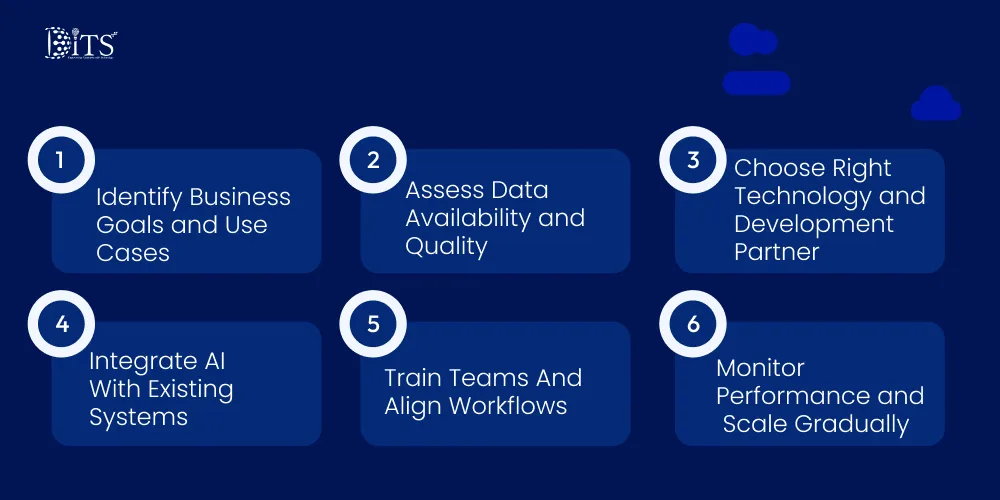
Identify Business Goals and Use Cases
Jumping into AI without a clear objective often leads to wasted effort.
Start by asking:
Where are deals slowing down?
Which processes consume the most time?
Where are errors or inefficiencies most frequent?
For some businesses, it’s lead management. For others, it’s pricing or documentation.
The idea is simple. Pick one high-impact area and focus there first. That’s usually where early wins come from.
Assess Data Availability and Quality
AI runs on data. If the data is scattered, incomplete, or inconsistent, results will suffer.
Businesses need to:
Organize property, customer, and transaction data
Clean outdated or duplicate records
Ensure systems capture data in a structured format
This step often gets overlooked. But here’s the catch. Strong data foundations lead to reliable AI outcomes.
Choose Right Technology and Development Partner
Not every solution fits every business. Off-the-shelf tools may solve basic problems but often lack customization.
This is where AI software development and tailored solutions come into play.
A reliable partner helps:
Identify the right tools and models
Customize solutions based on business workflows
Ensure scalability as the business grows
For companies planning long-term adoption, investing in the right expertise early makes a noticeable difference.
Integrate AI With Existing Systems
AI should not operate in isolation. It needs to work alongside existing CRMs, listing platforms, and internal tools.
This involves:
Connecting AI models with current databases
Ensuring smooth data flow across systems
Avoiding disruption to ongoing operations
Many businesses underestimate this step. But seamless integration is what makes AI practical, not just theoretical.
Technology alone doesn’t deliver results. People using it effectively do.
Teams need to:
Understand how AI supports their roles
Adapt workflows to leverage automation
Trust insights generated by the system
Initial resistance is common. But once teams see reduced workload and better outcomes, adoption improves naturally.
Monitor Performance and Scale Gradually
AI implementation is not a one-time activity. It evolves.
Businesses should:
Track performance metrics such as conversion rates, response time, and deal cycle duration
Identify areas for improvement
Expand AI usage into other functions once initial success is achieved
And here’s what typically happens. A company starts with lead scoring, sees results, then moves to pricing, then automation, and gradually builds an intelligent ecosystem.
At DITS, we follow this exact approach. AI is embedded into every stage of development, from coding to testing and customization, ensuring that businesses don’t just adopt AI, they actually benefit from it in real operations.
And when implementation is done right, AI stops being a tool. It becomes a competitive advantage.
The real estate industry is only scratching the surface of what AI can actually do. What feels advanced today will soon become standard practice.
And the shift is happening faster than most expect.
Hyper-Personalized Property Experiences
Buyers no longer want generic listings. They expect platforms to understand their preferences without having to explain everything repeatedly.
AI will evolve to:
Predict buyer intent even before explicit searches
Suggest properties based on lifestyle patterns, not just filters
Adjust recommendations dynamically as user behavior changes
This means platforms will feel less like search tools and more like advisors guiding decisions.
Smarter Investment Planning
Investment decisions will become more precise, backed by deeper insights.
AI systems will:
Forecast long-term property appreciation with higher accuracy
Analyze economic, demographic, and infrastructure data together
Provide scenario-based projections for different investment strategies
For investors, this reduces uncertainty and improves confidence in decision-making.
End-To-End Process Automation
From property discovery to final documentation, the entire transaction cycle will become more streamlined.
We’re moving toward:
Automated lead qualification and nurturing
Faster approvals and document verification
Reduced dependency on manual coordination between stakeholders
And while human expertise will always be important, repetitive tasks will gradually disappear.
Wider Adoption Across Mid-Sized Businesses
Earlier, AI adoption was limited to large enterprises. That’s changing.
With more accessible tools and scalable solutions:
Mid-sized agencies are beginning to adopt AI-driven platforms
Smaller firms are using automation to compete with larger players
Technology is becoming a differentiator, not a luxury
This shift is making the market more competitive, but also more efficient.
Stronger Focus on Integrated Systems
Standalone tools will lose relevance. Businesses will look for unified systems where everything works together seamlessly.
This is where AI solutions for enterprise will continue to evolve, offering integrated platforms that connect CRM, analytics, marketing, and operations into a single ecosystem.
The future is not about replacing real estate professionals. It’s about empowering them with better insights, faster processes, and smarter systems.
Businesses that adapt early will not just keep up. They will define how the industry operates in the coming years.
Need Smarter AI Solutions For Property Business Operations?
Build intelligent real estate platforms with predictive analytics, automated workflows, and personalized customer experiences for better business performance successfully.
Why Choose DITS For AI Real Estate Software Development
Selecting the right partner for AI implementation is often what determines success or failure. At DITS, the focus goes beyond building software. The goal is to solve real business problems with practical, scalable solutions.
What sets the approach apart is how AI is embedded into every stage of development. From coding and quality assurance to maintaining code quality and enabling deep customization, AI is not an add-on but part of the foundation. This ensures systems remain efficient, reliable, and adaptable as business needs evolve.
With strong experience in real estate app development, DITS understands industry-specific challenges such as lead management, property discovery, and transaction workflows. Solutions are designed to integrate smoothly with existing systems, minimizing disruption while improving performance.
For businesses looking to implement AI with clear outcomes, the focus remains on delivering measurable value and long-term efficiency.
Conclusion
AI is no longer a future concept in real estate. It is already influencing how properties are marketed, how leads are managed, and how decisions are made. Businesses that adopt it thoughtfully are seeing faster processes, better customer engagement, and stronger outcomes.
The key is not to implement everything at once, but to start with clear priorities and scale based on results. With the right strategy and execution, AI becomes more than just a tool. It becomes a long-term advantage in an increasingly competitive market.
Frequently asked questions
AI is used to automate lead management, improve property recommendations, predict pricing trends, and streamline documentation. It helps businesses make faster decisions while reducing manual effort.
Dinesh Thakur
25+ years of IT software development experience in different domains like Business Automation, Healthcare, Retail, Workflow automation, Transportation and logistics, Compliance, Risk Mitigation, POS, etc. Hands-on experience in dealing with overseas clients and providing them with an apt solution to their business needs.