25+ years of IT software development experience in different domains like Business Automation, Healthcare, Retail, Workflow automation, Transportation and logistics, Compliance, Risk Mitigation, POS, etc. Hands-on experience in dealing with overseas clients and providing them with an apt solution to their business needs.
Key Takeaways
AI reduces manual workload and improves team productivity.
Faster lead response directly increases conversion rates.
Personalized marketing improves engagement and client trust.
Automation frees up time for high-value business activities.
AI enhances decision-making with real-time market insights.
Better customer experience leads to long-term client retention.
Starting small with AI delivers faster and measurable results.
Clean data is essential for accurate AI performance.
Businesses adopting AI early gain a competitive advantage.
Spending hours analyzing property comps, only to realize the numbers are already outdated? Or watching potential leads slip away because your team is buried in follow-ups and paperwork? You’re not alone.
That’s exactly where the benefits of AI in real estate start becoming hard to ignore. What once felt experimental is now quietly transforming how agencies, developers, and brokers operate day to day. According to a report by Morgan Stanley, real estate companies can automate 37% of tasks that can enhance operational efficiency and productivity significantly.
From faster deal cycles to sharper decision-making, AI is no longer optional for businesses aiming to stay competitive.
At the same time, there’s hesitation. Will technology replace the human side of real estate? Not quite. It’s doing the opposite. It removes repetitive work so professionals can focus on what actually closes deals: relationships, negotiation, and trust.
Top Game-Changing Benefits of AI in Real Estate
AI is transforming the real estate industry by automating processes and improving operational accuracy and efficiency. Let’s explore some game-changing benefits of AI in real estate.
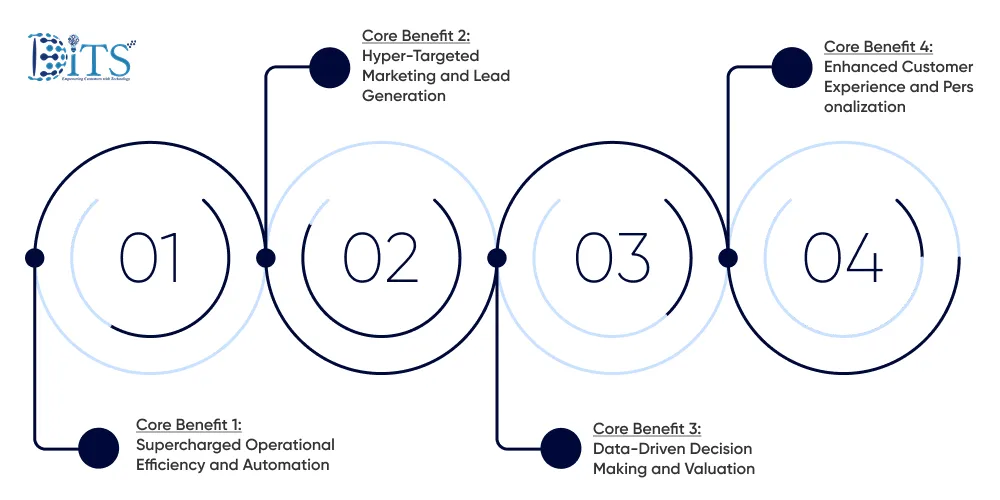
Core Benefit 1: Supercharged Operational Efficiency and Automation
In most real estate businesses, time is rarely spent where it matters. Teams often get pulled into repetitive tasks that don’t directly contribute to closing deals. This is where AI quietly changes the equation.
Automated Lead Capture and Initial Qualification
AI-driven chat systems engage visitors instantly, helping businesses capture inquiries that might otherwise be lost outside business hours. The system asks appropriate questions to collect user preferences while it separates genuine customers from people who only browse. The system automatically generates pre-qualified leads with minimal manual effort.
The present situation shows a complete change. Agents should only handle inquiries from potential customers who exhibit strong interest in their products. The system reduces time waste yet permits better customer conversion results to be calculated.
Smart Document Processing
The process of managing contracts lease agreements and disclosure documents causes organizations to experience both delays and expensive mistakes. AI tools can now identify essential information from documents within seconds while they detect errors and minimize the need for human checking.
High transaction businesses need this solution for two reasons. The solution provides both operational advantages and risk management capabilities.
Automated Administrative Tasks
The process of scheduling site visits and sending reminders and coordinating calendars should seem simple. The activities consume more total time than people expect. AI-powered assistants handle these tasks seamlessly, ensuring nothing slips through the cracks.
An agency which uses automation will enable each agent to recover from their work 10 to 15 hours every week. The agents will devote all their saved time to client work and closing deals.
The majority of organizations investing in real estate app development will connect their automated systems with existing workflows to simplify their business operations through this development.
Efficiency in business operations goes beyond rapid work completion. The process creates space for teams to concentrate on activities which produce business growth through sales generation.
Core Benefit 2: Hyper-Targeted Marketing and Lead Generation
Real estate marketing functions as a guessing game because marketers lack definite methods to execute their work. Marketing campaigns proceed through their budget spending phase and yield unpredictable outcomes. The application of AI technology enables business operations to achieve superior accuracy because it ensures measurable results.
Predictive Analytics for Buyers and Sellers
The AI tools complete their work by studying behavioral patterns and past sales records combined with indicators that show people who will be reaching their next life stage. Businesses initiate contact with homeowners who show potential to sell properties and buyers who research their available options instead of waiting for customer inquiries.
The situation has transformed. The organization can now send outreach messages that arrive at appropriate times and which contain information that matches the recipient's needs.
Dynamic Content and Ad Personalization
Traditional marketing methods treat all buyers as identical, but actual buyers display different purchasing behavior. The AI system personalizes property listings, email messages, and advertisements according to user behavior and their previous interactions with the system.
A family searching for spacious homes sees something entirely different from a young professional looking for a compact apartment near business hubs. The organization uses its advanced system to deliver personalized content which results in higher user interaction.
Enhanced Visual Marketing
Online platforms depend on first impressions to establish their initial connection with their audience. AI shows property owners the most effective presentation methods which previously required extensive time and high financial investment.
Virtual staging helps showcase empty properties with realistic interiors Renovation suggestions allow buyers to visualize potential upgrades Automated video creation turns static images into engaging property walkthroughs
The tools provide users with faster decision-making abilities. Property buyers experience the entire property instead of viewing a building.
Real estate businesses that want to expand their operations depend on AI technology which operates through platforms that integrate marketing functions with analytical processes and customer relationship management into one unified platform.
Core Benefit 3: Data-Driven Decision Making and Valuation
Real estate decisions have always relied on data, but the challenge has been depth and accuracy. Conventional approaches to valuation require specific data sets and empirical building records and human evaluation for their results. AI develops better solutions because it enables researchers to evaluate larger data sets with improved analytical capabilities.
Precision Property Valuation
Typical valuation methods assess a small number of variables. AI goes much further. It evaluates neighborhood trends, buyer demand patterns, infrastructure developments, and even subtle market sentiment indicators.
The pricing system establishes current market values which depend on present market conditions instead of using past value assessments.
For business owners, this reduces two common risks. Overpricing creates delays which result in lost business opportunities. Underpricing creates a situation where customers pay less than they should for products.
Market Trend Forecasting
Understanding where the market is heading is often more valuable than knowing where it stands today. AI uses transaction data together with rental movement patterns and economic indicators to forecast upcoming trends with great precision.
This allows firms to answer critical questions early. Which locations are likely to appreciate? Where will rental demand grow? When is the right time to enter or exit a market?
Investment Opportunity Identification
For developers and investors, identifying the right opportunity is everything. AI uses advanced scanning technology to analyze extensive datasets which help researchers discover unknown properties and developing areas and profitable rental markets that standard manual techniques would miss.
And here’s where it becomes interesting. Decisions that once took weeks of research can now be made in hours, with stronger confidence.
Organizations that adopt AI consulting services often gain an edge here, as they can build tailored models aligned with their specific investment strategies.
This level of intelligence is especially valuable in AI in real estate development, where accurate forecasting and site selection directly impact long-term project success.
Core Benefit 4: Enhanced Customer Experience and Personalization
Clients today expect more than just listings. They want services which deliver relevant solutions at fast speeds while showing that their needs form the foundation of the service. The client experience starts to change through AI technology at this point.
The Digital Concierge
Buyers now receive personalized property recommendations which exactly match their preferences. Buyers need to choose their properties according to three factors which include their preferred location and their financial abilities and their selected lifestyle choices. The three factors which define their neighborhood choice include quiet neighborhoods and park access and their natural lighting needs.
AI systems use search tools to understand user intent instead of processing user inputs. A buyer saying “family-friendly area” gets results that reflect safety, schools, and community vibe. The system shows. The system demonstrates that it takes less time to complete tasks for both users.
360-Degree Client Support
The relationship doesn’t end once a deal is closed. The AI systems maintain customer communication through their scheduled updates and reminder functions and their customer support capabilities.
Automated follow-ups after purchase or lease Maintenance request routing for property managers Personalized updates on property value or local market trends
The system develops trust through its minor interactions which establish trust without the need for ongoing manual work.
Building Long-Term Client Relationships
Past clients create difficulties for businesses which want to remain in touch with them. Businesses use AI technology to maintain their market presence through sending communication which takes into account specific situational details. The organization sends updates which customers find valuable because they relate to their current situation.
Over time, this process gives customers a hidden benefit. When clients are ready for their next move, they already know who to call.
Companies investing in AI software development now direct their resources toward creating positive customer experiences which make every touchpoint feel unified and timely and custom-built for each customer.
Businesses using AI in real estate development are increasingly using these capabilities to optimize project planning, identify high-potential locations, and reduce risks associated with long-term investments.
Getting Started: Implementing AI In Real Estate Business
Adopting AI can feel overwhelming at first. Too many tools, too many promises, and not always clear where to begin. But the most successful businesses don’t try to transform everything overnight. They start small and scale with clarity.
Start With Single Pain Point
Instead of spreading resources thin, identify one operational gap that is slowing your team down. It could be slow lead response, inefficient document handling, or inconsistent marketing output.
Solve that one problem first. Once results are visible, expanding becomes much easier and more structured.
Explore Available Tools
There’s no shortage of AI-powered platforms in the market. The key is choosing tools that align with your business model rather than chasing trends.
CRM systems with built-in intelligence for lead tracking and follow-ups
Property valuation and analytics tools for smarter pricing
Marketing platforms that automate campaigns and audience targeting
Content tools for listing descriptions and communication
For example, many firms are already experimenting with tools like ChatGPT for content creation or analytics platforms for lead scoring. The goal isn’t complexity. It’s efficiency.
Focus On Data Quality
Here’s something many businesses overlook. AI is only as effective as the data it receives. If your property listings, client records, or transaction history are inconsistent, the output will reflect that.
Clean, structured data becomes a competitive advantage. It improves accuracy, decision-making, and overall system performance.
Human-AI Partnership
AI works best when teams know how to use it properly. Training staff, redefining workflows, and setting clear expectations are essential steps.
At DITS, this is exactly how we approach integrating AI in real estate solutions. We don’t just deploy tools. We ensure they align with business processes, enhance productivity, and maintain long-term scalability.
We also use AI internally for software development, quality assurance, and maintaining code quality, ensuring every solution is optimized, reliable, and tailored to client needs.
In the end, implementing AI isn’t about replacing systems overnight. It’s about building smarter processes, one step at a time, and letting results guide the next move.
Searching For Reliable AI Real Estate Development Partner Today?
Work with experienced AI developers to build scalable and secure real estate technology solutions tailored for modern property management operations successfully.
AI implementation brings clear benefits, yet businesses face multiple challenges during the adoption process. The instant results businesses expect from their operations fail to materialize because they must execute their plans through disciplined work.
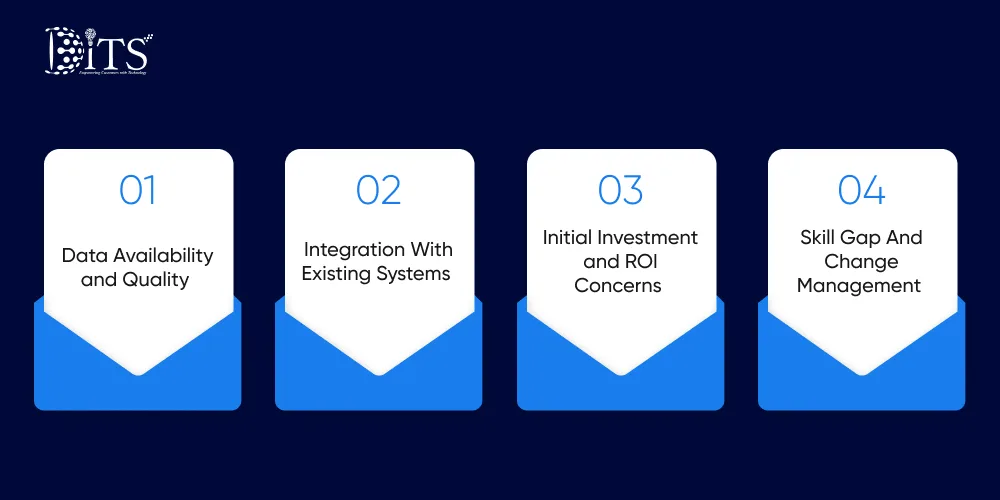
Data Availability and Quality
AI requires organizations to possess structured data which maintains dependable quality standards. Data distribution throughout real estate companies occurs through three main channels: spreadsheets, emails, and older software systems. This creates inconsistency.
The most sophisticated system requires clean data to produce trustworthy results. And that leads to poor decisions rather than better ones.
Integration With Existing Systems
Most businesses already have CRMs, listing platforms, and internal tools in place. The integration of AI into existing systems becomes challenging because organizations need to update their systems which lack proper scalability design.
The process requires organizations to implement advanced technologies. The process requires organizations to achieve seamless operation among all technologies.
Initial Investment and ROI Concerns
People experience reluctance about spending money. The decision-making process requires organizations to understand expected financial returns which will result from new system implementations.
AI creates a challenge because its benefits remain unseen until they reach their full potential. The impact builds over time through efficiency, better conversions, and improved decision-making.
Skill Gap And Change Management
Teams show resistance toward new technology implementations when they believe these changes will interrupt their regular operational procedures. Training becomes essential, not just for usage but for building confidence.
This is where businesses often underestimate effort. The complete adoption process requires organizations to manage both technology and user behavior.
Organizations that partner with experts offering AI solutions for enterprise often navigate these challenges more effectively, as they get structured implementation, integration support, and ongoing optimization.
In reality, these challenges are not barriers. They are checkpoints. Businesses that address them early are the ones that unlock the full potential of AI without unnecessary friction.
Why Choose DITS for AI Real Estate Solutions
Choosing the right technology partner often makes the difference between a successful AI initiative and a failed experiment. Businesses achieve disappointing results because they fail to implement their purchased tools according to their strategic needs.
DITS takes a different approach to its work. AI functions as a core component that we integrate into all our solutions. Our platform starts providing business benefits on its first day of operation.
What Sets DITS Apart
Business-First Approach
Our solutions address actual operational problems which require solutions that go beyond existing technological capabilities. This ensures that AI directly impacts efficiency, lead generation, and decision-making.
End-To-End Development Expertise
Our company provides complete project management services which cover all stages from initial planning until final system implementation to seamlessly connect with current business operations.
Built-In Intelligence Across Systems
We use AI technology throughout our software development process which includes testing and quality assurance to achieve both high code quality and quick delivery of products.
Customization And Scalability
The operational needs of each real estate business differ from each other. Our solutions fit specific business needs while our platform supports future expansion requirements.
Continuous Optimization
AI systems undergo ongoing changes because they do not remain fixed. We refine our models and processes to achieve better performance results which will last throughout time.
For organizations exploring the benefits of AI in real estate, having a partner who understands both technology and business context becomes critical.
Because at the end of the day, it’s not just about adopting AI. The process requires AI to be implemented which will result in sustainable business growth through measurable outcomes that need to remain simple.
Planning To Modernize Real Estate Technology Infrastructure Today?
Develop future-ready AI real estate platforms with automation, predictive analytics, and intelligent property management capabilities for long-term business growth.
AI technology has evolved beyond its previous status as an exclusive tool for major businesses. The technology transforms every aspect of real estate business operations, competition strategies, and organizational expansion methods. The system delivers measurable benefits by delivering operational improvements and better marketing results and through its ability to drive intelligent investment choices.
The advantages that artificial intelligence brings to real estate industry work depend on one fundamental transformation. The company needs to spend less time on repetitive work while dedicating more resources toward activities that generate significant value. Business development occurs when organizations reach that point.
The primary lesson from this situation extends beyond a single point. Companies that achieve success use AI technology at their facilities through defined processes. The companies use AI technology because they want to achieve specific outcomes while they expand their operations.
Real estate agents will remain in their professions because artificial intelligence systems will not take over their jobs. The technology provides real estate agents, who use it, with greater intelligence and faster execution and better customer connections.
In markets where success depends on precise timing and established trust and accurate execution.
Frequently asked questions
The main advantages of artificial intelligence for real estate businesses. The system decreases operational tasks for staff members while it boosts the rate of successful lead conversions, which leads to exact property assessments and better customer satisfaction. Businesses can make speedy choices while they sustain improved customer relationships.
Dinesh Thakur
25+ years of IT software development experience in different domains like Business Automation, Healthcare, Retail, Workflow automation, Transportation and logistics, Compliance, Risk Mitigation, POS, etc. Hands-on experience in dealing with overseas clients and providing them with an apt solution to their business needs.