Cost of Healthcare Software Product Development
Table Of Content
Published Date :
25 Mar 2026
Key Takeaways
- Healthcare software product development cost varies widely based on complexity, compliance, and integrations.
- Simple applications may start around $60,000, while enterprise platforms can exceed $500,000.
- Regulatory compliance, especially HIPAA, significantly impacts development timelines and costs.
- Integrations with EHRs, labs, and insurance systems often increase both budget and project duration.
- Hidden costs such as data migration, cloud infrastructure, and ongoing support can impact total investment.
Healthcare organizations across the United States are under constant pressure to modernize systems while controlling operational expenses. Whether it’s a hospital network upgrading its clinical systems or a startup launching a digital health platform, one question is worth considering in meetings what is the real cost of healthcare software product development?
The answer isn’t straightforward. A simple patient-facing app might cost under six figures, while a fully integrated clinical platform can run into hundreds of thousands or more. And then there are compliance requirements, integrations, and long-term scalability that quietly add to the investment.
Many decision-makers underestimate these variables early on. The result? Budget overruns, delayed launches, and missed market opportunities. This blog shares how costs for healthcare software product development are structured, and what truly drives them.
What Is Healthcare Software Product Development
When healthcare leaders talk about digital transformation, they mean building structured, scalable systems that support clinical workflows, patient engagement, and operational control. That’s what healthcare software product development offers exactly.
Unlike short-term app projects, these products are designed to evolve. They handle sensitive data, integrate with multiple systems, and support real-time decision-making. For example, an EHR platform used across multiple facilities or a telehealth system that scales from a few doctors to an entire network.
On top of that, modern systems increasingly rely on AI in healthcare to improve diagnostics, automate workflows, and enhance patient outcomes.
At DITS, for instance, AI is embedded directly into development workflows, from coding to quality assurance and customization, ensuring that systems are not only functional but also intelligent and adaptive.
So, when businesses evaluate the cost of software development for healthcare, they’re not just paying for code. They’re investing in a system that needs to perform reliably, scale efficiently, and stay compliant in a highly regulated environment.
Average Healthcare Software Product Development Cost In USA
Now let’s address the number that most executives are trying to pin down. The healthcare software product development cost in the US varies widely, and it’s a reflection of how different each project can be in terms of scope, compliance, and integrations.
A small clinic building a patient engagement tool will not spend the same as a hospital network deploying a multi-location clinical system.
Here’s a realistic cost breakdown based on current market trends:
| Software Type | Estimated Cost Range (USD) |
| Basic healthcare application | $60,000 – $120,000 |
| Mid-level healthcare system | $120,000 – $300,000 |
| Enterprise healthcare platform | $300,000 – $800,000+ |
Many businesses assume that once development is complete, spending slows down. In reality, ongoing costs such as maintenance, upgrades, and compliance audits continue to shape the total investment.
Also, working with an experienced healthcare software development company can influence this range significantly. The right partner may seem expensive upfront, but they often reduce long-term costs by avoiding rework, ensuring compliance from day one, and building scalable architecture.
So, while the numbers above provide a benchmark, the final healthcare software development cost always depends on how strategically the product is planned and executed.
Also Read: Healthcare Software Product Development: Ultimate Guide
Key Factors Influencing Healthcare Software Product Development Cost
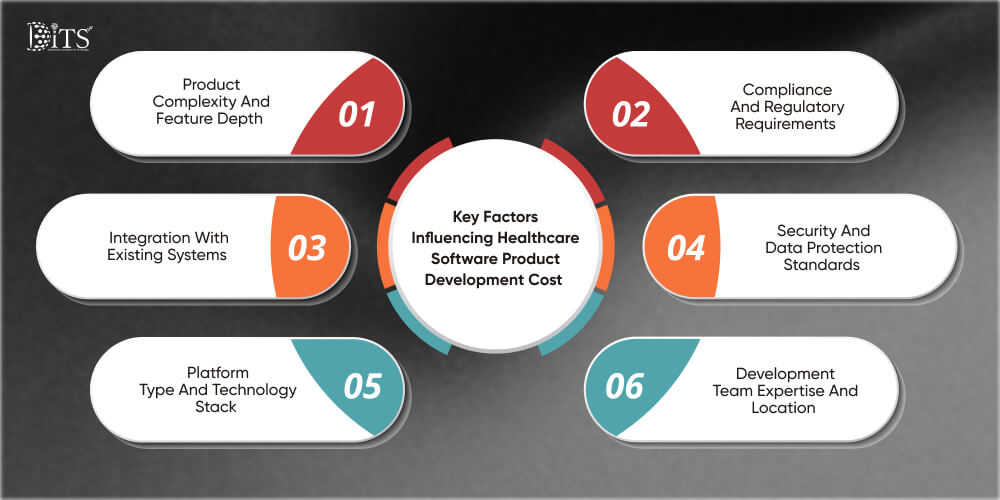
If two healthcare companies start similar projects, you’d expect similar budgets. But that rarely happens. One ends up spending twice as much. Why? Because cost isn’t driven by one factor. It’s shaped by a combination of technical, regulatory, and operational decisions made early in the process.
Let’s break down what actually moves the needle.
Product Complexity and Feature Depth
A basic scheduling system is straightforward. But once you add clinical workflows, patient data handling, analytics dashboards, and multi-user roles, complexity increases fast.
More features mean:
- More development hours
- More testing cycles
- More chances of rework
- And naturally, higher costs.
Compliance And Regulatory Requirements
Healthcare is not like other industries. Systems must comply with strict regulations such as HIPAA in the US. That involves secure data storage, audit trails, encryption, and access controls.
Skipping this upfront? Not an option. Fixing compliance later costs far more.
Integration With Existing Systems
Most healthcare platforms don’t operate in isolation. They need to connect with EHR systems, lab systems, insurance platforms, and billing tools.
Each integration adds:
- API development effort
- Data mapping complexity
- Testing dependencies
This is often where budgets stretch unexpectedly.
Security And Data Protection Standards
Handling patient data comes with responsibility. Strong encryption, role-based access, and secure cloud infrastructure are essential.
And here’s the reality. Security isn’t a one-time effort. It’s continuous. That adds to both initial and ongoing costs.
Platform Type and Technology Stack
Building for web is one layer. Adding mobile apps, cloud infrastructure, and analytics capabilities increases scope.
Businesses aiming for scalable, future-ready systems often invest more upfront, but avoid limitations later.
Development Team Expertise and Location
Choosing between in-house teams, US-based development teams, or offshore partners directly impacts pricing.
However, cost alone shouldn’t drive this decision. Experienced providers offering software development services for healthcare often deliver better architecture, faster timelines, and fewer long-term issues.
In the end, the healthcare software product development solutions you choose determine whether your investment becomes a scalable asset or an ongoing expense problem.
Are You Accurately Estimating Your Healthcare Software Budget?
Get a structured cost breakdown tailored to your product scope, compliance needs, and integrations to avoid overruns and improve investment clarity.
Hidden Costs Businesses Often Overlook
Most healthcare leaders walk into development discussions with a defined budget. On paper, it looks solid. Then midway through the project, additional costs start surfacing. Not because of poor planning, but because certain elements are easy to miss early on.
And honestly, these “hidden” costs are where budgets quietly stretch.
Compliance Implementation and Audits
Meeting regulatory standards is not limited to initial development. External audits, documentation, and periodic compliance checks add recurring costs.
Many teams account for basic compliance but overlook ongoing validation requirements.
Third-Party Integrations and Licensing
Connecting with external systems such as labs, pharmacies, or insurance providers often involves licensing fees or usage-based costs.
For example:
- API usage charges
- Vendor licensing fees
- Data exchange costs
These can accumulate quickly over time.
Data Migration from Legacy Systems
Migrating historical patient data is rarely simple. Data needs cleaning, restructuring, and validation before being moved into the new system.
It’s time-consuming. And if done incorrectly, it creates operational risks.
Infrastructure And Cloud Expenses
Hosting healthcare platforms requires secure and scalable infrastructure. Cloud costs depend on usage, storage, and performance needs.
As user volume grows, so do these expenses.
Training And Change Management
Even the most advanced system fails if teams don’t adopt it properly. Training staff, onboarding users, and managing workflow transitions require both time and investment.
And here’s the reality. Resistance to change can slow down ROI if not handled well.
Ongoing Support and System Enhancements
Post-launch, businesses often need:
- Feature updates
- Performance improvements
- Security upgrades
These are not optional. They’re necessary to keep systems relevant and compliant.
Organizations that partner with providers offering structured healthcare software product development solutions tend to manage these costs better, as long-term support is already built into the engagement model.
In the bigger picture, these overlooked elements significantly impact the total healthcare software product development cost. Planning for them early doesn’t just protect budgets, but timelines and business continuity as well.
How To Reduce Healthcare Software Development Cost
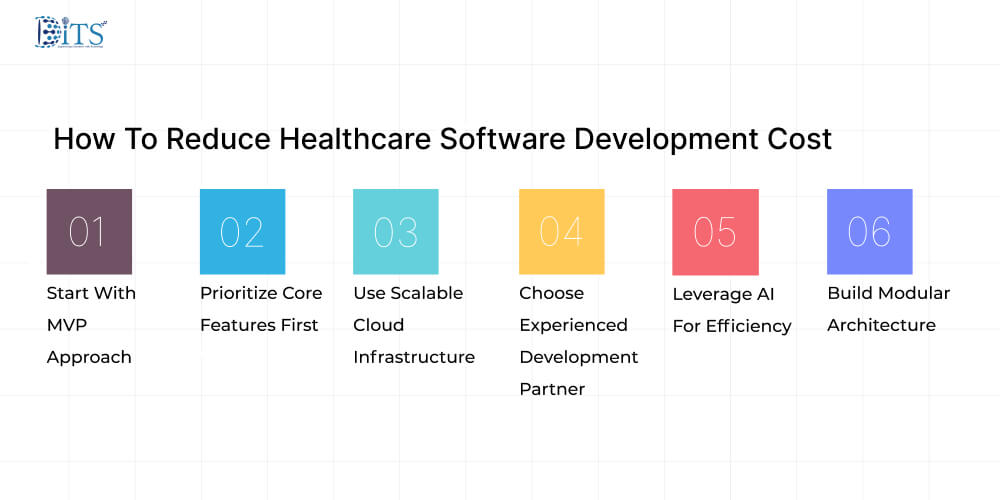
Controlling costs doesn’t mean cutting corners. In healthcare, that approach backfires quickly. Instead, smart organizations focus on structured planning, phased execution, and the right technology choices to keep budgets under control without compromising quality.
Start With MVP Approach
Building everything at once is risky and expensive. A minimum viable product allows you to launch with essential features, validate real-world usage, and then expand.
Many startups in the US follow this model. They launch within 4 to 6 months, gather feedback, and scale gradually. It reduces upfront investment and avoids building unnecessary features.
Prioritize Core Features First
Not every feature needs to be part of version one. Focus on what directly impacts patient care or operational efficiency.
Everything else can follow in later phases. This keeps development lean and targeted.
Use Scalable Cloud Infrastructure
Instead of heavy upfront infrastructure investments, cloud-based systems allow businesses to pay based on usage.
It’s flexible. And more importantly, it supports growth without major rework.
Choose Experienced Development Partner
Working with teams offering software development services for healthcare ensures better architecture, faster execution, and fewer costly mistakes.
Inexperienced teams often lead to rework. And rework is where budgets spiral.
Leverage AI For Efficiency
The use of AI in healthcare is no longer limited to clinical applications. It’s also transforming development processes.
At DITS, AI is integrated into coding, testing, and quality assurance workflows. This reduces manual effort, improves code quality, and speeds up delivery timelines without increasing costs.
Build Modular Architecture
Instead of a rigid system, modular design allows you to add or upgrade features without rebuilding the entire platform.
This approach keeps long-term costs predictable and manageable.
At the end of the day, reducing the healthcare software development cost is not about spending less. It’s about spending smart, at the right stages, with the right priorities.
Development Timeline for Healthcare Software Products
Cost and timeline often go hand in hand. The longer a project runs, the higher the investment. But in healthcare, speeding things up without proper planning can lead to compliance gaps and unstable systems. So, the goal isn’t just faster delivery. It’s controlled execution.
Here’s a realistic view of how timelines typically unfold in the US market:
- MVP healthcare product: 4 to 6 months
- Mid-level healthcare system: 6 to 10 months
- Enterprise healthcare platform: 10 to 18 months
These timelines are influenced by several moving parts. Regulatory approvals can slow things down. Integrations with systems like EHRs or health insurance software can introduce dependencies. DITS provide health insurance software development services for businesses across US and Canada. And then there’s testing, which takes longer in healthcare than in most industries.
Let’s take a practical scenario. A telehealth startup plans a 5-month launch. Midway, they decide to integrate remote diagnostics and analytics. That single decision can extend timelines by 2 to 3 months. It happens more often than expected.
This is where experienced teams like Ditstek Innovations, offering healthcare software development services bring value. They anticipate such changes early, structure development phases accordingly, and prevent timeline overruns.
The takeaway is simple. Timelines in healthcare product development are not just technical estimates. They are strategic commitments that directly influence the overall healthcare software product development cost and business outcomes.
Why Choose DITS For Healthcare Software Product Development
Choosing the right partner can make or break a healthcare product initiative. At DITS, the focus goes beyond just development. The approach is structured around building scalable, compliant, and future-ready systems aligned with real business needs.
With strong experience in healthcare software product development, DITS understands the complexities of US healthcare regulations, clinical workflows, and system integrations. This reduces friction during development and avoids costly corrections later.
DITS also brings proven experience in building advanced healthcare platforms, including remote patient monitoring software that enables real-time patient tracking and data-driven care delivery. This hands-on experience allows teams to anticipate real-world challenges and design more practical, scalable solutions.
A key differentiator is the integration of AI across the development lifecycle. From coding and testing to quality assurance and customization, AI is used to improve efficiency, maintain code quality, and accelerate delivery timelines.
DITS also emphasizes modular architecture, ensuring that products can scale as business requirements evolve. Combined with long-term support and optimization, this helps organizations control costs while continuously improving system performance.
Need Expert Guidance On Healthcare Software Investment Decisions?
Connect with experienced healthcare technology specialists to discuss your project scope, cost expectations, and strategic roadmap before committing resources.
Conclusion
The overall healthcare software product development cost depends on multiple moving factors. Product complexity, compliance requirements, integrations, and long-term scalability all play a role. Ignoring any one of these can lead to budget overruns or underperforming systems.
What stands out across successful projects is not just how much businesses spend, but how strategically they invest. Organizations that take time to define scope, choose the right architecture, and work with experienced partners tend to see better outcomes and more predictable costs.
In the end, healthcare software product development is not an expense to minimize. It’s an investment to optimize. And when done right, it becomes a long-term asset that drives efficiency, compliance, and growth across the organization.
FAQs
What is the typical healthcare software product development cost in the US?
The cost varies based on complexity, integrations, and compliance requirements. A basic solution may start around $60,000, while enterprise-level platforms can exceed $500,000 depending on features and scalability needs.
How long does healthcare software product development take?
Timelines usually range from 4 to 18 months. MVPs can be built within 4 to 6 months, while more complex systems with integrations and compliance requirements take longer.
How can businesses reduce healthcare software development cost?
Costs can be optimized by starting with an MVP, prioritizing core features, using cloud infrastructure, and partnering with experienced providers who understand healthcare workflows and regulations.
Why should businesses choose DITS Healthcare Software Product Development services?
DITS Healthcare Software Product Development services focus on building scalable, compliant, and AI-enabled systems. With expertise in US healthcare standards and system integrations, DITS helps reduce long-term costs while ensuring high-quality, future-ready solutions.
What makes DITS Healthcare Software Product Development services different?
DITS integrates AI into development, testing, and quality assurance processes, ensuring faster delivery and better system performance. Their focus on modular architecture and long-term support helps businesses scale without frequent redevelopment.
Is custom healthcare software better than off-the-shelf solutions?
Custom solutions offer greater flexibility, better integration capabilities, and scalability. While off-the-shelf software may have lower upfront costs, custom platforms provide stronger long-term value for growing healthcare organizations.

Nidhi Thakur
With more than 19 years of experience - I represent a team of professionals that specializes in the healthcare and business and workflow automation domains. The team consists of experienced full-stack developers supported by senior system analysts who have developed multiple bespoke applications for Healthcare, Business Automation, Retail, IOT, Ed-tech domains for startups and Enterprise Level clients.
Recent Posts

AI integration connects AI with existing systems and workflows, while AI adoption focuses on using AI effectively to drive measurable business outcomes.

Automated document processing helps reduce cargo insurance claim delays by streamlining document handling, validation, and claims workflows.

Automated document processing helps reduce cargo insurance claim delays by streamlining document handling, validation, and claims workflows.