With more than 20 years of experience - I represent a team of professionals that specializes in the healthcare and business and workflow automation domains. The team consists of experienced full-stack developers supported by senior system analysts who have developed multiple bespoke applications for Healthcare, Business Automation, Retail, IOT, Ed-tech domains for startups and Enterprise Level clients
Key Takeaways
Healthcare software product development often need to be modernized to meet the business and workflow problems. It is because the system may still function but struggle with scale, integrations, usability, or new care models.
To understand the biggest warning signs, just check your daily operations. Slow releases, manual workarounds, disconnected data, and difficult integrations often indicate deeper platform limitations.
Interoperability is a major modernization priority. Healthcare software increasingly needs to connect with EHRs, devices, third-party platforms, and other clinical or operational systems.
Modernization should improve the whole workflow, not just the technology. People, processes, data, systems, and handoffs should all be considered before deciding what to change.
Healthcare software can remain operational for years and still become a constraint. Releases take longer, integrations become harder to maintain, teams rely on manual workarounds, and fragmented data limits visibility across clinical and operational workflows.
These issues do not always call for a complete system replacement. However, at this moment modernization can be the best solution. It may involve improving integrations, restructuring the data layer, moving selected workloads to the cloud, redesigning outdated workflows, or replacing only the components that create the most risk and friction. The right approach depends on the system’s condition, its business impact, and what the organization needs to support in future.
This article explores which types of healthcare software are most likely to benefit from modernization, the decision-makers businesses should examine, and key compliance to judge the modernization needs.
Demand & Stats of Healthcare Software Product Modernization 2026-27
The global healthcare software market, part of the broader healthcare IT sector, has shown robust demand growth from 2026 to 2033, driven by digital transformation, EHR adoption, and telemedicine expansion. In 2026, ongoing trends like AI integration and SaaS platforms continue to fuel demand amid regulatory pushes for interoperability.
Growth Drivers
EHR/EMR mandates and cloud adoption boosted demand.
Telemedicine and remote monitoring surged, especially 2022-2025.
In 2026, AI for admin tasks, FHIR standards, and cybersecurity needs drive ongoing uptake; 67% of providers plan higher software spending.
Category
Adoption Rate (2021)
Adoption Rate (2026)
EHR Systems
~88%
94%
Telemedicine
23%
82%
FHIR Apps (Outpatient)
49%
64%
Patient Engagement (All 4 Capabilities)
72%
80% (hospitals)
AI Diagnostics (Large Systems)
N/A
73%
How Do You Know Healthcare Software Product Is Ready for Modernization?
A healthcare system does not need to fail completely before modernization becomes necessary. The signs often appear gradually through slower releases, difficult integrations, growing maintenance effort, manual workarounds, fragmented data, or performance issues as usage increases.
The following indicators can help teams identify when healthcare software modernization should move from a future consideration to a more immediate priority.
Signal
What It Can Indicate
New features take too long
Architecture or technical debt is slowing development
Integrations are difficult
Existing connectivity may be too rigid
Manual workarounds are increasing
Software no longer fits the workflow
Performance declines with growth
Architecture or infrastructure may need attention
Data remains fragmented
Interoperability needs improvement
Maintenance effort keeps rising
Technical debt is consuming resources
New technologies are difficult to add
The foundation may not support future requirements
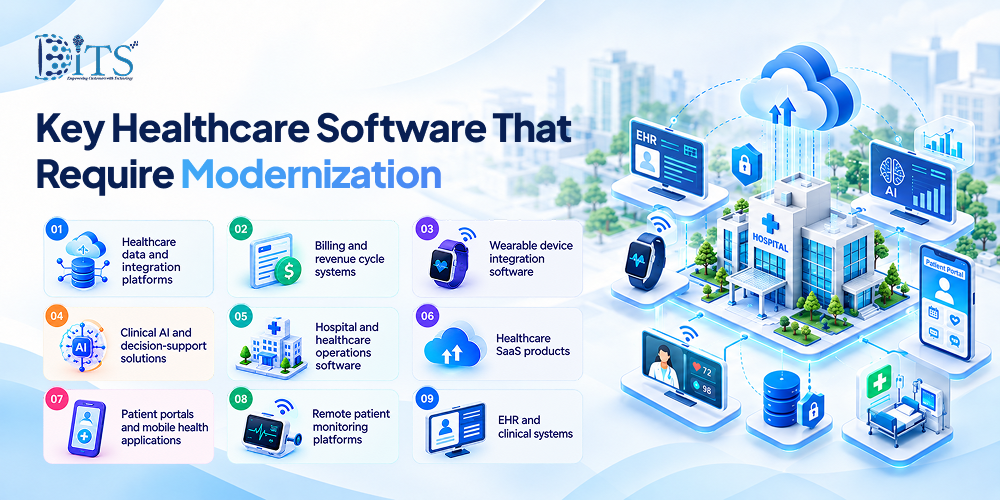
Key Healthcare Software That Require Modernization
Modernization needs can appear across many parts of a healthcare technology environment. The strongest elements are usually systems that have become difficult to integrate, scale, maintain, or adapt to changing clinical and operational workflows.
1. EHR and Clinical Systems
Electronic health record and clinical systems often sit at the center of care delivery, which means their limitations can affect multiple workflows at once. EHR adoption is already widespread. More than 99% of U.S. non-federal acute care hospitals had adopted a certified EHR by 2024, according to ONC data published in 2026.
These figures suggest that the next stage of EHR modernization is less about basic digitization and more about improving interoperability, standards-based APIs, automated data integration, usability, and connected clinical workflows.
2. Remote Patient Monitoring (RPM)
As Remote Patient Monitoring programs grow, the platform behind them has more to manage. Device connectivity issues, fragmented patient data, high alert volumes, limited EHR integration, and manual follow-ups can all create extra work for care teams. That is where modernizing the RPM becomes necessary. It may involve improving interoperability, strengthening device and API integrations, updating the platform architecture, or using analytics and AI-assisted prioritization where appropriate. The goal is simple - to help the program scale while keeping workflows feasible for the people running it.
3. Patient Portals and Mobile Health Applications
Patient portals and mobile health apps should make everyday healthcare tasks simple and connected. As these platforms grow, older systems may struggle to support new services, authentication methods, communication channels, or clinical integrations.
There are many areas where modernization can create a smoother experience. For instance, real-time appointment booking, secure digital payments for copays and other out-of-pocket costs, and clearer access to insurance information. Moreover, it can support asynchronous care, such as secure photo submissions and streamlined prescription refill requests. Alongside these features, organizations can improve usability, accessibility, mobile performance, identity management, APIs, and connectivity across the wider care environment.
4. Healthcare SaaS Products
Healthcare SaaS products often evolve through years. However, over time, technical debt can make the codebase harder to maintain. This may involve gradually separating tightly coupled components, such as billing or scheduling, from a monolithic application so they can be updated and scaled independently. Additionally, modern healthcare SaaS platforms may need standardized APIs that support FHIR and HL7, secure connections with EHR and EMR systems through SMART on FHIR, and reliable data pipelines for use cases such as Remote Patient Monitoring and high-volume clinical data ingestion. These connections must also include appropriate validation to maintain data quality and integrity.
5. Hospital and Healthcare Operations Software
Scheduling, care coordination, resource management, administrative workflows, and other operational systems can become inefficient when teams depend on disconnected applications or manual processes. Along with that, frequent spreadsheet use, duplicate data entry, and limited visibility across departments can indicate that the underlying software no longer fits the operational workflow. This is where modernization can help connect these processes and reduce unnecessary friction.
6. Clinical AI and Decision-Support Solutions
Clinical AI tools can become modernization areas when they are difficult to integrate with EHRs, rely on fragmented data, create extra steps for clinicians, or lack the governance and monitoring needed for ongoing use. As AI capabilities evolve, healthcare organizations may need to reassess the wider foundation around them, including data quality, interoperability, model monitoring, security, workflow integration, human oversight, and system performance.
7. Wearable Device Integration Software
Wearable and connected-device platforms can become difficult to manage as organizations add more devices, vendors, data sources, and care programs. Older integration layers may rely on custom connections, inconsistent data formats, or manual processes that make it harder to bring device-generated information into clinical workflows.
8. Billing and Revenue Cycle Systems
Billing and revenue cycle workflows depend on accurate information moving between clinical, administrative, and financial systems. Healthcare software product development modernization can strengthen the middle of the revenue cycle through computer-assisted coding. Moreover, using natural language processing, these tools can review clinical documentation, suggest applicable ICD-10 or ICD-11 codes, and flag missing or inconsistent information for human review.
At the claims stage, modern platforms can analyze historical payer patterns and identify potential claim issues before submission. This gives teams an opportunity to correct discrepancies earlier instead of relying primarily on retrospective denial appeals.
9. Healthcare Data and Integration Platforms
Healthcare data rarely exists in one place. It can be distributed across EHRs, patient applications, connected devices, operational systems, billing platforms, and analytics environments.
When these systems rely heavily on isolated or difficult-to-maintain connections, adding another application can increase complexity rather than improve it. Modernizing the integration and data layer can help create a more connected foundation for reporting, analytics, AI & automation, and future digital services.
The key point is that application modernization without considering the systems around it can leave the wider problem unresolved. Healthcare organizations should therefore assess software in the context of the people, workflows, data, integrations, and business processes that depend on it.
Key Compliance for Healthcare Software Product Development
Modernizing healthcare software also means reviewing whether the existing platform still meets current security, privacy, interoperability, and regulatory requirements. Older systems may rely on outdated access controls, legacy integrations, unsupported components, or data-handling practices that need to be reassessed as part of modernization. The exact requirements depend on the product, users, geography, and how the software handles health information.
HIPAA Compliance (U.S.)
Healthcare software products must comply with HIPAA regulations to protect patient health information. This includes implementing encryption, role-based access control, audit logs, and secure data transmission protocols to prevent unauthorized access and data breaches.
GDPR & Data Privacy Regulations
For global healthcare businesses, compliance with GDPR and regional data protection laws is mandatory. Healthcare software product development solutions must include consent management, data minimization policies, and secure cross-border data transfer mechanisms.
HL7 & FHIR Interoperability Standards
Interoperability is critical for integrating EHR, EMR, and third-party systems. Healthcare software product development services must follow HL7 and FHIR protocols to ensure structured data exchange between hospital systems, labs, insurers, and telehealth platforms.
FDA & Medical Device Regulations
If software performs diagnostic or clinical decision functions, FDA or regional medical device regulations may apply. Businesses developing AI-driven healthcare tools must document validation processes, risk assessments, and clinical safety evaluations.
SOC 2 & Cloud Security Compliance
Cloud-hosted healthcare platforms require SOC 2 compliance to demonstrate secure data handling practices. This includes continuous monitoring, incident response mechanisms, and infrastructure-level security controls within healthcare software product development environments.
ICD, CPT & Billing Standards Compliance
Healthcare products involving billing or revenue workflows must adhere to standardized coding systems such as ICD and CPT. Proper validation engines and audit trails ensure accurate claims processing and reduce regulatory risks for providers.
Why Choose DITS for Healthcare Software Consultation and Modernization
At DITS, healthcare software development modernization starts with understanding the business and healthcare workflow before deciding what technology to introduce.
From there, our approach moves through three connected stages: Understand & Advise, Validate & Plan, and Execute & Improve.
1. Understand & Advise Around the Business Priority
We begin by understanding what the organization is trying to improve, whether that involves patient access, clinical workflows, care coordination, administrative efficiency, revenue operations, or a new digital health product. This includes mapping current workflows, identifying friction, understanding user needs, reviewing existing systems, and defining the business outcomes the product should support.
2. End-to-End Custom Product Engineering
DITS provides complete product engineering services from requirement analysis and UI/UX prototyping to cloud deployment and maintenance. Businesses launching new healthcare products can visualize structured architecture, modular APIs, and scalable microservices aligned with their specialty workflows.
3. AI Integration into New and Existing Systems
We integrate AI models into both newly built platforms and legacy systems. Predictive analytics, clinical decision support, automated coding, and intelligent scheduling improve efficiency without disrupting ongoing operations, strengthening healthcare software product development solutions for measurable performance improvement.
4. Compliance-Driven and Secure Architecture
Our healthcare software product development approach prioritizes HIPAA compliance, role-based access control, audit logs, and encrypted data exchange. Multi-location providers can operate securely while meeting regional regulatory requirements and maintaining interoperability across EHR, billing, and third-party systems.
5. Scalable Infrastructure for Growing Healthcare Businesses
DITS designs cloud-native platforms using containerization and CI/CD pipelines to support business expansion. Startups, mid-size providers, and large enterprises can scale user volumes, integrate additional modules, and enhance system capabilities without performance bottlenecks.
See DITS Healthcare Software Products Development Services
Explore our portfolio across RPM, RCM, EHR, Medical Tourism, Population Health, Asset Monitoring, Wellness App, etc.
Custom healthcare software product development solutions allow businesses to align software with specific clinical workflows, payer requirements, and operational models. Unlike generic platforms, custom systems support specialty-based configurations, AI integration, and long-term scalability.
Nidhi Thakur
With more than 20 years of experience - I represent a team of professionals that specializes in the healthcare and business and workflow automation domains. The team consists of experienced full-stack developers supported by senior system analysts who have developed multiple bespoke applications for Healthcare, Business Automation, Retail, IOT, Ed-tech domains for startups and Enterprise Level clients