Top Use Cases of Conversational AI in Ecommerce
Table Of Content
Published Date :
20 Mar 2026
Key Takeaways
- Conversational AI in ecommerce improves customer engagement and conversions
- AI chatbots streamline order tracking and logistics in real time
- Ecommerce conversational AI enhances personalized product recommendations and filtering
- Conversational AI reduces cart abandonment with automated recovery strategies
- Businesses achieve scalable, multilingual customer support using AI systems
- AI-driven insights improve upselling, cross-selling, and revenue growth strategies
Conversational AI in Ecommerce is transforming how businesses manage customer interactions, sales processes, and post-purchase engagement. In real-world scenarios, ecommerce conversational AI handles product discovery by guiding users through catalogs based on intent, reducing bounce rates. It automates customer support by resolving order queries, returns, and refunds in real time, lowering support costs. Conversational AI for ecommerce also improves cart recovery by triggering personalized messages when users abandon purchases.
Businesses use conversational AI ecommerce systems to manage order tracking, sending proactive delivery updates that enhance customer trust. In large-scale operations, conversational AI in ecommerce integrates with CRM and inventory systems to provide accurate product availability and pricing instantly. For example, a fashion retailer can deploy AI chatbots to recommend products based on browsing behavior, increasing conversions. These use cases help startups, mid-size, and enterprise ecommerce businesses streamline operations while improving customer experience and revenue outcomes.
Stat & Demand of Conversational AI in Ecommerce
Conversational AI in ecommerce, powering chatbots and virtual assistants for personalized shopping, drives real-time engagement and sales in a rapidly expanding market. Valued at around $10-14 billion in 2026 (expected), it grows at 14-21% CAGR amid rising demand for instant, AI-driven customer interactions.
Market Statistics
The conversational commerce market hits $10.1 billion in 2026 (approx), up from $8.8 billion in 2025, projecting to $40.2 billion by 2036 at 14.8% CAGR. Broader conversational AI reaches $17.97 billion in 2026, fueled by ecommerce's need for omnichannel personalization and voice commerce. AI chats boost conversions 4x (12.3% vs. 3.1%) and enable $290 billion in 2025 spend through messaging channels.
Demand Drivers
89% of ecommerce firms use or test AI, with 64% of sales from first-time shoppers via chat, signaling high adoption for product discovery and support. Demand surges from smartphone messaging (e.g., WhatsApp, Instagram), where proactive recommendations and in-chat payments cut cart abandonment. Retailers like Walmart report 40% more purchases and 2.5x higher spend from conversational AI engagement.
Key Benefits Comparison
| Metric | With Conversational AI | Without AI |
| Conversion Rate | 12.3% | 3.1% (4x lift) |
| Average Order Value | 2.5x higher | Baseline |
| New Customer Acquisition | 64% of sales | Lower (traditional search) |
| Response Time | Instant / Real-time | Delayed (email/tickets) |
Top Use Cases of Conversational AI in Ecommerce
Implementing conversational AI in ecommerce transforms how brands interact with digital shoppers. This technology streamlines buyers’ journeys by integrating NLP and machine learning into storefronts. It allows startups and large scale businesses to automate complex service tasks while maintaining high levels of personalization and operational efficiency.
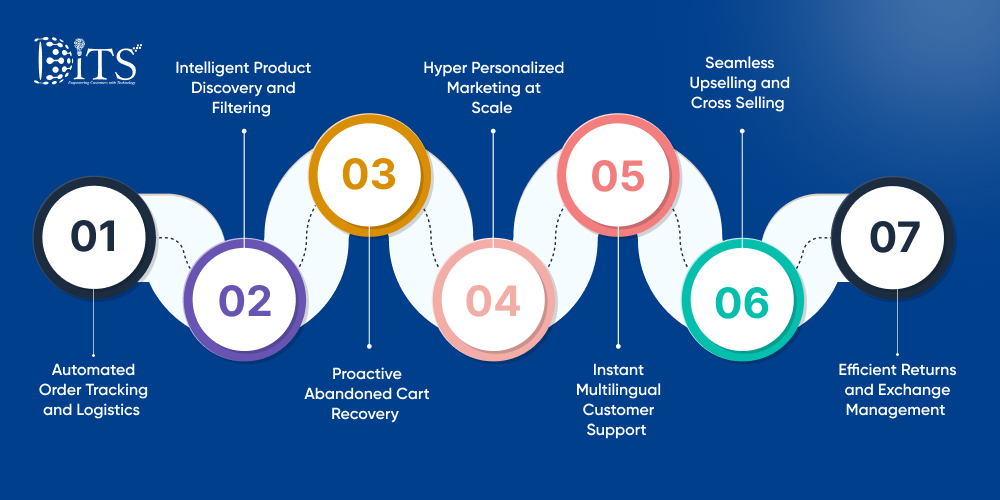
Automated Order Tracking and Logistics
Customers use conversational AI for ecommerce to get real time updates on shipments with the help of IoT. By connecting to APIs, the chatbot provides precise delivery timelines and status changes. This reduces the burden on support teams and minimizes "where is my order" inquiries for growing online retailers.
Intelligent Product Discovery and Filtering
Shoppers find items through natural dialogue rather than rigid menus. Conversational AI in ecommerce analyzes user intent to suggest relevant products based on size, color, or budget. This guided selling approach mimics an in store assistant, significantly increasing conversion rates for specialized retail platforms.
Proactive Abandoned Cart Recovery
AI agents send personalized reminders when users leave items in their digital baskets. By offering small incentives or answering last minute product questions, ecommerce conversational AI re-engages hesitant buyers. This direct intervention recovers lost revenue without requiring manual marketing effort from business owners.
Hyper Personalized Marketing at Scale
The system utilizes historical purchase data and browsing behavior to push tailored promotions via chat. Conversational AI for ecommerce ensures that discounts are relevant to the individual. This targeted strategy improves engagement and builds long term brand loyalty through data driven customer interactions.
Instant Multilingual Customer Support
Deploying conversational AI allows businesses to support a global audience in multiple languages. The software handles FAQs and troubleshooting instantly without hiring regional staff. This 24/7 availability ensures that international shoppers receive immediate assistance, regardless of their specific time zone.
Seamless Upselling and Cross Selling
During the checkout process, the chatbot identifies complementary products based on the current cart. Conversational AI in ecommerce suggests logical add-ons like batteries for electronics or matching accessories for apparel. This automated tactic increases average order value through intelligent, non-intrusive product recommendations.
Efficient Returns and Exchange Management
The AI manages the end to end return process by verifying policy compliance and generating shipping labels. Ecommerce conversational AI handles these repetitive tasks quickly, ensuring a smooth experience for the customer. Businesses save on administrative costs while maintaining a professional and reliable brand image.
Ditstek Innovations is the leading AI chatbot development company for ecommerce businesses. Whether you are a startup or a large scale enterprise, we build custom healthcare and retail software from scratch.
6 Steps to Integrate Conversational AI in Ecommerce Platform
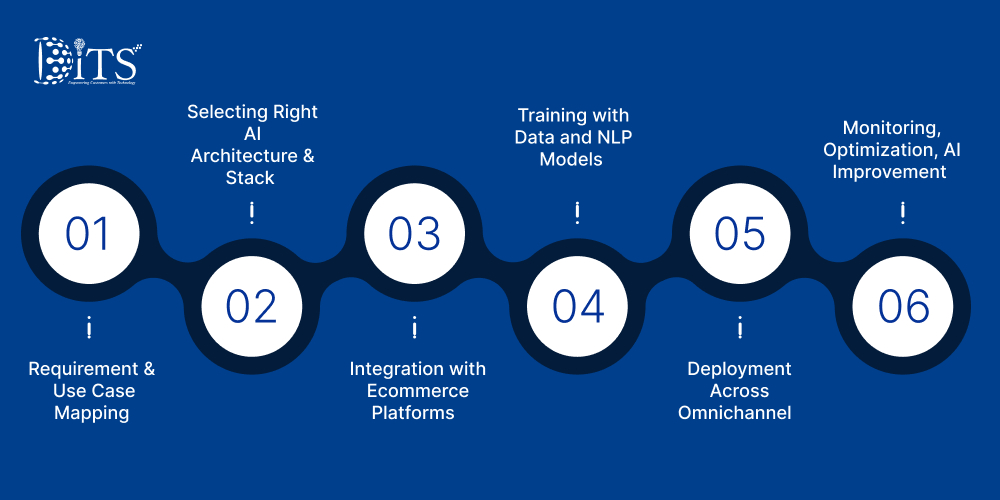
Integrating conversational AI in Ecommerce requires a structured approach, from requirement analysis to deployment and optimization. This section explains how ecommerce conversational AI is implemented with scalable architecture, AI integration, and continuous model improvement for business outcomes.
Requirement & Use Case Mapping
Start by defining business goals such as lead generation, customer support, or sales automation. A well-structured conversational AI ecommerce strategy maps use cases like order tracking, product recommendations, and cart recovery aligned with your ecommerce workflows.
Selecting Right AI Architecture & Stack
Implementing conversational AI in ecommerce requires choosing the right LLMs, NLP frameworks, and backend infrastructure. Businesses must work with an AI development company to design a scalable, API-first architecture that supports high-volume interactions and future integrations.
Integration with Ecommerce Platforms
Ecommerce conversational AI connects with platforms like Shopify, Magento, or custom systems via REST APIs and webhooks. This ensures real-time synchronization of product data, inventory, and order details, enabling accurate responses and seamless user interactions.
Training with Data and NLP Models
Conversational AI for ecommerce must be trained on product catalogs, customer queries, and historical interactions. Fine-tuning NLP models ensures the chatbot understands intent, handles variations in queries, and delivers context-aware responses across use cases.
Deployment Across Omnichannel
Once built, conversational AI in ecommerce should be deployed across web, mobile apps, and messaging platforms like WhatsApp and Instagram. This ensures consistent engagement and allows users to interact from their preferred channel without disruption.
Monitoring, Optimization, AI Improvement
Post-deployment, ecommerce conversational AI requires ongoing monitoring through analytics dashboards. Businesses track KPIs like response time and conversion rates while continuously improving models. Partnering with an AI chatbot development company ensures iterative updates, performance tuning, and long-term scalability.
Also Read: Benefits of Enterprise AI Chatbot Development Service for Ecommerce
How Much Does it Cost to Build & Integrate Conversational AI for Ecommerce
Ditstek Innovations offers scalable development tiers. By focusing on a high-impact MVP (Minimum Viable Product) and essential integrations, startups and mid-size businesses can deploy a sophisticated AI solution within a streamlined budget.
| Development Phase | Cost Range (USD) | Estimated Timeline | Key Technical Components |
| Discovery & Technical Mapping | $3,000 – $7,000 | 1–2 Weeks | Business logic definition, intent mapping, and platform architecture design |
| Data Engineering & RAG Setup | $5,000 – $12,000 | 2–3 Weeks | Vector database indexing (Pinecone/Milvus) and knowledge base integration. |
| Core NLP & Model Training | $7,000 – $20,000 | 4–6 Weeks | Fine-tuning LLMs (Llama 3/GPT-4) and prompt engineering for brand voice. |
| Ecommerce Stack Integration | $5,000 – $15,000 | 3–5 Weeks | API hooks for Shopify/Magento, inventory sync, and basic CRM connectivity. |
| UI/UX Design & Frontend | $3,000 – $8,000 | 2 Weeks | Responsive chat interface and custom widget deployment for web/mobile. |
| QA, Security & Deployment | $2,000 – $13,000 | 2–3 Weeks | UAT testing, encryption protocols, and cloud launch (AWS/Azure). |
| Total Estimated Investment | $25,000 – $75,000 | 3–5 Months | Production-ready, custom AI chatbot for ecommerce. |
Strategic Considerations for this Budget Range
- Modular Growth: This range allows for a powerful "V1" product that automates 70-80% of common queries and sales tasks, which can then be scaled as revenue increases.
- Targeted Integrations: Focuses on the most critical APIs (Inventory + Payment) to ensure the highest immediate ROI for your startup or mid-sized business.
- Proprietary Control: Unlike "off-the-shelf" SaaS bots, this is a custom-built product owned by your business, ensuring data privacy and unique functionality.
Feature Comparison: Custom Conversational AI Development
| Feature Category | Essential AI Build ($25K) | Enterprise AI Integration ($75K) |
| Core AI Engine | Pre-trained LLM with custom system prompts (GPT-4o / Llama 3). | Fine-tuned proprietary models + RAG (Retrieval-Augmented Generation). |
| Data Knowledge Base | Static PDF/Doc indexing (up to 50 documents). | Real-time dynamic syncing with SQL databases & Cloud storage. |
| Integration Depth | Basic API hooks (Shopify, WooCommerce, or Magento). | Deep bi-directional sync (ERP, CRM, Inventory, & Multi-carrier Shipping). |
| Conversation Logic | Linear intent mapping & FAQ automation. | Multi-turn reasoning, sentiment analysis, & proactive lead scoring. |
| Platform Reach | Single channel (Web-based chat widget). | Omnichannel (Web, iOS/Android App, WhatsApp, & Instagram). |
| User Personalization | Basic "First Name" and past order lookup. | Hyper-personalized recommendations based on full behavioral history. |
| Security & Compliance | Standard SSL encryption & GDPR basics. | HIPAA/SOC2 compliance, PII masking, & Advanced Pen-Testing. |
| Language Support | Single Language (English). | Full Multilingual support (up to 15+ languages). |
| Analytics Dashboard | Basic usage logs (Total chats, bounce rate). | Advanced BI integration (Conversion lift, AOV tracking, Heatmaps). |
Which Level Fits Your Business?
$25K Budget: Ideal for Startups looking to automate 80% of customer support and basic sales inquiries. It will be a "from-scratch" solution that establishes your brand's AI presence with professional-grade stability.
$75K Budget: Designed for Mid-size to Large Ecommerce Businesses that require a fully autonomous agent. This version doesn't just "talk", it will execute complex business logic, manage returns, and act as a dedicated 24/7 high-performance salesperson.
Get Custom Budget
Receive a detailed estimate based on your project scope, features, and integration needs. Partner with a specialized AI chatbot development company to ensure seamless deployment and measurable results.
Why Choose DITS for Conversational AI Development
Choosing the right partner for conversational AI in ecommerce impacts system performance, scalability, and business outcomes. This section outlines how a specialized team designs, integrates, and optimizes ecommerce conversational AI solutions tailored to real business workflows and customer engagement needs.
End-to-End Conversational AI Engineering
DITS delivers complete conversational AI ecommerce solutions, from requirement analysis to deployment and optimization. Businesses get structured architecture, NLP pipeline design, and API integrations, ensuring smooth chatbot functionality across product discovery, support automation, and transaction handling.
AI Integration with Existing Ecommerce Systems
We integrate AI into platforms like Shopify, Magento, and custom systems. Real-time API connections enable inventory sync, order tracking, and personalized recommendations, allowing businesses to enhance operations without disrupting existing workflows or infrastructure.
Scalable and Enterprise-Grade Architecture
Conversational AI in ecommerce requires scalable systems to handle high traffic and multiple user interactions. DITS builds cloud-native, microservices-based architectures that support millions of queries, ensuring consistent performance for startups, mid-size businesses, and large enterprises.
Domain-Focused AI Optimization
Our approach to conversational AI for ecommerce includes continuous model training using real customer interactions. This ensures better intent recognition, higher response accuracy, and improved conversion rates, helping businesses maintain efficient and intelligent customer engagement at scale.
FAQs-Conversational AI in Ecommerce
1. What is conversational AI in ecommerce and how does it work?
Conversational AI in ecommerce refers to AI-powered chat systems that interact with customers using natural language. It uses NLP, machine learning, and API integrations to handle queries, recommend products, and automate support within ecommerce platforms.
2. How can conversational AI ecommerce improve sales and conversions?
Conversational AI ecommerce improves conversions by guiding users through product discovery, offering personalized recommendations, and recovering abandoned carts. It reduces friction in the buying journey and provides real-time assistance, leading to higher engagement and completed purchases.
3. What business challenges can conversational AI for ecommerce solve?
Conversational AI for ecommerce helps address high support costs, delayed responses, cart abandonment, and lack of personalization. It automates repetitive tasks, improves response time, and enhances customer experience through intelligent interactions.
4. Can ecommerce conversational AI integrate with existing platforms?
Ecommerce conversational AI integrates with platforms like Shopify, Magento, and custom systems using APIs and webhooks. It enables real-time data sync for inventory, orders, and customer interactions without disrupting existing workflows.
5. Why should businesses choose DITS for conversational AI development?
DITS is a leading AI chatbot development company delivering scalable conversational AI in ecommerce solutions with AI integration, secure architecture, and domain expertise. We help businesses build intelligent systems that improve automation, customer engagement, and operational efficiency.
6. How can DITS help implement conversational AI ecommerce solutions for my business?
DITS provides end-to-end conversational AI ecommerce development, including design, integration, and optimization. We also offer AI integration into existing systems to enhance performance. Contact us to build a tailored conversational AI solution aligned with your business goals.

Dinesh Thakur
21+ years of IT software development experience in different domains like Business Automation, Healthcare, Retail, Workflow automation, Transportation and logistics, Compliance, Risk Mitigation, POS, etc. Hands-on experience in dealing with overseas clients and providing them with an apt solution to their business needs.
Recent Posts
Automated document processing helps reduce cargo insurance claim delays by streamlining document handling, validation, and claims workflows.

Automated document processing helps reduce cargo insurance claim delays by streamlining document handling, validation, and claims workflows.
Discover how chronic care management software uses algorithmic triage to identify patient risk, prioritize care, and improve care team efficiency.