Key Takeaways
Disconnected systems lead to redundant data input, incompatible medication records, and delayed communication with pharmacies.
EHR integration gives prescribers access to current medication history, allergy information, diagnoses, and treatment records. on medication history, allergies, diagnoses, and treatments, enabling better prescribing outcomes
The integration of a patient portal gives patients the access to medication information, refill requests, updates, and safe communication.
HL7 and FHIR standards, along with e-prescribing technologies, support structured and secure healthcare data exchange in modern healthcare systems.
Healthcare organizations can modernize and improve their existing prescription software products using APIs, middleware, workflow automation, and modern modules rather than replacing it.
The phased approach to integration saves organizations from losing their investment and mitigates transition risks, allowing businesses to retain their work processes.
The integration of EHRs, pharmacies, and patient portals can improve prescription processing, decrease the number of errors, and reduce manual administrative work.
The total replacement of the software is usually more appropriate when the current software is not secure or supported, is difficult to improve, or does not meet future demands.
Patient portals, pharmacies, and EHRs being disconnected cause manual data entry and tracking and compel staff to resolve gaps across different platforms. For this reason, prescription management software often fails to deliver the efficiency healthcare organizations expect.
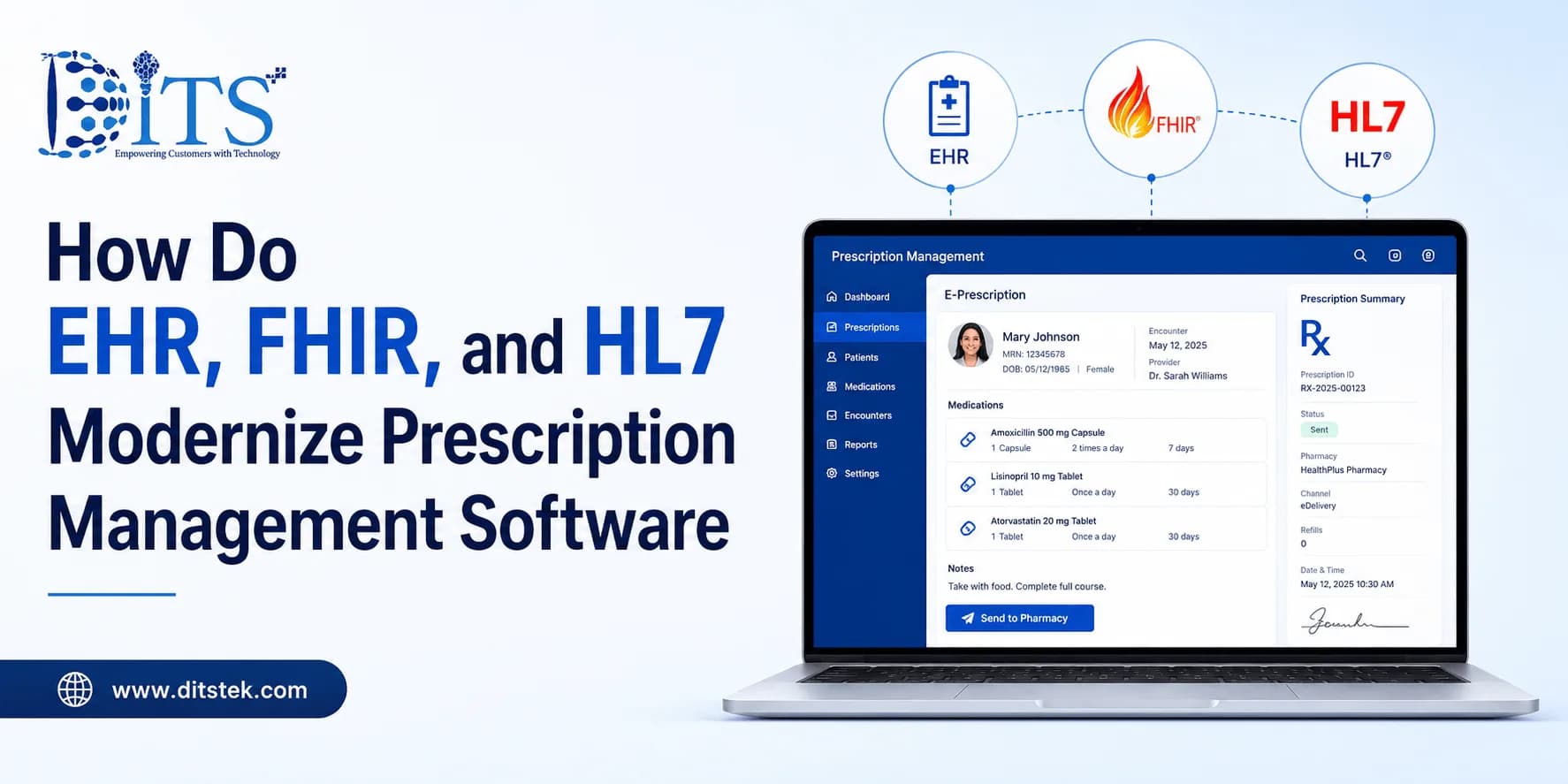
Through EHR integration and interoperability using FHIR and HL7 standards, organizations can ensure that data flows efficiently and that prescriptions are managed without changing all software systems.
Why Prescription Management Software Still Creates Workflow Gaps
Standalone prescription management software may support parts of the prescription process, but it still fails to manage the medical journey effectively. Workflow challenges arise if there is a breakdown of communication among pharmacies, patient portals, and electronic health record systems, including the following ones:
Data redundancy: The same prescription information must be entered several times in various systems which takes a lot of time and increases the risk of errors.
Unsynchronized medication records: An update can happen in one system with the update may not be synchronized with the other system.
Delayed pharmacy communication: There will be a lack of automatic flow of requests, clarifications, cancellations, and status updates to the pharmacy.
Outdated patient information: The portal can provide outdated medication information or can fail to provide sufficient information.
Human intervention: Employees will be forced to make phone calls to the pharmacy or to manually review information across different systems.
Such disconnected workflows can lead to prescription delays, duplicate documentation, medication discrepancies, higher administrative workload, and poor patient visibility.
This is one of the main reasons prescription management software should be connected to the overall healthcare system. The connection makes sure that information is shared effectively among the doctor, pharmacist, and patient. This way, the risk of manual data-entry and communication errors can be reduced.
How Integrated Systems Strengthen Prescription Management Workflows
Prescription management software is far more effective when integrated with the systems of doctors, pharmacies, and patients. These integrations minimize the manual transfer of information, help ensure the consistency of the data, and allow the prescription journey from prescribing to dispensing to go smoothly.
Integration of EHRs enables authorized prescribers and clinicians to access the latest information on a person’s medical treatment history, allergies, diagnoses and medical conditions, and treatments they are currently undergoing.
Key Benefits
Availability of current information on medications and allergies
Less duplication of effort across healthcare information systems
Improved correctness of medication records
Greater efficiency of clinical alerts and clinical decisions
Reduced time spent retrieving and reconciling medication information
Patient Portal Integration
Patient portals give patients direct access to their prescription information and status updates, allowing them to review their medications, submit refill requests, and receive notifications without repeatedly contacting the clinic or pharmacy. This brings transparency and reduces administrative work.
Key Advantages
A simple way to access current medication details
Ability to request refills online
Updates on prescription status, refill approvals, refill denials, and pharmacy processing
Notifications about pharmacy fulfillment, pickup, or delivery, where supported
Secure communication with the care team
HL7, FHIR, and ePrescribing
HL7 and FHIR standards, along with e-prescribing services, can form part of the technical foundation of prescription system connectivity. HL7 standards support structured data exchange between compatible healthcare systems, while FHIR supports standardized healthcare data exchange and is commonly implemented through RESTful APIs. Finally, e-prescribing supports the secure electronic transmission of prescriptions and related transactions between healthcare providers and pharmacies and to manage them.
Key Advantages
The standardized sharing of patient and medication data
The opportunity to connect to modern and legacy systems
The assurance of secure practices of issuing prescriptions, refills, and cancellations
Facilitation of faster synchronization across numerous healthcare applications
Phased modernization without full system replacement
How Integration Modernizes Existing Prescription Software Without Full Replacement
Healthcare organizations don't always have to think about replacing their existing prescription systems. Sometimes, the initial software works properly but is not connected with anything or doesn't have the capabilities of the new interoperability protocols.
The modest integration can help quiet all the mentioned issues without shifting to a new technology platform for healthcare organizations. Here are some examples:
Add APIs to connect existing applications
Implement FHIR interfaces
Use HL7 for connecting outdated systems
Implement middleware to manage data movement
Introduce ePrescribing into the workflow
Connect prescription software with patients' portals
Automate work processes for refills and clarifications
Change only malfunctioning modules
This allows organizations to keep the benefits of the systems they use while enhancing prescription data transfers.
The principal advantages of this integration include:
Protecting existing software investments
Minimizing migration and integration risks
Limited interference with clinical work processes
Reduced number of required retrainings
Better management of development costs
The ability to test everything gradually
In situations where the existing platform is not secure, lacks support, does not scale well, and cannot accommodate future requirements, then targeted integration is often a more practical and cost-effective path to modernization.
Advantages of Integrating EHRs, Pharmacies, and Patient Portals for Businesses
Integrating EHRs, pharmacy systems, and patient portals streamlines the prescription process. Healthcare institutions do not need to transfer data manually from one system to another but rather ensure that prescription-related data is maintained in sync among clinical, operational, and patient portals. All of this leads to increased efficiency and a decrease in delays and errors.
Quick Prescription Processing
All details on prescriptions, refill orders, queries, and status updates can be conveyed to pharmacists, healthcare professionals, and patients much more quickly.
Reduction in Medication Errors
When records are automatically synchronized, the likelihood of errors due to outdated medication lists, information loss, and duplicate entries is considerably reduced.
Reduced Duplicate Documentation
Administrative and clinical teams can avoid duplicating prescription entries across different systems, saving time and maintaining consistency.
Lower Administrative Burden
Automation helps reduce phone calls, faxes, follow-ups, status verifications, and manual work in the prescription process.
Better Patient Visibility
Patients get more precise information on prescription approvals, refill requests, pharmacy status, and the receipt and delivery of medicines.
Improved Operational Control
Healthcare managers will be able to better track pending requests, failed transactions, fulfillment delays, and workflow choke points.
Greater Value From Existing Software
This will make the current prescription management software more valuable by adding connectivity and automation, without requiring immediate changes to the software.
How Ditstek Supports Prescription Software Integration and Modernization
At Ditstek, we collaborate with businesses by providing top grade consulting services to modernize prescription workflows with the right approach. Instead of proposing a technology replacement, we assess your technology environment, identify interoperability challenges, and develop the most practical modernization path.
Our experience in healthcare software development, integration, HL7, FHIR, ePrescribing, APIs, and legacy system modernization allows us to assist you in connecting your EHR, pharmacy applications, and patient portal into a unified prescription ecosystem.
Why wait? Schedule a consultation with our professionals and get started.