With more than 20 years of experience - I represent a team of professionals that specializes in the healthcare and business and workflow automation domains. The team consists of experienced full-stack developers supported by senior system analysts who have developed multiple bespoke applications for Healthcare, Business Automation, Retail, IOT, Ed-tech domains for startups and Enterprise Level clients
Investing in Epic EHR is a significant financial decision for hospitals and healthcare practices. Known for its robust features and wide adoption among large healthcare organizations, EPIC remains one of the most popular EHR platforms available today. However, the cost of EPIC is a major concern for small, medium, and even large hospitals and medical facilities. The cost of implementing the solution may grow significantly if there are several facilities involved, along with legacy software and complex clinical processes.
So what is the cost of Epic EHR for a hospital? How can healthcare executives decide on whether an investment is worth making?
There is no one-size-fits-all price. Each organization faces its own cost of Epic due to the size of a particular company, selected modules, type of deployment, and implementation requirements. While some health systems implement multimillion-dollar EHR projects, others deploy the solution in a different way, commercially.
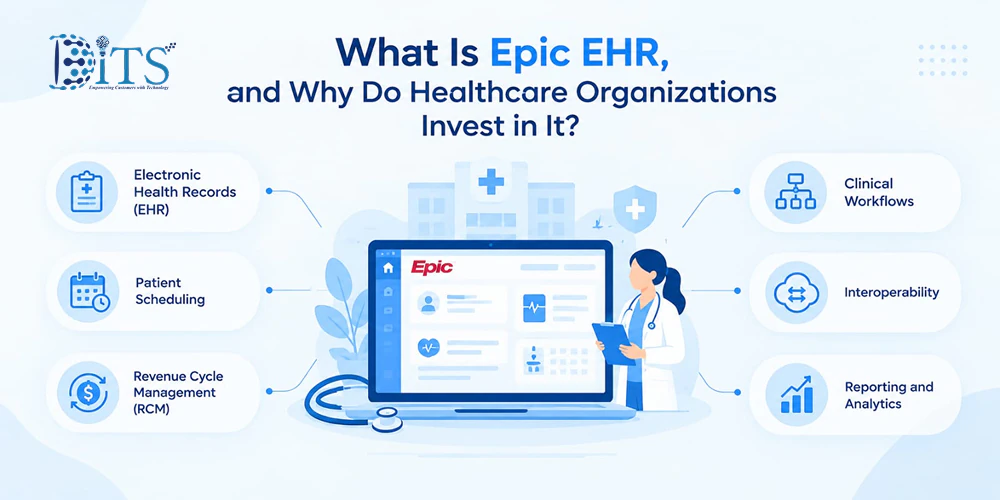
What is Epic EHR, and Why Do Healthcare Organizations Invest in It?
EPIC is a medical software used in healthcare that supports secure data management, improves the accessibility of patient records, and helps ensure information accuracy across the care continuum.
To put its significance in perspective, EPIC holds a substantial market share in the United States healthcare system. It’s used by many leading institutions, including Mayo Clinic, Johns Hopkins, and Cleveland Clinic, making it one of the most widely adopted EHR platforms in the country.
Peek through the key abilities that compels healthcare organizations to invest in this software;
Electronic Health Records (EHR): Records all necessary information about the patient, illness and treatment methods. Ensures the healthcare professionals have all the required and accurate information about the patients.
Patient Scheduling: Manages bookings, registrations and doctors’ availability. Prevents any problems with scheduling.
Revenue Cycle Management (RCM): Deals with billing, claims and payments. Eliminates errors and makes the process more efficient.
Clinical Workflows: Enhances clinical records keeping, orders and coordination. Enables efficient execution of the everyday tasks of medical practitioners.
Interoperability: Makes it possible to connect Epic with all the compatible medical records keeping systems and exits access to the data exchange.
Reporting and Analytics: Shows how the healthcare organization performs by using its clinical and financial data.
Get a Custom Epic Cost Breakdown!
Costs for Epic vary based on your hospital or clinic's size and needs. Let us help you understand what it means for your facility.
Whether it's a small clinic or a large hospital, the cost of EPIC varies significantly as it depends on a wide variety of parameters. Small practices or clinics have different needs than hospitals. They typically manage fewer patient records and offer a limited range of services.
Hospitals, especially those with multiple locations, require a system that can handle large volumes of patient data and complex business operations. Due to this scale, their costs for EPIC tend to be much higher.
Here’s a quick breakdown of typical costs for an average hospital:
Setup cost: $50,000 to $500,000 or more, depending on size, requirements, and software complexity
Monthly fees: $20,000 to $35,000, covering support, maintenance, and licensing
These numbers are estimates and can vary widely based on the specific features a hospital needs and the scale of implementation. For example, a multi-location hospital system with advanced modules and integrations will be at the higher end of the range.
So, when you ask, “How much does EPIC cost for a hospital?” The simple answer is that it’s a significant investment, often ranging from tens of thousands to several hundred thousand dollars upfront, plus ongoing monthly fees.
How Much Does Epic Cost for a Small Clinic?
Small clinics and practices have different needs and budgets compared to large hospitals. Their patient volumes are lower, and they usually don’t require all the advanced features that hospitals use. As a result, their EPIC implementation costs are significantly lower.
Typical features often excluded in small clinic setups include:
Complex multi-location scheduling and billing
Advanced analytics and reporting modules
Extensive specialty-specific workflows
Large-scale interoperability with other health systems
For smaller practices, EPIC offers a tailored solution called “Epic Garden Plot.” This is a more affordable, scaled-down version designed specifically for smaller healthcare providers. It provides essential functionalities such as:
Patient scheduling and registration
Basic clinical documentation
Secure patient record management
Cost-wise, small clinics can expect:
Setup cost: Approximately $10,000 to $50,000
Monthly fees: Around $2,000 to $10,000, depending on the size and features selected
The Garden Plot solution helps small clinics access EPIC’s robust platform without the complexity or cost burden of full hospital-scale systems.
How Much Does Epic EHR Cost Per Month?
When it comes to ongoing expenses, the monthly cost of using Epic EHR depends on several factors, including the size of the healthcare provider, the number of users, and the specific services included in the contract.
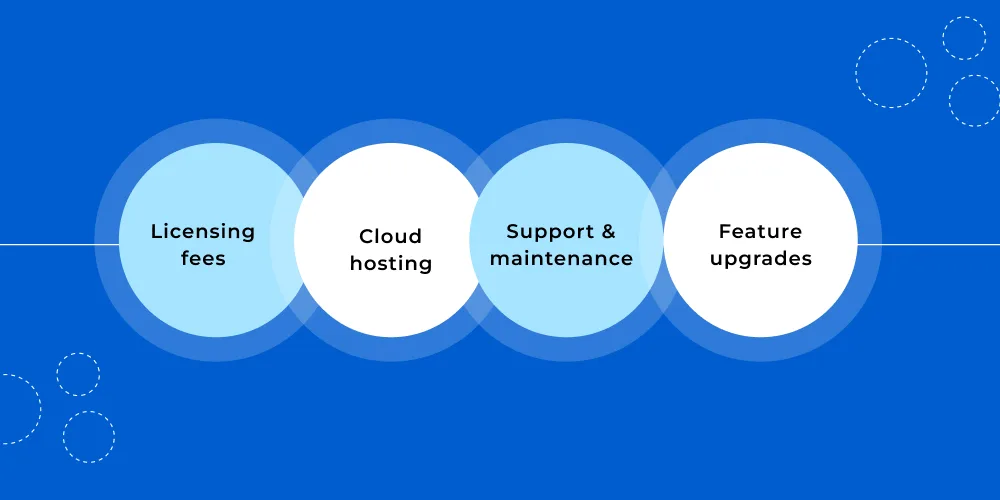
Here’s a quick breakdown of what these recurring costs typically cover:
Licensing fees: Charges for the right to use Epic’s software, often based on the number of users or devices accessing the system.
Cloud hosting: Fees for storing patient data securely on Epic’s cloud infrastructure or third-party cloud services.
Support and maintenance: Regular technical support, software updates, and troubleshooting to keep the system running smoothly.
Feature upgrades: Access to new features and enhancements as Epic rolls out updates over time.
Because contracts and needs vary widely, monthly fees can fluctuate significantly. For hospitals, this can mean anywhere from $20,000 to $35,000 or more per month, while smaller clinics will pay less depending on their setup.
Understanding these ongoing costs helps healthcare organizations plan budgets and ensures they get the right balance between functionality and affordability.
Get Clarity on Epic Implementation Costs!
Don’t make decisions in the dark. Fill out the form and receive a customized cost analysis for your clinic or hospital.
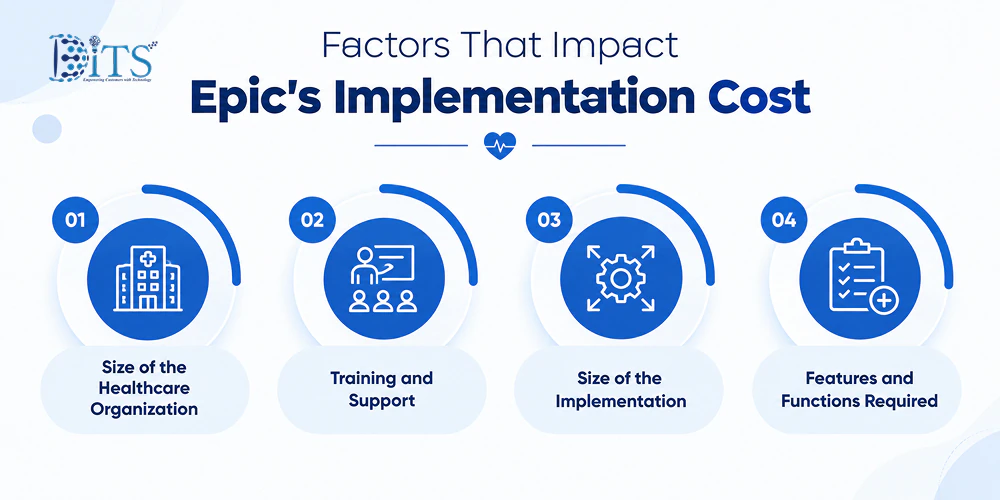
The total cost of Epic EHR software depends on several factors, including the size of the implementation, system design, feature complexity, and ongoing maintenance. However, the major cost is typically influenced by three key factors outlined below:
Size of the Healthcare Organization
The size of a hospital can greatly influence the cost of implementing an Epic EHR system. A large-sized hospital having several departments, a larger number of patients, and a complex workflow would need many integrations and configurations and thus, more investment in enterprise application development. However, small-sized hospitals and stand-alone clinics have lesser requirements, and thus their cost would be relatively lower. They can even go for Epic Community Connect to get EHR features.
Training and Support
Most people think that Epic software is complicated to use. However, this very complication is actually the difficulty in getting used to its interface. The company, of course, offers training and support, but these are billed separately, which adds to the total cost of EPIC software. The more support and training you require, the more they will add to the cost.
Size of the Implementation
As expected, the price of Epic is influenced by the size of the healthcare organization. From independent small clinics to huge hospital systems, Epic promises to have the right solution for every organization. Naturally, a small practice will not need the full enterprise setup of Epic as much as a large hospital might. It is basically priced on the scope of the Epic solution that you require. A silver lining is that it is possibly negotiable, depending on your size and your specific objectives.
Features and Functions Required
Suppose a huge hospital serves a high patient volume; its EHR needs would be very vast, demanding a wide range of features. It works the same way for Epic. If your practice is looking for specific, customized features outside what's normally offered, the price will be raised. The more customized and the more feature-rich your Epic system should be, the more you're going to put into it.
EPIC Cost Based on the Size of the Organization
Large Hospitals
Implementation of Epic for a large hospital may require a hefty upfront investment, which can go as high as $500,000 without including any custom features. Said price, however, goes even higher for custom advanced features and upgrades. Generally, large hospitals might expect an additional monthly fee of about $35,000 for their Epic EMR system.
Small/Independent Clinics
When it comes to using an EPIC system for small facilities, the question arises, how much does EPIC cost for a small clinic. An enterprise software solution might seem expensive to small clinics. It may cost around $1200 without customizations. Generally, small clinics and healthcare facilities prefer limited customization to keep the cost within their small budget.
Epic EHR Cost Breakdown (Development + Implementation)
A major part of the EPIC EHR system is the EPIC software. That is why it is important to consider the cost of EPIC software when it comes to getting an EPIC EHR system for your healthcare organization. So, let's dive into the cost breakdown of EPIC software.
Total estimated cost range: $170,000 to $690,000+
Note: Many healthcare organizations license Epic’s software rather than developing it from scratch, which can affect costs significantly.
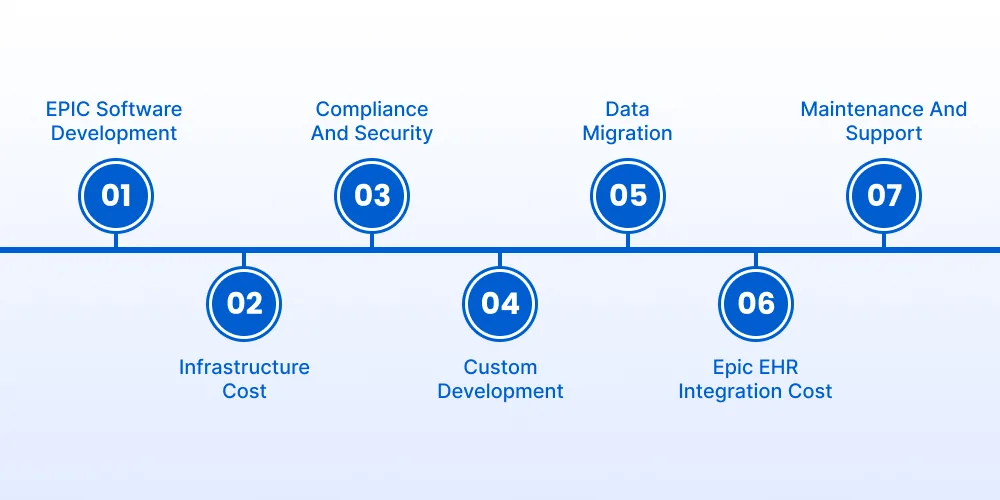
EPIC Software Development
The development part consists of both the frontend and backend coding for building of core functionalities, UI/UX interface and design, APIs and database. The total cost varies between $100,000 and $300,000 depending on the features complexity and location of the custom healthcare software development company.
Infrastructure Cost
The infrastructure consists of multiple things, including hosting and cloud services, servers, storage, and backups which costs between $10,000 and $50,000. However, healthcare organizations need to scale up the infrastructure with the growing user base and data volume which adds to the cost.
Compliance and Security
Every software and system used in healthcare organizations should adhere to the compliance regulations like HIPAA, and data security regulations. So, the EPIC software should adhere to HIPAA, and it should have data encryption for security of user data. To make the software adhere to compliance and security regulations, it cost between $20,000 to $80,000.
Custom Development
However, to suit your specific requirements costs money. Still, with its abundant customization features and the ability for integration, Epic is a giant masterpiece! The more custom features and integrations you include, the higher the price of your Epic system will be as well. You should think carefully about which customizations are really necessary in order not to exceed your budget.
Data Migration
The cost of moving your old data over can be one of the largest expenses for implementing Epic. This is a costly and time-consuming process. If your data is fairly simple and low-volume, you could see lower migration costs. But complex data can run up that cost into thousands of dollars.
Epic EHR Integration cost
To use the EPIC system more efficiently, you need to integrate it with your existing systems. Integration with existing applications and systems like lab systems, billing software, and pharmacy, makes the data exchange easier with the EPIC system. Integration of EPIC with other healthcare systems can cost anywhere between $15,000 and $60,000. Again, it depends on the number of systems and applications that need to be integrated.
Maintenance and Support
Maintenance and support is important to ensure that the EPIC works continuously without issues or technical errors. It involves the ongoing operational support and software enhancements, updates, bug fixes and help desk support which costs between $25,000 and $100,000 per year. However, maintenance and support is often required in long term service agreements, while some organizations may prefer it for a limited period.
Want an Exact Number, Not Just Ballpark Figures?
Fill out the form and we’ll give you a detailed Epic cost breakdown based on your facility type and size.
Evaluating Total Cost of Ownership and Long-Term ROI of Epic EHR
The cost of Epic EHR go beyond the setup cost alone. Other costs, such as licensing, integration of system, infrastructure, training, and afterward maintenance, add to the total cost of ownership (TCO) of Epic EHR. Assessing these costs in conjunction with benefits from operation enables hospitals to find out if investing in Epic is worthwhile.
TCO for Five Years
Approximation of TCO of five years is a helper for hospitals in comparing the first cost against the recurring costs and enabling long-term budgeting of technology expenditures.
Specified Cost Category
Initial Costs
Ongoing Costs
Licensing
Cost of initial licensing
Cost of renewal or subscription
Implementation
Cost of configuration and deployment of Epic
Cost of software improvements
Integration
Cost of connectivity with current systems
Cost of maintenance of interface
Infrastructure
Cost of hosting and installation
Cost of upgrading
Training & Support
Cost of training staff and assistance during go-live
Cost of ongoing support
Evaluating Epic EHR Return on Investment
A hospital needs to evaluate the ROI of Epic EHR using performance improvements from better efficiency, billing, system integration, and productivity. Comparing them against the total investment will show if the Epic EHR system provides enough business value.
Is It Worth It to Spend on Epic? Comparing Your EHR Solutions
Even being expensive, Epic EHR can become an appropriate investment for certain companies. However, all hospitals do not necessarily require the replacement of the existing system.
Epic EHR: Cost vs. Advantages at a Glance
Advantages: Centralized storage of data, information exchange improvement, integration of clinical work processes, and advanced reporting capabilities.
Cost: Licensing fees of the software, system implementation, integration, purchase of hardware, personnel training, and maintenance fees.
Choosing the Most Effective EHR Strategy for Your Business
Healthcare Setting
Recommended Approach
Business Considerations
Large Hospitals and Health Care Networks
Implementation of Epic EHR
Applicable for complicated health care organizations.
Hospitals with Disconnected Systems
Integration or modernization of EHR systems
Improves information exchange without requiring replacement of the system.
Small Hospitals and Clinics
Hosted EHR solutions or modernization
Ensures work process automation and considers the budget issues.
Healthcare Organizations with Specific Needs
Custom healthcare software or EHR extensions
Solves certain functional problems not covered by the existing solutions.
How DITS Assists Healthcare Companies To Make Informed Decisions About Their EHR
Epic is too expensive for you, and your existing EHR cannot satisfy your needs? You do not have to opt for a complete system change. DITS can help you evaluate your current technology environment and see whether you need to update, integrate or create new solutions according to your business needs.
DITS specializes in the following services related to EHR:
Evaluation of existing EHRs to find out workflow issues, gaps in integrations, and other limitations in the existing technologies.
EHR integration with existing healthcare applications, medical devices, and other third party systems.
Interoperability via healthcare data exchange standards, such as HL7 and FHIR.
Implementation of HIPAA security measures, data protection controls and other regulatory considerations.
Scalable cloud or on-premises solutions to fit evolving requirements and meet growing needs.
Modernization, maintenance and technical support to enhance reliability and performance.
Whether you’re scaling up, starting fresh, or planning to modernize your legacy systems, we help you design and deploy the right-fit EHR.
Let’s talk about building a smarter healthcare platform with expert IT consulting that aligns technology, workflows, and patient outcomes.
Frequently asked questions
The cost for a hospital varies greatly based on its size, complexity, and the specific Epic modules implemented. Factors like user count, customization needs, and implementation services significantly influence the total investment. It's not a fixed figure and requires a detailed assessment of the hospital's requirements.
Nidhi Thakur
With more than 20 years of experience - I represent a team of professionals that specializes in the healthcare and business and workflow automation domains. The team consists of experienced full-stack developers supported by senior system analysts who have developed multiple bespoke applications for Healthcare, Business Automation, Retail, IOT, Ed-tech domains for startups and Enterprise Level clients