25+ years of IT software development experience in different domains like Business Automation, Healthcare, Retail, Workflow automation, Transportation and logistics, Compliance, Risk Mitigation, POS, etc. Hands-on experience in dealing with overseas clients and providing them with an apt solution to their business needs.
When a business wants to build new software or upgrade an existing one, the technology it selects plays a vital role. It is related directly to how scalable the application or platform can be, long-term maintenance costs, performance of the application, and its adaptability to new business needs.
The two most trusted technologies in this area are .NET Framework and .NET Core (which is now modern .NET). Both are developed by Microsoft, and both are commonly used for business applications, but they are appropriate for different situations. Also, startups and new businesses need to know the difference between .net core and .net framework to choose the right tool for their projects.
Choosing between dotnet core vs dotnet framework is a strategic business decision. The key reasons being:
Scalability: Will the platform grow as your business needs, customers, and market needs grow?
Speed: Is the platform able to deliver fast and seamless experiences for your customers or team?
Cost of ownership: Will the platform allow you to minimize your long-term development and infrastructure costs?
Future-ready: Is the technology going to be supported well into the future, and will there be continued active development surrounding the technology in the coming years?
One objective of this blog is to clear the difference between dot net and dot net core or modern .NET, in simple terms, that makes business sense. You will gain a deeper understanding of where and how each tool can help meet an organization's specific business goals and how to make the right choice for your next project.
What Is .NET and .NET Core
Before going deep into comparisons, let’s first understand these two technologies in business terms.
What is .NET Framework
The .NET Framework is a mature platform created by Microsoft for building applications in particularly Windows desktops, internal enterprise tools, and older web systems. It has been in use for over twenty years and is still used in many large businesses.
It is considered stable and proven but is limited to Windows. It is suitable for maintaining older systems or applications that have heavy ties to the Windows infrastructure.
What is .NET Core
.NET Core is the modern, efficient, and cross-platform version of .NET. It was introduced by Microsoft, in part, to overcome the limitations of the old .NET Framework.
It can deploy to Windows, Linux, and macOS, giving businesses greater flexibility with their plans on where and how they run their app. It is designed for cloud, mobile app, API, and modern web platform development.
Since .NET 5, Microsoft has bundled .NET Core and .NET Framework into the same category - commonly referred to as modern .NET (e.g. .NET 6, .NET 7, .NET 8).
Why This Is Important for Tech Businesses
If you're maintaining an old system, it's possible you're using .NET Framework.
If you're starting something new or migrating to the cloud, then .NET Core (or .NET 6+) is likely an efficient and future-proof choice. That is why businesses using the old .Net framework should consider upgrading .net applications to a later version.
.NET vs .NET Core: Business-Focused Comparison
Present as a side-by-side comparison or table. Focus on the impact to business:
Factor
.Net Framework
.Net Core
Platform Support
Windows only
Cross-platform (Windows, Linux, macOS)
Performance
Good, but older tech
High-performance, modern architecture
Maintenance & Updates
Legacy, limited updates
Actively developed and supported
Deployment
Centralized
Flexible, cloud-ready, container-friendly
Use Cases
Internal enterprise apps
Web, mobile, cloud, IoT, microservices
Scalability
Limited by platform
Designed for scalable solutions
Future-Proofing
Risk of obsolescence
Long-term Microsoft strategy
Future-Proof Your Software with Expert .NET Development!
Build modern, secure, and high-performing applications with our seasoned .NET development team by your side from start to scale.
As of now we have an idea of the difference between dotnet core and dotnet framework, let's consider how your choice affects business operations, IT strategy, and long-term goals. Here's a simplified perspective on when to use each technology, based on real business needs, not technical needs.
When to Use .NET Framework
There are still some business use cases for .NET Framework, particularly when:
There is already an established system built on .NET Framework
If there is already a system running successfully on the .NET Framework, and you do not need cross-platform support and you are not needing major new features, it is likely more economical to maintain that application rather than build a new one.
Targeting Windows Only Environments
If your whole team uses Windows desktops or servers and have no intention to move to Linux, MacOS, or the cloud, .NET Framework does the job just fine.
Need Stability, not Innovation
For internal tools or mission-critical systems that do not need to be frequently updated or have new integrations, .NET Framework is a mature, stable, and well-supported environment. In short choose .NET Framework when you are maintaining older systems, or using a Windows-only, low-change environment.
Build Once, Run Anywhere - Maximize Reach with .NET!
Whether it’s mobile, web, or cloud, we help you go live faster and reach users across devices seamlessly.
If you are looking to undertake new development or are thinking about your choices lasting into the future, .NET Core (or its new "successor" .NET 6+) is the right choice:
Developing a new application
With any new product, portal, or platform, it makes sense to start from modern technology. With .NET Core, you have choices, speed, and it will be around for the long haul.
You're looking for a broader reach across users and devices
Web, mobile, cloud, .NET Core supports multiple platforms. Your app can run on Windows, macOS, or Linux, and we can even containerize it for micro-services.
You're looking for better performance and cloud-ready
.NET Core has been developed to consume less and go fast. It also plumbs in well with various cloud providers, notably Microsoft Azure and AWS, which is important for many fast-growing digital businesses.
You're committed to long-term support and scalability
Microsoft is actively developing .NET Core/.NET 6+, so if you are a customer looking for future-proof, scalable options you shouldn't have any other choice.
In summary: choose .NET Core if you are looking to create new, modern, high performing, scalable applications that can adapt and scale over time as your business grows.
Comparison of Benefits of .Net and .Net Core
Both the .net framework and .net core offer different benefits when used by software development teams. Here is the detailed comparison of both that tech businesses should know before choosing any tool for development.
Category
.Net Core
.Net Framework
Platform Support
Cross-platform: Runs on Windows, Linux, and macOS
Windows-only: Designed specifically for Windows
Performance
High performance with lightweight Kestrel web server
Good performance, but generally slower than .NET Core in web scenarios
Development Flexibility
Supports self-contained deployment (includes runtime with app)
Requires .NET Framework to be pre-installed on the server
App types Supported
Modern web apps, microservices, APIs, console apps
Web Forms, WPF, Windows Forms, legacy enterprise applications
Cloud and Microservices Ready
Optimized for cloud-native and containerized apps (Docker, Kubernetes)
Limited support for containers and microservices
Dev Tools
Compatible with Visual Studio, Visual Studio Code, and CLI tools
Fully integrated with Visual Studio IDE
API Consistency
Unified MVC and Web API development model
Separate pipelines for MVC and Web API
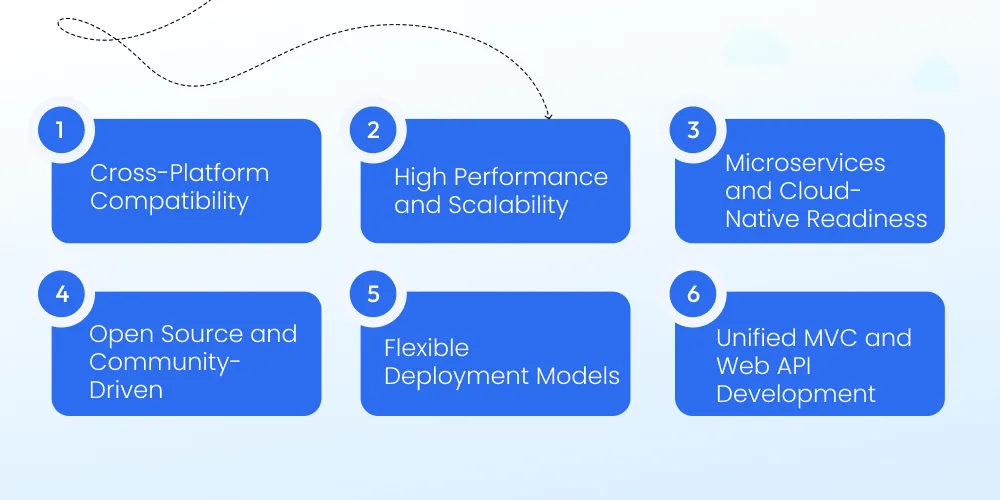
Benefits of .Net Core
1. Cross-Platform Compatibility
.NET Core is designed from the ground up to run on Windows, macOS, and Linux, making it ideal for modern, distributed environments and development teams targeting multiple platforms.
2. High Performance and Scalability
It delivers superior performance through Kestrel, a lightweight and efficient web server. Applications built on .NET Core typically show better throughput and lower memory usage than those on the .NET Framework.
3. Microservices and Cloud-Native Readiness
Its modular design and container-friendly structure make .NET Core perfect for microservices architectures and cloud-based applications. It integrates well with Docker and Kubernetes, making deployment and scaling easier.
4. Open Source and Community-Driven
.NET Core is fully open source and developed in collaboration with a large developer community under the .NET Foundation. This fosters innovation, transparency, and rapid evolution.
5. Flexible Deployment Models
With support for self-contained deployments, .NET Core allows apps to carry their own runtime. This makes versioning more predictable and reduces dependency conflicts.
6. Unified MVC and Web API Development
Unlike the traditional .NET Framework, .NET Core has a unified framework for MVC and Web APIs, simplifying web development and reducing the learning curve for developers.
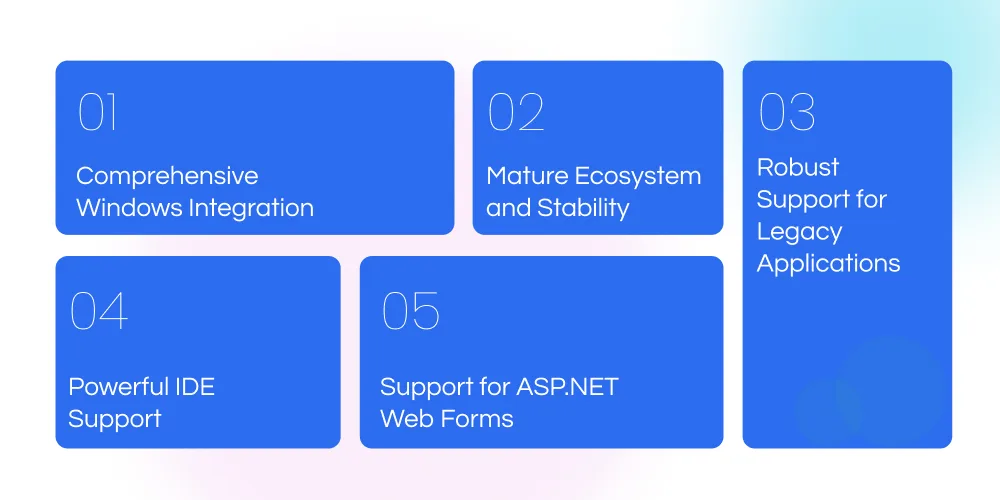
Benefits of .NET Framework
1. Comprehensive Windows Integration
.NET Framework is tightly integrated with Windows OS and offers seamless access to Windows APIs, Windows Forms, WPF, and ASP.NET Web Forms, making it ideal for enterprise apps relying on Windows-only technologies.
2. Mature Ecosystem and Stability
As a mature platform with over two decades of evolution, the .NET Framework has a rich ecosystem of libraries, tools, and third-party integrations. It’s widely used in large-scale enterprise environments.
3. Robust Support for Legacy Applications
For businesses running legacy systems, the .NET Framework provides backward compatibility and support for older technologies, which is crucial for long-term maintenance and system continuity.
4. Powerful IDE Support
It is fully integrated with Visual Studio, which provides advanced debugging, UI design tools, and seamless project management features. This offers a smooth development experience for enterprise developers.
5. Support for ASP.NET Web Forms
Unlike .NET Core, the full .NET Framework supports ASP.NET Web Forms, which is still used in many enterprise applications that require event-driven, drag-and-drop web development.
Custom .NET Solutions Tailored to Your Business DNA!
From web apps to enterprise tools, we craft .NET solutions that align perfectly with your workflows and vision.
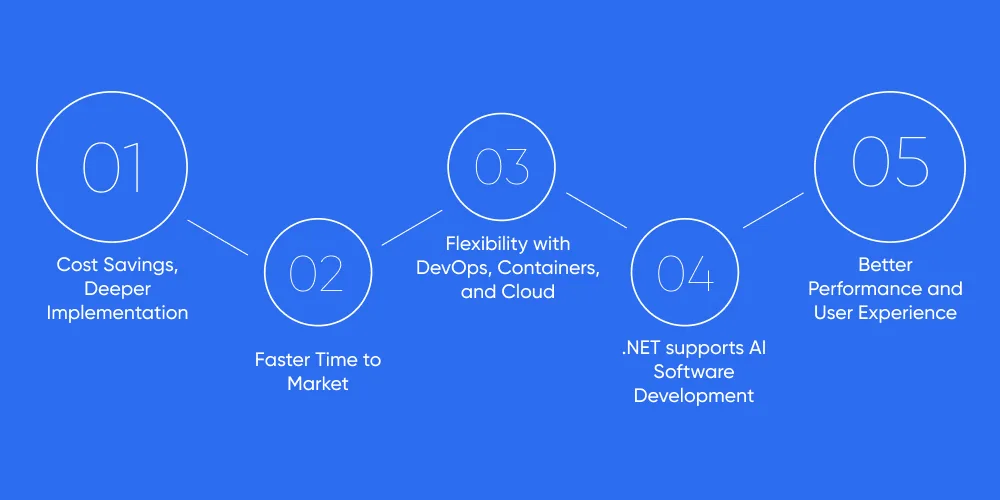
More and more companies are upgrading their digital systems and more are picking .NET Core (or its later iteration, .NET 6/7/8) -- and for many reasons. Here are the reasons why this is happening, and what that means for your business:
Cost Savings, Deeper Implementation
Various details that .NET Core is open-source, as well as free, means you will:
Not pay license costs for the framework itself
Save money on software costs over the long term
The support of an active community to continue to enhance it
In turn, businesses have a more cost-effective development option than vendor lock-in with a financed license, and a more efficient ROI-related payback period than previous enterprise techniques.
Faster Time to Market
The .NET Core programming application environment is iterable and supports new development paradigms and lightweight architecture (conversationally called microservices) such as APIs that leverage it, which enables:
Speed prototyping and fostering implementation
Reduced iteration time on products and feature releases
The ability to re-negotiate requirements in order to accommodate more agile responses to customers, as markets demand
A new customer-facing modality through which your team can add features and bring them to market quickly. This helps in delivering a more adaptable framework and differentiating your business from competitors.
Flexibility with DevOps, Containers, and Cloud
.NET Core was designed for today's infrastructure. It has great native support for:
DevOps pipelines (CI/CD tools like GitHub Actions, Azure DevOps)
Containerization with Docker and Kubernetes
Cloud platforms like Microsoft Azure and Amazon Web Services (AWS)
This flexibility gives your business more control over deployments, improved scalability, and automation, while supporting modern software delivery methods.
.NET supports AI Software Development
.NET can be used to build applications that perform tasks like natural language processing, computer vision, and audio generation used for AI software development. Also, tools like ML.NET allow .NET developers to integrate AI models into their applications without needing to learn a new technology stack.
Better Performance and User Experience
.NET Core has been optimized for speed, memory utilization and responsiveness. You will see:
Faster load times
Better user experience
Lower infrastructure costs because of better resource utilization
In business terms: Happy users, lower hosting fees, and applications that perform under load, even as your audience grows.
Whether you're building a new digital product or upgrading a legacy software application, .NET Core provides the performance, cost-effectiveness, and future-readiness that modern businesses need to succeed in today's technology environment.
How can DITS help you choose and implement the Right .NET Stack?
Comparing dotnet core vs dotnet framework and choosing the right .net stack is a decision that can have lasting implications for your organization. That's where the Ditstek Innovations (DITS) come in. Our job is to streamline the journey and ensure that your organization gets the right technology, the right way, starting from the first day. Here’s how we work:
1. Analyze Your Business Needs and Current Infrastructure
When we start working, our first step is to understand:
Are you struggling with whether to select the legacy .NET Framework or modern .NET?
We will break down the pros and cons for your unique circumstance, including:
Selecting the best platform for new applications to develop
Whether you should rebuild your legacy systems or migrate
Future proofing your technology investments
3. Build or Modernize Applications Considering Performance, Security, and Growth
Whether you are developing new solutions or modifying your current solutions, we create solutions that are:
Fast and scalable with modern architecture
Secure and compliant following best practices
User-friendly
For this, we also make use of AI technology to make the right decisions while developing software, and the AI helps us build applications faster, which in turn affects the time to market for our clients.
DITS being a custom software development company, builds software solutions for a variety of industries including healthcare, logistics, retail, fintech and edtech industries. The technology we use depends on the business and its specific needs and goals related to the project. Our services are not limited to software development; we also offer application integration and maintenance services, like the asp.net integration and asp.net maintenance services.
Unsure How .NET Framework Limits Scalability?
Let us explain the practical implications and show you what switching to .NET Core could unlock for your project.
When it comes to choosing between .NET Framework and .NET Core (or current versions of .NET 6/7/8), it’s more than just a development framework – it’s putting your company in a position for sustainability.
Assuming that you are controlling a legacy system and need not worry about cross-platform support, the .NET Framework may still be a decent option for you. However, if you are in the process of creating something new, seeking performance, wanting cloud scaling, or reach, then modern .NET is obviously the next step.
Ultimately, the final decision is dependent on your goals, existing infrastructure, and growth. And this is exactly where the right partner can benefit you.
Frequently asked questions
The main difference is in platform support and performance. .NET Framework is Windows-only and best for maintaining older systems. .NET Core (now just .NET 6/7/8) is cross-platform, faster, and better suited for cloud and modern web development. It's ideal for new projects or businesses planning to scale.
Dinesh Thakur
25+ years of IT software development experience in different domains like Business Automation, Healthcare, Retail, Workflow automation, Transportation and logistics, Compliance, Risk Mitigation, POS, etc. Hands-on experience in dealing with overseas clients and providing them with an apt solution to their business needs.