25+ years of IT software development experience in different domains like Business Automation, Healthcare, Retail, Workflow automation, Transportation and logistics, Compliance, Risk Mitigation, POS, etc. Hands-on experience in dealing with overseas clients and providing them with an apt solution to their business needs.
Issues with inventory are more often caused by things like insufficient visibility, unreliable information, human interaction, and information not being shared rather than inventory levels. This may result in stock-outs, excess stock levels, waiting to fulfill orders, increased holding costs, and tied-up capital.
Increased operational complexity leads to poor inventory decision-making. Integration of artificial intelligence and the Internet of Things would assist in improving real-time visibility, forecast capabilities, automation of processes, and making inventory decisions accurately.
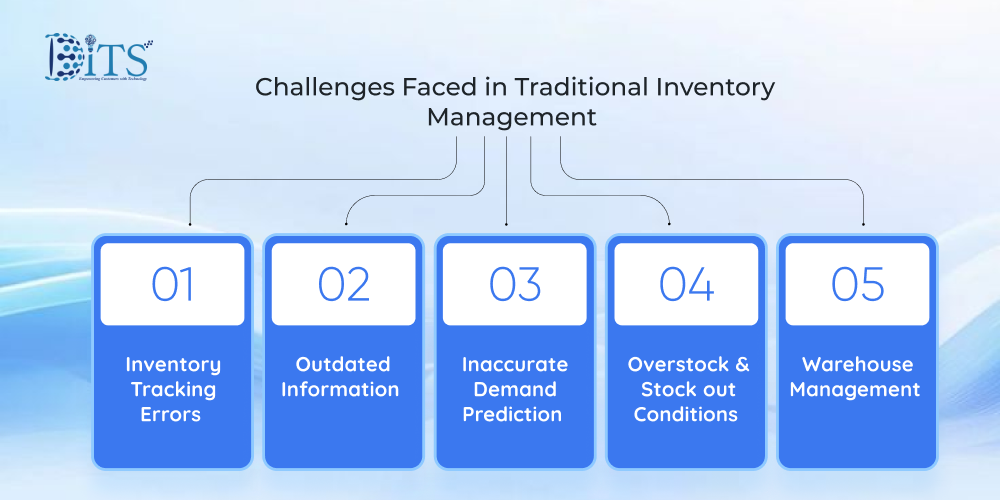
Challenges Faced in Traditional Inventory Management
Businesses face multiple challenges in managing inventory that impact efficiency, profitability and customer satisfaction. Here are some common challenges that businesses face while managing inventory.
Inventory Tracking Errors
When employees move items in a warehouse manually, they may forget to scan or log their location updates. In worst cases, they may not do it at the right time, which leads to phantom situations in which items appear as available, but actually they are not. The items may be misplaced or present in a wrong location. Such errors can disrupt the entire supply chain, which further leads to inaccurate stock levels, wasted money and delays in order fulfillment.
Outdated Information
Sometimes the recorded stock levels and real levels can be different, since traditional inventory systems sometimes rely on human updates. Inaccurate inventory counts, postponed restocking, and a restricted understanding of inventory can all arise from a lack of real-time visibility. For example, due to lack of real time data on how rapidly parts are used for production, a manufacturing company can unintentionally run out of them. This results in lost sales, unhappy customers, and delays in delivery of finished goods.
Inaccurate Demand Prediction
Demand forecasting can be challenging, but it's essential for managing inventory. It is affected by a number of factors, including promotions and seasonal trends. Changing customer tastes also play a role. Forecasts that are based exclusively on historical sales data can be sometimes inaccurate.
Overstock and Stock out Conditions
Stock outs can result in missed sales, irate customers, and possible harm to a brand's reputation. Especially for seasonal or perishable goods that might later need to be thrown out or discounted, overstocking raises holding costs and locks up cash. Thus, maintaining a balance in stock levels is a crucial aspect of inventory control.
Warehouse Management
Another challenge is regulating the flow of goods and making the most of storage space. Overstocking, lost materials, and disarray brought on by ineffective storage can result in delays and higher operating expenses. Inefficient warehouse architecture and labor-intensive, slow manual operations can reduce worker productivity.
How AI and IoT Are Used in Inventory Management
AI and IoT can assist firms in gaining better visibility of their inventories, making predictions about future demand, and enabling them to make informed decisions. AI can analyze data and help make predictions, while IoT can give real-time data regarding inventory movements and warehouse activities.
Forecast Demand and Plan Inventory
AI algorithms can take into account past sales, demand trends, seasons, and current data to assist companies with their inventory planning process. This approach can decrease the chances of overstock and improve the product availability.
Monitor Inventory in Real Time
With IoT sensors and devices as well as the RFIDs, one can have continuous tracking of the inventory movements in different warehouses.
Inventory Replenishment Automation
AI can make recommendations on inventory replenishment using the current inventory status, lead time, and demand trends.
Monitoring Warehouse and Assets
IoT sensors can track the status of the inventory, equipment, and conditions of storage within warehouse operations.
Detecting Exceptions and Anomalies
An AI algorithm can detect anomalies and exceptions like unusual inventory movements, high demand trends, and other issues related to inventory that should be investigated.
Predictive Maintenance
The data provided by IoT equipment in the warehouse can be analyzed to understand the signs of its failure and organize the maintenance process.
ERP and WMS Integration
AI and IoT are much more useful in combination with ERP and WMS. Integration will enable inventory data to be transferred through procurement, warehousing, order management, and fulfillment processes.
Business Benefits of AI and IoT in Inventory Management
The use of AI and the Internet of Things allows businesses to make their inventories more efficient through better data collection, visibility, and access to information. Their greatest value lies in making the processes of inventories more effective, efficient, and consistent across all locations.
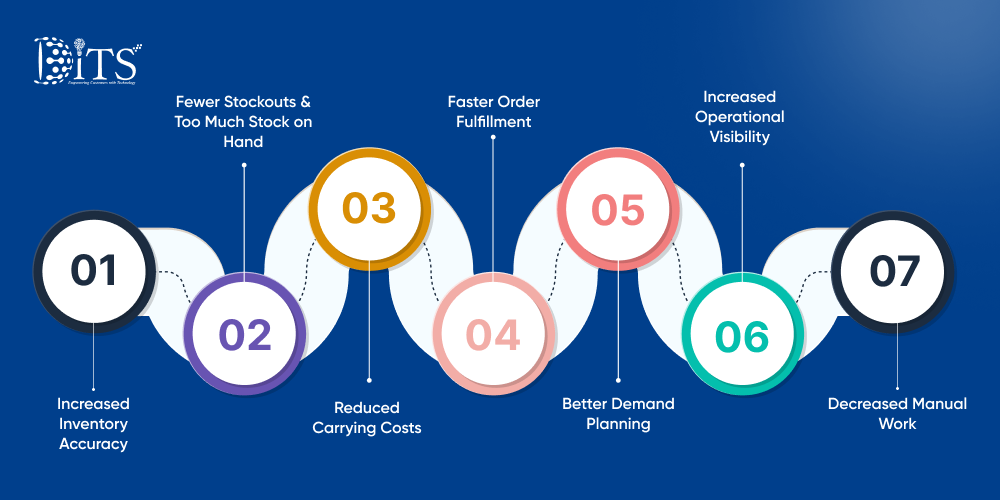
Increased Inventory Accuracy
Real-time tracking and data collection in real-time can help minimize discrepancies and increase trust in inventory records.
Fewer Stockouts and Too Much Stock on Hand
Through better planning and better inventory visibility, companies may be able to balance stock better and respond quicker to any changes in demand.
Reduced Carrying Costs
With better planning, there will be less inventory buildup, which will help companies to minimize the costs associated with storing and managing the excess inventory.
Faster Order Fulfillment
Inventory visibility will help teams find available stock easier and coordinate order fulfillment better.
Better Demand Planning
Leveraging enterprise AI solutions helps analyze historical and real-time data to improve demand planning and replenishment of products.
Increased Operational Visibility
With connected devices and systems, there is better visibility into movements in inventory, warehouse operations, and any exceptions that may occur.
Decreased Manual Work
Through automation, manual work in inventory management can be reduced and people can focus on other aspects of operation.
When Should Businesses Consider AI and IoT for Inventory Management?
AI and IoT are relevant when businesses experience inventory challenges that impact accuracy, efficiency, and growth. First, they must identify gaps in current processes and systems to find the best technology solution.
Frequent Inventory Discrepancies
In terms of consistent mismatch between the current stock and the information on the system, AI and IoT can facilitate the process by allowing for better tracking methods and showing participants the source of the mistake. Moreover, it would allow the company to reduce the amount of delay along with manual updates.
Rising Manual Effort
Manual processes might require the organization to switch to automation, particularly if too much time is spent on either counting the stock or reconciling information with records. IoT is capable of gathering inventory information automatically while AI is used for determining the most important exceptions.
Unreliable Forecasts
Businesses that regularly get stockouts or excess stock due to demand estimation inaccuracies can benefit from recording and processing historical data and seasonal changes to improve their forecasting accuracy.
Poor Warehouse Visibility
Businesses that have problems tracking their inventory when it comes to where it is located, where it moves, and how it is stored might consider implementing AI/IoT-based monitoring solutions. This will allow them to achieve better visibility in warehouses and distribution centers.
Difficulties with Scalability
With growing volumes of inventory, inventory locations, SKUs, order channels, etc., it might become difficult to manage things manually. Here, AI, IoT, and automation might allow businesses to work with more complex issues without increasing efforts proportionally to them.
Increasing System Fragmentation
When inventory is stored in different ERP, WMS, procurement, and order management systems, the first step to take is integration. Connected systems create a basis for more advanced solutions such as AI/IoT.
AI and IoT should not be used just for the sake of using them. Instead, a business should first detect the operational issue and choose the solution among integration, automation, modernization, AI, and IoT.
AI, IoT, Automation, Integration, or Modernization: What Does Your Business Actually Need?
Businesses need to first find out what is behind inventory failure before spending money on AI or IoT. The proper remedy may instead be integration, automation, or modernization, rather than the inclusion of more technology.
Business Problem
What to Evaluate
Business Objective
Inventory data differs across systems
System Integration
Create consistent data across ERP, WMS, procurement, and order management systems.
Teams rely on manual inventory updates
Workflow Automation
Reduce repetitive work, errors, and processing delays.
Limited visibility into stock movement
IoT
Enable real-time tracking of inventory, assets, and warehouse activity.
Demand forecasts are frequently inaccurate
AI and Predictive Analytics
Improve inventory planning and respond more effectively to demand changes
Legacy systems limit scalability or integration
Modernization
Extend system capabilities while reducing operational and technical constraints.
Existing platforms no longer support business needs
System Replacement
Move to a platform better suited to current workflows, integrations, and future growth.
The right decision depends on existing technology, operational priorities, integration requirements, cost, and expected business value. Businesses should evaluate these factors before deciding what to automate, integrate, modernize, retain, or replace.
What Businesses Should Evaluate Before Implementing AI and IoT?
A business needs to evaluate whether its systems, data, and processes are ready to be integrated with AI and IoT solutions to prevent further complexity and risk.
Data Quality
For AI to work well, the data needs to be accurate and accessible. Data quality issues may result in poor forecast results, process automation, and decision-making.
ERP / WMS Compatibility
Newly acquired capabilities need to integrate well with already-existing ERP systems, WMS, and order management system.
Integration Complexity
Businesses need to consider how many systems, databases, and processes they will have to integrate into the project.
Security
Connected devices and data transfers may create new vulnerabilities, which should be considered from the beginning.
Infrastructure
A business should make sure that its network, cloud, and other infrastructure is ready for handling additional data flow.
Cost
Implementation, integration, maintenance, training and other costs should be balanced with expected value of the operation.
Scalability
A solution should be able to handle additional inventories, warehouses, locations, transactions, and users in the future.
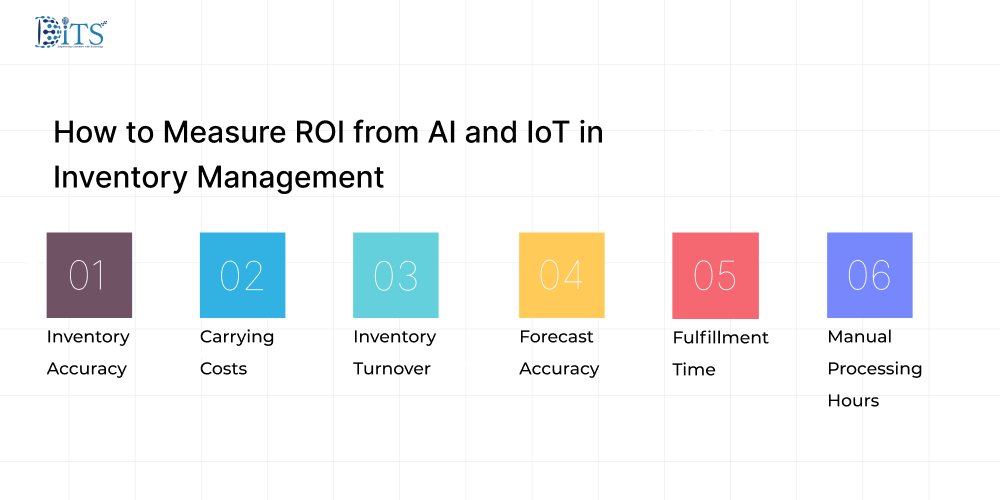
How to Measure ROI from AI and IoT in Inventory Management?
ROI calculations help identify if any gains are achieved from investments into artificial intelligence and IoT technologies by measuring the improvement of inventory management. It would be ideal to calculate the improvement in various operational metrics and then relate that improvement to the overall investment and operations costs.
Inventory Accuracy
Compare accuracy rates between the system records and physical inventories before and after implementing the real-time tracking and data automation systems.
Carrying Costs
Evaluate if improved planning reduces the amount of excess inventory, costs of storing the inventory, and amount of money tied in stock.
Inventory Turnover
Measure how effectively and efficiently the inventory is being used in the business and how well the stock levels correspond to the actual demand.
Forecast Accuracy
Compare actual demand with the forecasted one and evaluate if artificial intelligence-based planning is improving decision making about purchases and replenishment of the inventory.
Fulfillment Time
Evaluate time needed for fulfilling an order before and after implementation to identify how better inventory tracking increases productivity and efficiency.
Manual Processing Hours
Record the amount of time taken in stock counting, reconciliation, data entry, and other routine activities of inventory management.
How DITS Helps Businesses Make Better Inventory Technology Decisions
DITS helps businesses move from inventory challenges to clear technology decisions. We assess workflows, systems, data quality, and operational gaps to uncover where disconnected platforms, manual effort, poor visibility, or forecasting limitations are affecting performance.
With a clear view of these priorities, DITS helps shape the most practical technology approach and supports its execution. This may involve strengthening system connectivity, simplifying workflows, upgrading legacy platforms, or introducing new capabilities that improve efficiency, scalability, continuity, and long-term value.
Explore our body of work to see how businesses have improved connected operations, modernized critical systems, and built more scalable technology foundations.
Your Freight’s Got a New AI Assistant!
DITS builds AI-driven logistics solutions that optimize routing, prevent delays, and make real-time decisions faster than any human ever could.
AI and the IoT enhance inventory precision due to less dependence on manual entry and more precise real-time information. The IoT can monitor the movement and location of the inventory, and the AI can analyze the inventory trend and detect discrepancies and anomalies. Combining them with ERP or WMS systems enables businesses to keep their inventory information updated and accurate.
Dinesh Thakur
25+ years of IT software development experience in different domains like Business Automation, Healthcare, Retail, Workflow automation, Transportation and logistics, Compliance, Risk Mitigation, POS, etc. Hands-on experience in dealing with overseas clients and providing them with an apt solution to their business needs.