25+ years of IT software development experience in different domains like Business Automation, Healthcare, Retail, Workflow automation, Transportation and logistics, Compliance, Risk Mitigation, POS, etc. Hands-on experience in dealing with overseas clients and providing them with an apt solution to their business needs.
Key Takeaways
NLP enables chatbots to understand and process human language accurately.
Intent recognition models classify user queries for correct response routing.
Entity extraction captures critical information like names, locations, and dates.
Machine learning refines chatbot responses by analyzing past interactions continuously.
Integration with business systems ensures real-time, actionable, and context-aware responses.
AI chatbots reduce costs, improve efficiency, and enhance customer experience.
Get AI Chatbot starting from $25/hr or $25K for businesses.
Businesses implement chatbots using a combination of machine learning, natural language processing, and rule-based logic to automate conversations and improve customer interactions. The most common AI techniques used in chatbots include intent recognition, which identifies user queries, and entity extraction, which captures key data like names or requirements.
NLP models process human language to generate accurate responses, while deep learning models improve response quality over time based on user interactions. Many systems also use conversational AI frameworks with dialogue management to maintain context across multiple queries. For enterprise use, chatbots integrate with CRM, ERP, and databases to deliver real-time information such as order status or service updates. Predictive analytics further helps in suggesting next actions or responses. This structured approach allows businesses to reduce support costs, handle high query volumes, and deliver consistent customer experiences across digital platforms.
AI Chatbot Market Demand & Stats
AI chatbots for businesses saw strong growth in 2025, with the generative AI chatbot market valued at $9.9 billion, projected to reach $12.98 billion in 2026. Demand remains high due to automation needs in customer service, sales, and HR, driven by cost savings and 24/7 scalability.
The global chatbot market is forecasted to grow from $11.45 billion in 2026 to $32.45 billion by 2031 at a 23.15% CAGR. Generative AI chatbots specifically hit $9.9 billion in 2025, expanding at 31.11% CAGR through 2034 amid rising enterprise adoption.
Businesses report 30-40% customer service cost reductions and 340% first-year ROI from chatbots. 95% of customer interactions are expected to be AI-powered by 2025, boosting demand in BFSI (leading segment) and healthcare (fastest-growing). E-commerce sees 15% higher average order values via upsells.
Metric
Statistic
Fortune 500 Usage
67% in 2025
SMB Adoption
34% in 2025
B2B Implementations
58% focused on B2B
Large Enterprises (>5K employees)
60%+ adoption
Consumer Preference
87% prefer bots
Industry
Market Share/Notes 2025-26
BFSI
Dominant; loyalty via proactive queries
Retail/E-commerce
~30%; 15% higher order values
Healthcare
Highest CAGR; routine task streamlining
IT/Telecom
Internal workflows key
Others
Travel/hospitality growing 23%+ YoY
Ready to Build Smarter AI Chatbots?
Transform customer interactions with scalable AI models designed for automation, accuracy, and measurable operational impact across departments.
Modern chatbots rely on structured AI models to process language, understand intent, and automate responses. Ditstek Innovations leads AI chatbot development, delivering NLP, ML models, and sentiment analysis for startups, mid-size firms upgrading systems, and large real estate enterprises enhancing sales pipelines with scalable solutions.
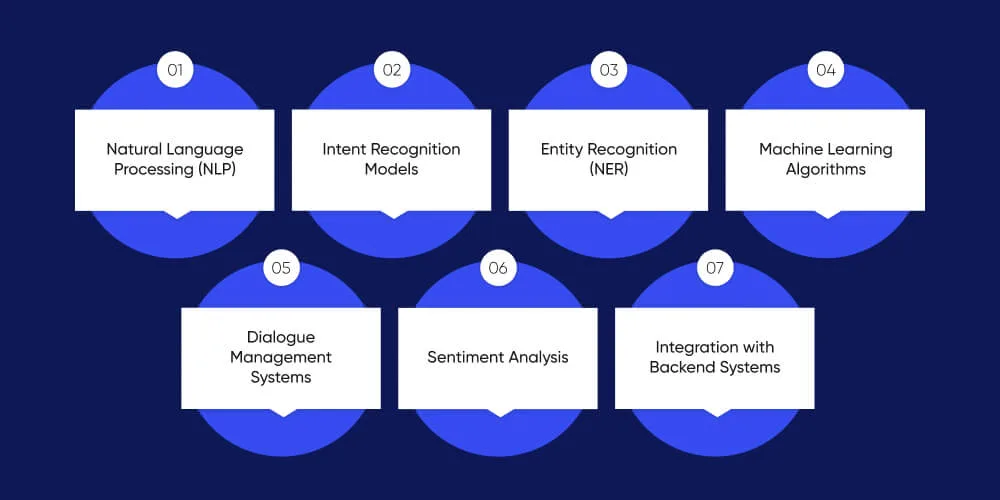
1. Natural Language Processing (NLP)
NLP enables chatbots to understand human language in real time. It processes user queries, breaks them into tokens, and interprets meaning. Businesses use this to automate customer support, where users type questions and receive accurate responses without manual intervention. It needs an AI development company to create the chatbots with accuracy and deliver a high-end solution.
2. Intent Recognition Models
Intent classification algorithms identify what the user wants, such as booking, inquiry, or complaint. This is one of the core AI techniques used in chatbots to route queries correctly. For example, a real estate chatbot identifies whether a user is looking to buy, rent, or schedule a visit.
3. Entity Recognition (NER)
Named Entity Recognition extracts specific data like names, locations, or dates from user input. Businesses use this in booking systems where chatbots capture details such as property location, budget range, or preferred time slots for scheduling visits.
4. Machine Learning Algorithms
Chatbots use supervised and unsupervised learning models to improve over time. By analyzing past conversations, they refine responses and accuracy. Businesses benefit from continuous improvement, where customer queries are handled more efficiently with reduced human intervention.
5. Dialogue Management Systems
These systems maintain conversation flow and context across multiple interactions. They ensure that chatbots respond logically based on previous inputs. In real use, a chatbot remembers user preferences during a property search and provides relevant follow-up suggestions.
6. Sentiment Analysis
Sentiment analysis detects user emotions such as frustration or satisfaction. Businesses use this to prioritize critical conversations. For instance, if a customer shows dissatisfaction, the chatbot can escalate the query to a human agent for faster resolution.
7. Integration with Backend Systems
Get custom AI chatbots that connect with CRM, ERP, and databases to fetch real-time data. This allows businesses to provide instant updates like property availability, pricing, or order status. It ensures that chatbot responses are accurate, actionable, and aligned with business operations.
Cost to Integrate AI Technologies in Chatbots
For businesses aiming for high-scale automation and seamless digital transformation, these AI techniques used in chatbots represent the core of a robust AI strategy. Ditstek Innovations is the leading AI chatbot development company, delivering enterprise-grade solutions tailored for startups, mid-size firms, and large-scale real estate portfolios.
AI Technology
Estimated Cost (USD)
Business Use & Scope
Natural Language Processing (NLP)
$25,000 – $60,000
Enables chatbots to interpret complex human language and maintain accuracy across diverse industries.
Intent Recognition Models
$25,000 – $50,000
Identifies user goals to automate lead qualification, support ticketing, and specific task-based interactions.
Entity Recognition (NER)
$25,000 – $45,000
Extracts structured data like names, locations, and dates for personalized, context-aware user responses.
Machine Learning Algorithms
$30,000 – $70,000
Facilitates continuous system improvement by training on historical data for high-precision decision-making.
Dialogue Management Systems
$25,000 – $55,000
Controls conversation logic to ensure structured and meaningful multi-step user journeys.
Sentiment Analysis
$25,000 – $50,000
Detects emotional cues to adjust tone dynamically, essential for high-stakes customer experience management.
Backend System Integration
$30,000 – $70,000
Synchronizes the AI with CRM, ERP, and databases for real-time automation and business process alignment.
How to Integrate AI in Chatbot
Integrating AI into a chatbot is not just a plug-and-play task. Businesses need a structured approach and technical expertise to make it work in real operations. It starts with identifying use cases like customer support, lead qualification, or service requests, followed by designing intent flows based on real user behavior. This is where AI techniques used in chatbots, such as natural language understanding and machine learning models, are applied to train the system accurately.
To make the chatbot functional, it must be integrated with business systems like CRM, ERP, or internal databases through secure APIs. This ensures the chatbot responds with real-time and context-aware information. Testing, validation, and continuous learning are required to maintain accuracy and performance at scale.
Because of this complexity, businesses require the support of an experienced AI chatbot development company. Ditstek Innovations helps design, develop, and deploy AI-driven chatbots that align with business workflows, ensuring reliable performance, scalability, and measurable ROI.
7 Real Life Use Cases of AI Techniques in Chatbots
Businesses apply AI-driven chatbot systems across customer support, sales, operations, and service automation. These real-life use cases show how chatbots improve response time, reduce manual workload, and deliver accurate, data-driven interactions across different business functions.
Appointment Scheduling and Booking Systems
Healthcare, real estate, and service businesses use chatbots to automate appointment booking. The system checks availability through calendar APIs, confirms slots, and sends reminders. This reduces no-shows and administrative workload while improving customer experience.
Customer Support Automation with NLP
Businesses deploy chatbots to handle high-volume customer queries using natural language processing. The system identifies intent, retrieves answers from knowledge bases, and resolves issues like order tracking or account queries. AI techniques used in chatbots ensure faster resolution and reduced support costs.
Lead Qualification and Sales Funnel Management
Chatbots interact with website visitors, ask qualifying questions, and segment leads based on behavior and responses. Integrated with CRM systems, they assign scores and route high-value prospects to sales teams, improving conversion rates and reducing manual follow-ups.
Appointment Scheduling and Booking Systems
Healthcare, real estate, and service businesses use chatbots to automate appointment booking. The system checks availability through calendar APIs, confirms slots, and sends reminders. This reduces no-shows and administrative workload while improving customer experience.
E-commerce Order Assistance and Recommendations
Chatbots assist users in product discovery by analyzing preferences and past behavior. They suggest relevant products, answer questions, and guide users through checkout. This improves cart conversion rates and enhances personalized shopping experiences.
Internal Employee Support Systems
Organizations implement chatbots for HR and IT support, handling queries related to payroll, leave policies, or system access. Integrated with internal databases, these bots reduce dependency on support teams and improve operational efficiency across departments.
Fraud Detection and Customer Verification
Financial and real estate businesses use chatbots for identity verification and fraud detection. By analyzing user inputs, transaction patterns, and behavioral data, chatbots flag suspicious activities and trigger security protocols, ensuring safe and compliant business operations.
Looking to Reduce Support Costs Fast?
Implement intelligent chatbot systems that handle high query volumes while improving response accuracy and customer satisfaction.
Partner With DITS for Implementing AI Techniques in Chatbots
DITS helps businesses design, develop, and deploy chatbot systems using advanced AI models, real-time data processing, and scalable architecture. The focus is on accuracy, integration, and measurable business outcomes across industries and operational workflows.
End-to-End AI Chatbot Architecture Development
DITS builds complete chatbot ecosystems from intent recognition to response generation using NLP pipelines, machine learning models, and API integrations. Businesses can deploy chatbots across websites, apps, and CRMs with structured workflows based on AI techniques used in chatbots for real-time interactions.
Seamless Integration with Business Systems
Chatbots are integrated with ERP, CRM, payment gateways, and internal databases to automate workflows. For example, a real estate firm can connect chatbot queries directly to property databases, enabling instant responses, lead capture, and automated follow-ups without manual intervention.
Custom Model Training with Domain Data
DITS trains AI models on industry-specific datasets, ensuring higher accuracy in responses. In healthcare or finance, chatbots understand domain terminology and workflows. This reduces errors, improves decision support, and ensures reliable automation aligned with business operations.
Scalable and Performance-Driven Deployment
DITS uses cloud-based infrastructure, microservices architecture, and load balancing to ensure chatbot scalability. Businesses handling thousands of daily queries can maintain performance without downtime, while analytics dashboards track engagement, response accuracy, and ROI for continuous improvement.
Frequently asked questions
AI techniques used in chatbots include Natural Language Processing, Machine Learning, intent recognition, sentiment analysis, and deep learning models. These techniques help chatbots understand user queries, process context, and deliver accurate, real-time responses for business operations.
Dinesh Thakur
25+ years of IT software development experience in different domains like Business Automation, Healthcare, Retail, Workflow automation, Transportation and logistics, Compliance, Risk Mitigation, POS, etc. Hands-on experience in dealing with overseas clients and providing them with an apt solution to their business needs.