Key Takeaways
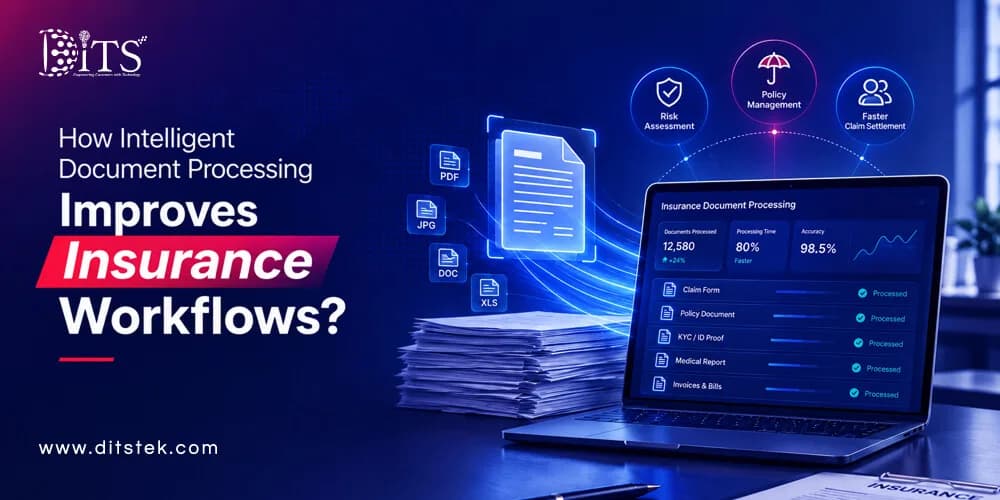
Intelligent Document Processing (IDP) enables insurers to automate document capturing, classifying, extracting, validating and routing across core processes.
Intelligent document processing in healthcare automates document processing, saving effort and reducing errors, re-work and delays.
Integration with claims, policy administration, CRM, billing, EHR, fraud detection, and document management solutions improves the exchange of data and reduce the re-entry.
Phased deployment, starting with a workflow or type of document with high volumes will enable insurance companies to verify its performance and value.
Intelligent document processing for insurance is used for claims processing, underwriting, policy servicing, billing, compliance and health insurance workflows.
Human verification is required for documents that are not fully completed or have unclear or inaccurate information.
Have you ever noticed how much time insurance teams spend processing documents? Document processing, claim forms, policy applications, invoices, medical files, identity verifications, etc., typically move through multiple departments before a decision is made. It hampers processes, leads to errors, and makes it difficult to identify pending documentation.
Intelligent document processing for insurance solve these problems by automating the capture, classification, extraction, validation, and routing of document data. It enables the claims, underwriting, and policy administration departments to obtain accurate information more quickly.
Market Scope and Opportunities
Intelligent document processing market size is projected to be around $29.7B by 2033 along with a rapid CAGR growth of 33.8%.
If we have a look at the regional insights, North America, Middle east, Africa, Europe, Asia pacific and south America dominates.
There is a great opportunity for businesses to tap into this market and gain substantial results. As a leading health insurance software development company, we will help you explore and deliver scalable, and regulation-compliant solutions tailored to your business goals.
Common Document Processing Challenges Insurance Companies Face
The insurance companies receive enormous documents from their clients, providers, agents, portals, emails, and even third parties. Most of the time, the documents are received in various formats and contain missing information, poor scans, or inaccurate data. The more an organization relies on manual document processing, the longer it takes to process them.
Manual data entry: Staff members have to devote considerable time entering data from various forms, invoices, and reports into internal systems.
Inconsistent document formats: Formats of non-editable documents (i.e., PDFs or scanned documents), handwritten papers or emails cannot be processed correctly.
Missing or incomplete information: The absence of signatures and incomplete documents lead to delays in decision-making.
High error rates: Frequent manual data entry increases the likelihood of errors such as incorrect policy numbers, incorrect claim descriptions, incorrect dates, or errors in financial data.
Limited workflow visibility: Difficulties in tracking documents, required actions, and responsible personnel in various departments.
Disconnected legacy systems: Ineffective communication between document storage areas and insurance systems leads to redundant work and to information being retained across different systems.
Comparison Between Traditional and Intelligent Document Processing for Insurance
Traditional insurance document workflows are highly dependent on the segregated file formats, non-stop verification, and manual data entry. All these things delay the process and increase the possibility of errors along with delayed submissions. That's why intelligent document processing for insurance comes into place as it tracks document status, ensures ownership, and smoothly covers all the pending actions across departments.
Here we have elaborately shown the comparison;
How Document Processing Automation Works in Insurance?
Document processing automation is beneficial for insurance providers because it enables them to process documents with minimal human endeavors. The process consists of importing documents from varied sources, analyzing their content, and organizing the data before ensuring compliance with the required business guidelines. Finally, the document is sent to the designated department or concerned system.
Document Capture
Captures documents from emails, customer portals, mobile devices, and scanned documents.
Document Classification
Determines whether the document is a claim, application, bill, medical record, etc.
Data Extraction
Identifies relevant information such as policy numbers, claimant details, dates, invoice amounts, from insurance documents.
Data Validation
Compares the extracted information with the existing policy and business rules.
Workflow Routing
Sends the validated data to claims, underwriting, billing, compliance, or policy administration groups.
Exceptional Handling: Signals the incomplete or unclear documents and route them directly for human review.
Types of Insurance Documents Ideal for Automation
With intelligent document processing in healthcare, you can process all kinds of structured, semi-structured, and unstructured documents that are used in claims, underwriting, policy servicing, billing, and compliance. IDP extracts the relevant information, validates the fields, and routes the document through the appropriate workflows.
Where IDP Adds Value Across Insurance Workflows?
Intelligent document processing in healthcare covers almost everything in the insurance industry that is reliant on document data collection, analysis, and verification processes. It improves the process and helps teams speed up the information transfer and boost the quality of decisions.
Claims Processing: Helps with gathering the information on the claims and processing it into useful data
Policy Applications: For policy applications, IDP captures the information about applicants, ID documents, and their financial records;
Underwriting: Organizes risk reports, medical records, inspection documents, and financial statements for review.
Policy servicing and renewals: IDP manages change request processing as well as updating the information about clients.
Billing and Payments: Pulls data from invoices and verifies expenses before sending it for approval or payment.
Compliance and KYC: Quickly reviews consent forms, customer verification documents, and identification documents.
Top Benefits of Intelligent Document Processing for Insurance
Intelligent document processing in insurance is extremely advantageous since it increases process efficiency, improves data quality, and enhances service delivery. It will reduce the amount of manual work required for paper-based operations.
Faster Processing
Enables the automation of the process of gathering documents, classifying, extracting, and validating them.
Provides shorter intermediary processing time for applications and claims.
Offers all-important information without needing to look in different files.
Lower Operational Costs
Helps avoid repetitive data entry and document processing.
Enables insurers to handle a larger volume of documents without significantly increasing staffing.
Reduces the amount of rework caused by data entry mistakes.
Better Data Accuracy
Ensures an even processing of different forms and invoices.
Offers validation of information against established rules and related systems.
Helps avoid situations when errors in manual entry lead to duplication and discrepancies in information.
Fewer Processing Delays
Allows prompt detection of partially filled forms, missing documents, and unclear information.
Enables better routing of exceptions to the appropriate staff member.
Keeps claims from getting stuck due to missing documents.
Improved Employee Productivity
Decreases time used for data entry.
Makes it easier for employees to get necessary information.
Better customer and provider experience
Increases the speed of updates and resolutions.
Which Existing Insurance Platforms Support IDP Integration?
IDP provides the maximum advantage when it collaborates with insurers’ current systems. It connects document information with claims, policy, underwriting, billing, and customer management systems instead of developing another separated tool. This minimizes re-entry, increases data flow, and allows teams to react to accurate data faster.
Claims Management Systems: Transfers all information regarding claimants, incidents, invoices, and other documents directly to claim files.
Policy Administration Systems: Updates policy records through information received from applications for obtaining new policies, renewals, and servicing.
Underwriting Systems: Issues structured information from inspection reports, loss runs, financial documents, and risk assessments to be reviewed by underwriting personnel.
CRM Systems: Connects activity with customer portfolios, history of communication, and requests.
Billing and Payments Systems: Routes validated information regarding invoice processing and payments.
EHR Systems: Provides healthcare insurance operations with efficient operations through connecting medical records, clinical information, and documents of the physician with claim management.
Fraud Detection Tools: Transfers the extracted data and document inconsistencies to fraud detection systems for further development.
Document Management Systems: Stores processed files, metadata, validation results, and audit histories in a centralized location.
How to Implement Intelligent Document Processing for Insurance?
The adoption of IDP begins with selecting the appropriate workflow, rather than trying to automate all document processes in one go. The first step for insurance companies would be to identify high-volume, repeatable operations where manual verification leads to inefficiency.
Identify High-Impact Workflows
Focus on claims, underwriting, onboarding, or billing workflows with many documents.
Find out where data entry is done manually and where verification and processing delays happen.
Choose workflows that have an impact on operations and customers.
Map Documents and Data Fields
Make a list of documents for each workflow.
Specify what information needs to be extracted, such as policy numbers, claimant information, dates, and amounts.
Determine types of structured, semi-structured, and unstructured documents.
Validation Rules Definition
Develop rules that dictate how data extracted can be validated against policies, customers, providers, or claim data.
Develop confidence levels for automatic processing.
Identify those exceptions that need manual validation.
Integrate with existing Systems
Integrate IDP with claims, policy administration, underwriting, CRM, billing, and document management systems.
Employ secure APIs for reducing duplicate data entry.
Make sure that the system can be integrated with both legacy and new systems.
Implement a Pilot Program
Start with one document or one business process.
Test the system for accuracy, exception handling, etc.
Improve the system using real-world documents and feedback from employees.
Expand and Optimize
Implement IDP in more processes after successful pilot project results.
Monitor time taken, accuracy rate, exception rate, and costs per document.
Keep improving models and rules of business as documents and processes evolve.
How Ditstek Helps Insurers Build Smarter Document Workflows
As a technology consultant, Ditstek provides consultation services that help insurance companies know which type of intelligent document processing to implement to get the most out of their operations. Our starting point is to evaluate the document-intensive process, the existing system, data issues, and automation needs, among others.
With Ditstek, you can plan, design, and implement intelligent document processing solutions for your operations.
Consulting on IDP strategy and workflow automation
Building custom insurance document processing solutions
Modernizing legacy insurance platforms and integration
Human-in-the-loop review and exceptions handling
Cloud deployment and compliance planning
Pilot development, testing, and large-scale implementation
Ongoing optimization, monitoring, and technical support