How to Build AI-Powered Medical Claims Auditing Software
Table Of Content
Published Date :
18 May 2026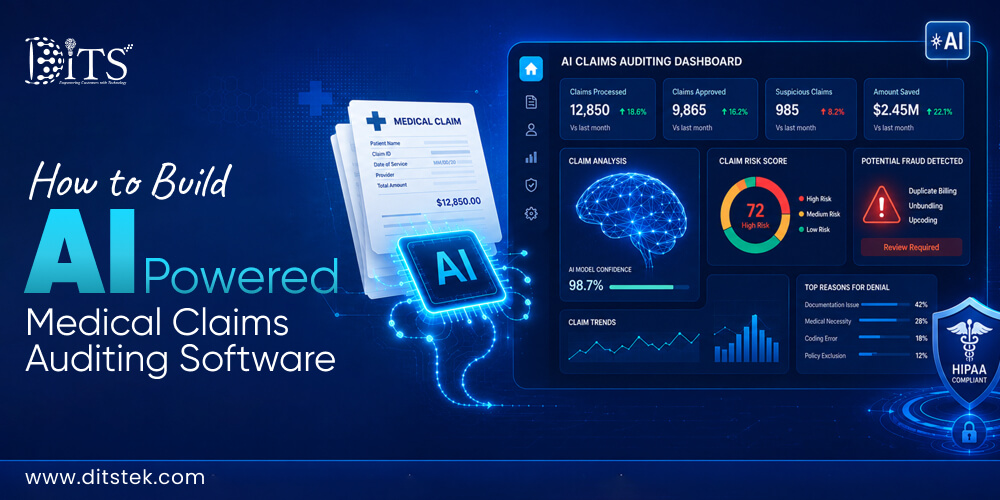
Key Takeaways
- AI-powered medical claims auditing software helps healthcare organizations improve claim accuracy, reduce denials, detect fraud risks, and strengthen financial performance through automated auditing workflows.
- Modern claims auditing platforms combine rule-based validation with AI, predictive analytics, and NLP to identify billing errors, suspicious activity, and reimbursement risks more efficiently.
- Healthcare providers, insurers, TPAs, and revenue cycle management companies use claims auditing software to manage high claim volumes with greater speed, consistency, and compliance control.
- Building medical claims auditing software requires deep understanding of healthcare workflows, interoperability standards, payer rules, compliance requirements, and secure data handling.
- Scalable architecture, AI integration, claims validation engines, EHR connectivity, and security infrastructure are essential components of enterprise-grade auditing platforms.
- Partnering with an experienced healthcare software development company helps organizations build intelligent, compliant, and future-ready claims auditing systems that support long-term operational growth.
Healthcare organizations deal with an enormous number of insurance claims every day, and even a small error in the process can lead to denied reimbursements, delayed payments, compliance issues, or significant revenue loss. As billing regulations continue to evolve and claim volumes increase, many providers and insurance companies are finding it difficult to manage audits through manual processes alone.
Traditional auditing methods often depend heavily on human review, spreadsheets, and disconnected systems. While these approaches may work at a smaller scale, they quickly become inefficient when organizations need to process thousands of claims across multiple payers, specialties, and compliance requirements. The result is slower operations, higher administrative costs, and a growing risk of missed inaccuracies or fraudulent activities.
This is where medical claims auditing software is becoming a critical part of modern healthcare and insurance operations.
A well-designed claims auditing platform helps organizations review claims more accurately, identify billing inconsistencies, detect fraud risks, reduce denials, and improve reimbursement outcomes. More importantly, modern solutions are now moving beyond basic rule-based auditing by using artificial intelligence to make the entire process faster, smarter, and more proactive.
AI is changing how healthcare organizations approach claims auditing. Instead of simply identifying problems after claims are processed, intelligent systems can now predict denial risks, flag suspicious billing patterns, analyze medical documentation, and recommend corrective actions before financial damage occurs. This shift is helping healthcare providers and insurers move from reactive auditing to data-driven decision-making.
However, building medical claims auditing software is not only about adding automation or AI features. The development process requires a deep understanding of healthcare workflows, payer requirements, compliance regulations, interoperability standards, data security, and user expectations across both provider and insurance environments.
For organizations planning to invest in such a solution, understanding the development process is just as important as understanding the business benefits.
In this guide, we will explore how AI-powered medical claims auditing software works, the essential features modern platforms require, the role of AI in transforming claims management, and the step-by-step process involved in building a scalable, secure, and compliant solution for healthcare and insurance businesses.
What is Medical Claims Auditing Software?
Medical claims auditing software is a digital solution designed to review, verify, and analyze healthcare insurance claims for accuracy, compliance, and financial integrity before or after payment is processed. Its primary goal is to help healthcare organizations and insurance companies identify errors, reduce revenue leakage, improve claim accuracy, and ensure that billing practices align with regulatory and payer requirements.
In simple terms, the software acts as an intelligent checkpoint within the claims lifecycle. It examines claims data, coding details, medical documentation, payer rules, and billing patterns to identify issues that could lead to denials, overpayments, underpayments, compliance violations, or fraudulent activities.
As healthcare billing systems become more complex, organizations are increasingly relying on automated auditing platforms to manage high claim volumes with greater speed and consistency.
The software is commonly used by:
- healthcare providers
- insurance companies
- third-party administrators (TPAs)
- medical billing companies
- revenue cycle management firms
How Claims Auditing Differs from Claims Processing
Although they are closely connected, claims processing and claims auditing serve different purposes.
Claims processing focuses on submitting and managing claims for reimbursement. This includes generating claims, assigning billing codes, and sending information to insurance payers.
Claims auditing, however, focuses on reviewing those claims to verify whether they are accurate, compliant, and financially valid. The auditing process checks for issues such as:
- incorrect coding
- missing documentation
- duplicate billing
- reimbursement inaccuracies
- suspicious claim patterns
In simple terms, claims processing helps move claims through the system, while claims auditing helps ensure those claims are correct.
Want Better Accuracy In Medical Claims Processing Systems?
Create scalable healthcare auditing software with predictive analytics, fraud detection, and automated validation for faster claims review processes effectively.
Basic Workflow of Medical Claims Auditing Software
Most medical claims auditing platforms follow a structured review workflow.
The system first collects claims data from billing platforms, EHR systems, payer databases, and medical records. It then validates claims against payer policies, coding standards, and compliance rules.
Once the review is completed, the software flags issues such as:
- coding mismatches
- incomplete claims
- duplicate submissions
- unusual billing behavior
- payment discrepancies
Modern platforms also support both pre-payment and post-payment auditing.
Pre-payment Auditing: This process reviews claims before reimbursement is issued. The goal is to prevent inaccurate or non-compliant claims from entering the payment cycle.
Post-payment Auditing: This process analyzes claims after payment has already been processed to identify overpayments, underpayments, fraud risks, or recurring billing issues.
In addition to rule-based validation, many modern systems now use AI to strengthen fraud detection, identify hidden claim anomalies, and improve audit accuracy over time.
As healthcare organizations continue to focus on operational efficiency and financial sustainability, medical claims auditing software is becoming a critical part of building smarter and more reliable revenue management systems.
Why Healthcare Organizations Are Investing in Medical Claims Auditing Software
Healthcare organizations are handling increasing claim volumes, but even small billing errors can create major financial losses at scale. Industry reports suggest that claim denial rates can range between 5% and 15%, while reworking a denied claim may cost several times more than processing it correctly the first time.
What makes this more critical is that a large percentage of claim denials are considered preventable. Yet many organizations still rely on fragmented workflows and manual auditing processes that struggle to scale efficiently.
This is one of the biggest reasons providers, insurers, and RCM companies are investing in medical claims auditing software.
For healthcare and insurance leaders, investing in medical claims auditing software is increasingly about more than automation. It is about building a more financially stable, scalable, and proactive claims management ecosystem.
How AI is Transforming Medical Claims Auditing Software
Traditional claims auditing systems are largely rule-based. They follow predefined logic to identify coding mismatches, missing information, or policy violations. While this approach is still important, it often struggles to keep up with the growing complexity and volume of modern healthcare claims.
This is where AI is changing the way medical claims auditing software operates.
Instead of only reviewing claims after issues occur, AI-powered systems can analyze historical and real-time claims data to identify patterns, predict risks, and support faster decision-making across the auditing process.
One of the biggest advantages of AI is predictive analysis.
Modern auditing platforms can identify high-risk claims before submission by analyzing:
- Past denial trends
- Coding patterns
- Payer-specific behaviors
- Documentation inconsistencies
This helps organizations reduce avoidable denials instead of spending time and resources correcting them later.
AI is also improving fraud detection capabilities.
Rather than relying only on static rules, machine learning models can detect unusual billing behavior, duplicate claims, abnormal treatment frequency, or suspicious reimbursement activity that may otherwise go unnoticed during manual reviews.
Another major development is the use of Natural Language Processing (NLP) in claims auditing.
NLP allows software to analyze unstructured medical content such as:
- Physician notes
- Discharge summaries
- Treatment documentation
- Clinical records
This helps validate whether billed procedures align with the supporting medical documentation.
AI is also helping auditing teams prioritize workload more efficiently. Instead of reviewing every claim equally, intelligent systems can automatically flag high-risk claims for deeper review while allowing low-risk claims to move faster through the process.
For healthcare and insurance organizations, this creates a more proactive auditing environment where teams can focus their attention on the areas with the highest financial or compliance impact.
As AI capabilities continue to evolve, medical claims auditing software is moving beyond simple automation and becoming a more intelligent decision-support system for modern healthcare operations.
Looking To Automate Medical Claims Auditing Processes Efficiently?
Build AI-powered medical claims auditing software that improves accuracy, reduces fraud risks, and streamlines healthcare claims management operations successfully.
Step-by-Step Medical Claims Auditing Software Development Process
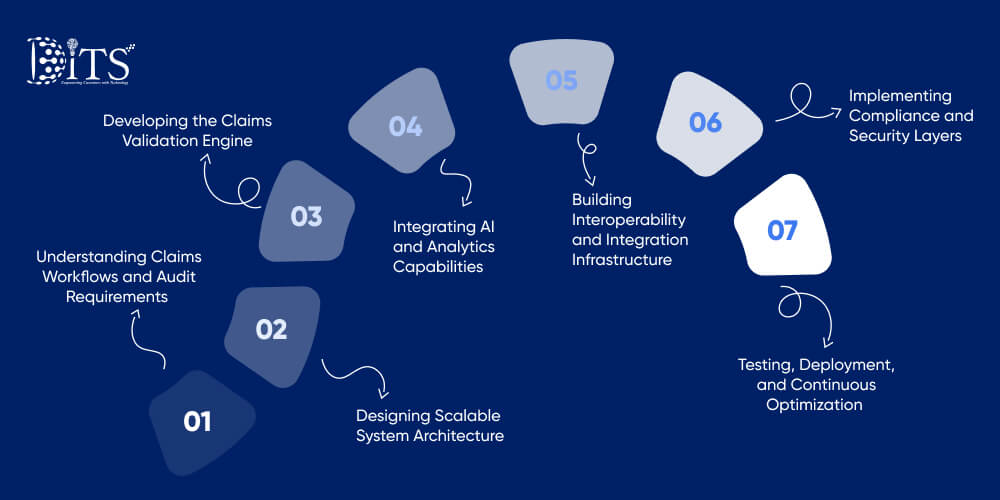
Developing medical claims auditing software requires more than building a billing application with validation rules. The platform must align with healthcare workflows, payer requirements, compliance standards, and large-scale data processing needs from the beginning.
A structured development approach helps organizations build systems that are scalable, secure, and practical for real-world healthcare operations.
The development process typically includes:
Understanding Claims Workflows and Audit Requirements
Before development begins, teams first analyze how claims move across the organization. This stage is critical because healthcare providers, insurers, and RCM firms often follow very different auditing processes.
The goal here is to identify:
- Where claim denials occur
- What triggers manual reviews
- Which payer rules create delays
- How fraud checks are currently handled
- Where revenue leakage happens
Without this workflow analysis, organizations risk building software that automates isolated tasks instead of improving the overall auditing ecosystem.
Designing Scalable System Architecture
Medical claims auditing software must process large claim volumes while supporting multiple users, real-time validations, and integrations across healthcare systems.
This is why modern platforms are commonly designed using cloud-native or microservices-based architecture.
A scalable architecture usually includes:
- Claims ingestion layer
- Audit rule engine
- AI processing layer
- Analytics and reporting modules
- Integration services
- Security and compliance infrastructure
This modular approach helps organizations scale the platform more efficiently as claim volumes and operational requirements grow.
Developing the Claims Validation Engine
The rule engine acts as the core processing layer of the auditing platform. It validates claims against payer rules, coding standards, and reimbursement logic before or after payment processing.
The system is generally designed to support CPT and ICD code validation, modifier checks, duplicate claim detection, documentation verification, eligibility validation and payer-specific reimbursement rules.
Since payer policies frequently change, configurable rule management becomes essential for long-term scalability.
Integrating AI and Analytics Capabilities
AI integration is transforming how modern auditing systems identify risks and prioritize reviews.
Instead of relying only on static validation rules, AI models can analyze historical and real-time claims data to detect denial patterns, suspicious billing activity, reimbursement anomalies and more.
Many platforms also use Natural Language Processing (NLP) to analyze the physician notes, discharge summaries, treatment documentation and clinical records.
This helps validate whether submitted claims align with supporting medical evidence.
Building Interoperability and Integration Infrastructure
Medical claims auditing software must exchange data continuously with existing healthcare systems.
This often includes integration with:
- EHR and EMR platforms
- Medical billing software
- Payer systems
- Clearing houses
- Revenue cycle management systems
Most enterprise-grade platforms use RESTful APIs, HL7 standards, and FHIR interoperability frameworks to ensure secure and seamless data exchange across systems.
Implementing Compliance and Security Layers
Since the platform processes protected health information and financial records, compliance and security must be built directly into the architecture. Development teams typically implement HIPAA-compliant infrastructure, encrypted data storage, role-based access controls, secure authentication systems, audit logging and API security protocols.
These controls help organizations reduce compliance risks while maintaining secure access to sensitive healthcare data.
Testing, Deployment, and Continuous Optimization
Before deployment, the platform undergoes multiple layers of validation to ensure performance, accuracy, and compliance readiness.
This usually includes functional testing, claims validation testing, AI model testing, security testing, performance testing and integration testing.
After deployment, continuous optimization remains essential because payer rules, reimbursement workflows, and AI models continue evolving over time.
For this reason, medical claims auditing software should be treated as a continuously evolving healthcare technology platform rather than a one-time implementation project.
Why Healthcare Organizations Partner with DITS for Medical Claims Auditing Software Development
Building enterprise-grade medical claims auditing software requires much more than application development expertise. The platform must support healthcare interoperability, payer-specific workflows, AI implementation, compliance requirements, and secure data handling within a scalable architecture.
This is where working with an experienced healthcare technology partner becomes critical.
At DITS, development teams focus on building intelligent healthcare solutions tailored to real operational and reimbursement challenges. From AI-powered audit engines and workflow automation to secure integrations and compliance-focused architecture, the goal is to help healthcare and insurance organizations create scalable platforms that improve both efficiency and financial outcomes.
By combining healthcare domain understanding with modern AI and software engineering capabilities, organizations can build claims auditing systems that are not only technically strong but also operationally practical for long-term growth.
Conclusion
As healthcare reimbursement systems become more complex, medical claims auditing software is evolving from a supporting operational tool into a strategic technology investment. Healthcare providers, insurers, TPAs, and RCM firms are increasingly looking for intelligent platforms that can improve claim accuracy, reduce denial rates, strengthen compliance, and support faster financial decision-making.
AI is accelerating this transformation by helping organizations move beyond traditional rule-based auditing toward more proactive and data-driven claims management. From predictive denial analysis and fraud detection to intelligent workflow automation, modern auditing systems are creating measurable operational and financial impact across the healthcare ecosystem.
However, building a scalable and reliable medical claims auditing platform requires more than adding automation features. Organizations need a development approach that combines healthcare domain expertise, AI capabilities, interoperability planning, security architecture, and compliance-focused engineering.
For businesses planning to invest in next-generation claims auditing solutions, partnering with an experienced healthcare software development company can significantly improve both implementation success and long-term scalability.
FAQs
What is medical claims auditing software?
Medical claims auditing software is a healthcare solution designed to review and validate insurance claims for accuracy, compliance, coding integrity, reimbursement correctness, and fraud detection before or after payment processing.
How does AI improve medical claims auditing software?
AI helps analyze large volumes of claims data to identify denial risks, suspicious billing patterns, duplicate claims, reimbursement anomalies, and workflow inefficiencies. It also supports intelligent claim prioritization and predictive auditing.
Who uses medical claims auditing software?
The software is commonly used by healthcare providers, insurance companies, TPAs, medical billing companies and revenue cycle management firms.
What are the key features of medical claims auditing software?
Some of the most important features include claims validation engine, AI-based denial prediction, fraud detection, workflow automation, compliance monitoring, NLP-based document analysis, reporting dashboards and EHR and billing system integrations.
What is the difference between pre-payment and post-payment auditing?
Pre-payment auditing reviews claims before reimbursement is issued to reduce denials and billing errors. Post-payment auditing analyzes processed claims to identify overpayments, underpayments, compliance issues, or fraud risks.
Why is interoperability important in medical claims auditing software?
Medical claims auditing platforms need to exchange data with EHR systems, billing software, payer databases, and RCM tools. Strong interoperability ensures smoother workflows, accurate validations, and better operational efficiency.
How long does it take to develop medical claims auditing software?
The development timeline depends on platform complexity, AI requirements, integration scope, compliance needs, and customization levels. Enterprise-grade solutions may require several months for architecture planning, development, testing, and deployment.
How can DITS help with medical claims auditing software development?
DITS helps healthcare and insurance organizations build scalable, AI-powered medical claims auditing solutions tailored to operational workflows, compliance requirements, interoperability standards, and long-term business goals.

Nidhi Thakur
With more than 19 years of experience - I represent a team of professionals that specializes in the healthcare and business and workflow automation domains. The team consists of experienced full-stack developers supported by senior system analysts who have developed multiple bespoke applications for Healthcare, Business Automation, Retail, IOT, Ed-tech domains for startups and Enterprise Level clients.
Recent Posts
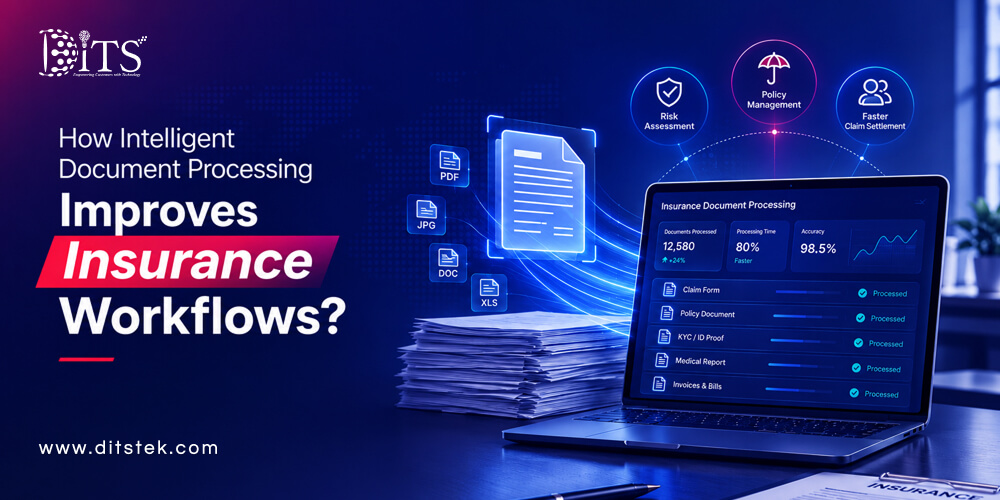
Explore how intelligent document processing for insurance helps businesses automate document workflows, reduce processing costs, improve accuracy, and strengthen operational efficiency across insurance functions.
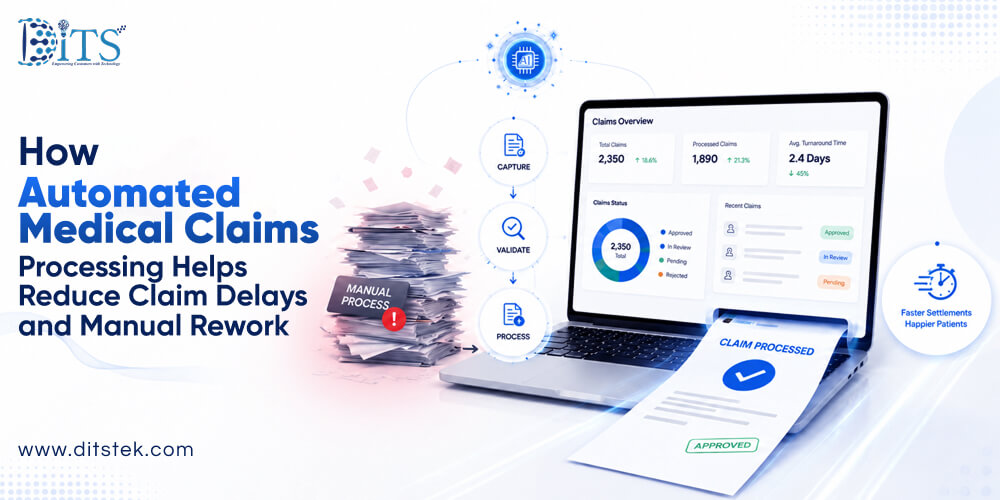
Discover how automated medical claims processing reduces delays, manual rework, claim denials, and administrative costs while improving reimbursement speed and operational efficiency.
Learn how to build medical billing software with essential features, integrations, security, and development costs.