How to Build Your Own AI Agent
Table Of Content
Published Date :
13 May 2026
Key Takeaways
- AI agents help businesses automate decision-making tasks, not just repetitive work.
- Organizations across the world are adopting AI agents to improve productivity and operational efficiency.
- Reliable data sources and system integrations determine the effectiveness of an AI agent.
- A structured development reduces implementation risks and improves success rates.
- AI agents deliver the most value when integrated with enterprise platforms and workflows.
- Proper infrastructure, security controls, and monitoring systems are critical for long-term reliability.
- Companies that adopt intelligent automation early gain operational advantages and faster decision-making.
A few years ago, most companies experimented with automation through simple scripts or workflow tools. Helpful, yes. Transformational? Not quite. Today the conversation has shifted. Businesses across the United States are exploring intelligent systems that can interpret information, make decisions, and execute tasks with minimal human intervention. That shift is where AI agents enter the picture.
From automating customer service inquiries and streamlining supply chain logistics to generating data-driven insights in seconds, AI agents are rapidly transforming how companies in United States operate.
For many leadership teams, the big question is no longer whether AI will shape operations. The real question is how to build your own ai agent in a way that actually improves productivity, reduces operational friction, and supports long-term business growth.
What Is AI Agent?
Before exploring implementation strategies, it helps to understand what businesses actually mean when they talk about AI agents.
An AI agent is a software entity capable of observing inputs, analyzing context, making decisions, and executing tasks automatically. Instead of waiting for constant instructions, it works toward a defined objective using available data and connected tools.
Unlike static automation scripts, these agents adapt to changing inputs. They can evaluate customer queries, review datasets, trigger workflows, or escalate decisions when human intervention becomes necessary.
For example, a customer support AI agent may automatically categorize incoming tickets, draft responses using company knowledge bases, and route complex cases to the right department. That means fewer manual steps and faster service delivery.
Core Capabilities of AI Agents
Modern AI agents combine several operational abilities that make them valuable for enterprise environments.
Common capabilities include:
- Task Automation: Agents can execute repetitive operational work such as ticket classification, order tracking updates, or report generation without constant supervision.
- Data Analysis And Decision Support: They process large volumes of structured and unstructured information, helping managers identify patterns or operational risks.
- Conversational Interaction: Through natural language interfaces, agents can communicate with customers, employees, or internal systems.
- Integration With Enterprise Systems: AI agents can connect with CRMs, ERP systems, internal dashboards, or customer databases to perform tasks within existing workflows.
When companies invest in AI software development, these capabilities are often integrated directly into operational platforms so that automation becomes part of everyday business processes.
Looking To Automate Business Operations With AI Agents?
Build scalable AI agents that reduce manual work, improve productivity, and deliver faster operational insights across enterprise environments successfully.
Key Components Required to Build AI Agent
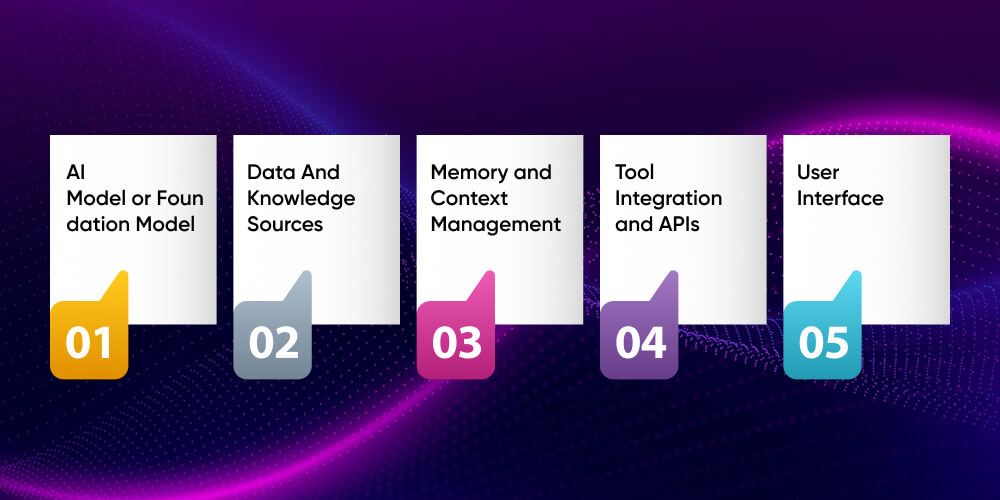
A reliable AI agent behaves like a coordinated system. Models interpret information, knowledge sources provide context, integrations trigger actions, and interfaces allow users to interact with the agent.
AI Model or Foundation Model
At the core sits the intelligence layer. This is the model responsible for interpreting language, analyzing inputs, and generating responses or decisions.
Businesses typically choose between:
- Large language models capable of handling broad tasks
- Domain-specific models trained for industry workflows
- Hybrid systems combining multiple models for different tasks
The choice depends on complexity. A logistics company may require predictive operational models, while a customer support agent might rely primarily on conversational models.
Organizations working with experienced teams in AI agent development often customize models so they align with internal workflows rather than forcing operations to adapt to generic tools.
Data And Knowledge Sources
An AI agent becomes valuable only when it understands company knowledge.
Common data sources include:
- Internal documentation
- Customer support knowledge bases
- CRM records
- Product documentation
- Operational dashboards
- APIs from third-party platforms
For instance, imagine a procurement manager asking an internal AI agent about supplier performance. Without access to purchasing data and vendor reports, the agent simply guesses. With the right data sources, it delivers accurate insights within seconds.
Memory and Context Management
Memory allows the agent to maintain context during interactions and across sessions.
Two main forms exist:
1. Short-Term Memory
- Maintains conversation flow during a single interaction
- Tracks recent instructions or user questions
2. Long-Term Memory
- Stores historical interactions
- Learns preferences, operational patterns, or repeated workflows
For businesses building internal assistants, memory dramatically improves usability. Instead of repeating instructions, employees interact with a system that remembers past discussions and operational context.
Tool Integration and APIs
AI agents rarely operate alone. Their real value appears when they interact with business systems.
Typical integrations include:
- CRM platforms
- ERP systems
- Helpdesk software
- Analytics platforms
- Document management systems
These integrations allow the agent to move from conversation to action. For example, a sales manager could ask the agent to generate a lead report, update pipeline notes, and notify the sales team automatically.
At DITS, we often integrate AI capabilities into enterprise platforms through structured AI consulting initiatives, ensuring the agent fits existing operational infrastructure rather than disrupting it.
User Interface
Even the most advanced agent needs an accessible interface.
Common interaction methods include:
- Chat interfaces within company portals
- Dashboards embedded in internal tools
- Voice-based assistants for operational environments
A well-designed interface makes the AI agent feel like a natural extension of existing software rather than another tool employees must learn from scratch.
With these components in place, organizations can move forward confidently and begin structuring the development process.
Step-By-Step Process to Build Your Own AI Agent
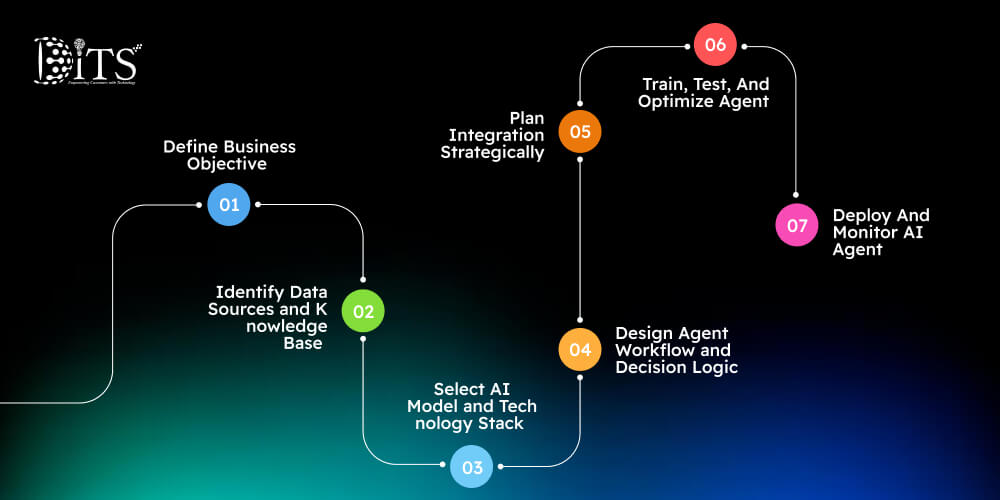
Once the foundational components are understood, the next step is implementation. Many companies jump straight into model selection or coding. That approach usually creates confusion, wasted budget, and systems that never reach production.
Building an AI agent is closer to designing a business system than launching a technical experiment. Clear objectives, reliable data, and operational integration determine whether the agent becomes useful or simply another unused tool.
Below is a practical roadmap organizations follow when planning how to build your own ai agent in a structured, business-focused way.
Define Business Objective
Everything begins with the problem.
An AI agent should address a clear operational need rather than exist as a technology demonstration. Leadership teams typically start by identifying areas where repetitive decision-making slows productivity.
Examples include:
- Handling large volumes of support requests
- Qualifying incoming sales leads
- Monitoring operational metrics across departments
- Summarizing internal reports for executives
A healthcare firm in Boston recently implemented an internal reporting agent that reviews weekly operational dashboards and summarizes insights before management meetings. What previously required several hours of manual analysis now takes minutes.
Clarity at this stage prevents expensive course corrections later.
Identify Data Sources and Knowledge Base
Once the objective is defined, the next priority is information access.
AI agents depend heavily on internal knowledge to perform reliably. Businesses typically connect their agents to structured and unstructured sources such as:
- Company documentation
- Operational databases
- Customer interaction logs
- Product manuals
- CRM and ticketing systems
If the data foundation is weak or fragmented, the agent will struggle to provide accurate outputs. Many organizations spend considerable time consolidating information before deployment.
Select AI Model and Technology Stack
Model selection determines how the agent processes information and responds to tasks.
Companies evaluate several factors when choosing their technology stack:
- Performance requirements
- Operational scale
- Data sensitivity
- Integration complexity
Some organizations rely on general-purpose language models. Others deploy specialized models designed for finance, healthcare, or logistics environments.
Technology stack decisions also include infrastructure choices, development frameworks, and monitoring tools that support long-term reliability.
Design Agent Workflow and Decision Logic
This stage transforms the concept into an operational process.
Teams map how the agent should behave in different scenarios:
- What triggers its actions
- Which data sources it accesses
- How it evaluates responses
- When it escalates tasks to humans
Consider a customer service agent. The workflow might look like this:
- Receive customer query
- Analyze intent and sentiment
- Retrieve relevant documentation
- Draft a response
- Route complex cases to support staff
Designing this logic carefully ensures the system behaves predictably and supports business workflows instead of disrupting them.
Build Integrations with Business Systems
An AI agent becomes significantly more powerful when connected to operational platforms.
Typical integrations include:
- CRM platforms
- Helpdesk systems
- Analytics dashboards
- Inventory management tools
- Internal databases
These integrations allow the agent to execute actions, not just provide information. A sales agent could update pipeline records automatically or notify representatives when high-value prospects appear.
Organizations adopting ai solutions for enterprise environments often prioritize integration early because disconnected AI tools rarely deliver measurable operational impact.
Train, Test, And Optimize Agent
Before deployment, the agent must be tested extensively.
This phase involves:
- Evaluating response accuracy
- Refining prompts and workflows
- Validating integration behavior
- Testing edge cases and unusual queries
Many teams run pilot programs with a small group of employees before scaling the system organization-wide.
Small adjustments during testing often lead to major improvements in reliability and user trust.
Deploy And Monitor AI Agent
Deployment does not mark the end of development. In many ways, it marks the beginning.
Successful AI agents require ongoing monitoring to ensure:
- Response accuracy remains consistent
- Integrations continue functioning correctly
- Performance meets operational expectations
Usage analytics, feedback loops, and periodic updates help the system evolve as business processes change.
At DITS, we integrate AI into our engineering workflows as well. Our teams use intelligent tools during software development, quality assurance, code maintenance, and product customization. That experience allows us to design systems where AI supports real business operations rather than existing as isolated features.
Once deployment stabilizes, organizations can expand capabilities and automate additional workflows.
Technology Stack for AI Agent Development
Behind every effective AI agent sits a technology ecosystem that keeps the system reliable, scalable, and secure. Many organizations initially focus only on models. In reality, the surrounding infrastructure matters just as much.
A strong technology stack ensures the agent can process data efficiently, interact with enterprise systems, and operate consistently under real business workloads.
Below are the major layers companies typically implement when designing an AI agent platform.
AI Models and Frameworks
The intelligence layer begins with the model responsible for reasoning and generating outputs.
Common frameworks and tools include:
- Large language models for natural language understanding
- Machine learning frameworks for predictive analytics
- Orchestration frameworks for coordinating agent workflows
- Prompt management systems for structured interactions
These frameworks allow developers to design agents capable of analyzing instructions, retrieving relevant information, and executing complex tasks.
Backend Infrastructure
AI agents require dependable backend systems to manage processing, storage, and communication between components.
Typical infrastructure includes:
- Cloud computing environments
- Scalable containerized services
- API management platforms
- Distributed computing environments
For enterprise deployments, reliability is critical. If the system cannot scale during peak usage, the agent becomes a bottleneck rather than a productivity tool.
Data Processing Tools
Data pipelines ensure that information flows smoothly between sources and the AI agent.
Organizations typically implement tools for:
- Data ingestion from internal platforms
- Data cleaning and transformation
- Document indexing and retrieval
- Real-time analytics processing
Clean, structured data dramatically improves the accuracy of AI outputs. Without proper data pipelines, even powerful models struggle to deliver meaningful insights.
Integration And Automation Tools
AI agents generate real value when they interact with operational systems.
Integration platforms enable the agent to connect with:
- CRM systems
- Enterprise resource planning software
- Support ticket platforms
- Workflow automation systems
- Internal business dashboard
These integrations allow the agent to trigger actions across departments. A finance team could request expense summaries, while a support team might automate ticket categorization.
Organizations investing in ai powered solutions environments often prioritize integration architecture because it determines how easily the agent fits into existing operations.
Security And Compliance Tools
Security is a top priority when deploying intelligent systems within corporate environments.
Typical security controls include:
- Identity and access management systems
- Encryption for data storage and transmission
- Monitoring tools for system activity
- Compliance frameworks for industry regulations
For sectors such as healthcare, finance, and logistics, maintaining strict control over sensitive information is essential.
A well-designed technology stack balances intelligence, reliability, and governance. When these elements align, AI agents can operate safely within complex business environments.
Cost Of Building AI Agent
One of the first questions executives ask is simple: what will it cost? The answer varies widely because AI agents differ in complexity, scale, and operational requirements. A small internal assistant that summarizes reports will cost far less than an enterprise system handling thousands of customer interactions daily.
The good news is that companies rarely need to build everything at once. Most successful deployments begin with a focused use case, prove value, and expand gradually.
The following table provides a general estimate of investment levels businesses often encounter.
| AI Agent Complexity | Development Investment | Estimated Monthly Operating Cost | Example Use Case |
| Basic Internal Agent | $20,000 - $60,000 | $500 - $2,000 | internal reporting assistant |
| Operational Workflow Agent | $60,000 - $150,000 | $2,000 - $6,000 | customer support automation |
| Enterprise Intelligent Agent | $150,000 - $400,000+ | $6,000 - $20,000+ | multi-system enterprise automation |
These figures vary depending on integrations, data scale, and customization requirements.
Organizations planning long-term intelligent automation strategies often work with specialists experienced in AI-based solutions environments to design scalable systems that grow with operational demand.
Why Choose DITS For Building AI Agent
Choosing the right technology partner plays a critical role in determining whether an AI initiative delivers measurable business value or remains an experimental project. Building an AI agent involves much more than selecting a model or writing code. It requires aligning intelligent automation with business workflows, integrating with enterprise platforms, and designing systems that can scale as operational demands grow.
DITS approaches AI implementation with a business-first mindset, ensuring that every AI agent we build directly supports operational efficiency, data-driven decision-making, and improved customer experience.
At DITS, development begins with a clear understanding of the operational challenges an organization wants to address. Instead of deploying generic automation tools, our team designs AI agents tailored to specific business processes such as customer service automation, operational reporting, internal workflow management, or decision-support systems. Through structured ai consulting, we evaluate where intelligent automation can deliver the highest impact and develop solutions that align closely with organizational goals.
Our engineering approach is grounded in strong ai software development practices that prioritize scalability, performance, and reliability. We focus on designing architectures that support enterprise integrations, secure data handling, and long-term system stability. Rather than creating isolated AI features, our teams build intelligent systems that function as part of a company’s core software infrastructure.
What further differentiates DITS is how deeply AI is embedded into our own development processes. We actively use AI across the software lifecycle for software development productivity, quality assurance, maintaining consistent code quality, and enabling product customization. This hands-on experience allows us to design AI agents that operate efficiently within real-world business environments.
For organizations planning to build your ai agent, DITS delivers enterprise-grade solutions that integrate seamlessly with existing systems such as CRM platforms, operational dashboards, and internal data sources. Our focus on enterprise-ready architecture ensures that AI agents remain secure, scalable, and adaptable as business requirements evolve, ultimately turning intelligent automation into a long-term strategic advantage.
Planning To Deploy Enterprise Grade AI Agent Solutions?
Design secure and scalable AI agents with reliable infrastructure, business-focused workflows, and long-term operational support for modern enterprises successfully.
Conclusion
AI agents represent the next phase of intelligent business automation. These systems can interpret information, analyze context, and execute tasks with minimal human intervention. When implemented correctly, these systems reduce operational friction and help leadership teams make faster, better-informed decisions.
For executives exploring build your own ai agent initiatives, the most important step is starting with a clearly defined objective. Focus on a practical business challenge, establish strong data foundations, and design systems that integrate smoothly with existing operations.
Businesses that approach AI adoption strategically will build intelligent operational systems capable of supporting growth, efficiency, and long-term competitiveness.
Frequently Asked Questions
How long does it take to build AI agent for business operations?
The timeline depends on the complexity of the use case and the number of systems the agent must integrate with. A focused internal assistant designed for tasks such as document retrieval or operational reporting may take 6 to 10 weeks. More advanced agents that integrate with CRM platforms, analytics systems, or customer service environments may require 3 to 6 months.
What types of businesses benefit most from AI agents?
AI agents can deliver value across many industries, particularly where large volumes of information or repetitive decision-making exist. Sectors such as healthcare, logistics, manufacturing, financial services, SaaS companies, and customer support operations frequently adopt AI agents to automate workflows, analyze operational data, and assist teams with daily decision-making.
How can DITS AI agent building services help businesses?
DITS AI agent building services help organizations design, develop, and deploy intelligent agents tailored to their operational workflows. Our teams analyze business processes, identify automation opportunities, and build AI agents that integrate with existing enterprise systems such as CRM platforms, operational dashboards, and internal databases.
What factors influence cost of building AI agent?
Several elements influence the overall investment required. These include the complexity of the AI agent, number of enterprise integrations, volume of data processing, infrastructure requirements, and security considerations. A basic internal agent may require a modest investment, while enterprise-level agents supporting multiple departments and large datasets will require more advanced architecture and infrastructure.
Why should companies consider DITS AI agent building services instead of developing internally?
Many organizations initially explore internal development but encounter challenges related to integration complexity, model optimization, and enterprise security requirements. DITS AI agent building services provide specialized expertise in designing scalable AI architectures, integrating agents with existing business systems, and ensuring long-term operational reliability.

Dinesh Thakur
21+ years of IT software development experience in different domains like Business Automation, Healthcare, Retail, Workflow automation, Transportation and logistics, Compliance, Risk Mitigation, POS, etc. Hands-on experience in dealing with overseas clients and providing them with an apt solution to their business needs.
Recent Posts
AI triage in healthcare helps prioritize patients, improve access, streamline care decisions, and enhance patient engagement with smarter workflows.
AI-powered dispatch scheduling reduces transportation costs by optimizing routes, vehicle utilization, driver schedules, and delivery operations for greater efficiency.
AI integration connects AI with existing systems and workflows, while AI adoption focuses on using AI effectively to drive measurable business outcomes.