25+ years of IT software development experience in different domains like Business Automation, Healthcare, Retail, Workflow automation, Transportation and logistics, Compliance, Risk Mitigation, POS, etc. Hands-on experience in dealing with overseas clients and providing them with an apt solution to their business needs.
For logistics companies, delivery stations are where speed, accuracy, and customer satisfaction are decided. The cost to build a last mile delivery management software depends on features, integrations, data processing requirements, and AI capabilities. Businesses investing in final mile delivery tracking systems must consider real-time GPS monitoring, route optimization engines, barcode scanning, API integrations with ERP or warehouse systems, and driver performance dashboards.
Ditstek Innovations, a leading transportation and logistics software development company, builds tailored solutions from scratch or upgrades existing systems with AI-driven tracking, predictive ETA models, and automated dispatch workflows to improve operational efficiency and ROI.
Stats & Demand of Last Mile Delivery Tracking Software 2026
Current estimates place the global market size around $7-15 billion as of early 2026, with varying CAGRs from 6.8% to 17% projected through 2032-2035 depending on the analyst.
Source
2025/2026 Size
Projected Size
CAGR
Timeframe
Precision Business Insights
$7.5B (2024)
$10.9B
4.8%
2026-2032
Future Market Insights
$15.2B (2025)
$41.5B
10.6%
2025-2035
Persistence Market Research
$7.6B (2026)
$12.0B
6.8%
2026-2033
Business Research Insights
$2.71B (2026)
$5.08B
7.26%
2026-2035
Key Trends
AI-powered real-time tracking and route optimization dominate, cutting failed deliveries by 20%.
Customization for personalization, such as flexible handoffs at stations or lockers, meets rising B2B/B2C demands.
Sustainability features like eco-routing gain traction amid regulations.
Cost Breakdown: Last Mile Delivery Station Tracking Software
Building a last mile delivery station tracking software requires a robust architecture to manage real-time logistics, driver communication, and warehouse sorting. Based on industry standards and the service model provided by DITS (Ditstek Innovations), here is the cost breakdown starting from your baseline of $25,000.
Phase / Component
Estimated Cost (Starting)
Key Deliverables
1. Discovery & UI/UX Design
$4,000 – $6,000
Wireframes, User Journeys (Dispatcher/Driver), and high-fidelity prototypes.
2. Core Backend Development
$8,000 – $12,000
Database architecture, API development, and station/hub management modules.
3. Real-Time Tracking & GPS
$5,000 – $8,000
Google Maps/Mapbox integration, live driver positioning, and geofencing.
4. AI Integration (Smart Suite)
$6,000 – $12,000
Predictive ETAs, AI-based route optimization, and automated sorting logic.
5. Testing & Quality Assurance
$3,000 – $5,000
Load testing for peak hours, security audits, and field-test simulations.
Total Estimated Build
$26,000 – $43,000+
Note: Final price scales with complexity and volume.
Key AI Features Included in This Budget
Integrating AI at this price point typically focuses on the "Predictive" and "Optimization" layers of the last mile:
Dynamic Route Optimization: Instead of static paths, the AI calculates routes in real-time based on traffic, weather, and "driver fatigue" patterns.
Predictive Delivery Windows: Machine learning models analyze historical station data to provide customers with a 95%+ accurate arrival time.
Automated Dispatching: AI matches orders to the nearest available vehicle at the station, reducing "idling time" at the hub.
Failed Delivery Analysis: Identifying patterns in failed deliveries (e.g., certain neighborhoods or times) to suggest better scheduling.
Ongoing Operational Costs
Cloud Hosting (AWS/Azure): $200 – $1,000/month (depends on volume).
API Fees (Google Maps/SMS): Usage-based (typically $0.50 – $2.00 per 1,000 requests).
Maintenance: 15-20% of the initial build cost per year.
Cost To Build Final Mile Delivery Tracking Software: Based on Complexity
When building final mile delivery tracking software, the cost is primarily driven by how much "thinking" the software has to do. A basic app that just shows a dot on a map is significantly cheaper than an enterprise-grade system build custom AI software to predict traffic patterns and optimize fuel consumption. By leveraging DITS (Ditstek Innovations) services, which typically begin at $25,000, you can scale from a Minimum Viable Product (MVP) to an advanced AI-integrated ecosystem.
Multi-stop route planning, automated scheduling, electronic Proof of Delivery (ePOD), and basic ERP/OMS integrations.
3 – 5 Months
Advanced (AI-Driven)
$120,000 – $250,000+
AI route optimization, predictive ETAs, machine learning for failed delivery analysis, and IoT sensor integration.
5 – 7 Months
Enterprise Grade
Custom Pricing
Multi-region orchestration, full white-labeling, high-security compliance (GDPR/SOC2), and deep legacy system syncing.
9+ Months
1. Basic (MVP) – $25,000 – $50,000
This cost covers core functionality required to launch a working system quickly. It includes GPS API integration, basic dispatcher dashboard UI, trip status controls, SMS gateway setup, and cloud hosting setup. Development focuses on essential modules only, limited user roles, and minimal third-party integrations. Suitable for startups validating operations.
2. Mid-Level – $50,000 – $120,000
This range includes advanced workflow automation such as multi-stop route algorithms, automated dispatch scheduling logic, ePOD with digital signatures, and ERP/OMS API integrations. Costs increase due to backend architecture expansion, database optimization, role-based access control, and mobile app enhancements. Ideal for growing logistics businesses handling higher delivery volumes.
3. Advanced (AI-Driven) – $120,000 – $250,000+
AI-based route optimization, predictive ETA modeling using machine learning, failed delivery pattern analysis, and IoT device integrations require data engineering, model training, and scalable cloud infrastructure. Costs reflect AI development, real-time analytics pipelines, and performance monitoring systems. Designed for businesses aiming to reduce fuel costs and delivery failures.
4. Enterprise Grade – Custom Pricing
Enterprise systems involve multi-region deployment, microservices architecture, white-label capability, SOC2/GDPR compliance layers, advanced cybersecurity frameworks, and deep integration with legacy systems. Costs depend on customization depth, security requirements, infrastructure scale, and deployment regions. Built for large enterprises managing nationwide or global last mile operations.
Last Mile Logistics Tracking Software: Advanced Features DITS Build
DITS develops advanced last mile logistics tracking software with AI-driven route optimization, real-time delivery updates, and predictive analytics. These last mile delivery management platforms enhance efficiency, reduce delays, and give businesses complete visibility across their final mile delivery operations.
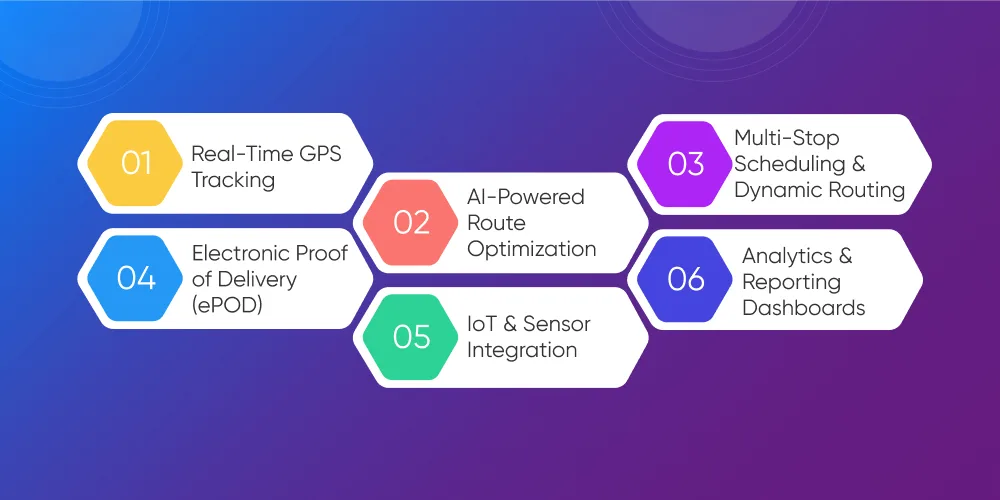
1. Real-Time GPS Tracking
DITS builds last mile delivery tracking platforms with real-time GPS monitoring for drivers and vehicles. Businesses can visualize delivery locations on dashboards, monitor fleet movement, and respond to delays instantly, ensuring accuracy and transparency in final mile delivery tracking.
2. AI-Powered Route Optimization
Advanced AI algorithms calculate the most efficient routes considering traffic, weather, and delivery priorities. Logistics software development reduces fuel costs and delivery times, providing predictive ETAs to improve customer satisfaction across high-volume operations.
3. Multi-Stop Scheduling & Dynamic Routing
DITS integrates automated multi-stop route planning and dynamic rerouting. The last mile delivery management software adjusts routes in real time based on delays, cancellations, or priority changes, keeping operations seamless and scalable.
4. Electronic Proof of Delivery (ePOD)
Drivers can capture delivery confirmations digitally, including signatures, photos, or QR codes. This final mile delivery tracking platform eliminates paperwork, ensures accountability, and provides verifiable records for audit and customer communication.
5. IoT & Sensor Integration
The software connects with custom IoT software to monitor vehicle status, package conditions, and environmental factors. Businesses using last mile delivery management platforms gain insights into operational efficiency and proactive maintenance alerts.
6. Analytics & Reporting Dashboards
DITS includes real-time reporting dashboards to track KPIs such as delivery times, delays, and driver performance. Predictive analytics within the last mile logistics tracking software allows businesses to forecast demand, optimize staffing, and enhance route efficiency.
Best AI Tools to Enhance Last Mile Delivery Tracking
Effective last mile logistics tracking relies on advanced AI tools to improve route efficiency, predict delays, monitor assets, and enhance customer experience. These AI tools integrate with your last mile delivery management software, providing real-time insights and operational control for startups, mid-size firms, and large enterprises.
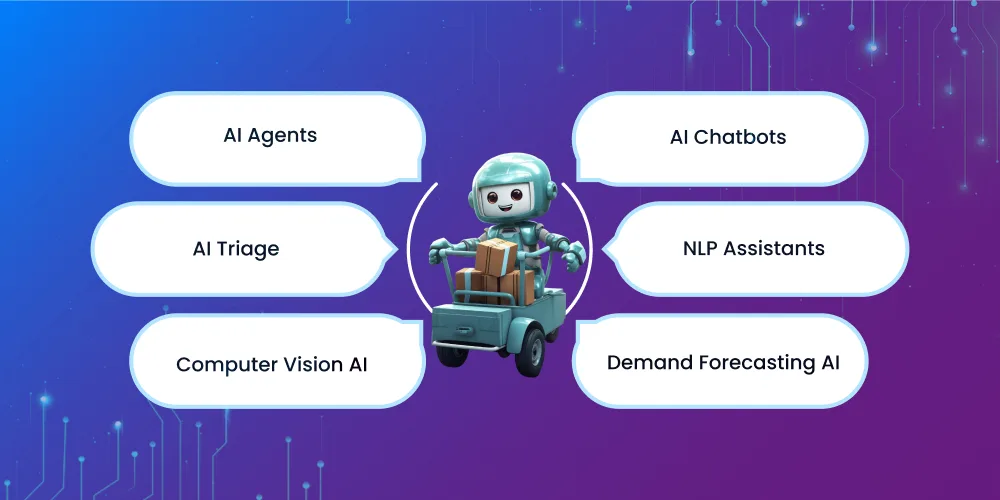
AI Agents
Partnering with an AI agent development company allows businesses to create autonomous systems that manage delivery tasks, optimize routes, and handle dynamic scheduling. These AI agents enhance your last mile delivery tracking platform, reduce manual intervention, and improve delivery accuracy for high-volume operations.
AI Chatbots
AI chatbot development company helps to build a high-end chatbots for real-time communication between dispatchers, drivers, and customers. Integrated with a last mile delivery management platform, these chatbots handle queries, update delivery status, and collect feedback, improving service quality while reducing human workload.
AI Triage
AI triage helps to analyze delivery incidents, delays, and exceptions to prioritize critical issues. Businesses using last mile logistics tracking software can instantly reroute drivers, manage workload efficiently, and prevent cascading delays in high-demand periods.
NLP Assistants
Natural Language Processing assistants interpret voice commands and text updates from drivers. Integrated with a final mile delivery tracking system, NLP assistants automate reporting, confirm deliveries, and provide actionable insights without disrupting driver workflow.
Computer Vision AI
Computer vision AI monitors loading, package handling, and proof of delivery via image recognition. Businesses can reduce damages, verify deliveries, and enhance security, ensuring reliable operations in any last mile delivery management software deployment.
Demand Forecasting AI
Demand forecasting AI predicts delivery volumes, peak times, and resource needs using historical data. Integrated with a last mile delivery tracking platform, it helps businesses allocate vehicles, optimize inventory, and improve customer satisfaction through timely deliveries.
Why DITS for Last Mile Delivery Tracking
DITS offers end-to-end solutions for businesses aiming to improve delivery efficiency, reduce delays, and optimize operations. Our last mile delivery tracking platform integrates AI, IoT, and real-time analytics to provide actionable insights and scalable solutions for startups, mid-size companies, and large enterprises.
Comprehensive Real-Time Tracking
DITS provides a final mile delivery tracking system that monitors vehicles, shipments, and drivers in real time. Businesses can visualize delivery progress, anticipate delays, and take corrective actions instantly using our last mile delivery management software.
AI-Powered Route Optimization
Our last mile logistics tracking platform uses AI algorithms to optimize multi-stop routes. This reduces fuel costs, improves delivery speed, and minimizes operational inefficiencies for businesses handling high-volume deliveries.
Scalable Platform Architecture
DITS builds a last mile delivery management platform capable of scaling from local operations to multi-region networks. Businesses can expand operations without performance loss or system interruptions.
Seamless System Integrations
Our software integrates with ERP, CRM, and inventory systems. Businesses gain centralized control over orders, delivery status, and logistics workflows through a unified last mile delivery tracking platform.
Predictive Analytics and Insights
The platform offers predictive insights to anticipate delays, analyze delivery performance, and forecast demand. Businesses can make data-driven decisions to improve customer satisfaction and operational efficiency.
Customizable and Secure Solutions
DITS delivers tailored last mile delivery management software with role-based access, GDPR-compliance, and encryption. Enterprises can configure dashboards, reports, and alerts according to operational priorities and security standards.
Looking to Upgrade Your Existing Platform
Modernize your legacy delivery systems with AI-powered tracking, predictive ETAs, and automation tools.
Implementing a robust last mile delivery tracking platform is essential for businesses aiming to improve efficiency, reduce delays, and enhance customer satisfaction. DITS provides custom last mile delivery management software with AI-driven optimization, real-time monitoring, and seamless integration, helping startups, mid-size businesses, and large enterprises scale operations while maintaining accuracy and transparency across their delivery networks.
Ready to Optimize Your Last Mile Costs?
Get a tailored cost estimate and strategic roadmap aligned with your delivery volume, integrations, and AI requirements.
Final mile delivery tracking monitors shipments from the last hub to the customer’s doorstep. Businesses using it gain real-time visibility, reduce delivery delays, and improve customer satisfaction while managing operations efficiently.
Dinesh Thakur
25+ years of IT software development experience in different domains like Business Automation, Healthcare, Retail, Workflow automation, Transportation and logistics, Compliance, Risk Mitigation, POS, etc. Hands-on experience in dealing with overseas clients and providing them with an apt solution to their business needs.