With more than 20 years of experience - I represent a team of professionals that specializes in the healthcare and business and workflow automation domains. The team consists of experienced full-stack developers supported by senior system analysts who have developed multiple bespoke applications for Healthcare, Business Automation, Retail, IOT, Ed-tech domains for startups and Enterprise Level clients
Key Takeaways
Healthcare organizations often rely on separate systems for patient records, laboratory results, billing, and medical devices. Integration helps these systems share information without repeated manual data entry.
The payoff is practical: fewer typing errors, fewer gaps in the chart, and less time clicking between screens.
Getting systems to “understand” each other takes APIs, shared standards like HL7 and FHIR, and careful data mapping. Skip the mapping and the same lab result can end up meaning different things in different places.
Speed matters, but not everywhere. A critical lab value should reach the clinician right away. A billing report can wait for tonight’s batch.
You don’t need to rip out old systems. Many legacy platforms can be connected to newer tools through interfaces or middleware.
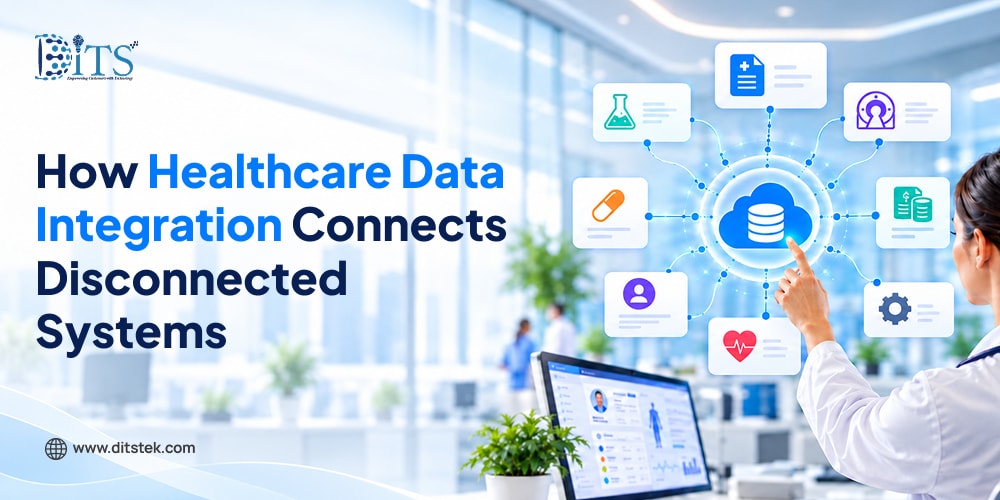
Healthcare data integration is how a hospital's EHR, lab, billing, and device systems share patient data without staff retyping it. Get it right and a reading or result shows up where the clinician already is. Get it wrong and someone is copying numbers between screens.
A patient's blood pressure cuff sends a reading to a cloud platform every morning. The platform stores it, the device did its job, and the hospital's EHR still never hears about it. So, the nurse logs into a separate portal for the cuff data, then flips back to the EHR for the history and prescriptions. Two screens, one patient, and neither has the full picture.
It happens because departments buy their own tools. Notes live in one system, labs in another, then imaging, scheduling, insurance, billing. Nobody planned for them to disagree, but they do. A lab result sits for hours before it reaches the chart. Billing retypes details registration already collected.
Why Healthcare Systems Remain Disconnected
Hospitals rarely end up with disconnected systems because someone planned it that way. It builds up over years: a new EHR here, a legacy lab system that never got retired, a monitoring platform added last quarter.
Electronic records are close to universal in the U.S. now. ASTP/ONC reports that more than 99% of non-federal acute care hospitals had certified EHR technology by 2024, and roughly 91% of office-based physicians did. On interoperability, 76% of hospitals in 2025 took part in all four measured activities: sending, receiving, finding, and integrating electronic health information.
But adoption isn't the same as connection. A hospital might exchange records with another provider just fine and still have someone uploading files by hand from its monitoring equipment. A lot of organizations own the software they need already. What they don't have is a reliable link between the pieces, and that's worth knowing before you budget for anything new. Several recurring challenges can prevent healthcare systems from sharing information reliably. Understanding these challenges helps organizations identify the right integration approach.
Older Applications Have Limited Interfaces
Nobody replaces a whole hospital's software in one go. The new EHR arrives and the old lab system stays put. Some tool survives because it does one specialized job that nothing newer handles well. Many of these systems speak proprietary formats, old messaging protocols, or custom connections that somebody built years ago and maybe left the company.
Replacing them can be costly and disrupt established workflows. Frequently the better answer is an integration layer that lets the old system talk to the new ones.
Different Systems Use Different Data Formats
Two systems can describe the same lab test with different codes and different field layouts. Devices make it worse. A blood pressure monitor might send sys and dia, while the receiving application expects systolic and diastolic pressure with units attached. If the mapping isn't done right, the connection seems to work and the data still can't be trusted. Test codes and timestamp formats cause the same grief. They look minor until the data shows up in a chart, a report, or a monitoring dashboard.
Patient Matching Is More Complicated Than It Appears
Systems rarely agree on who a patient is. The EHR has a record number, and every other application has its own. Devices add another layer of complexity. A monitor may send a hardware identifier, which the integration platform must map to the correct patient record.
Now say a monitor gets returned and given to someone else, and nobody updates the mapping. If the device-to-patient mapping isn't updated and validated, the new patient's readings could be incorrectly associated with the previous patient's record. That's a much bigger deal than a transfer that simply failed, because nothing looks wrong.
Custom Connections Become Hard to Maintain
A single connection between two applications may be straightforward to maintain. Thirty is a different story. A hospital links the EHR to the lab, then later adds a patient portal, a reporting tool, and new monitoring gear. Build each link on its own and the IT team ends up babysitting a growing network of interfaces across different vendors. Whenever a vendor changes something, somebody has to work out what broke. A shared API layer or an integration platform helps here, particularly when several applications need the same data.
How Healthcare Data Integration Connects Systems
There isn't one right method. An EHR-to-lab link may run on standard healthcare messaging. A monitoring platform probably takes device data through APIs. Billing software often just swaps files on a schedule. What you pick depends on the application, the data, and how quickly the other side needs it.
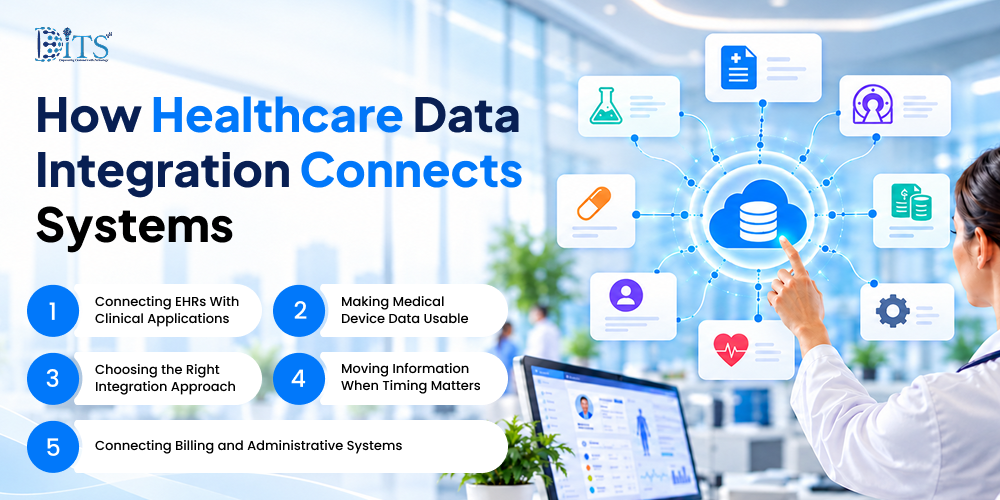
Connecting EHRs With Clinical Applications
The EHR often serves as a central clinical record, but labs, imaging, pharmacy, and remote monitoring all send data into it. Most organizations use HL7 messages, FHIR-based APIs, REST APIs, or vendor-specific interfaces for this. Supporting a standard doesn't mean things will just work, though. Both systems still have to agree on what's being sent, which identifiers are required, and how updates are handled.
A lab result is a good example. Delivering it is the simple part. The EHR then needs to attach it to the right patient and, if there is one, the right order. When that step fails, the result lands in the system, and a person fixes it manually.
Making Medical Device Data Usable
Device data has its own headaches. An IoT blood pressure monitor may send shortened field names, a device ID, and values in whatever structure the manufacturer picked. Before anyone can use that, the integration service has to interpret the fields, tie the device to a patient, validate the readings, and store them in one consistent format. If the provider works with an outside EHR, patient and provider details may need syncing as well.
For remote monitoring providers, what matters most is the stretch between a reading arriving and the care team seeing it. One bad patient match or one misread value can undermine an otherwise functional integration.
Choosing the Right Integration Approach
A hospital connecting an aging lab system to its EHR has different needs than a startup building a monitoring product from scratch. Established clinical systems often already exchange HL7 v2 messages. Newer ones tend to offer FHIR APIs. Some older tools support neither, so they need custom connectors.
Before choosing, get clear on what your current applications can actually do. How do they identify patients? Which records need to move? Do updates have to be instant, or is a scheduled transfer okay? Don't forget security, error handling, and who'll maintain it later. A direct interface may be enough for a simple link. Once several applications lean on the same data, an integration layer usually ends up easier to manage.
Moving Information When Timing Matters
A billing update and an abnormal vital sign don't have the same urgency. Real-time integration earns its cost when data should prompt a fast response, such as checking each new measurement against alert thresholds, or getting a critical lab value to another system without waiting for overnight batch processing. APIs, message queues, and event-driven designs all work for this.
Things still go wrong. Networks drop, messages show up out of order, and devices send the same reading twice. A solid system recognizes a duplicate instead of saving it as new, and it picks up after an interrupted transfer without losing data. For clinical alerts, delivery also needs real notification and escalation procedures behind it.
Connecting Billing and Administrative Systems
Registration, insurance checks, scheduling, claims, and financial reporting all use overlapping information. When they don't talk, staff retype demographics and sort out mismatches by hand. A familiar example: insurance details change at registration, billing keeps using the old ones, and the problem only surfaces when someone reviews the claim. Connecting the systems cuts that rework and keeps everything downstream current. Similar initiatives offer practical examples of how healthcare technology can support remote patient monitoring and data exchange.
Benefits of Data Integration in Healthcare
Healthcare organizations rarely struggle because they lack data. They struggle because the data sits in separate systems. Here is where connecting those systems pays off.
Less time lost to repetitive work
A nurse checking three applications for a patient’s latest readings, or a billing clerk retyping details registration already captured, loses only a few minutes each time. Across departments and shifts, those minutes become real labor cost and real staff fatigue. Integration removes the repetition at the source.
Reporting leadership can trust
Monthly operational reports often need appointment data from one system and billing data from another. When patient IDs or reporting periods don’t match, someone reconciles them by hand before the numbers mean anything. Integration reduces that effort, and a quality check on the output keeps the results reliable.
More value from your existing EHR and software
Replacing a platform isn't always necessary, especially when it already meets your core business needs. If the main challenge is sharing data with other systems, integration through APIs or middleware can be a more practical investment. This approach allows employees to continue using familiar tools, improves data flow across systems, and helps businesses get more value from their existing technology investments.
A practical foundation for analytics and AI
Analytics and AI initiatives depend on data from multiple applications. Without integration, teams spend most of their time collecting data instead of using it. Integration makes these projects realistic, though data quality, governance, and access controls still need clear ownership.
Clearer technology decisions
A well-planned integration effort shows which applications are worth keeping and which are costing more than they return. An experienced technology consulting partner can assess each system against current business needs and long-term goals, helping organizations decide where integration, modernization, or replacement will deliver the greatest value.
Ready to connect your systems?
Our team helps healthcare organizations assess their current environment, integrate EHR and supporting platforms, and build a roadmap that fits their budget and goals.
When healthcare systems don't share data properly, the impact shows up in daily work. Clinicians spend time checking separate applications, staff repeat data entry, and important information can take longer to reach the right person.
Healthcare Data Integration helps solve these problems by connecting existing systems and making information easier to access and use. But the solution isn't always to replace old software or introduce another platform. It starts with understanding where the gaps exist and what needs to change.
DITS helps healthcare organizations identify these gaps and decide whether integration, system upgrades, or legacy modernization makes the most sense for their needs. The focus is on making existing technology work better together while supporting the organization's wider goals.
Discuss Your Healthcare Integration Requirements With DITS
Conclusion
Disconnected systems rarely fail with a bang. They quietly make everyday work slower. A clinician opens another application for a reading. An administrator checks two records because they don't match. A billing employee types in something that already exists elsewhere.
Integration closes those gaps by making information easier to move and use. The best place to start is wherever disconnected data costs you the most effort, and from there, let what you need drive the decisions, not the urge for another big technology overhaul.
Frequently asked questions
Clinicians don’t have to jump between separate apps to find what they need. Lab results, patient history, and monitoring data are all easier to get to. That means better coordination between care teams, less repeated work, and a faster response when something important shows up.
Nidhi Thakur
With more than 20 years of experience - I represent a team of professionals that specializes in the healthcare and business and workflow automation domains. The team consists of experienced full-stack developers supported by senior system analysts who have developed multiple bespoke applications for Healthcare, Business Automation, Retail, IOT, Ed-tech domains for startups and Enterprise Level clients