IoT Integration Services: Benefits, Challenges, Solutions & Industry Use Cases
Table Of Content
Published Date :
11 May 2026
Key Takeaways
- The IoT integration service provides businesses with the ability to integrate various devices, cloud-based systems, enterprise applications, within a single network.
- The IoT integration solution guarantees real-time visibility, increased efficiency, automation, and decision-making based on data analysis.
- The Industrial IoT integration services helps with smart manufacturing, energy and asset management, predictive maintenance, industrial automation, and predictive maintenance
- The most typical problems experienced by businesses are systems incompatibility, data silos, protocol diversity, scalability limitations, and security vulnerabilities.
- Different technologies utilized in the IoT integration process such as MQTT, RESTful APIs, CoAP, Modbus, AWS IoT, and edge artificial intelligence.
- Applications of IoT integration solutions include healthcare industry, manufacturing sector, logistics, retail, agriculture, real estate, and energy and utilities sectors.
“IoT devices generate data.
Integrated IoT ecosystems generate business value.”
With increased reliance of businesses on connected devices, cloud platforms, and real-time analytics, the biggest issue is not about adopting IoT but making it work together seamlessly.
When systems don't work together effectively, it creates operational inefficiencies, fragmented data, security issues, and limits an organization's ability to work. Thus, without an integrated IoT system, businesses are bound to face irregularities in converting data into actionable insights and generating valuable results. That's the reason why IoT integration services have become a necessity.
What are IoT Integration Services?
Integration of IoT devices and systems is the process of linking together all of the different parts of an IoT ecosystem (sensors, devices, gateways/clouds, applications, and enterprise systems) as one integrated digital ecosystem. Connecting these devices together through integration allows them to share data with each other and communicate with each other in real time.
IoT integrations services introduces protocols like MQTT, REST API, OPC-UA, and CoAP, that helps businesses to make better decisions through data analysis.
Why Businesses need IoT-Integrated Solutions?
With an increased presence of IoT ecosystems in many facets of modern business, businesses face challenges with disconnected devices, fragmented data from multiple systems/platforms, and isolated operational systems. IoT-integrated solutions accelerate operational efficiency and automation processes with real-time decision-making.
Here's why businesses need IoT integrated solution;
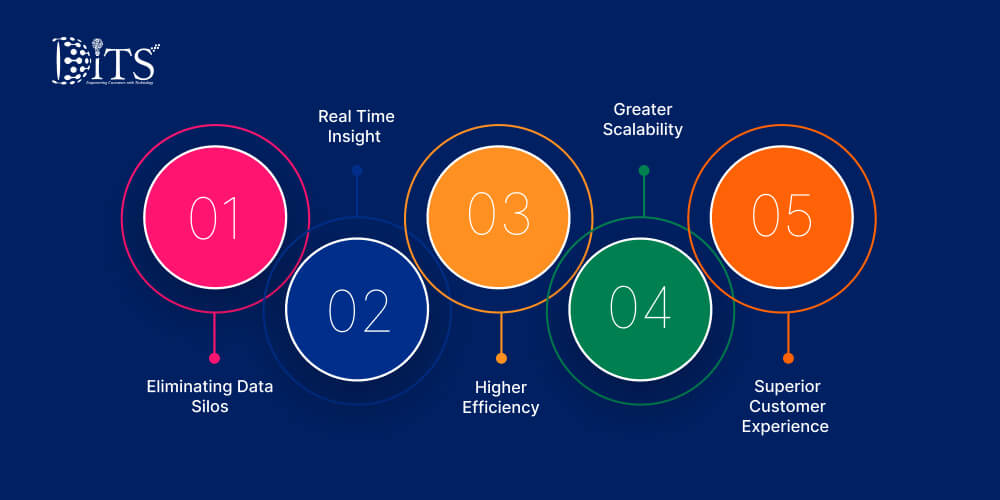
Eliminating Data Silos
IoT Integration technologies assist enterprises in consolidating data in one place, making sure that communication is established between different devices, apps, clouds, and other systems.
Real Time Insight
IoT solution integration services help businesses keep an eye on their operations in real time, making analysis and evaluation of their activities more convenient.
Higher Efficiency
Allows businesses to automate processes and make decisions quickly by relying on data gathered via the use of IoT devices and analytical tools.
Greater Scalability
With the increasing adoption of IoT, businesses require scalability and advanced integration frameworks that ensure data protection and interoperability across connected environments.
Superior Customer Experience
The IoT integration solutions provide personalized experiences for end users, thereby optimizing business operations and workflows.
Want Better Visibility Across Connected IoT Devices?
Enable real-time monitoring, predictive maintenance, and streamlined workflows through advanced IoT integration services tailored for modern enterprises today.
Industrial IoT Integration Services Delivering Smart Solutions
With Industry 4.0 transforming the way industries run by creating connected systems, providing real-time data to drive decisions, and automatically making processes more intelligent, IIoT integration services allow manufacturers to link machines, sensors, enterprise systems, and analytic platforms together to improve visibility, automation, efficiency, and decision-making across every industrial setting and smart factory.
Smart Manufacturing Integrations
Enables real-time communication among the production tools and equipment which helps manufacturers in enhancing visibility, optimizing processes, and maximizing operational agility throughout smart factories.
Industrial Automation and Monitoring
Integrating industrial automation with IIoT enables manufacturers to automate workflows related to their industrial processes and provides a single source to monitor their global operations in real time.
Energy and Asset Management
Provides manufacturers with the ability to monitor their energy consumption, determine how their assets are performing, and improve the utilization of resources in their organizations.
Predictive Maintenance
Help manufacturers reduce unplanned downtimes, increase equipment life cycles, and enable manufacturers to proactively schedule maintenance activities.
SCADA and PLC Integrations
Creates seamless communication among various equipment, monitoring systems, and enterprise applications, along with amplified visibility and remote monitoring & controlling processes for all industrial operations.
Key Challenges and Solutions of IoT Integration
IoT device integration services within organizations often result in various operational complexities. The reason behind this is the ability for these devices to be scalable, interoperable, secure, and allow for real-time operational efficiencies. Below, we have illustrated crucial challenges and solutions
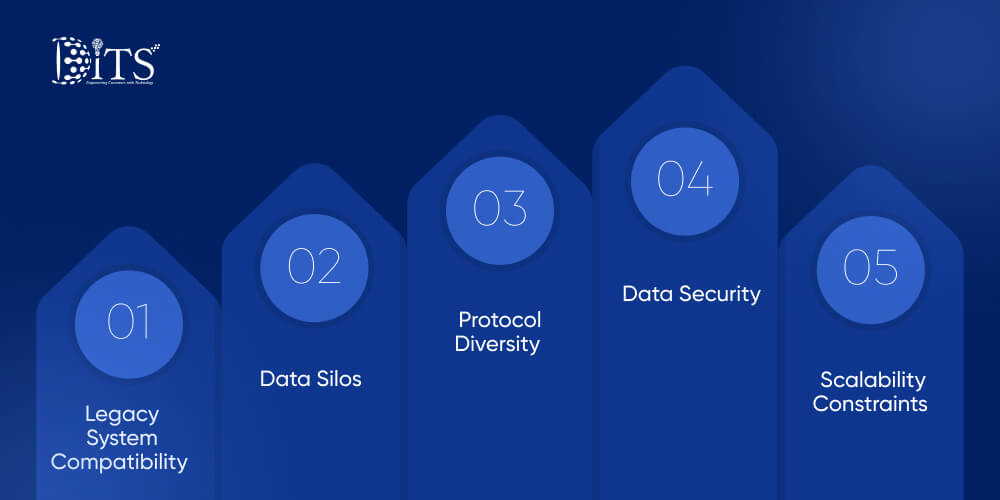
Legacy System Compatibility
Many businesses rely on legacy infrastructure that is not built for modern connected environments. Interoperating between older industrial systems and enterprise applications or operational technologies and modern IoT platforms can cause communication and interoperability issues.
Solution: By using APIs, middleware, and custom integration frameworks, businesses can bridge the gap between legacy systems and new IoT architectures, thereby minimizing disruption.
Data Silos
There are billions of devices generating vast amounts of valuable data in IoT environments. Such data sources, if not accessed, result in data fragmentation along with inconsistent operational insights.
Solution: Through a unified strategy and methodology, IoT integration solutions create a single source of truth for knowledge by centralizing data streams from all connected systems. All this helps with real-time visibility, perform data analytics, and make better-informed decisions.
Protocol Diversity
Because IoT devices use a wide range of communication protocols (MQTT, CoAP, OPC UA, Modbus, etc.), there is currently a lack of seamless interoperability among IoT devices and platforms for businesses.
Solution: By using Scaled IoT system integration services to create an equivalent translation framework between protocols, businesses can achieve maximum interoperability. It improves business results by lowering costs and reducing time-to-market for products and services.
Data Security
The IoT system integration involves the expansion of various connected ecosystems, which results in maximized risk exposure and unauthorized data access.
Solution: Secure APIs, device authentication, encrypted communications, and access control mechanisms will improve IoT security in distributed environments.
Scalability Constraints
The ability to connect the countless devices and systems within a dedicated IoT network creates lower operational efficiency due to performance limitations.
Solution: By implementing cloud-native architecture, edge computing, and scalable infrastructures to build an organization's IoT ecosystem, they will be able to scale their IoT systems with minimal impact on performance.
Real World Use cases of IoT Integration Across Industries
Through IoT integration solutions, industries are able to create connected ecosystems, gain real-time visibility, automate their processes intelligently, and operate data-driven. Explore the top applications of IoT across multiple industries as under;
Healthcare
In healthcare, IoT system integration services allows remote patient monitoring, medical devices connection, and fetching real-time health information through smartphones and other connected devices.
Manufacturing
Manufacturing industry uses IoT integration for purposes of having a smart factory, performing predictive maintenance, automating processes, and monitoring production.
Logistics & Supply Chain
Through IoT technologies, logistics industry has been able to create more efficient solutions for monitoring shipments and managing fleets and inventories.
Real Estate
With IoT system integration services, real estate companies are able to create smart buildings that feature smart lighting, heating/cooling, occupancy monitoring, energy optimization, and automation of buildings and building processes.
Retail
Retail industry relies on IoT solutions for creating a seamless customer experience and for optimizing operations within retail outlets.
Agriculture
Agriculture benefits from IoT technology through creating connected ecosystems that allow farmers to perform precision farming, monitor crops and soils, automate irrigation, etc.
Energy & Utilities
Energy and utilities companies use IoT solutions to better track their network infrastructures, optimize the energy consumption and improve the asset management.
Tech Stacks
| Tech stacks | Purpose |
| MQTT | Real-time communication between connected devices with minimal power consumption. |
| CoAP | Supports efficient communication in low-power and resource-constrained IoT environments. |
| REST APIs | Establishes seamless interoperability and effective system integrations with secure data exchange across all platforms. |
| AWS IoT | Ensures scalability for device management, real-time analytics, and delivers security capabilities. |
| Google Cloud IoT | With in-built ML functionality, it offers real-time data processing with highly scalable connectivity via the cloud. |
| Modbus | Creates reliable communication between industrial equipment, PLCs, and monitoring systems. |
| Edge AI |
Enables decision-making faster by reducing latency and allowing real-time analytics to occur closer to the connected devices. |
Future Trends in IoT Integration Solutions
The future of IoT encompasses Edge AI, 5G-enabled IoT, and artificial intelligence analytics. The trend involves the increasing adoption of autonomous operations and hyper-automation by companies that require efficient, timely automation.
Edge AI technology allows real-time processing, and digital twins assist organizations in simulating physical assets with real-time data. In addition, 5G enables IoT to help enhance connectivity, scalability, and low-latency communications within smart ecosystems.
With the continued development of smart technologies, the future trend involves intelligent and scalable IoT ecosystems.
Searching For Trusted IoT Integration Services Partner Today?
Develop secure and future-ready IoT ecosystems with advanced cloud integration, edge computing, and intelligent data-driven automation solutions successfully.
Conclusion
With the acceleration of global digital transformation, IoT integration service offerings are now more than ever essential for helping organizations to create intelligent, connected, and scalable ecosystems. The successful implementation of IoT among businesses is going to provide real-time visibility, improved efficiency, and increased automation.
Through connecting their devices, platforms/enterprise systems, and analytics within one ecosystem, companies will have the ability to optimize their operations while maximizing their return on investment from IoT.
Our goal at DITS is to provide IoT integration services from a business perspective with a focus on providing safe and scalable IoT solutions for your future digital transformation. As a top-rated IoT software development company in the USA, we have the potential to turn your vision into reality.
FAQs Related to IoT Solution Integration Services
What are IoT integration services?
IoT integration services connect multiple IoT devices, cloud platforms, and enterprise apps into a unified ecosystem, which allows real-time monitoring and communication across connected environments.
Are IoT integration solutions secure?
Yes, modern IoT integration solutions are secure as they use access control frameworks, secure APIs, and authentication protocols that provide protection against any unauthorized access.
How long does an IoT integration project take?
The IoT integration project varies from couple of weeks to several months, depending on the complex infrastructure, legacy system integration, device connectivity requirements, etc.
What industries benefit from IoT solution integration services?
Healthcare, Logistics, Energy & utilities, agriculture, manufacturing, retail highly benefit from the IoT solution integration services as it leads to process optimization, seamless data exchange, enhanced efficiency, better customer experiences, etc.
Does IoT solution integration services scale with business growth?
Absolutely! With advanced IoT system integration services, businesses are bound to expand their business growth. This is possible with the help of edge computing, highly scalable cloud infrastructure, flexible architecture, edge computing, and more.

Dinesh Thakur
21+ years of IT software development experience in different domains like Business Automation, Healthcare, Retail, Workflow automation, Transportation and logistics, Compliance, Risk Mitigation, POS, etc. Hands-on experience in dealing with overseas clients and providing them with an apt solution to their business needs.
Recent Posts
AI-powered dispatch scheduling reduces transportation costs by optimizing routes, vehicle utilization, driver schedules, and delivery operations for greater efficiency.
AI integration connects AI with existing systems and workflows, while AI adoption focuses on using AI effectively to drive measurable business outcomes.
Automated document processing helps reduce cargo insurance claim delays by streamlining document handling, validation, and claims workflows.