25+ years of IT software development experience in different domains like Business Automation, Healthcare, Retail, Workflow automation, Transportation and logistics, Compliance, Risk Mitigation, POS, etc. Hands-on experience in dealing with overseas clients and providing them with an apt solution to their business needs.
TL; DR
Internet of Things industrial automation depends on connected data. When machine, maintenance, production, and business systems stay siloed, automation works with an incomplete operational view.
Data interoperability supports stronger IoT use cases. Predictive maintenance, monitoring, and automated workflows depend on systems sharing usable data.
Scalable IoT requires a consistent data foundation. Common models, reliable integrations, and clear ownership make it easier to expand across machines, lines, and plants.
A manufacturing unit can have thousands of connected data points and still operate with fragmented information. This creates an empirical restriction for Internet of Things industrial automation. A machine may detect an abnormal condition. Although deciding what happens next often requires context from production schedule, maintenance history, quality systems, and enterprise applications.
When those systems cannot exchange usable information, gaps appear in the automation chain. People, spreadsheets, or custom integrations then must step in and connect the missing pieces.
Therefore, a manufacturing unit or factory may be connected at the equipment level while still remaining fragmented at the operational level. Scaling industrial automation requires more than connecting machines. The owners also need data to move across systems with the right context and consistency.
This blog looks at how data silos form, where they create bottlenecks, and what a stronger data foundation needs to support connected automation.
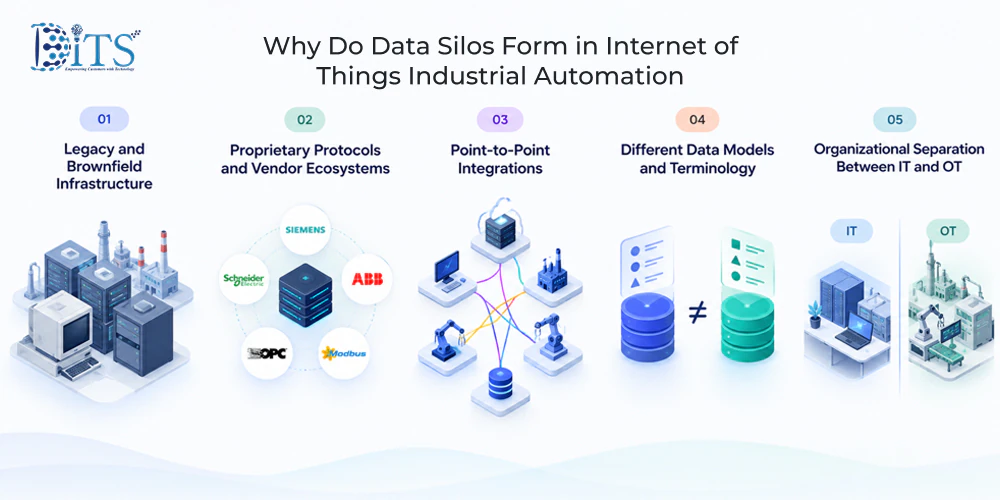
Why Do Data Silos Form in Internet of Things Industrial Automation?
As manufacturers add new machines, applications, and integrations, data can gradually become spread across disconnected systems. Understanding why this happens starts with the common factors that create industrial data silos.
Legacy and Brownfield Infrastructure
Industries hardly ever replace every system at once. That is the reason mostly new IoT sensors, analytics platforms, and automation tools often work alongside older PLCs, networks, and applications. As a result, a layered environment is created where technology collects and shares data differently.
Proprietary Protocols and Vendor Ecosystems
Two machines performing similar jobs may represent their data differently because they come from different vendors. The problem can go beyond communication protocols to include different tag names, asset structures, status codes, interfaces, and event definitions. So, connecting a machine does not necessarily mean its data can immediately be understood or reused elsewhere.
Point-to-Point Integrations
A direct integration between two systems can be the fastest way to solve an immediate requirement. But as more machines and applications are connected, these integrations accumulate their own mappings, rules, and dependencies.
This creates integration debt. Each new connection may solve one problem while making the overall environment harder to change. According to MuleSoft’s 2026 research, more than a third of IT teams’ time goes into designing, building, and testing custom integrations. Over time, adding or changing one system can require understanding several existing connections first, making automation harder to maintain and reproduce.
Different Data Models and Terminology
Systems can exchange data successfully while interpreting it differently. For example, one platform may record a machine as simply “running,” while another distinguishes productive running, setup, and idle time. ITU identifies this difference between syntactic interoperability, exchanging data correctly, and semantic interoperability, understanding that data consistently.
Organizational Separation Between IT and OT
Data silos can also form through separate decisions about ownership and priorities. OT may optimize systems around production reliability, while IT focuses on enterprise applications, data platforms, security, and integration. If both teams use different asset definitions, architecture standards, or data ownership rules, fragmentation can continue even when the underlying technology is connected.
The Hidden Data Bottlenecks Behind Industrial Automation
Data silos limit Internet of Things industrial automation by reducing the context available to systems when they need to make or support a decision. A machine may generate the right signal, but if production, maintenance, quality, or business data sits elsewhere, the automation can only respond to part of the situation.
1. Automation Sees Only Part of the Operation
A machine may report a fault, but that signal alone does not show whether production is running a priority order, whether the asset was recently serviced, or whether the issue is already affecting quality. When these details remain in separate systems, automation works with a partial operating picture.
2. Real-Time Workflows Break at System Handoffs
Many industrial workflows depend on several systems acting in sequence:
Machine condition → Production context → Maintenance system → Work order → Parts availability
If one system cannot provide usable data to the next, the workflow often needs a manual check, approval, or data entry step. This creates a bottleneck between systems and curbs the efficiency of internet of things industrial automation in supporting end-to-end workflows.
3. AI and Analytics Spend More Effort Preparing Data
Fragmented data creates repeated work before analytics can begin. Teams may need to reconcile asset IDs, align timestamps, standardize units, or determine which system owns a particular definition. When every use case requires the same preparation, scaling analytics or AI becomes an integration problem as much as a modelling problem.
Are Data Silos Limiting Your Industrial Automation?
Connect machine, maintenance, production, and business systems to improve data visibility and enable more reliable automated workflows.
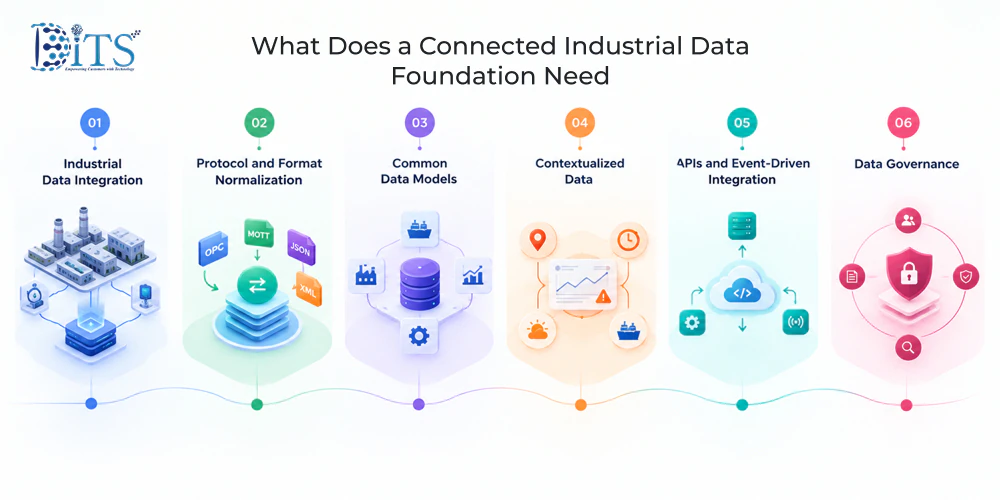
What Does a Connected Industrial Data Foundation Need?
A connected industrial data foundation makes information usable across machines, applications, and business workflows without requiring every system to store or process data in the same way. The goal is not to centralize everything. It is to make sure the right data can move with enough structure and context to support the next decision.
A connected Internet of Things industrial automation environment depends on the following elements:
Industrial Data Integration
Integration should connect OT, IoT, enterprise, and cloud systems around the workflow they need to support. For instance, machine condition data becomes more useful when it can reach maintenance, production, or quality systems rather than remaining inside a monitoring dashboard. The priority should be the flow of the decision, not simply the number of connected systems.
Protocol and Format Normalization
Industrial environments often contain equipment that communicates in different ways.
Normalization creates a more consistent layer between those machines and downstream applications. As a result, this reduces the need for every new analytics, maintenance, or automation use case to understand each machine interface separately.
Common Data Models
A common data model gives systems a consistent way to describe assets, measurements, events, and relationships. This is especially important when several plants use different names or structures for similar equipment. The goal is not to erase every local difference, but to establish enough common meaning for data to be compared and reused.
Contextualized Data
A sensor value becomes more useful when the system also knows what produced it and what was happening at the time. Connecting a reading with the asset, production line, product, operating state, process, and timestamp helps downstream systems understand why that value matters. This is the difference between collecting data and making it operationally useful.
APIs and Event-Driven Integration
For Internet of Things industrial automation to support real-time action, industrial data needs to move beyond dashboards. APIs allow applications to request and exchange information, while event-driven integration can pass important changes to downstream systems as they occur. For example, a condition change could create a maintenance event or trigger another workflow instead of waiting for someone to notice it on a dashboard.
Data Governance
A connected environment also needs agreement on the data itself. Manufacturers need to know which system owns a definition, who can access or change the data, what quality is acceptable, and how information should be managed over time. Without these decisions, different teams can reconnect the same data in different ways and recreate the silos they were trying to remove.
For Internet of Things industrial automation, a strong data foundation is therefore less about building one large platform and more about creating a dependable path from machine data to shared context to operational action.
Ready to Scale Your IoT Industrial Automation?
Explore data integration, common data models, and system interoperability to support scalable industrial automation across operations.
Which Applications of IoT in Industrial Automation Depend Most on Connected Data?
Many applications of Internet of Things industrial automation depend on more than sensor data. They need information from machines, production systems, maintenance platforms, quality tools, and business applications to work together. The more an IoT use case depends on multiple systems, the more data silos can limit its value.
Predictive Maintenance
Predictive maintenance is becoming one of the most important applications of IoT in manufacturing. According to Fortune Business Insights, the segment is projected to account for 30.22% of the IoT in manufacturing market in 2026, making it the largest application segment. Its value comes from using connected sensors and analytics to monitor equipment conditions and identify potential failures before they interrupt production.
Automated Maintenance Workflows
A machine alert becomes more useful when it can trigger the next steps automatically.
For example:
Machine condition → Maintenance alert → Work order → Spare-parts check → Technician action
If those systems cannot share usable data, the workflow stops between steps and people have to bridge the gap manually.
Quality and Process Monitoring
Quality problems are rarely explained by one data point. In Internet of Things industrial automation, teams may need to connect sensor readings with machine settings, batch information, product data, operating conditions, and inspection results. Bringing this data together makes it easier to understand what was happening when a defect or process change occurred.
Production Optimization
IoT can provide real-time information about machine status, cycle time, downtime, and process conditions. That information becomes more useful when combined with production schedules, orders, material availability, and line performance. Without those connections, optimization can remain limited to individual machines rather than the wider production flow.
Cross-Plant Analytics and Automation
A use case that works in one plant may be difficult to reproduce elsewhere if every facility uses different asset names, data structures, protocols, or system definitions. Consistent, connected data makes it easier to compare similar assets and reuse successful automation approaches across multiple sites.
How DITS Helps Build Internet of Things Industrial Automation That Can Scale
Scaling Internet of Things industrial automation requires more than adding sensors, gateways, or connected equipment. Automation becomes repeatable when information can move across machines, operational systems, and business applications with consistent structure, meaning, and context.
At DITS, we approach the problem in three stages:
Understand & Advise - We define the business goals, map the systems and data, and identify where gaps are affecting operations.
Validate & Plan - We validate the use case, prioritize the right integrations, and plan how data and systems should work together.
Execute & Improve - We connect the systems, test the workflow in real conditions, and improve the solution as it scales.
Make Your Industrial Data Work Together
Identify integration gaps, improve data consistency, and build a roadmap for connected workflows, predictive maintenance, and smarter operations.
The long-term value of Internet of Things industrial automation depends on how well different systems can communicate and share context. When machines, control systems, maintenance platforms, enterprise applications, and analytics tools can exchange usable data, automation can support a more complete view of operations.
As industrial environments grow more connected, manufacturers need an interoperability strategy that can support new devices, applications, and use cases over time. This creates a stronger base for scaling automation, improving coordination, and adapting the technology environment as operational needs change.
Frequently asked questions
Internet of Things industrial automation uses connected sensors, machines, software, and data systems to monitor operations, exchange information, and support automated actions across industrial environments.
Dinesh Thakur
25+ years of IT software development experience in different domains like Business Automation, Healthcare, Retail, Workflow automation, Transportation and logistics, Compliance, Risk Mitigation, POS, etc. Hands-on experience in dealing with overseas clients and providing them with an apt solution to their business needs.