Benefits of AI in Manufacturing Industry
Table Of Content
Published Date :
22 May 2026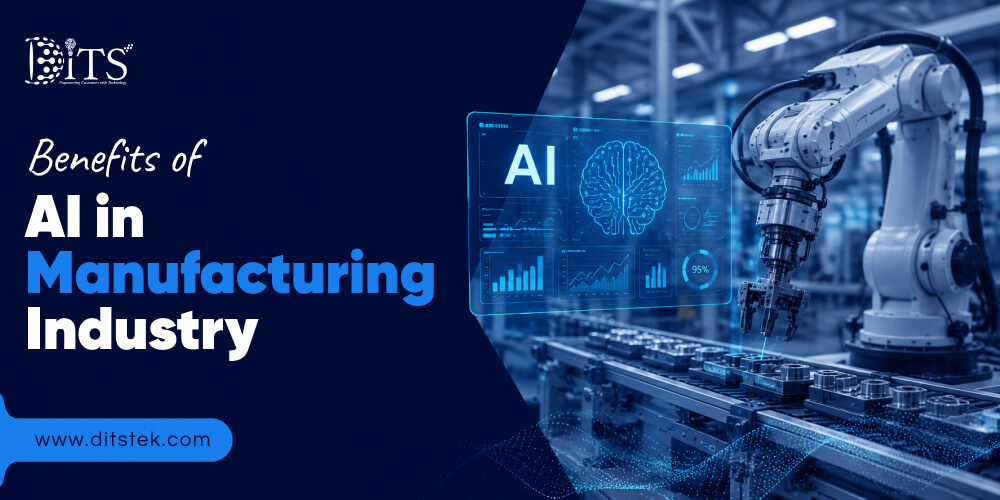
Key Takeaways
- AI is becoming essential in manufacturing.
- It improves efficiency and speeds up production.
- Predictive maintenance reduces downtime.
- AI helps maintain consistent product quality.
- Supply chains become more accurate and reliable.
- Data insights support faster decisions.
- Small pilot projects reduce implementation risks.
- Scalable AI systems support long-term growth.
- Right technology partner ensures better results.
The manufacturing industry is undergoing a major transformation as artificial intelligence (AI) technology continues to advance. The manufacturing sector has received operational improvements through artificial intelligence which enables companies to improve their performance, cuts expenses, improve product standards and maintain their market position against global competition.
According to a report the global AI in manufacturing market is projected to reach USD 155.04 billion by 2030.
Artificial intelligence is helping with things like keeping machines running and checking the quality of products. It is also helping with getting supplies and automating work. This means that companies can make decisions faster and smarter. Manufacturers, no matter how big or small they are using intelligence to make their work easier stop machines from breaking down and do what customers want.
In this guide we will look at the benefits of AI in manufacturing industry see how it is used in real life and find out how companies can use artificial intelligence to grow and get better results.
Understanding AI In Manufacturing
The manufacturing environment operates AI technology as an active system which monitors the entire production process. The system operates throughout the entire production space because it connects to equipment and control panels and operational decision-making tools. The system detects patterns in data while it learns to create recommendations which would need multiple hours of work for teams to discover.
AI in manufacturing businesses is used to develop intelligent systems which improve their decision-making abilities. Machines operate through their basic functions while they maintain active control over their operational processes. Production lines adapt their operations according to changes in customer needs and available resources and actual system performance metrics.
Key Technologies Driving AI Adoption in Manufacturing Industry
A few technologies are quietly powering this shift:
- Machine learning enables systems to develop improved outcomes through learning from previous operational data.
- Computer vision technology performs automated inspections by detecting defects which human inspectors cannot detect.
- Predictive analytics produces forecasts about future failures and delays and demand changes which will occur.
And then there is the rise of AI agents in manufacturing, which act like digital supervisors. The system operates without requiring human supervision while it observes operations and generates alerts and suggests operational improvements.
Searching For Reliable AI Manufacturing Software Development Partner?
Work with experienced AI developers to build scalable and secure manufacturing solutions tailored for modern industrial business requirements successfully.
Why Manufacturing Businesses are Adopting AI
Manufacturing leaders today are under constant pressure to do more with less. Margins are tighter, customer expectations are higher, and delays are far less forgiving than they used to be. In such an environment, relying only on traditional systems starts to feel like a limitation.
That is why many businesses are actively moving toward AI in manufacturing industry. Not because it is trending, but because it directly addresses real operational pain points.
Cost Pressures and Margin Optimization
Raw material costs fluctuate. Energy expenses rise unexpectedly. Labor efficiency varies across shifts. These small gaps quietly eat into profits.
AI helps identify where exactly the leak is happening. Whether it is excess material usage or underutilized machines, businesses get clarity and can act quickly. And when decisions are based on actual data, cost control becomes far more predictable.
Demand For Faster Production Cycles
Customers now expect to receive updates about their orders. Customers expect companies to provide them with fast service and transparent information and steady performance. AI provides organizations with capability to create flexible production schedules which enhance their manufacturing operations.
The system modifies its operational procedures according to the importance of upcoming orders and the current state of resources. The production process achieves results which operate at nearly instant speeds. The project implementation achieves three benefits which include faster results, reduced delays and improved process efficiency.
Need For Higher Accuracy and Less Waste
Even a small defect rate can create large financial losses over time. Manual inspection processes frequently fail to identify minor defects which exist in products. Manufacturers use computer vision technology to discover defects during the initial stages of production.
This process decreases the need for rework while minimizing waste and producing higher quality results. The process of discarding complete products creates negative feelings for people. The process has to end because people need to discard complete products which could have remained intact.
Competing In a Global Market
Companies now face international competition because their competitors can access both lower labor costs and faster supply routes. AI technology creates equal opportunities for all organizations.
Organizations gain a significant advantage over their competitors through their ability to make quick decisions while managing their resources and maintaining operational stability. Modern organizations need AI integration in existing systems which will connect their different operational components to maintain operational efficiency.
When all systems establish communication with each other, organizations obtain enhanced capabilities to make decisions which correspond directly with their objectives.
7 Key Benefits of AI In Manufacturing Industry
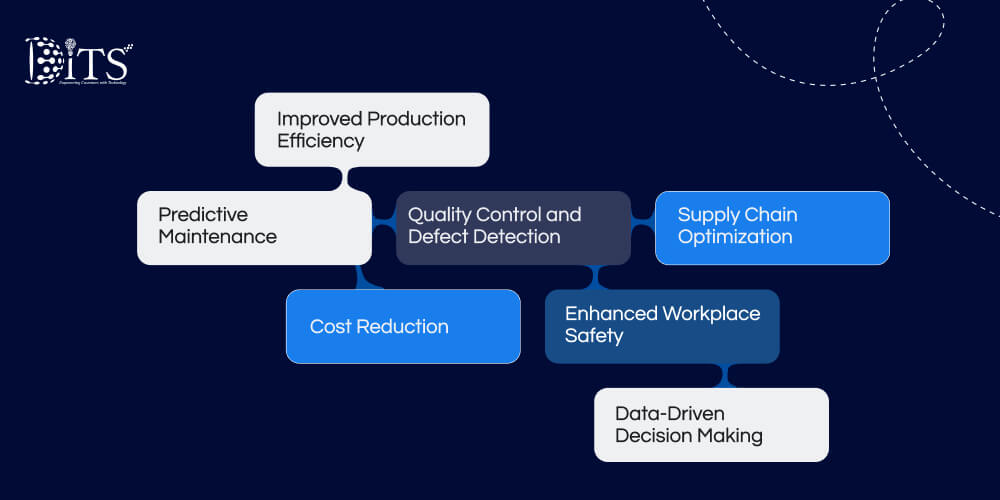
When AI starts becoming part of daily operations, the impact is not limited to one department. It spreads across production, maintenance, supply chain, and even decision-making at the leadership level. The benefits are practical, measurable, and often visible within months if implemented correctly.
Improved Production Efficiency
Production lines often suffer from small inefficiencies that go unnoticed. A few seconds of delay here, minor idle time there. Over weeks, it adds up.
AI helps streamline these gaps by automating repetitive tasks and optimizing workflows.
- Automated scheduling of production tasks based on demand and capacity
- Real-time adjustments in machine operations
- Faster decision-making on the shop floor
Many businesses implementing AI in manufacturing report noticeable improvements in output within the first quarter itself. And once efficiency improves, scaling becomes much easier.
Predictive Maintenance
Unexpected machine failure is one of the most expensive disruptions in manufacturing. It halts production, delays deliveries, and increases repair costs.
AI changes this approach completely.
- Monitors machine health continuously
- Predicts failures before they occur
- Schedules maintenance only when required
Instead of reacting to breakdowns, teams stay ahead of them. This reduces downtime significantly and improves equipment lifespan.
Quality Control and Defect Detection
Quality issues rarely appear suddenly. They build up gradually and often go unnoticed until the final stage.
AI-powered inspection systems bring consistency and precision.
- Detect micro-level defects using computer vision
- Maintain uniform quality across batches
- Reduce dependency on manual inspection
This is where businesses exploring generative AI use cases in manufacturing are also seeing value, especially in simulating defect scenarios and improving quality benchmarks before actual production.
Supply Chain Optimization
Supply chain disruptions can throw entire production plans off track. And most businesses still rely on static planning models.
AI introduces adaptability.
- Demand forecasting based on historical and real-time data
- Inventory optimization to avoid overstocking or shortages
- Smarter logistics planning
And here’s the kicker. When supply chain decisions become data-driven, businesses gain control over timelines and costs.
Cost Reduction
Cost savings do not come from one big change. They come from fixing multiple small inefficiencies.
AI helps in:
- Reducing material wastage
- Optimizing energy consumption
- Improving labor productivity
Over time, these improvements directly reflect in better margins.
Enhanced Workplace Safety
Manufacturing environments often involve risk. Heavy machinery, hazardous materials, and high-speed operations make safety a constant concern.
AI systems can monitor environments in real time.
- Identify unsafe conditions before incidents occur
- Alert teams instantly
- Support compliance with safety standards
It adds an extra layer of protection that does not rely solely on human observation.
Data-Driven Decision Making
Many manufacturing decisions are still based on experience and assumptions. While experience matters, data brings clarity.
AI transforms raw production data into actionable insights.
- Performance dashboards with real-time updates
- Accurate forecasting for production and demand
- Better planning at the management level
At DITS, we extend this capability further through AI software development, where AI is not just an add-on but integrated into the core system. From development to quality assurance and ongoing customization, AI supports every stage to ensure consistent performance and scalability.
Quick Snapshot of AI Benefits in Manufacturing Industry
| Area | Business Impact |
| Production | Higher efficiency and faster output |
| Maintenance | Reduced downtime and repair costs |
| Quality | Consistent output with fewer defects |
| Supply Chain | Better forecasting and planning |
| Cost | Lower operational expenses |
| Safety | Reduced workplace risks |
| Decision Making | Faster and more accurate strategies |
And once these benefits start aligning, something interesting happens. Operations become predictable. Teams become proactive. And leadership finally gets the visibility needed to scale with confidence.
Real-World Use Cases of AI In Manufacturing
It is one thing to talk about benefits. It is another to see how AI actually plays out inside a working factory. And this is where things get interesting. Businesses are not just experimenting anymore. They are deploying AI in very targeted, outcome-driven ways.
Smart Factories and Automated Production Lines
Imagine a production floor where machines communicate with each other. One machine slows down, the next adjusts automatically. No manual intervention. No delays piling up.
That is what smart factories are doing today.
- Real-time monitoring of production performance
- Automated adjustments to maintain output levels
- Reduced dependency on manual supervision
This is where agentic AI in manufacturing is starting to gain traction, acting almost like a digital operations manager that keeps everything aligned.
AI In Inventory and Warehouse Management
Inventory mismanagement is a silent profit killer. Too much stock locks capital. Too little stock delays orders.
AI helps strike that balance.
- Predicts inventory needs based on demand patterns
- Tracks stock movement in real time
- Reduces overstocking and stockouts
Many businesses adopting generative AI in manufacturing industry are also using it to simulate demand scenarios and plan inventory more accurately.
Robotics And Intelligent Assembly Systems
Robots have been part of manufacturing for years. But now, they are becoming smarter.
- Adaptive robots that adjust to different product designs
- Precision assembly with minimal errors
- Faster production cycles without compromising quality
This shift is often supported by generative AI software development, where systems are trained to improve processes continuously rather than follow fixed instructions.
Energy Consumption Optimization
Energy costs are rising, and inefficient usage directly impacts profitability.
AI helps monitor and optimize energy consumption across facilities.
- Identifies high energy-consuming processes
- Suggests optimization strategies
- Reduces unnecessary energy usage
A small reduction in energy waste can lead to significant savings over time. Especially for large-scale manufacturing units.
Future Trends of AI In Manufacturing
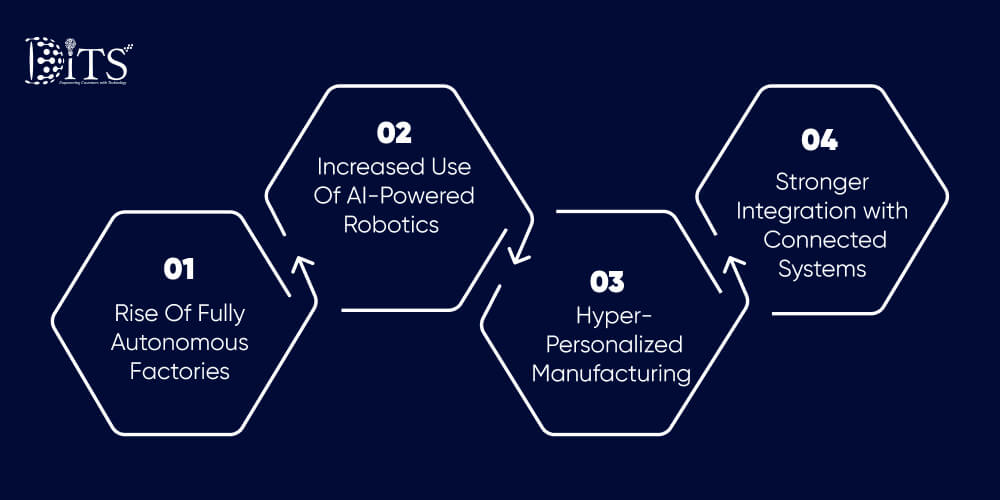
AI in manufacturing is still evolving, and what we see today is just the beginning. The next phase is less about adoption and more about maturity. Systems will not only support operations but start driving them.
Rise Of Fully Autonomous Factories
Factories are gradually moving toward minimal human intervention. Not overnight, but steadily.
- Self-adjusting production lines
- Automated decision-making based on real-time data
- Reduced dependency on manual supervision
This is where ai agents in manufacturing will play a larger role, managing workflows, identifying inefficiencies, and making operational calls on the go.
Increased Use Of AI-Powered Robotics
Robotics is becoming more intelligent and flexible. Instead of performing one fixed task, machines are learning to adapt.
- Multi-tasking robotic systems
- Faster setup for new product lines
- Improved precision in complex operations
And here’s the shift. Businesses will not need to overhaul entire systems. They will upgrade capabilities incrementally.
Hyper-Personalized Manufacturing
Customer expectations are changing. Bulk production is no longer the only priority.
- Custom product configurations
- Smaller batch sizes with higher flexibility
- Faster response to market demand
With generative ai in manufacturing, businesses can simulate designs, test variations, and move to production much faster than traditional methods allow.
Stronger Integration with Connected Systems
Manufacturing ecosystems are becoming more connected. Machines, software, and supply chains are starting to operate as one unified system.
- Real-time data exchange across departments
- Better coordination between production and logistics
- Improved visibility for leadership teams
This is where IoT software development becomes critical, enabling seamless communication between devices and systems.
Why Choose DITS For AI-Based Manufacturing Solutions
Manufacturing businesses need solutions that are practical, scalable, and aligned with real operational goals, not just technical capabilities. Here are the reasons for which companies choose DITS for AI based manufacturing solutions.
Industry-Focused AI Expertise
Manufacturing comes with its own complexities. Production dependencies, supply chain variables, and compliance requirements all need to be considered together.
DITS brings hands-on experience in AI in manufacturing, ensuring that solutions are designed around actual business challenges rather than generic templates.
Custom Solutions Built for Business Needs
No two manufacturing units operate the same way. A one-size-fits-all approach rarely works.
- Tailored AI models based on production workflows
- Custom dashboards for real-time insights
- Flexible systems that adapt to changing requirements
This approach ensures that the solution fits into your operations, not the other way around.
End-To-End Development and Support
From planning to deployment and beyond, DITS handles the complete lifecycle.
- Requirement analysis and strategy
- Development using advanced AI software development practices
- Continuous monitoring and optimization
AI is also used internally across development, quality assurance, code maintenance, and customization. This helps maintain consistency, improve performance, and reduce delivery timelines.
ROI-Driven Implementation
Every business decision comes down to return on investment. AI is no different.
DITS focuses on:
- Delivering measurable outcomes within defined timelines
- Prioritizing high-impact use cases
- Ensuring scalability for long-term growth
Because at the end of the day, the goal is simple. Improve efficiency, reduce costs, and create systems that support sustainable business growth.
Need Smarter AI Solutions For Manufacturing Operations Today?
Build intelligent manufacturing systems with predictive maintenance, automation, and real-time analytics for better productivity and operational performance successfully.
Conclusion
Manufacturing is entering a phase where efficiency is no longer enough. Businesses need precision, predictability, and the ability to respond quickly to changing demands. That is exactly what AI in manufacturing industry brings to the table.
From improving production output to reducing downtime and optimizing supply chains, the impact is both immediate and long-term. And as systems evolve, the role of AI will only deepen, influencing not just operations but strategic decision-making as well.
For business leaders, the opportunity is clear. Those who adopt early and implement thoughtfully will operate with greater control and flexibility. Others may find themselves constantly reacting to challenges instead of staying ahead of them.
The shift has already begun. The only question is how strategically you choose to move
forward.
FAQs
How does AI improve manufacturing efficiency?
AI improves efficiency by automating repetitive tasks, optimizing production schedules, and enabling real-time decision-making, which reduces delays and improves output consistency.
Is AI suitable for small and mid-sized manufacturing businesses?
Yes, AI can be implemented in phases, starting with smaller use cases such as predictive maintenance or quality control, making it suitable for businesses of all sizes.
What is the cost of implementing AI in manufacturing?
The cost depends on the scope, complexity, and level of customization required, but businesses often start with pilot projects to manage investment and measure ROI.
How long does it take to see ROI from AI solutions?
Most businesses begin to see measurable improvements within 3 to 6 months, especially when AI is applied to high-impact areas like maintenance or production planning.
How can DITS help in AI development for manufacturing?
DITS provides end-to-end AI solutions tailored for manufacturing businesses, focusing on scalability, performance, and measurable business outcomes.

Dinesh Thakur
21+ years of IT software development experience in different domains like Business Automation, Healthcare, Retail, Workflow automation, Transportation and logistics, Compliance, Risk Mitigation, POS, etc. Hands-on experience in dealing with overseas clients and providing them with an apt solution to their business needs.
Recent Posts
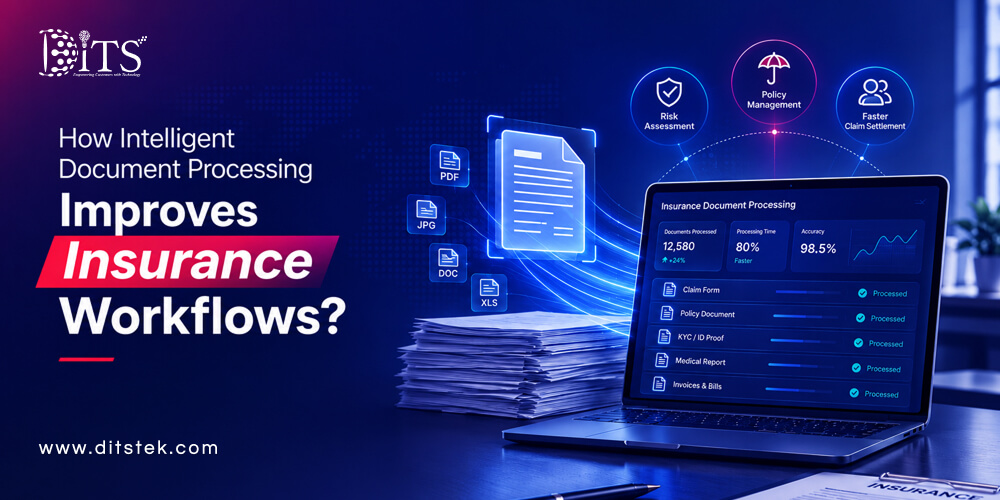
Explore how intelligent document processing for insurance helps businesses automate document workflows, reduce processing costs, improve accuracy, and strengthen operational efficiency across insurance functions.
Discover how automated medical claims processing reduces delays, manual rework, claim denials, and administrative costs while improving reimbursement speed and operational efficiency.

Learn how to build medical billing software with essential features, integrations, security, and development costs.