CRM Implementation Cost Breakdown in 2026
Table Of Content
Published Date :
01 Apr 2026
CRM implementation is no longer a tactical decision. It is a strategic investment that directly impacts revenue growth, customer retention, and operational efficiency.
Enterprises and startups are actively adopting CRM platforms to centralize customer data, automate workflows, and enable data-driven decision-making. However, one of the most critical questions remains unanswered for many stakeholders. What is the actual cost of CRM implementation?
The average cost of CRM implementation typically ranges from $10,000 to $500,000+, depending on business size, customization level, integrations, and data complexity. Small businesses usually incur lower costs due to limited requirements, while enterprises invest significantly more in advanced automation, scalability, and analytics capabilities.
The reality is that CRM costs are not limited to software licensing. Organizations must account for multiple cost layers, including customization, integration, data migration, and ongoing support.
This blog provides a structured CRM implementation cost breakdown to help decision-makers plan budgets, evaluate ROI, and avoid hidden expenses. It also helps businesses understand the average cost of CRM implementation and the key factors that influence overall investment.
CRM implementation costs can vary significantly across industries such as healthcare, fintech, and SaaS due to regulatory requirements, data complexity, and integration ecosystems.
Why Understanding CRM Implementation Cost is Critical
A clear understanding of CRM implementation cost enables organizations to make informed investment decisions and avoid budget overruns.
Without proper cost planning, businesses often face the following:
- Unexpected implementation delays
- Cost escalations due to scope creep
- Inefficient system adoption
- Poor return on investment
A well-defined cost structure allows organizations to
- Align CRM investment with business goals
- Optimize resource allocation
- Ensure faster deployment timelines
- Improve adoption across teams
For CXOs and decision-makers, this clarity is essential to justify investment and ensure long-term scalability.
Ready to Implement CRM with Maximum ROI?
Align your CRM investment with business growth goals, improve adoption, and ensure long-term value through a structured and efficient implementation strategy.
Key Factors That Influence CRM Implementation Cost
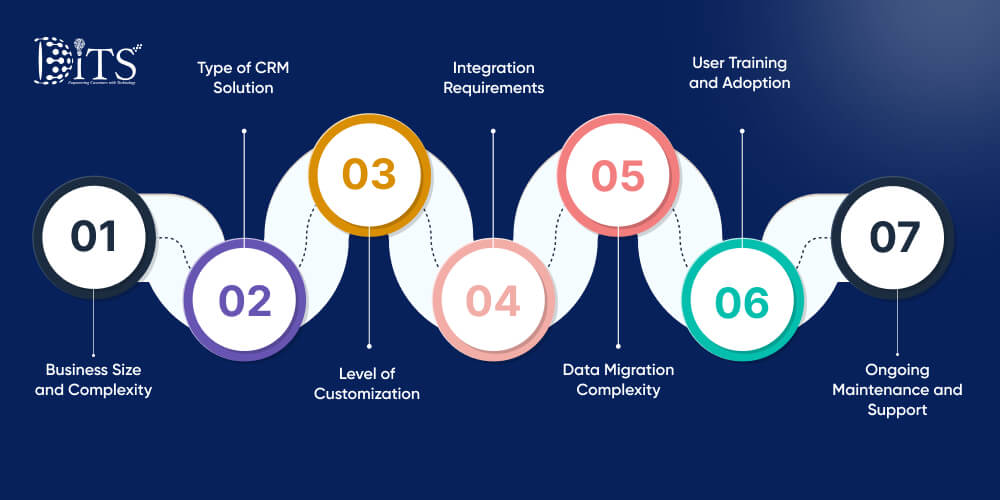
CRM implementation cost varies significantly based on multiple variables. Understanding these factors helps in building a realistic budget.
1. Business Size and Complexity
The size of the organization directly impacts implementation cost.
- Startups and small businesses typically require basic CRM functionalities with minimal customization.
- Mid-sized companies need integrations, workflow automation, and reporting capabilities.
- Enterprises require complex architectures, multi-system integrations, and advanced analytics.
As complexity increases, both development effort and implementation timelines expand.
2. Type of CRM Solution
The choice between different CRM types plays a major role in cost estimation.
Cloud-based CRM (SaaS)
- Lower upfront cost
- Subscription-based pricing
- Faster deployment
On-premise CRM
- Higher initial investment
- Infrastructure and maintenance costs
- Greater control over data
Custom-built CRM
- High development cost
- Fully tailored functionality
- Long-term flexibility and scalability
Each option comes with trade-offs between cost, control, and scalability.
3. Level of Customization
Customization is one of the most significant cost drivers.
Standard CRM platforms often require configuration to align with business processes. Advanced customization includes:
- Custom dashboards and reporting
- Workflow automation
- Industry-specific modules
- AI-driven insights and predictive analytics
Higher customization leads to increased development time and cost, but it significantly enhances operational efficiency. Many businesses also leverage an AI software development company to build advanced automation and predictive capabilities within their CRM systems.
4. Integration Requirements
Modern businesses rely on multiple systems. CRM integration is essential for seamless operations.
Common integrations include:
- ERP systems
- Marketing automation platforms
- Customer support tools
- Payment gateways
- Data analytics platforms
The number and complexity of integrations directly influence implementation cost. For example, a mid-sized company integrating CRM with ERP, marketing automation, and payment systems may see integration costs ranging between $15,000 and $40,000 depending on API complexity and real-time data requirements.
5. Data Migration Complexity
Migrating existing customer data into a new CRM system requires careful planning.
Key cost drivers include the following:
- Data volume
- Data quality and cleansing requirements
- Data mapping and transformation
- Legacy system compatibility
Poor data migration can lead to operational disruptions, making this a critical investment area.
6. User Training and Adoption
CRM success depends on user adoption. Training is not optional.
Organizations must invest in:
- Role-based training programs
- Documentation and onboarding resources
- Change management strategies
Higher adoption leads to better ROI, making training a necessary cost component.
7. Ongoing Maintenance and Support
CRM implementation is not a one-time cost. Ongoing expenses include:
- System updates and upgrades
- Technical support
- Performance optimization
- Feature enhancements
Businesses must factor in these recurring costs for long-term sustainability.
How to Plan Your CRM Investment for Maximum ROI
A comprehensive CRM implementation cost breakdown helps organizations move beyond surface-level pricing. This is especially important for organizations investing in scalable enterprise systems supported by enterprise software development services.
It enables:
- Accurate budgeting and financial planning
- Reduced implementation risks
- Improved system performance
- Stronger ROI realization
Detailed CRM Implementation Cost Breakdown
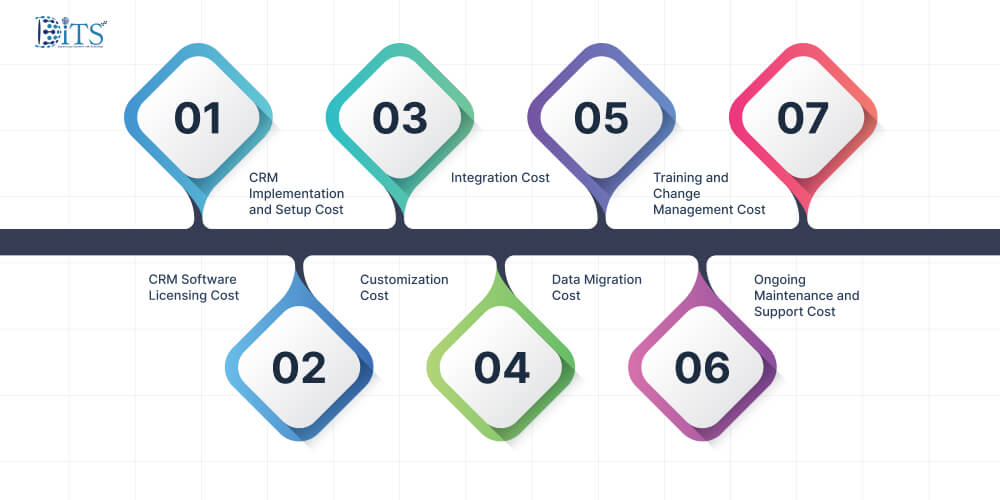
Understanding cost drivers at a granular level helps organizations build accurate budgets and avoid financial surprises. Below is a structured breakdown of the major cost components involved in CRM implementation.
1. CRM Software Licensing Cost
This is the foundational cost of any CRM implementation.
Pricing depends on the platform, features, and number of users. Leading platforms like Salesforce, HubSpot, and Microsoft Dynamics follow similar pricing models, with costs increasing based on advanced automation, AI capabilities, and enterprise-grade features.
Typical pricing models include:
- Per user per month subscription
- Tier-based pricing (basic, professional, enterprise)
- Feature-based pricing
Estimated Cost Range:
- Basic CRM: $10 to $50 per user per month
- Mid-tier CRM: $50 to $150 per user per month
- Enterprise CRM: $150 to $300+ per user per month
Cost Impact Factors:
- Number of users
- Feature requirements
- AI and automation capabilities
- Data storage limits
Organizations adopting AI-enabled CRM platforms may incur higher subscription costs but gain advanced analytics, predictive insights, and automation benefits.
2. CRM Implementation and Setup Cost
Implementation involves configuring the CRM platform to align with business processes.
This includes:
- System setup and configuration
- Workflow design
- User roles and permissions
- Dashboard and reporting setup
Estimated Cost Range:
- Small business: $5,000 to $15,000
- Mid-sized company: $15,000 to $50,000
- Enterprise: $50,000 to $150,000+
Cost Drivers:
- Business process complexity
- Number of workflows
- Reporting requirements
- Implementation partner expertise
Efficient implementation ensures faster time-to-value and reduces long-term operational friction.
3. Customization Cost
Customization ensures that the CRM aligns with specific business needs.
Customization areas include:
- Custom modules and fields
- Advanced automation workflows
- AI-based lead scoring and forecasting
- Industry-specific features
Estimated Cost Range:
- Basic customization: $5,000 to $20,000
- Advanced customization: $20,000 to $100,000+
Cost Drivers:
- Level of personalization required
- Integration with business logic
- AI model implementation
Customization significantly improves usability and productivity but must be aligned with ROI objectives.
4. Integration Cost
CRM systems must integrate with existing business tools to ensure data consistency and operational efficiency. This becomes even more critical in the transportation industry, where real-time tracking, logistics coordination, and multi-system integrations significantly increase implementation complexity.
Common integrations:
- ERP systems
- Marketing automation platforms
- Customer support systems
- Third-party APIs
Estimated Cost Range:
- Simple integrations: $2,000 to $10,000
- Moderate integrations: $10,000 to $30,000
- Complex integrations: $30,000 to $100,000+
Cost Drivers:
- Number of systems to integrate
- API availability and compatibility
- Real-time vs batch data synchronization
Seamless integration reduces manual effort and enhances cross-functional visibility.
5. Data Migration Cost
Data migration ensures that historical customer data is accurately transferred to the new CRM system.
Key activities include:
- Data extraction from legacy systems
- Data cleansing and validation
- Data mapping and transformation
- Testing and verification
Estimated Cost Range:
- Small datasets: $2,000 to $10,000
- Medium datasets: $10,000 to $30,000
- Large enterprise datasets: $30,000 to $100,000+
Cost Drivers:
- Volume and complexity of data
- Data quality issues
- Number of data sources
High-quality data migration directly impacts CRM performance and decision-making accuracy.
6. Training and Change Management Cost
User adoption is critical for CRM success. Training ensures that teams can effectively use the system.
Includes:
- User onboarding sessions
- Role-based training programs
- Documentation and knowledge base creation
- Change management initiatives
Estimated Cost Range:
- Small teams: $1,000 to $5,000
- Mid-sized teams: $5,000 to $20,000
- Enterprises: $20,000 to $50,000+
Cost Drivers:
- Number of users
- Training depth and format
- Organizational change complexity
Higher adoption leads to increased productivity and faster ROI realization.
7. Ongoing Maintenance and Support Cost
CRM systems require continuous optimization and support.
Ongoing costs include:
- Technical support
- System updates and upgrades
- Performance monitoring
- Feature enhancements
Estimated Cost Range:
- 15% to 25% of total implementation cost annually
Cost Drivers:
- System complexity
- Support level agreements
- Frequency of updates
Ongoing investment ensures system reliability, security, and scalability.
Planning CRM Implementation Without Cost Overruns?
Identify hidden costs, optimize your CRM budget, and align implementation strategy with business objectives to maximize long-term ROI and efficiency.
Average Cost of CRM Implementation for Businesses
The table below highlights the average cost of CRM implementation across different business sizes, helping stakeholders estimate investment requirements based on complexity and scale.
| Business Type | Estimated Total Cost | Key Focus Areas | Typical Scope |
| Startups and Small Businesses | $10,000 to $50,000 | Basic setup, minimal customization | Standard CRM deployment with limited integrations |
| Mid-Sized Companies | $50,000 to $150,000 | Integrations, workflow automation, reporting | Multi-system integration with moderate customization |
| Enterprises | $150,000 to $500,000+ | Advanced customization, AI capabilities, scalability | Complex architecture with enterprise-grade integrations |
What Drives Cost Variability
CRM implementation cost is not fixed because every organization has unique requirements. For example, the healthcare industry often requires higher investment due to compliance requirements and sensitive data handling. This is why understanding the full CRM implementation cost breakdown is essential for accurate budgeting and long-term planning.
Key variables include:
- Industry-specific workflows
- Level of automation required
- Data complexity
- Integration ecosystem
- AI and analytics adoption
Organizations that prioritize scalability and automation typically incur higher upfront costs but achieve stronger long-term returns.
Strategic Takeaway
The average cost of CRM implementation should not be evaluated as a standalone expense. Instead, it should be aligned with a broader digital transformation strategy to maximize long-term business value. It should be aligned with:
- Revenue growth objectives
- Customer lifecycle optimization
- Operational efficiency improvements
Organizations that invest strategically in CRM implementation achieve:
- Faster decision-making through centralized data
- Improved customer engagement and retention
- Reduced manual processes through automation
How to Optimize CRM Implementation Costs
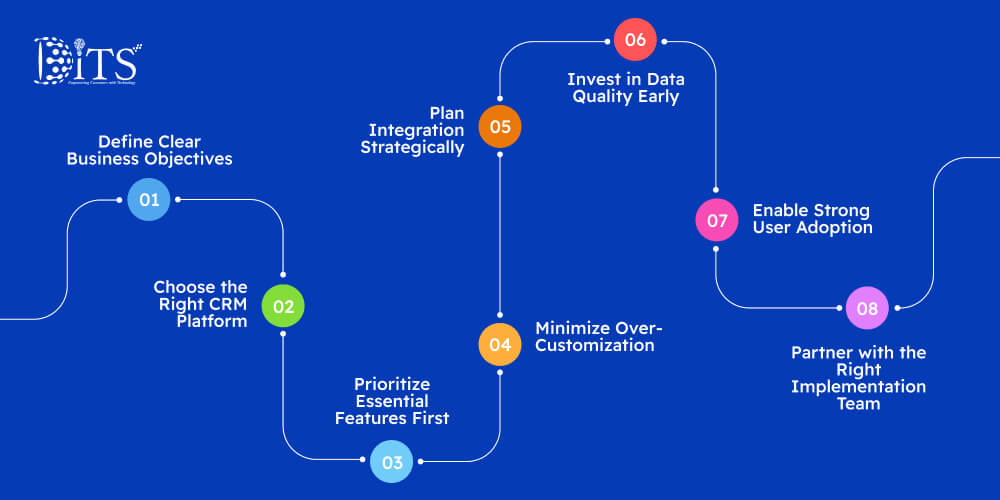
Effective CRM implementation is not about minimizing cost. It is about maximizing value while maintaining efficiency, scalability, and performance.
Organizations that approach CRM strategically can reduce unnecessary expenses while improving long-term ROI.
1. Define Clear Business Objectives
Unclear requirements lead to scope creep and cost overruns.
Start with well-defined objectives:
- What problems should the CRM solve
- Which processes need automation
- What outcomes are expected
Impact:
- Reduces unnecessary customization
- Accelerates implementation timelines
- Aligns investment with measurable outcomes
2. Choose Right CRM Platform
Selecting the right platform prevents overspending on unused features or underinvestment in critical capabilities. In many cases, businesses evaluate custom software development to build systems that align exactly with their operational requirements.
Best practices:
- Evaluate business requirements before selecting a CRM
- Avoid overpaying for enterprise features if not required
- Ensure the platform supports scalability
Impact:
- Optimizes licensing costs
- Ensures long-term flexibility
- Reduces future migration expenses
3. Prioritize Essential Features First
Avoid implementing everything at once. A phased approach reduces upfront costs and implementation risks.
Recommended approach:
- Start with core functionalities
- Add advanced features in later phases
- Validate ROI at each stage
What this means in practice:
- Reduces initial investment
- Improves adoption
- Enables iterative optimization
4. Minimize Over-Customization
Excessive customization increases both implementation and maintenance costs.
Best practices:
- Use out-of-the-box features wherever possible
- Customize only where it delivers clear business value
- Avoid complex workflows that are difficult to maintain
Impact:
- Reduces development cost
- Simplifies system management
- Improves scalability
5. Plan Integration Strategically
Integrations are essential but can become a major cost driver if not planned properly.
Approach:
- Identify critical integrations first
- Use APIs and middleware for flexibility
- Avoid redundant integrations
Impact:
- Reduces development complexity
- Improves system performance
- Ensures data consistency
6. Invest in Data Quality Early
Poor data quality leads to rework, delays, and inefficiencies.
Focus areas:
- Data cleansing before migration
- Standardized data formats
- Validation processes
What this means in practice:
- Reduces migration cost
- Improves CRM performance
- Enhances decision-making accuracy
7. Enable Strong User Adoption
Low adoption leads to wasted investment.
Key actions:
- Provide role-based training
- Implement change management strategies
- Ensure user-friendly system design
Impact:
- Increases productivity
- Accelerates ROI realization
- Reduces support costs
8. Partner with the Right Implementation Team
Experienced implementation partners help avoid costly mistakes.
Selection criteria:
- Industry expertise
- Proven implementation track record
- Technical capabilities in integration and customization
Impact:
- Faster deployment
- Reduced risk
- Higher implementation quality
ROI of CRM Implementation
CRM implementation should be evaluated based on measurable business outcomes rather than upfront cost.
Organizations that implement CRM effectively achieve significant operational and financial gains.
Key ROI Drivers
1. Increased Sales Productivity
- Automated workflows reduce manual tasks
- Sales teams focus on high-value activities
- Improved lead tracking and conversion
Typical Impact:
- 20% to 30% increase in sales productivity
2. Improved Customer Retention
- Centralized customer data enables personalized engagement
- Faster response times improve customer satisfaction
Typical Impact:
- 10% to 25% improvement in customer retention
3. Operational Efficiency
- Automation reduces administrative workload
- Integration eliminates data silos
Typical Impact:
- 15% to 30% reduction in operational costs
4. Better Decision-Making
- Real-time analytics provide actionable insights
- AI-driven forecasting improves accuracy
Typical Impact:
- Faster and more accurate strategic decisions
Businesses evaluating CRM implementation should also assess whether a platform-based solution or a custom-built CRM better aligns with their long-term growth, integration ecosystem, and scalability requirements.
Looking to Optimize Your CRM Implementation Budget?
Discover cost-saving opportunities, streamline implementation processes, and ensure efficient CRM deployment with the right technology and integration approach.
Conclusion
A well-planned CRM implementation is a high-impact investment that drives growth, efficiency, and scalability.
Understanding the CRM implementation cost breakdown allows organizations to make informed decisions about the average cost of CRM implementation and align their investment with long-term business value.
- Build realistic budgets
- Avoid hidden expenses
- Align technology with business goals
- Maximize long-term ROI
Businesses that focus on strategic implementation rather than cost minimization achieve stronger outcomes and sustainable growth.
FAQs
1. What is the average cost of CRM implementation in 2026?
The average cost of CRM implementation ranges from $10,000 to $500,000+, depending on business size, customization, integrations, and AI capabilities. Small businesses typically spend less, while enterprises require higher investment due to complexity and scalability requirements.
2. What factors affect CRM implementation cost the most?
Key factors include business complexity, level of customization, number of integrations, data migration requirements, and user training. Advanced features such as AI-driven analytics and automation also increase overall CRM implementation cost.
3. How much does CRM software cost per user?
CRM software typically costs between $10 and $300+ per user per month. Pricing depends on the platform, feature set, and level of automation, with enterprise solutions offering advanced capabilities at higher pricing tiers.
4. Is CRM implementation a one-time cost?
CRM implementation is not a one-time cost. In addition to initial setup and customization, businesses must account for ongoing expenses such as maintenance, upgrades, support, and licensing fees, which can be 15% to 25% annually.
5. How can businesses reduce CRM implementation costs?
Businesses can reduce CRM implementation costs by defining clear objectives, minimizing unnecessary customization, prioritizing essential features, ensuring data quality, and choosing scalable CRM platforms that align with long-term business goals.
6. Why choose DITS for CRM implementation services?
DITS delivers scalable and cost-efficient CRM solutions aligned with business objectives. The team focuses on streamlined implementation, seamless integrations, and AI-driven capabilities to enhance performance, reduce operational costs, and accelerate ROI.

Dinesh Thakur
21+ years of IT software development experience in different domains like Business Automation, Healthcare, Retail, Workflow automation, Transportation and logistics, Compliance, Risk Mitigation, POS, etc. Hands-on experience in dealing with overseas clients and providing them with an apt solution to their business needs.
Recent Posts

AI triage in healthcare helps prioritize patients, improve access, streamline care decisions, and enhance patient engagement with smarter workflows.
AI-powered dispatch scheduling reduces transportation costs by optimizing routes, vehicle utilization, driver schedules, and delivery operations for greater efficiency.

AI integration connects AI with existing systems and workflows, while AI adoption focuses on using AI effectively to drive measurable business outcomes.