Agentic AI vs AI Agents: What Businesses Need to Know Before Investing
Table Of Content
Published Date :
20 May 2026
Key Takeaways
- AI agents are best suited for structured, repetitive tasks
- Agentic AI enables adaptive, outcome-driven automation
- Choosing the wrong approach can limit scalability and increase long-term costs
- Businesses should align AI investments with process complexity and future goals
- Strategic implementation matters as much as technology selection
Across boardrooms in the United States, conversations around AI have moved beyond experimentation. Leaders are now asking sharper questions. What exactly are we investing in? And more importantly, what kind of outcomes should we expect?
This is where confusion often begins. Terms like agentic AI vs AI agents are used interchangeably, even though they represent very different capabilities. One promises structured automation, while the other hints at autonomous decision-making. The gap between the two can quietly influence budgets, timelines, and long-term strategy.
It is similar to how businesses evaluate something like healthcare software product development cost. On paper, two solutions may look comparable. In reality, their architecture and future scalability can lead to very different investments.
This blog breaks down that difference in practical terms, so decision-makers can move forward with clarity rather than assumptions.
What are AI Agents?
In most organizations, AI adoption starts with practical use cases. A chatbot handling customer queries. A system routing tickets. A tool automating repetitive workflows. These are AI agents.
At a business level, AI agents are designed to perform specific tasks based on predefined rules or prompts. They operate within a fixed scope and respond to inputs rather than making independent decisions.
For example, a support assistant can resolve common issues instantly and escalate complex ones. It improves speed and reduces manual effort but still depends on structured inputs and human oversight when things go off script.
Where they fit best:
- Customer support automation
- HR workflows like onboarding and query handling
- Appointment scheduling and reminders
- Basic reporting and operational analytics
Many US businesses rely on structured AI agent development to achieve quick wins, especially when the focus is efficiency and short-term ROI. But their limitation is clear. They work well in predictable environments, not in dynamic ones.
What is Agentic AI?
Agentic AI takes a step further. Instead of just executing tasks, it focuses on achieving outcomes.
These systems can plan, make decisions, and adapt as situations evolve. They break down complex goals into smaller actions and adjust their approach based on results, often with minimal human input.
Take logistics as an example. While a traditional system suggests routes, an agentic system continuously evaluates traffic, delays, and priorities, then updates decisions in real time. It is not just following rules. It is managing the process.
Key characteristics:
- Multi-step planning and execution
- Context awareness across systems
- Continuous learning from outcomes
- Reduced need for manual intervention
This is why organizations exploring AI solutions for enterprise environments are increasingly looking at agentic models, especially where workflows are complex and interconnected.
However, greater autonomy comes with higher expectations. These systems require strong data foundations, integration capabilities, and governance to deliver consistent value.
Want To Invest In Right AI Technology Solution?
Compare AI agents and agentic AI systems to identify the best approach for automation, scalability, and future business growth efficiently.
Core Differences Between Agentic AI and AI Agents
At a surface level, both concepts may appear similar. Both use AI. Both automate processes. But when you look closer, the difference becomes operational, not just technical. This is where the discussion around ai agents vs. agentic ai becomes critical for business leaders evaluating long-term investments.
AI agents are execution-focused. They follow instructions and complete defined tasks. Agentic AI, on the other hand, is outcome-focused. It decides how to achieve a goal and adapts along the way.
This distinction is where many leadership teams miscalculate. Choosing between AI agents vs agentic AI is not just a technology decision. It directly impacts scalability, cost structure, and long-term automation strategy.
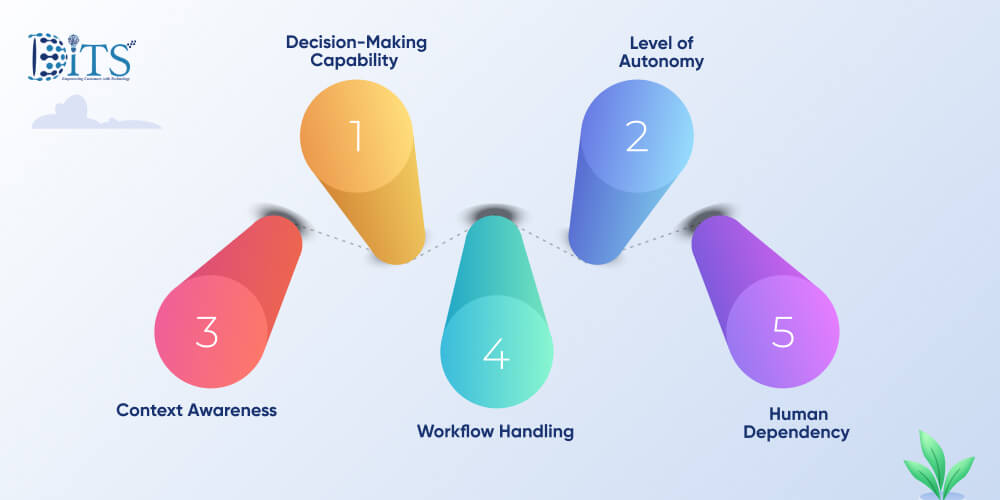
Here are the core areas where the difference becomes evident:
Decision-making capability
AI agents rely on predefined rules. Agentic systems evaluate situations and make decisions dynamically.
Level of autonomy
Agents require triggers and supervision. Agentic AI operates with higher independence once goals are defined.
Context awareness
Traditional agents work within limited data scope. Agentic AI connects multiple data points to maintain context.
Workflow handling
AI agents manage single-step or linear processes. Agentic AI handles multi-step, evolving workflows.
Human dependency
Agents escalate when complexity increases. Agentic systems attempt resolution before involving humans.
This is the practical side of the AI agents vs agentic AI difference. It is not about which one is better, but which one aligns with the nature of your business processes.
Agentic AI Vs AI Agents Key Differences at Glance
The table below simplifies the agentic ai vs ai agents difference, helping executives quickly align the concept with business priorities.
| Dimension | Agentic AI | AI Agents |
| What It Is | A capability or architectural approach | A specific implementation or tool |
| Scope | Broad, enterprise-level vision | Narrow, task-focused execution |
| Autonomy Level | Defines and enables autonomy | Operates within predefined limits |
| Complexity | Multi-step planning and orchestration | Single or limited workflow execution |
| Analogy | Self-driving technology | A specific self-driving car |
| Business Relevance | Long-term strategy and transformation | Short-term efficiency and ROI |
Why This Difference Matters For US Businesses
At first glance, this may seem like a technical distinction. In reality, it is a business decision with long-term financial implications.
Many organizations invest in automation expecting transformation. What they get instead is incremental efficiency. The reason is simple. They deploy AI agents where agentic capabilities are actually needed.
This gap shows up in subtle ways. A process gets faster, but not smarter. Teams still intervene frequently. Decision cycles remain slow. Over time, the cost of these limitations starts adding up.
For US businesses operating in competitive markets, this distinction directly impacts:
- Operational efficiency and cost optimization across departments
- Speed of decision-making in dynamic environments
- Ability to scale automation beyond basic workflows
- Alignment with broader digital transformation goals
It’s similar to evaluating healthcare software product development cost. The initial investment might look controlled, but without the right architecture, scaling becomes expensive and inefficient.
AI agents help optimize tasks. Agentic AI helps optimize outcomes.
Understanding the AI agents vs agentic AI difference early helps businesses avoid investing in systems that solve today’s problems but fail to scale for tomorrow’s complexity.
Planning To Modernize Operations With Intelligent AI Systems?
Implement future-ready AI platforms that support autonomous workflows, operational visibility, and data-driven business decision-making processes effectively.
When to Use AI Agents
Not every problem needs a highly autonomous system. In fact, for many businesses, AI agents are the right starting point.
They work best in environments where processes are structured, predictable, and repeatable. If the goal is to reduce manual effort and improve response time, AI agents deliver value quickly.
Typical use cases include:
- Customer support automation for handling high-volume queries
- Appointment scheduling and reminders in healthcare and services
- HR operations such as onboarding workflows and internal support
- Basic reporting and data extraction tasks
These systems are relatively faster to deploy and require lower upfront investment. Many organizations see measurable ROI within 3 to 6 months.
However, there is a limit. As soon as processes become dynamic or require judgment, AI agents begin to fall short. They need constant rule updates, and human intervention becomes frequent again.
That’s usually the point where businesses start re-evaluating their approach.
When to Invest in Agentic AI
Agentic AI becomes relevant when business processes are no longer linear. When decisions depend on multiple variables. When outcomes matter more than individual tasks.
These systems are designed for complexity.
Consider scenarios like supply chain optimization, financial risk analysis, or healthcare workflow coordination. These are not single-step processes. They evolve constantly, and decisions need to adapt in real time.
Agentic AI fits well in such environments because it can:
- Evaluate multiple inputs simultaneously
- Plan and execute multi-step actions
- Adjust decisions based on changing conditions
- Reduce dependency on manual oversight
The investment is higher. There is no denying that. But the return is also strategic. Businesses gain systems that scale with complexity rather than breaking under it.
This is where the conversation around AI agents vs agentic AI shifts from cost to capability.
At this stage, understanding ai agents vs. agentic ai is no longer optional. It becomes essential for making the right strategic investment.
Industry Specific Applications of Agentic AI vs AI Agent
The real value of choosing between these approaches becomes clearer when you look at how different industries apply them.
In healthcare, for instance, AI agents are often used for appointment scheduling or basic patient communication. But when it comes to managing care pathways or coordinating between departments, agentic systems bring far more value by adapting to patient conditions and clinical priorities in real time.
In finance, AI agents help automate routine checks and reporting. However, agentic AI is increasingly being used for fraud detection and risk assessment, where decisions depend on multiple data points that change constantly.
Manufacturing offers another perspective. AI agents can monitor equipment or generate alerts. But agentic systems can predict failures, adjust production schedules, and optimize operations without waiting for human intervention.
Logistics and supply chain operations show perhaps the clearest contrast. While agents assist with tracking and updates, agentic AI dynamically adjusts routes, manages delays, and balances cost with delivery timelines.
Each industry starts with automation. But over time, the shift toward intelligent, adaptive systems becomes almost inevitable.
Key Challenges and Considerations
Adopting AI, especially at scale, is rarely straightforward. The technology may be powerful, but the surrounding ecosystem determines whether it succeeds or fails.
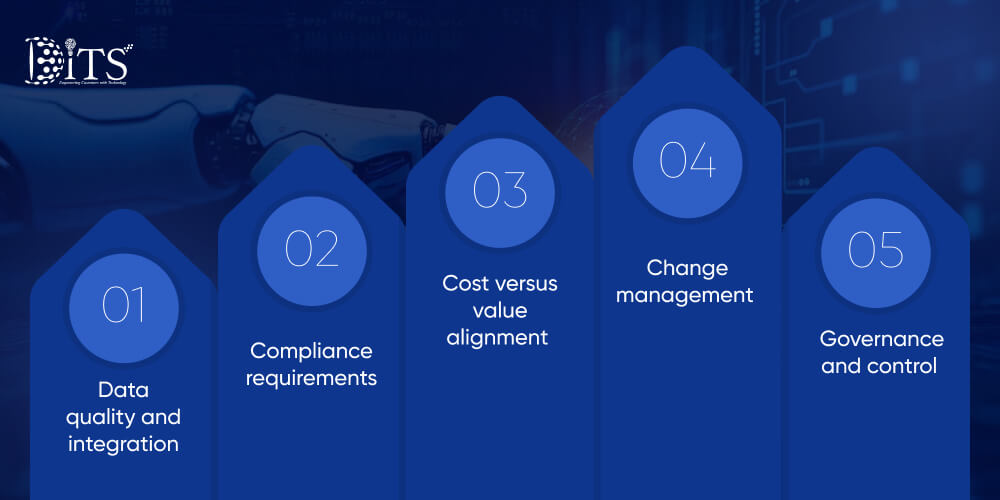
Several challenges tend to surface early:
Data quality and integration
Systems are only as effective as the data they rely on. Inconsistent or siloed data limits both agents and agentic systems.
Compliance requirements
US regulations, particularly in healthcare and finance, demand strict controls. Systems must align with standards such as HIPAA while maintaining operational flexibility.
Cost versus value alignment
Initial investments can appear manageable, but scaling without a clear roadmap often leads to unexpected expenses.
Change management
Teams need time and training to adapt. Resistance to new systems can slow adoption, even when the technology is sound.
Governance and control
As systems become more autonomous, businesses must define boundaries, accountability, and oversight mechanisms.
Organizations that address these factors early tend to see smoother implementation and stronger returns.
Why Choose DITS For AI-powered Solutions Development
Choosing the right technology is only half the equation. Execution is where most initiatives succeed or fail.
At DITS, the focus goes beyond building standalone systems. The approach is centered on creating scalable, business-aligned solutions that evolve with operational needs. Whether it involves structured AI agent development or more advanced autonomous systems, the goal remains consistent. Deliver measurable outcomes, not just functional tools.
What sets the approach apart is how AI is embedded across the development lifecycle:
- AI-assisted software development to accelerate delivery timelines
- Intelligent quality assurance to identify issues early and reduce rework
- Continuous monitoring to maintain code quality and system stability
- Customization aligned with specific business workflows
In practice, this means AI is not treated as an add-on. It becomes part of how every solution is built, tested, and optimized.
For US businesses navigating the shift between AI agents vs agentic AI, having a partner that understands both tactical deployment and long-term architecture can make a significant difference. It reduces risk, shortens time to value, and ensures the system scales with business growth.
Need Smarter AI Strategy For Business Automation Today?
Explore how agentic AI and AI agents improve workflows, operational efficiency, and intelligent decision-making across enterprise business environments effectively.
Conclusion
The discussion around agentic ai vs ai agents difference ultimately comes down to business intent, not just technology.
AI agents offer a practical way to improve efficiency and reduce operational load. Agentic AI, on the other hand, represents a shift toward systems that think, adapt, and scale with business complexity.
For US businesses, the real opportunity lies in understanding where they stand today and where they want to go next. Because in the end, AI is not just a technology investment. It is a long-term capability that shapes how organizations operate, compete, and grow.
FAQs
What is the difference between AI agents and agentic AI?
AI agents focus on executing predefined tasks, while agentic AI systems are designed to plan, adapt, and achieve broader outcomes with minimal human input.
Is agentic AI suitable for small or mid-sized businesses?
It can be, but only when processes involve complexity and require decision-making. Otherwise, AI agents often provide a more practical starting point.
How much does it cost to implement agentic AI solutions?
Costs vary based on system complexity, data infrastructure, and integration needs. Businesses should evaluate long-term value rather than just upfront investment, similar to how healthcare software product development cost is assessed.
Can AI agents evolve into agentic AI systems?
Yes, in many cases. Organizations often begin with task-based systems and gradually expand capabilities by adding intelligence layers and decision-making frameworks.
How can DITS support businesses in choosing between AI agents and agentic AI?
DITS helps organizations evaluate their current processes, data maturity, and long-term goals to determine the right approach between agentic ai vs ai agents. Through its AI software development capabilities, the team designs solutions that align with business outcomes, whether it involves deploying task-specific systems or building more autonomous, decision-driven architectures.
Do DITS AI agent development services support scalability toward agentic systems?
Yes, DITS focuses on building flexible foundations through its AI agent development services, allowing businesses to start with structured automation and gradually evolve toward agentic capabilities. This ensures that early investments are not wasted and systems can scale as operational complexity increases.

Dinesh Thakur
21+ years of IT software development experience in different domains like Business Automation, Healthcare, Retail, Workflow automation, Transportation and logistics, Compliance, Risk Mitigation, POS, etc. Hands-on experience in dealing with overseas clients and providing them with an apt solution to their business needs.
Recent Posts
Explore how intelligent document processing for insurance helps businesses automate document workflows, reduce processing costs, improve accuracy, and strengthen operational efficiency across insurance functions.
Discover how automated medical claims processing reduces delays, manual rework, claim denials, and administrative costs while improving reimbursement speed and operational efficiency.
Learn how to build medical billing software with essential features, integrations, security, and development costs.