25+ years of IT software development experience in different domains like Business Automation, Healthcare, Retail, Workflow automation, Transportation and logistics, Compliance, Risk Mitigation, POS, etc. Hands-on experience in dealing with overseas clients and providing them with an apt solution to their business needs.
Operational insight matters more than simple location tracking
Clear objectives must guide system architecture
Long-term scalability determines sustained ROI
AI-driven fleet intelligence is now practical for small US businesses
Fleet performance directly affects margins. With structured planning and disciplined implementation, intelligent tracking becomes a competitive advantage rather than an expense.
Introduction
Fuel prices fluctuate without warning. Insurance premiums creep up. Drivers take longer routes than expected. For a small fleet of 15 or 40 vehicles, these “small leaks” quietly drain tens of thousands of dollars every year. Most owners see the symptoms but lack visibility into root causes. That is where AI vehicle tracking systems change the equation.
Traditional GPS tells you where a vehicle is. Intelligent systems tell you why costs are rising, which driver behaviors increase risk, and when a truck is likely to break down before it actually does. What used to be reserved for national carriers is now accessible to regional contractors, field service firms, and delivery businesses across the US.
For leadership teams focused on margins and operational control, this is no longer optional technology. It is strategic infrastructure.
What are AI Vehicle Tracking Systems
Many businesses assume vehicle tracking simply means placing a GPS device in a truck and viewing dots on a map. That approach provides location data, but it rarely drives meaningful operational change.
AI vehicle tracking systems combine telematics hardware, cloud infrastructure, and machine learning models to convert raw driving data into operational intelligence. Instead of just tracking movement, the system analyzes patterns. It identifies harsh braking trends, inefficient routing, excessive idling, fuel anomalies, and early warning signs of mechanical failure.
Core components typically include:
IoT-enabled telematics devices installed in vehicles
Sensors capturing engine diagnostics, fuel consumption, and driving behavior
Cloud-based data ingestion pipelines
AI models for prediction and optimization
Web and mobile dashboards for operational visibility
Here is the real shift. Data alone does not reduce costs. Insight does. When artificial intelligence processes thousands of driving events per day, leadership gains measurable levers to improve safety, reduce waste, and protect assets. That is where value begins to compound.
Want Smarter Fleet Visibility Without Increasing Operational Costs?
Discover how AI-powered fleet intelligence reduces fuel waste, improves driver safety, and delivers actionable insights for better operational decisions.
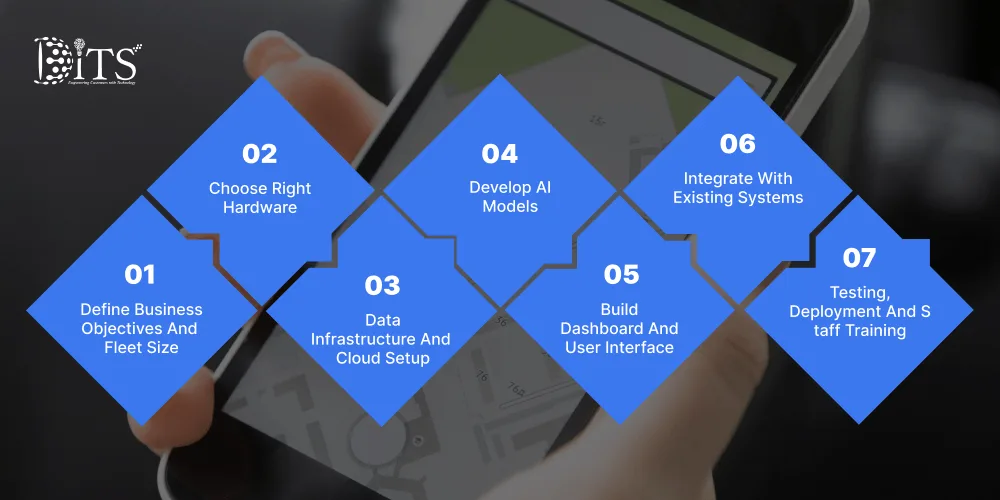
Step-By-Step Process to Build AI Vehicle Tracking Systems
Step 1: Define Business Objectives and Fleet Size
Start with business impact, not technical ambition. Identify where money is leaking. Is it excess fuel consumption, accident-related costs, late deliveries, or frequent downtime? Quantify it. For example, if annual fuel spend is $750,000 and idle time averages 18 percent, even a modest 5 to 8 percent reduction creates meaningful savings.
Segment your fleet as well. Light-duty vans behave differently from heavy construction trucks. Urban delivery routes differ from interstate logistics. Defining use cases clearly at the beginning prevents overengineering later.
Set performance targets tied to KPIs such as:
Fuel cost per mile
Accident rate per 100,000 miles
Average maintenance downtime
On-time arrival percentage
Without numeric targets, success becomes subjective.
Step 2: Choose Right Hardware
Hardware decisions determine data quality and poor data leads to unreliable AI outcomes.
OBD-II devices work well for small commercial vehicles and are relatively easy to install. For heavy-duty fleets, advanced GPS units with CAN bus integration provide deeper access to engine diagnostics. Adding accelerometers and fuel-level sensors enhances behavior tracking and consumption analysis.
Consider these practical factors:
Installation time per vehicle, typically 30 to 90 minutes
Device durability in extreme US weather conditions
Data transmission reliability in rural areas
Many businesses leverage IoT development services to ensure hardware selection aligns with long-term analytics goals rather than short-term cost savings.
Hardware should not only collect data. It must collect the right data. DITS helps small and medium enterprises collect the right data by offering IoT development services combined with AI technology.
Step 3: Data Infrastructure and Cloud Setup
A fleet of 50 vehicles can generate millions of data points monthly. Speed, RPM, throttle position, fuel flow, braking intensity. The infrastructure must handle continuous ingestion without lag.
Architectural priorities should include:
Real-time streaming pipelines for immediate alerts
Structured data storage for analytics
Redundant backups for risk mitigation
Role-based access control for data security
Latency matters. If harsh braking alerts arrive hours later, intervention loses impact. Cloud platforms such as AWS and Azure offer scalable architecture that can expand as fleets grow from 20 vehicles to 200.
Data governance must also be defined early. Who owns the data? How long is it stored? Who has access? These decisions reduce legal and compliance exposure later.
Step 4: Develop AI Models
This stage moves beyond tracking into intelligence.
Route optimization models analyze historical trip data, traffic patterns, and delivery density to recommend efficient scheduling. Driver behavior models evaluate acceleration curves, braking frequency, and cornering intensity to calculate risk scores. Predictive maintenance models correlate engine sensor patterns with historical breakdown events to forecast failure probabilities.
Important considerations include:
Training models on at least 3 to 6 months of historical data
Continuously retraining models to adapt to seasonal changes
Validating predictions against real-world outcomes
For example, if a predictive model flags a 70 percent probability of alternator failure within 30 days and the event occurs within that window, model confidence increases. Over time, accuracy improves.
A powerful backend is useless without clear visualization. Executives need strategic insights. Fleet managers need operational alerts. Drivers need actionable feedback.
Design considerations should include:
Executive summary panels displaying cost trends and safety metrics
Real-time map view with exception alerts
Driver performance scorecards
Maintenance forecasting dashboards
Avoid clutter. Too many metrics overwhelm users. Focus on the handful of indicators directly linked to financial impact.
User adoption determines system success. If supervisors do not log in daily, optimization stalls.
Step 6: Integrate With Existing Systems
Integration prevents duplication of effort. Fuel data should automatically flow into accounting systems for cost analysis. Driver safety scores may influence payroll incentives. Maintenance forecasts should sync with ERP scheduling modules.
Businesses already investing in transportation & logistics software can extend that ecosystem by embedding predictive fleet intelligence directly into dispatch and billing workflows.
Integration planning should address:
API compatibility
Data synchronization frequency
Error-handling protocols
Disconnected systems create friction. Connected systems create leverage.
Step 7: Testing, Deployment and Staff Training
Deployment should not be abrupt. Begin with a controlled pilot involving a small fleet segment. Measure baseline metrics for at least 30 days before activation. Then compare performance after implementation.
Key evaluation points include:
Change in idle time
Reduction in harsh driving events
Improvement in fuel efficiency
Decrease in unscheduled breakdowns
Training is equally critical. Drivers may initially perceive monitoring as surveillance. Leadership must frame it as a safety and performance enhancement initiative. Transparent communication improves acceptance.
After rollout, schedule quarterly reviews. AI models require refinement. Operational patterns shift. Continuous improvement ensures the system remains aligned with business objectives.
Building AI vehicle tracking systems is not a one-time project. It is an evolving operational strategy designed to strengthen margins, reduce risk, and enhance service reliability over time.
Technology Stack Considerations for US Small Businesses
SQL or NoSQL databases depending on data structure
End-to-end encryption for data security
US businesses must also address state-level privacy regulations and federal compliance standards. Data governance should be built into architecture, not added later as a patch.
Companies with broader automotive software solutions portfolios often leverage reusable architecture patterns to accelerate development timelines while maintaining reliability.
Estimated Cost to Build AI Vehicle Tracking Systems In US
Costs vary depending on complexity and fleet size. Below is a simplified reference range.
Component
Estimated Cost Range
Hardware Per Vehicle
$100 to $400 one-time
Software Development
$40,000 to $120,000
AI Model Development
$20,000 to $60,000
Cloud And Maintenance
$1,000 to $5,000 per month
A 10-vehicle fleet may require a $60,000 to $90,000 initial investment. A 100-vehicle deployment can exceed $200,000 depending on customization depth.
Custom builds cost more upfront than SaaS subscriptions. However, over five years, ownership often delivers stronger ROI when operational optimization is significant.
Why Partner with AI Development Company for Fleet Tracking Solutions
Building internally requires deep expertise in data engineering, AI modelling, cloud security, and compliance. Most small businesses do not maintain that bench strength in-house.
Partnering with experts in custom software development ensures architecture aligns with specific workflows, whether serving HVAC teams, construction crews, or delivery fleets.
At DITS, artificial intelligence is embedded across our engineering lifecycle. We provide AI software development services, automated quality assurance, maintaining code quality, and customization. Every platform we build integrates AI at its core rather than treating it as an add-on feature.
That integrated approach reduces deployment risk and shortens time to measurable outcomes.
Curious How AI Can Optimize Your Fleet Operations?
Understand how predictive analytics, real-time tracking, and intelligent automation transform vehicle data into measurable operational and financial improvements.
For small and mid-sized US businesses, fleet operations directly influence profitability, customer satisfaction, insurance exposure, and long-term scalability.
AI vehicle tracking systems convert movement into metrics, behavior into risk scores, and engine data into predictive signals. Instead of reacting to breakdowns or rising fuel bills, management teams gain the ability to anticipate and optimize. That shift alone can protect margins in highly competitive markets.
Technology by itself is not the differentiator. Clear objectives, disciplined deployment, proper integration, and continuous refinement determine whether the system becomes a reporting tool or a performance engine.
Businesses that treat fleet intelligence as core infrastructure position themselves for sustained operational control, cost efficiency, and data-driven growth. In a market where small inefficiencies compound quickly, precision becomes power.
Frequently asked questions
Standard GPS tools typically focus on location visibility and basic reporting. DITS AI vehicle tracking software development goes further by embedding predictive analytics, driver risk modeling, and maintenance forecasting directly into the system architecture. The goal is not only to monitor vehicles but to improve operational performance, reduce fuel waste, and lower risk exposure through intelligent automation. Each solution is customized around business workflows rather than delivered as a generic dashboard.
Dinesh Thakur
25+ years of IT software development experience in different domains like Business Automation, Healthcare, Retail, Workflow automation, Transportation and logistics, Compliance, Risk Mitigation, POS, etc. Hands-on experience in dealing with overseas clients and providing them with an apt solution to their business needs.