With more than 20 years of experience - I represent a team of professionals that specializes in the healthcare and business and workflow automation domains. The team consists of experienced full-stack developers supported by senior system analysts who have developed multiple bespoke applications for Healthcare, Business Automation, Retail, IOT, Ed-tech domains for startups and Enterprise Level clients
Key Takeaways
Build healthcare software products for in-house operations and internal efficiency.
Entrepreneurs can develop healthcare software products to start SaaS-based businesses.
Custom healthcare products allow AI integration for predictive analytics and automation.
Scalable healthcare software supports multi-location clinics and large hospital networks.
Compliance-ready software ensures HIPAA, FHIR, and GDPR regulatory adherence.
AI-enabled healthcare products improve patient management, billing, and operational workflows.
The healthcare industry is evolving every day in response to technology and market demand, to serve more accurately and dynamically with healthcare software. Custom healthcare software product development is helping the healthcare industry to create a bridge between the visions of healthcare businesses and reality to serve with a more efficient workflow, without any long queues, and appointment timings. Healthcare software products are shaping the industry to create a faster, better, and transparent system for hospitals, pharmacies, pharmaceutical & biotech companies, patients, insurance companies, etc.
Either want to set up a SaaS based healthcare software product or want to build for in-house operations, the healthcare software product helps business to run a centralized version with customized features, healthcare compliance, and advanced frameworks.
Demand & Stats of Healthcare Software Products 2025-26
The global healthcare software market, part of the broader healthcare IT sector, has shown robust demand growth from 2021 to 2025, driven by digital transformation, EHR adoption, and telemedicine expansion. In 2026, ongoing trends like AI integration and SaaS platforms continue to fuel demand amid regulatory pushes for interoperability.
Year
Healthcare Software Market Size (USD Billion)
Notes/Source
2021
~41.7 (projected start)
Estimated baseline for growth to 2033
2024
36.3
9.9% YoY growth; top vendors like Microsoft hold 12% share
2025
~27.5 (SaaS subset) to 354-880 (broader IT)
SaaS at $27.53B
2026
33.2 (SaaS) to 402+ (IT)
SaaS to $33.21B (20.6% growth); IT projected $402.69B
EHR/EMR mandates and cloud adoption boosted demand post-2021.
Telemedicine and remote monitoring surged, especially 2022-2025.
In 2026, AI for admin tasks, FHIR standards, and cybersecurity needs drive ongoing uptake; 67% of providers plan higher software spending.
Growth Drivers
EHR/EMR mandates and cloud adoption boosted demand post-2021.
Telemedicine and remote monitoring surged, especially 2022-2025.
In 2026, AI for admin tasks, FHIR standards, and cybersecurity needs drive ongoing uptake; 67% of providers plan higher software spending.
Category
Adoption Rate (2021)
Adoption Rate (2024/2025)
EHR Systems
~88%
94%
Telemedicine
23%
82%
FHIR Apps (Outpatient)
49%
64%
Patient Engagement (All 4 Capabilities)
72%
80% (hospitals)
AI Diagnostics (Large Systems)
N/A
73%
What is Healthcare Software Product Development
Healthcare software product development is the process of designing, building, and maintaining digital solutions that streamline clinical operations, patient management, and administrative workflows. It can be an application, software, SaaS platform, or a in house system to improve the efficiency and accuracy. The entrepreneurs can provide the product as a SaaS to help healthcare institutions as well.
Custom healthcare product supports electronic health records (EHR), telehealth, revenue cycle management, and patient engagement systems. Businesses leverage healthcare software product development services to automate processes, reduce errors, and ensure compliance with regulatory standards such as HIPAA.
The AI integration enhances decision-making through predictive analytics, real-time monitoring, and intelligent automation, enabling faster diagnoses and improved patient outcomes. Custom healthcare software development solutions allow startups, mid-size organizations, and large-scale enterprises to tailor systems to their specific workflows, payer requirements, and specialty needs. By implementing scalable and secure platforms, healthcare providers can improve operational efficiency, optimize resource allocation, and maintain financial stability.
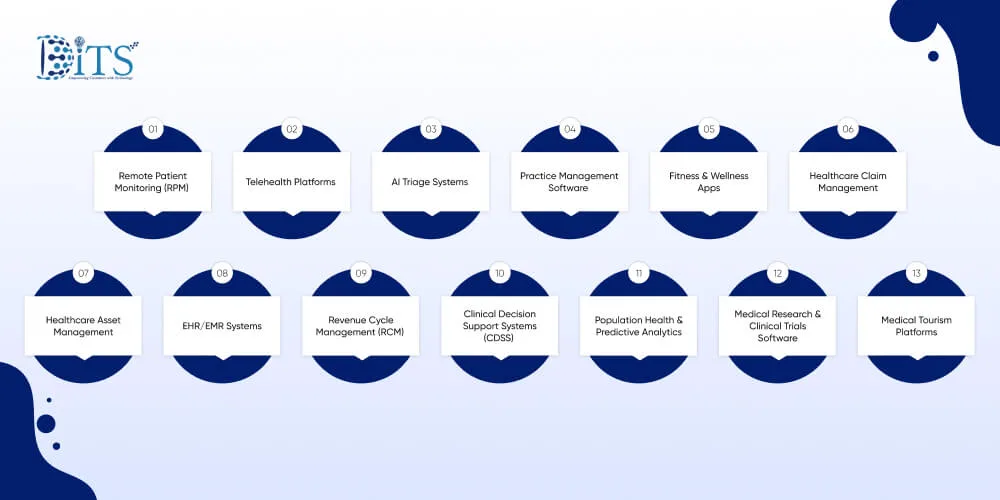
13 Types of Healthcare Software Product Development in Demand
Healthcare software product development encompasses diverse solutions that streamline operations, improve patient care, and integrate AI-driven insights. From telehealth platforms to revenue cycle management, businesses can adopt scalable, secure, and customizable healthcare software product development services.
Remote Patient Monitoring (RPM)
RPM software development helps to enable real-time patient data tracking, including vitals and chronic condition monitoring. Healthcare providers can identify anomalies early, improve outcomes, and reduce hospital readmissions through continuous digital observation and AI-assisted alerts integrated into existing systems.
Telehealth Platforms
Telehealth software allows virtual consultations, scheduling, and secure video communication between providers and patients. Businesses can scale services across regions, reduce in-person visits, and improve care access while integrating AI-driven diagnostics and automated workflows.
AI Triage Systems
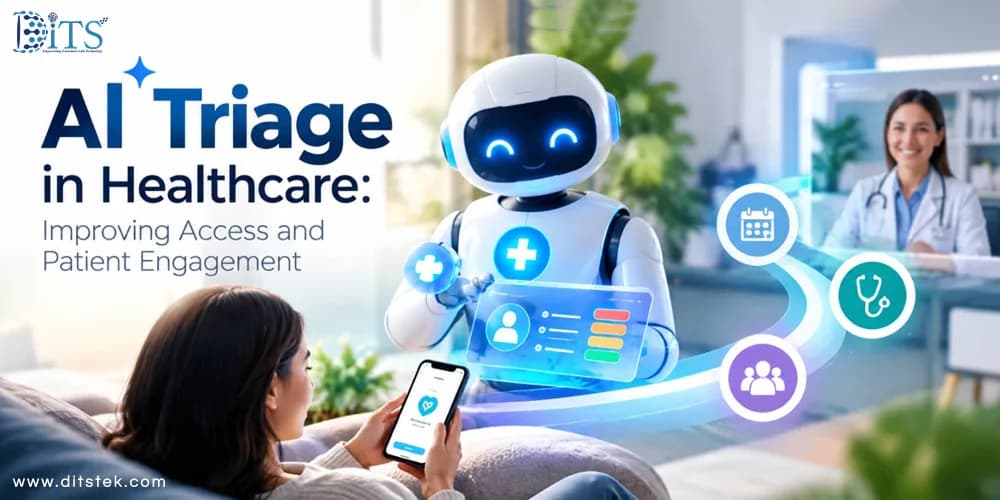
AI triage solutions analyze patient symptoms and prioritize care efficiently. These systems integrate with hospital workflows to reduce wait times, automate preliminary assessments, and improve clinical decision-making for startups and large healthcare networks.
Practice Management Software
Practice management solutions streamline scheduling, billing, and staff coordination. AI integration can predict patient flow, optimize resource allocation, and improve operational efficiency for multi-location clinics or specialized practices.
Fitness & Wellness Apps
Custom wellness apps track activity, nutrition, and health metrics, offering personalized insights. Businesses can integrate AI algorithms to deliver recommendations, monitor compliance, and encourage preventive care.
Healthcare Claim Management
Health insurance claim software automates submission, validation, and adjudication. AI-driven analytics detect errors, reduce rejections, and ensure faster reimbursements while integrating seamlessly with existing billing systems.
Healthcare Asset Management
Healthcare asset management software monitor equipment, inventory, and consumables in real time. AI integration helps predict maintenance needs, reduce downtime, and optimize procurement for hospitals and medical facilities.
EHR/EMR Systems
Electronic health record systems centralize patient data, enabling secure access and interoperability. AI modules assist in predictive diagnostics, clinical recommendations, and administrative automation.
Revenue Cycle Management (RCM)
RCM software helps in medical billing, claim processing, and patient payments. AI-driven validation, predictive denial management, and reporting dashboards improve cash flow and operational efficiency for practices of any size.
Clinical Decision Support Systems (CDSS)
CDSS platforms assist clinicians with evidence-based recommendations. AI software development company helps with analyzes patient records, identifies risk factors, and suggests optimal treatment pathways to improve clinical outcomes.
Population Health & Predictive Analytics
These solutions aggregate patient data to identify trends, risk groups, and care gaps. AI models predict disease outbreaks, resource demand, and preventive care opportunities for better strategic planning.
Medical Research & Clinical Trials Software
Software solutions streamline trial management, patient recruitment, and data collection. AI-driven analytics accelerate study outcomes, improve protocol compliance, and enhance trial scalability.
Medical Tourism Platforms
Custom platforms manage patient travel, treatment bookings, and international compliance. AI recommendations optimize care provider selection and cost-efficiency, enhancing patient experience across borders.
See DITS Healthcare Software Products Development Services
Explore our portfolio across RPM, RCM, EHR, Medical Tourism, Population Health, Asset Monitoring, Wellness App, etc.
Business Benefits of Developing Healthcare Software Products
Developing custom healthcare software products improves operational efficiency, financial performance, and scalability. From AI-driven automation to revenue optimization, healthcare software product development solutions help businesses reduce costs, increase patient volume, and strengthen long-term contract value.
Lower Labor Costs
Healthcare software product development reduces dependency on manual billing, scheduling, and documentation processes. Automated workflows, AI-assisted coding, and digital patient intake forms minimize administrative workload, allowing hospitals and clinics to optimize staffing costs while maintaining operational efficiency.
Increased Patient Volume
Digital appointment systems, telehealth platforms, and automated triage tools enable providers to handle higher patient loads. Businesses implementing healthcare software product development services can visualize shorter wait times and improved scheduling accuracy, increasing service capacity without expanding physical infrastructure.
Transitioning from Guessing to Knowing
Integrated analytics dashboards replace assumptions with real-time KPIs such as patient acquisition cost, AR days, and treatment outcomes. AI integration into existing systems enables predictive forecasting, helping leadership teams make data-driven operational and financial decisions.
Higher Life-Time Value (LTV)
Custom patient engagement systems, follow-up automation, and personalized care recommendations improve retention. Healthcare software product development solutions support long-term patient relationships, increasing repeat visits and subscription-based service models for sustained revenue growth.
Higher B2B Contracts
Scalable and compliant digital platforms improve credibility when partnering with insurers, enterprises, and healthcare networks. A structured product ecosystem built by a healthcare software product development company strengthens negotiation leverage for larger and longer-term B2B contracts.
Improved Cash Flow
Integrated revenue cycle modules automate claims submission, eligibility checks, and payment tracking. AI-assisted validation reduces rejections, ensuring faster reimbursements and predictable cash flow across multi-location healthcare organizations.
Higher Reimbursement Rates
Accurate coding engines, compliance monitoring, and payer-specific rule configuration improve clean claim rates. Businesses using advanced healthcare software product development services can visualize higher reimbursement realization and reduced revenue leakage across specialties.
Challenges & Solution of Healthcare Software Product Development
Healthcare software product development involves regulatory, technical, and operational complexities. Addressing compliance, interoperability, scalability, and AI integration challenges with structured healthcare software product development solutions ensures secure, scalable, and business-aligned digital healthcare products.
1. Regulatory Compliance & Data Security
Challenge: Healthcare products must comply with HIPAA, HL7, and regional data regulations. Non-compliance risks legal penalties and reputational damage.
Solution: Structured healthcare software product development services implement encryption, role-based access, audit trails, and compliance-ready architecture from the design phase.
2. Interoperability with Legacy Systems
Challenge: Hospitals often operate multiple EHR, billing, and diagnostic systems that do not communicate efficiently.
Solution: Custom healthcare software product development solutions include API-first architecture and FHIR-based integrations, ensuring seamless data exchange across existing infrastructure.
3. Scalability Across Multi-Location Operations
Challenge: Startups scale quickly, while enterprises manage high transaction volumes across branches. Poor architecture leads to downtime and performance issues.
Solution: Cloud-native deployment and microservices architecture within healthcare software product development ensure performance scalability and high system availability.
4. Complex Clinical Workflows
Challenge: Generic platforms fail to align with specialty-specific workflows, causing inefficiencies in patient care and billing.
Solution: As a custom healthcare software product development company, solutions are built around real clinical workflows, integrating AI-driven automation into existing systems for optimized operations.
5. Data Accuracy & Decision-Making Gaps
Challenge: Manual reporting and fragmented databases limit actionable insights for leadership teams.
Solution: Embedded analytics dashboards and AI models transform raw clinical and financial data into real-time KPIs for strategic business decisions.
6. High Development Risk & Cost Overruns
Challenge: Undefined scope, changing requirements, and lack of technical planning increase development costs.
Solution: A structured product lifecycle approach including requirement mapping, MVP validation, and iterative releases ensures predictable investment and measurable ROI.
Cost to Build Healthcare Products
In the 2026 market, a full-scale enterprise version of these products typically costs $150,000 to $400,000+. However, by focusing on core features and using cross-platform frameworks (like Flutter or React Native), DITS helps to launch a "Version 1.0" within your $80k ceiling.
Product
Entry Cost (Basic)
Max Cost (High-End MVP)
Key Feature Focus for this Budget
Fitness & Wellness Apps
$25,000
$55,000
Activity tracking, manual logs, basic UI.
Practice Management Software
$35,000
$65,000
Scheduling, patient profiles, basic billing.
Telehealth Platforms
$40,000
$80,000
Secure video, appointment booking, chat.
EHR/EMR Systems
$45,000
$80,000
Digital records, simple templates, HIPAA vault.
Medical Tourism Platforms
$30,000
$60,000
Listings, booking, document uploads.
AI Triage Systems
$50,000
$80,000
Rule-based logic + basic LLM integration.
Remote Patient Monitoring (RPM)
$55,000
$80,000
1-2 device integrations (e.g., Apple Health).
Revenue Cycle Management (RCM)
$50,000
$80,000
Claim submission, basic denial tracking.
Healthcare Claims Management
$50,000
$80,000
Automation of manual entry, basic validation.
Healthcare Asset Management
$35,000
$65,000
Inventory tracking, QR/Barcode scanning.
Clinical Decision Support (CDSS)
$60,000
$80,000
Evidence-based alerts for core interactions.
Population Health/Analytics
$55,000
$80,000
Data visualization for small patient sets.
Medical Research/Clinical Trials
$60,000
$80,000
Patient recruitment tools, secure data logs.
1. Interoperability Cost
In healthcare, your software is only as valuable as the data it can access. If your RPM or Telehealth tool can't talk to a hospital's EHR (like Epic or Cerner), it becomes a "data silo" that doctors hate using.
The HL7/FHIR Tax: Modern standards like FHIR R4 are required for data exchange. Building a custom bridge to a single major EHR typically costs $15,000 to $50,000.
The Middleware Strategy: To stay under $80k, you shouldn't build custom integrations. Instead, you use "aggregators" like Redox or Particle Health. Cost Shift: You trade high upfront development costs (CAPEX) for monthly subscription fees (OPEX). The Reality: In a $25k–$80k budget, you will likely limit yourself to one-way data flow.
2. Compliance Cost
You aren't just building an app; you're building a "Covered Entity" or "Business Associate" under law. This adds a mandatory 20%–30% overhead to every development hour.
The HIPAA/GDPR "Build-In": This isn't just a checkbox; it involves technical requirements like AES-256 encryption at rest, automatic session timeouts, and detailed audit logs (who saw what and when). Cost Factor: Developers must spend more time on "DevSecOps"—the secure backend—rather than visible features.
The Audit Trap: A formal third-party HIPAA audit or SOC 2 Type II certification (often required to sell to hospitals) costs $20,000 to $40,000 alone.
Key Compliance for Healthcare Software Product Development
Healthcare software product development requires strict regulatory compliance, data protection, and interoperability standards. Businesses must align with healthcare laws, security frameworks, and clinical data protocols to ensure safe, scalable, and legally compliant digital healthcare products.
1. HIPAA Compliance (U.S.)
Healthcare software products must comply with HIPAA regulations to protect patient health information. This includes implementing encryption, role-based access control, audit logs, and secure data transmission protocols to prevent unauthorized access and data breaches.
2. GDPR & Data Privacy Regulations
For global healthcare businesses, compliance with GDPR and regional data protection laws is mandatory. Healthcare software product development solutions must include consent management, data minimization policies, and secure cross-border data transfer mechanisms.
3. HL7 & FHIR Interoperability Standards
Interoperability is critical for integrating EHR, EMR, and third-party systems. Healthcare software product development services must follow HL7 and FHIR protocols to ensure structured data exchange between hospital systems, labs, insurers, and telehealth platforms.
4. FDA & Medical Device Regulations
If software performs diagnostic or clinical decision functions, FDA or regional medical device regulations may apply. Businesses developing AI-driven healthcare tools must document validation processes, risk assessments, and clinical safety evaluations.
5. SOC 2 & Cloud Security Compliance
Cloud-hosted healthcare platforms require SOC 2 compliance to demonstrate secure data handling practices. This includes continuous monitoring, incident response mechanisms, and infrastructure-level security controls within healthcare software product development environments.
6. ICD, CPT & Billing Standards Compliance
Healthcare products involving billing or revenue workflows must adhere to standardized coding systems such as ICD and CPT. Proper validation engines and audit trails ensure accurate claims processing and reduce regulatory risks for providers.
Advanced Features of Healthcare Software Product
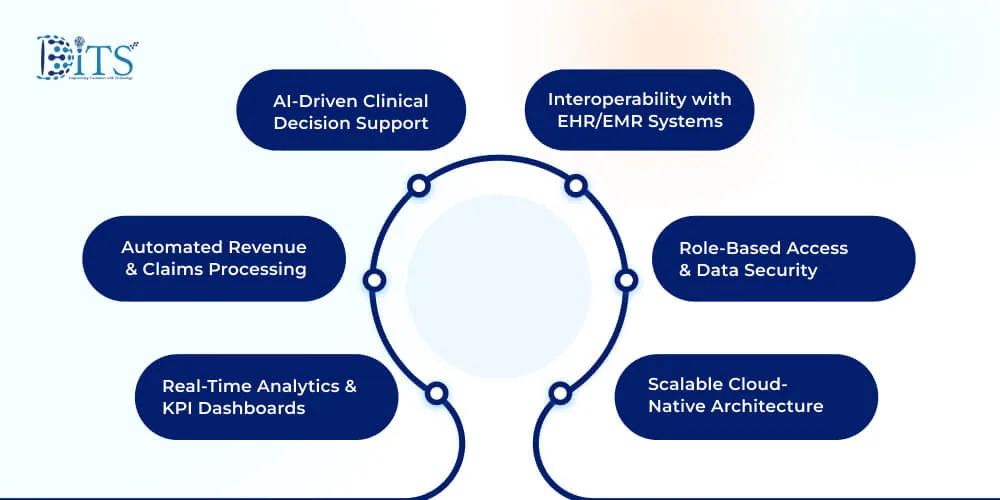
Advanced healthcare software product development integrates AI, interoperability, automation, and compliance-ready architecture. Modern healthcare software product development solutions enable secure data exchange, predictive analytics, and scalable infrastructure for startups, mid-size providers, and enterprise healthcare organizations.
1. AI-Driven Clinical Decision Support
AI modules analyze patient history, lab reports, and diagnostic data in real time. Healthcare software product development services integrate predictive algorithms that flag high-risk patients, assist in treatment recommendations, and reduce diagnostic errors within clinical workflows.
2. Interoperability with EHR/EMR Systems
Modern healthcare software product development solutions support HL7 and FHIR standards for seamless data exchange. Hospitals can synchronize patient records across departments, laboratories, and billing systems, ensuring unified data visibility and operational continuity.
3. Automated Revenue & Claims Processing
Agentic AI development helps to automate eligibility checks, claim validation, and denial prediction. Businesses visualize improved clean claim rates and faster reimbursements through rule-based automation embedded in healthcare software product development frameworks.
4. Role-Based Access & Data Security
Enterprise-grade encryption, audit trails, and role-based access control ensure HIPAA compliance. Healthcare providers can monitor user activity, secure patient data, and prevent unauthorized access across multi-location networks.
5. Real-Time Analytics & KPI Dashboards
Integrated analytics dashboards display KPIs such as patient flow, AR days, resource utilization, and treatment outcomes. Decision-makers gain structured insights for operational planning and performance optimization.
6. Scalable Cloud-Native Architecture
Cloud-based deployment supports auto-scaling, microservices architecture, and API-driven integrations. Startups and large healthcare enterprises can expand service offerings without infrastructure bottlenecks while maintaining system performance and reliability.
Why Choose DITS for Healthcare Software Product Development
DITS delivers secure, scalable, and AI-integrated healthcare software product development solutions tailored to business goals. From architecture design to system integration, healthcare organizations gain compliant, high-performance platforms built for operational efficiency and long-term growth.
1. End-to-End Custom Product Engineering
DITS provides complete product engineering services from requirement analysis and UI/UX prototyping to cloud deployment and maintenance. Businesses launching new healthcare products can visualize structured architecture, modular APIs, and scalable microservices aligned with their specialty workflows.
2. AI Integration into New and Existing Systems
We integrate AI models into both newly built platforms and legacy systems. Predictive analytics, clinical decision support, automated coding, and intelligent scheduling improve efficiency without disrupting ongoing operations, strengthening healthcare software product development solutions for measurable performance improvement.
3. Compliance-Driven and Secure Architecture
Our healthcare software product development approach prioritizes HIPAA compliance, role-based access control, audit logs, and encrypted data exchange. Multi-location providers can operate securely while meeting regional regulatory requirements and maintaining interoperability across EHR, billing, and third-party systems.
4. Scalable Infrastructure for Growing Healthcare Businesses
DITS designs cloud-native platforms using containerization and CI/CD pipelines to support business expansion. Startups, mid-size providers, and large enterprises can scale user volumes, integrate additional modules, and enhance system capabilities without performance bottlenecks.
Want to Validate Your Product Idea?
Assess feasibility, compliance requirements, core features, and development approach before investing in healthcare software product development.
Healthcare software product development is the process of designing, building, and maintaining digital healthcare platforms such as EHR systems, telehealth apps, RPM solutions, and billing software. It focuses on compliance, security, interoperability, and scalable architecture for healthcare businesses.
Nidhi Thakur
With more than 20 years of experience - I represent a team of professionals that specializes in the healthcare and business and workflow automation domains. The team consists of experienced full-stack developers supported by senior system analysts who have developed multiple bespoke applications for Healthcare, Business Automation, Retail, IOT, Ed-tech domains for startups and Enterprise Level clients