Data analytics software for healthcare is strategic asset that improves margins, compliance, and care quality when aligned with business KPIs.
Clean data integration and strong security foundation determine long-term success more than dashboard design.
Scalable architecture and right technology choices protect total cost of ownership over five years.
Adoption, clinical validation, and phased rollout directly impact ROI.
Most mid-sized healthcare organizations see measurable financial and operational gains within 12 to 18 months when execution is disciplined.
Healthcare leaders in the U.S. are no longer asking whether they need better insights. They are asking how quickly they can get them without disrupting care delivery or exposing the organization to compliance risk. Margins are tightening, reimbursement models are shifting toward value-based care, and boardrooms want visibility into performance in near real time. This is where data analytics software for healthcare becomes more than a reporting tool. It turns operational noise into measurable direction.
The challenge is not collecting data. Most hospitals already sit on years of clinical, financial, and operational information. The real question is how to structure, secure, and activate it in a way that drives executive decisions. Building the right analytics platform requires clarity, discipline, and alignment with business outcomes from day one.
What is Healthcare Data Analytics Software
At its core, healthcare analytics platform consolidates clinical, financial, and operational data into a single decision layer. Unlike standard reporting tools that only display historical numbers, it helps leadership understand patterns, risks, and future impact.
There are four practical layers most organizations rely on:
Descriptive analytics to track past performance such as readmission rates or denial percentages
Diagnostic analytics to identify why certain trends occurred
Predictive models to forecast risks like patient deterioration or revenue leakage
Prescriptive insights that recommend next actions
For example, a multi-specialty clinic in Texas reduced claim denials by 18 percent within six months after identifying coding gaps through predictive analysis. The insight was not hidden. It was simply buried in disconnected systems. Once surfaced properly, decision-making became faster and more confident.
Well-built platforms move beyond static dashboards. They connect financial health with clinical performance. And that’s where real value begins.
Ready to Accelerate ROI with Healthcare Analytics Solutions?
Understand how AI driven analytics solutions accelerate implementation timelines, reduce errors, and deliver measurable financial and operational improvements for organizations.
Now as we know that data analytics software in healthcare helps leaders understand the operational patterns and risks in detailed reports, let us dive into the steps to build the software.
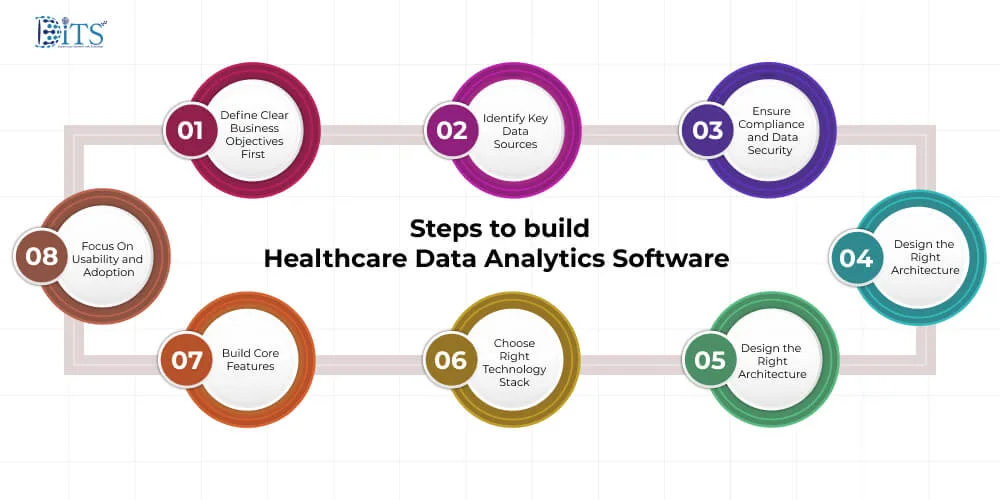
Define Clear Business Objectives First
Before writing a single line of code, executive teams must define why they are building the platform. Without a clear business lens, analytics initiatives often stall or become expensive reporting experiments.
Common objectives include:
Reducing cost per patient encounter
Improving quality scores tied to CMS reimbursement
Lowering no-show rates and readmissions
Increasing revenue cycle efficiency
Supporting population health programs
Consider this scenario. A mid-sized hospital group invested nearly $1.2 million in analytics infrastructure but failed to align it with value-based care metrics. Adoption remained low because department heads did not see direct relevance to their KPIs. Technology was not the issue. Strategy was.
Clear targets shape architecture, integration scope, and budget. When goals are specific and measurable, implementation becomes focused and defensible at the board level.
Identify Key Data Sources
Healthcare data rarely lives in one system. It is scattered across platforms, departments, and sometimes external partners. Successful healthcare data analytics software development begins with mapping these sources carefully.
Typical data inputs include:
EHR and EMR systems
Practice management and scheduling tools
Billing and claims platforms
Laboratory and imaging systems
Data from remote patient monitoring devices
Payer and public health datasets
Fragmented data creates blind spots. When financial systems cannot communicate with clinical platforms, leadership decisions rely on partial visibility. Interoperability standards such as HL7 and FHIR become essential here.
Early data assessment often reveals quality issues. Duplicate records, inconsistent coding, missing timestamps. Cleaning this foundation may take weeks, sometimes months. But ignoring it leads to unreliable insights. And unreliable insights erode executive trust quickly.
Getting data right is not glamorous work. Yet it determines whether analytics becomes a strategic asset or just another dashboard.
Ensure Compliance and Data Security
Healthcare data carries regulatory weight and reputational risk. Any analytics initiative must be built around HIPAA, HITECH, and CMS reporting obligations from the beginning, not added as an afterthought.
Core safeguards typically include:
End-to-end encryption for data in transit and at rest
Role-based access controls aligned with job functions
Detailed audit trails to monitor access and modifications
Multi-factor authentication for privileged users
Business Associate Agreements with all technology partners
Security is not only about avoiding penalties. It is about preserving institutional credibility. A single breach can cost millions in remediation and erode patient confidence overnight. On top of that, class action exposure is becoming more common in the U.S. healthcare environment.
When compliance architecture is embedded early, implementation becomes smoother and scalable. When it is rushed later, costs multiply. Executive teams should treat security investment as risk insurance, not overhead.
Design the Right Architecture
Architecture determines long-term flexibility. Decisions made in early design stages can either support growth or limit it within two years.
Healthcare organizations typically evaluate:
Cloud-based infrastructure for scalability and lower capital expenditure
On-premise deployment for stricter internal governance
Hybrid environments to balance both
Data warehousing structures are ideal for structured reporting, while data lakes support more complex modelling and large-scale ingestion. API-first architecture ensures smooth integration with EHRs and external systems.
Architecture Model
Best For
Consideration
Cloud-Based
Multi-location health systems
Requires strong cloud governance
On-Premises
Highly regulated environments
Higher upfront infrastructure cost
Hybrid
Gradual digital transition
More complex management
Scalability planning is often underestimated. A regional hospital processing 200,000 patient records annually may double that volume within five years. Systems must anticipate that trajectory. Otherwise, performance degradation becomes inevitable.
Choose Right Technology Stack
Technology selection should align with business objectives, not vendor popularity. The wrong stack can increase integration cost by 30 to 40 percent over time.
A typical structure includes:
ETL tools for structured data ingestion
Secure relational or distributed databases
Machine learning frameworks for predictive modelling
Executive-level dashboard tools for visualization
This stage is where many organizations consult healthcare software development experts to avoid fragmented implementation. Selecting tools that integrate smoothly with existing EHR systems reduces long-term maintenance cost and downtime.
At DITS, we integrate AI into every stage of healthcare data analytics software services, from automated code review and quality assurance to intelligent customization. AI-assisted development improves code stability, accelerates testing cycles, and reduces human error during deployment. It is not a marketing layer. It is embedded into engineering workflows.
Technology choices should support measurable outcomes. If a stack cannot scale, integrate, or secure data efficiently, it will eventually demand rework. And rework is expensive.
Build Core Features in Data Analytics Software for Healthcare
Once foundation and architecture are in place, value is delivered through functionality. Executives are not investing in infrastructure. They are investing in visibility and control.
Effective data analytics software for healthcare should include:
Executive dashboards tracking KPIs such as length of stay, denial rate, cost per admission, and provider productivity
Predictive risk models for readmissions or high-cost patients
Automated CMS and payer reporting
Revenue leakage detection alerts
Role-based access views for clinical, operational, and finance teams
Consider a health system managing 12 facilities. Without unified analytics, leadership meetings often revolve around conflicting numbers. After deploying structured dashboards, reporting cycles dropped from 10 days to 48 hours. Decision-making accelerated. Accountability improved.
Here’s the kicker. Simplicity drives adoption. Overcomplicated dashboards frustrate clinicians and finance managers alike. Clean design with relevant metrics wins every time.
Focus On Usability and Adoption
Technology alone does not create impact. Adoption does.
Analytics tools must align with clinical workflows. If physicians need five extra clicks to access insights, usage declines quickly. And underutilized systems become sunk costs.
Strong implementation includes:
Short training cycles tailored to department heads
Department-specific dashboards aligned to measurable KPIs
Feedback loops for iterative improvement
Executive sponsorship to reinforce accountability
For example, predictive models connected to remote patient monitoring programs can flag high-risk patients in real time. But if care coordinators are not trained to act on alerts, predictive capability becomes academic rather than operational.
Adoption planning should begin before deployment. Cultural alignment often determines ROI more than technical sophistication.
Testing And Validation
Healthcare data is sensitive and complex. Errors are costly. Testing must go beyond surface-level validation.
Comprehensive validation includes:
Data integrity testing to confirm accuracy across systems
Clinical model validation with physician oversight
Security penetration testing
Performance testing under peak load scenarios
Many healthcare boards now require independent validation for predictive algorithms before full deployment. That is not bureaucracy. It protects patient safety and institutional reputation.
At DITS, our healthcare data analytics software development approach integrates AI-assisted quality assurance to detect anomalies in code structure, data mapping, and performance thresholds before release. This reduces rework cycles and strengthens long-term maintainability.
When testing is rigorous, deployment risk declines significantly. And executive confidence rises accordingly.
Deployment Strategy and Change Management
Deployment should be phased, not rushed. Large-scale healthcare systems often pilot analytics tools within one department before expanding enterprise wide.
Effective rollout strategy includes:
Department-level pilot program lasting 60 to 90 days
Clear KPI benchmarks before and after implementation
Ongoing performance monitoring post-launch
Executive review checkpoints
Some organizations attempt full rollout across multiple facilities simultaneously. It sounds efficient. It rarely is. Controlled scaling protects operational stability.
Estimated Cost to Build Data Analytics Software for Healthcare
Cost depends heavily on scope, integration depth, and compliance requirements. For U.S. healthcare organizations, typical investment ranges include:
Small specialty clinics: $120,000 to $250,000
Mid-sized hospital groups: $350,000 to $900,000
Large multi-facility systems: $1.2 million to $3 million or more
Ongoing maintenance typically ranges from 15 to 25 percent of initial build cost annually. Security upgrades, model refinement, and regulatory updates drive these expenses.
Nobody likes unexpected budget overruns. Early clarity on scope, data complexity, and integration prevents those surprises.
Common Challenges Healthcare Businesses Face
Even well-funded initiatives encounter obstacles.
Frequent challenges include:
Data silos across departments
Resistance from clinical teams
Integration delays with legacy systems
Underestimating long-term maintenance effort
These issues do not indicate failure. They signal the need for structured governance and executive alignment.
Organizations that treat analytics as strategic infrastructure rather than short-term IT projects tend to achieve stronger outcomes.
Build Custom Vs Buy Off the Shelf
Off-the-shelf platforms may offer faster initial deployment. However, customization limitations often restrict strategic flexibility.
Custom-built systems provide:
Greater control over data governance
Tailored KPI alignment
Scalable integration capabilities
Long-term cost optimization
When evaluating vendors, leadership should consider total cost of ownership over five years rather than upfront licensing fees alone.
High-performing healthcare organizations increasingly invest in custom healthcare data analytics software services to align analytics with unique operational models and reimbursement structures.
Are You Maximizing Value From Healthcare Data Assets?
Identify gaps in your current reporting systems and unlock opportunities to reduce costs, improve compliance, and enhance patient outcomes today.
Building data analytics software for healthcare is not purely a technology initiative. It is a strategic transformation effort tied directly to cost control, quality metrics, and patient outcomes.
When objectives are defined clearly, architecture is scalable, compliance is embedded, and adoption is prioritized, analytics becomes a competitive advantage rather than an operational burden.
Healthcare data already exists inside your organization. The question is whether it is working for you or simply sitting in storage. The answer depends on how intentionally you build the system around it.
Frequently asked questions
For mid-sized hospital groups, implementation usually takes 6 to 9 months, depending on integration complexity and data quality. Smaller specialty clinics may complete deployment within 4 to 6 months, while enterprise systems with multiple facilities often require phased rollout over 9 to 15 months.