

Unified Enterprise Application
Processes, policies, training modules, projects, employee communication, and collaboration tools are consolidated into one browser-based workplace rather than maintained across multiple disconnected applications.
An enterprise employee engagement platform that brings organizational communication, knowledge, training, events, documents, communities, recognition, rewards, administration, and analytics into one digital environment designed for distributed and collaborative teams.
The solution is a centralized digital workplace solution designed to replace disconnected communication and knowledge tools with one collaborative enterprise hub. It combines employee communities, social communication, knowledge management, training, events, document collaboration, groups, recognition, gamification, rewards, administration, and reporting. Network Administrators manage branding, users, competitions, news, and platform configuration while employees gain unified access to organizational processes, policies, projects, learning material, and collaboration channels, helping distributed teams operate through a shared digital environment.
From scattered documents to isolated departments, these were the real-world roadblocks reducing productivity and breaking internal alignment.

Teams relied heavily on asynchronous written communication without regular calls, making alignment, information sharing, and development of a cohesive organizational culture more difficult.

Knowledge, training, communication, collaboration, projects, and engagement activities existed across separate workflows, increasing friction for employees trying to access organizational information.

A critical training module required rapid delivery while maintaining acceptable engineering and learning quality within a tightly constrained project schedule.

The around he existing codebase presented poor internal testability, creating technical concerns maintaining stability as new workplace functionality was introduced.

Unprotected branches and inconsistent development controls required stricter pull-request reviews and quality gates while engineering teams continued delivering against demanding timelines.

Mobile applications and external ERP, CRM, HRMS, and collaboration integrations were excluded from the initial scope so the core platform could launch without uncontrolled complexity.
Ditstek implemented Digital Workplace Transformation through a focused web platform, structured project-management practices, stronger development governance, controlled scope, real-time backend capabilities, and centralised employee communication, knowledge, learning, and engagement workflows.

Asana introduced clearer task visibility and oversight for distributed contributors, supporting rapid training-module delivery while preserving strict review and quality requirements.

Undefined external enterprise integrations were deliberately excluded from the initial release, keeping the platform decoupled from legacy systems while protecting launch stability.

React, Next.js, and TypeScript provide one user experience across knowledge, training, communications, groups, events, recognition, administration, and organizational activities.

Firebase supports real-time synchronization, authentication, storage, and backend functions while providing scalable infrastructure for application operations and collaboration data.

Members, Administrators, and Network Administrators receive appropriate capabilities after authentication and role resolution, protecting configuration functions while maintaining straightforward employee access.

Documents, discussions, training material, groups, chat, events, and news create an HR communication platform experience that reduces dependence on fragmented internal communication channels.
The platform supports Employee Experience Transformation through community engagement, enterprise search, knowledge sharing, training, real-time communication, events, gamification, rewards, administration, reporting, and governance from one centralized application.
Processes, policies, training modules, projects, employee communication, and collaboration tools are consolidated into one browser-based workplace rather than maintained across multiple disconnected applications.

Database operations, authentication, file storage, tags, version management, and real-time synchronization are supported through Firebase and associated backend functions.

Protected resources require validated authentication and role identification before users enter personalized dashboards appropriate to their assigned privileges.

Personalized dashboards surface relevant information while global search discovers members, groups, events, documents, rewards, challenges, courses, and newsfeed posts.
Centralized documents and files make organizational materials easier to store, organize, share, discover, and reuse for continuous employee learning.

Discussion feeds, announcements, and real-time chat support Workplace Collaboration Modernization by giving distributed employees consistent channels for asynchronous and immediate communication.

Dedicated team workspaces, member discovery, event creation, participation tracking, and visible training schedules support coordination across organizational communities and projects.

Competitions, leaderboards, redeemable points, and rewards encourage participation while providing structured mechanisms for recognizing employee contributions.

White-label branding, configuration controls, KPI reporting, recognition metrics, administrative settings, and audit trails provide organizations with centralized governance and operational visibility.
Tangible improvements in speed, collaboration, and engagement proved the platform’s role as a game-changer for internal operations.

Employees can access communication, documents, learning, events, projects, recognition, and community functions without moving between multiple disconnected internal systems.

Real-time chat, community feeds, groups, directories, and organizational announcements provide consistent communication channels for teams operating primarily through written interaction.

Global search and centralized documents make organizational information and training material easier for employees to locate and reuse across everyday work.

Competitions, rewards, recognition, community participation, and events provide multiple mechanisms for encouraging employee involvement within the shared workplace environment.

Role controls, configuration management, white-label settings, analytics, and audit histories give administrators stronger visibility into platform use and operational changes.

The centralised architecture supports employee communication transformation by keeping workplace communication, learning, engagement, and governance within one managed digital environment.

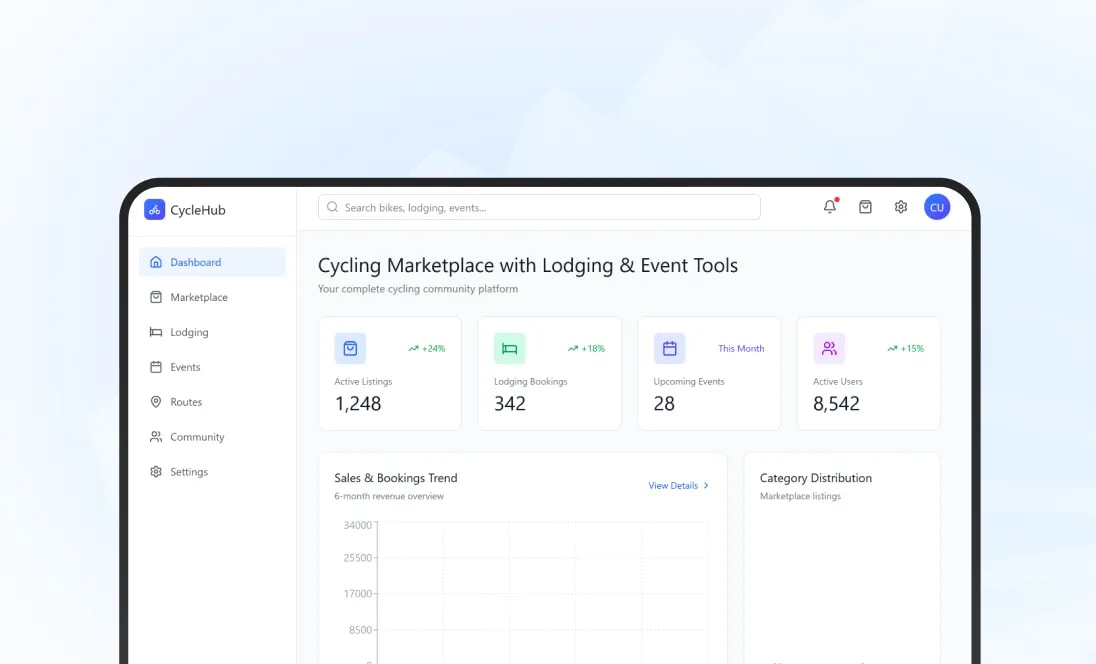
A cycling-focused marketplace that brings event registration, cyclist-friendly accommodation, branded merchandise, and rider communities into one digital experience. Ditstek modernized the backend while maintaining shared account access across legacy and updated platform modules.
View Project