25+ years of IT software development experience in different domains like Business Automation, Healthcare, Retail, Workflow automation, Transportation and logistics, Compliance, Risk Mitigation, POS, etc. Hands-on experience in dealing with overseas clients and providing them with an apt solution to their business needs.
Key Takeaways
Conversational systems improve response speed and reduce operational costs.
Automation handles routine queries, freeing agents for complex tasks.
Faster claims processing strengthens customer trust and retention.
Integration enables personalized and seamless customer experiences.
Systems scale easily during peak demand without extra resources.
Interaction data helps drive better business decisions.
Early adoption creates a strong competitive advantage.
Insurance leaders across the US are under pressure to do more with less. Customers expect instant answers, regulators demand accuracy, and operational costs continue to rise. Traditional support models are struggling to keep up, especially during high-demand periods like claims surges or policy renewals.
This is where conversational AI in insurance starts to make a real difference. It creates a responsive, always-available system that handles customer interactions with speed and consistency.
And that is exactly where the shift is happening.
What Is Conversational AI In Insurance?
At its core, conversational ai insurance refers to intelligent systems that interact with users through natural language, either via chat or voice. These systems are trained to understand intent, respond accurately, and guide users through processes that once required human intervention.
In a typical insurance setup, this technology connects directly with existing platforms such as CRM systems, policy databases, and claims management tools. The result is not just a chatbot sitting on a website, but a fully integrated communication layer that works across channels.
Here is what it usually handles:
Customer queries related to policies, renewals, and coverage
First-level claims assistance and status tracking
Lead qualification and product recommendations
Appointment scheduling and reminders
But here’s the real value. It does not just answer questions. It learns from interactions, improves responses over time, and adapts to customer behavior patterns.
Many insurers are already leveraging AI chatbot development to create tailored conversational experiences that reflect their brand voice and compliance requirements. When done right, it feels less like interacting with software and more like having a knowledgeable assistant available at all times.
Key Operational Challenges in US Insurance Industry
Running an insurance business in the US is not just about underwriting risk anymore. It is about managing scale, compliance, and customer expectations all at once. And that balance is getting harder to maintain.
Take customer support, for example. Many insurers still rely heavily on call centers. During peak periods, wait times stretch beyond acceptable limits. Customers get frustrated. Agents burn out. And service quality starts to dip.
Then comes claims processing. Even today, a simple claim can take days, sometimes weeks, due to manual verification steps and fragmented systems. That delay directly impacts customer trust.
Here are some of the most pressing challenges insurers are dealing with:
Rising operational costs driven by staffing and infrastructure
Increasing demand for instant, round-the-clock support
Complex regulatory landscape across states and federal guidelines
Disconnected customer journeys across web, mobile, and phone channels
Limited bandwidth for agents to handle high-value interactions
And there is a bigger issue underneath all of this. Legacy systems. Many insurers are still operating on outdated platforms that do not easily support modern digital experiences.
This is where insurance conversational ai begins to show its strategic value. Not as a quick fix, but as a layer that bridges operational gaps without forcing a complete system overhaul.
Because in a market where speed and accuracy define customer loyalty, even small inefficiencies start to cost big.
Ready to Modernize Your Insurance Customer Interactions Today?
Transform response times, reduce costs, and deliver seamless experiences with conversational AI tailored to your insurance workflows and compliance needs.
Core Business Benefits of Conversational AI In Insurance
Once implemented correctly, conversational ai for insurance does more than streamline communication. It starts influencing cost structures, customer retention, and operational efficiency in measurable ways. And for leadership teams, that is where the real conversation begins.
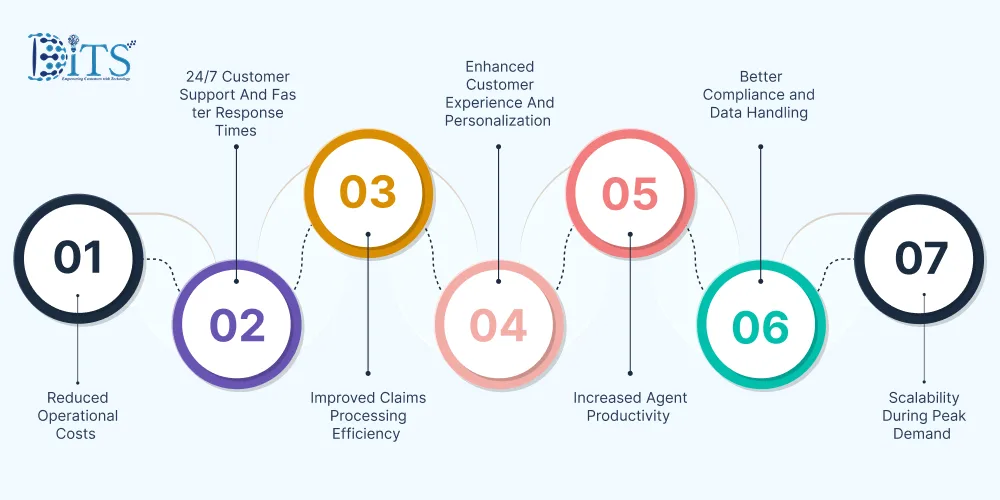
Reduced Operational Costs
Handling thousands of repetitive queries through human agents is expensive. Salaries, training, infrastructure, and attrition all add up.
With conversational systems in place:
Up to 60–70% of routine queries can be automated
Call center volumes drop significantly within the first 3–6 months
Cost per interaction reduces by nearly 30%
This does not eliminate human roles. It simply reallocates them to areas where judgment and expertise actually matter.
24/7 Customer Support And Faster Response Times
Customers do not operate on business hours. Accidents happen at night. Policy questions arise on weekends.
An AI-driven system ensures:
Instant responses without wait times
Consistent service quality across all hours
Higher customer satisfaction scores over time
Improved Claims Processing Efficiency
Claims are where insurers either win or lose customer confidence.
With automation:
Customers can initiate claims instantly
Required information is collected step by step
Real-time updates reduce uncertainty
Imagine reducing a 5-day process to under 24 hours for simple cases. That kind of turnaround does not just improve operations. It reshapes brand perception.
Enhanced Customer Experience And Personalization
Modern customers expect relevance. Generic responses do not work anymore.
Conversational systems enable:
Context-aware interactions based on user history
Personalized policy suggestions
Seamless transitions across chat, mobile, and voice
This is where AI integration services play a crucial role, ensuring that data flows smoothly across systems to support meaningful conversations rather than isolated responses.
Increased Agent Productivity
Your best agents should not be answering basic policy questions all day.
Instead, with AI handling routine interactions:
Agents focus on complex cases and high-value clients
Resolution quality improves
Employee satisfaction increases due to reduced repetitive workload
And yes, this has a direct impact on retention. Skilled agents are more likely to stay when their work feels meaningful.
Better Compliance and Data Handling
US insurance operates under strict regulatory frameworks. Every interaction needs to be accurate, traceable, and secure.
Conversational AI systems:
Deliver consistent, policy-aligned responses
Maintain detailed interaction logs for audits
Support secure data handling practices
No room for guesswork. Everything is structured, documented, and compliant.
Scalability During Peak Demand
Think about natural disasters or open enrollment periods. Customer inquiries spike overnight.
Traditional systems struggle. Hiring temporary staff is costly and inefficient.
With conversational AI:
Systems scale instantly without additional headcount
Response quality remains consistent even during surges
Business continuity is maintained without operational stress
And that is not just efficiency. That is resilience.
Real-World Use Cases of Conversational AI Across Insurance Segments
The value of conversational AI systems becomes clearer when you look at how different insurance segments are applying them in day-to-day operations. These are not experimental use cases. They are already delivering measurable outcomes.
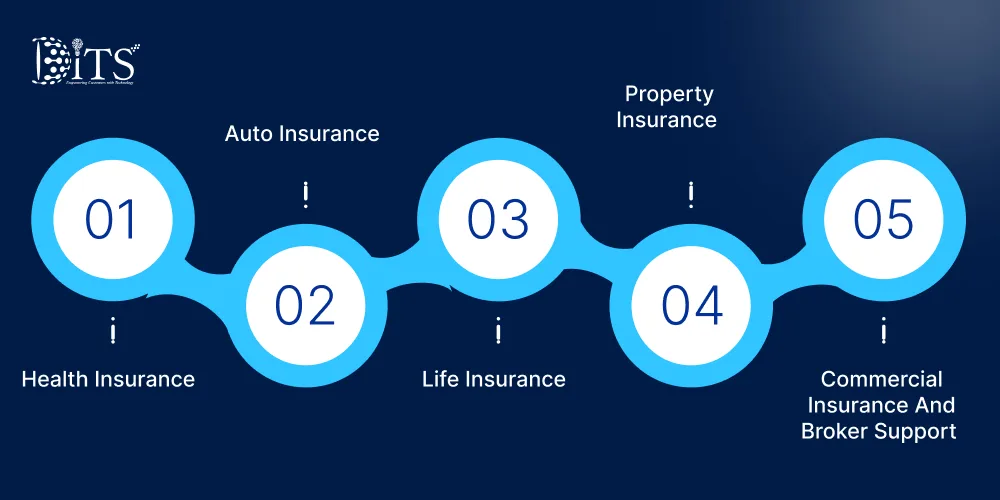
Health Insurance
Members often have ongoing queries related to coverage, claims, and provider networks. Instead of long call queues:
This is where AI agent development plays a strong role, enabling intelligent workflows that guide customers without confusion or delays.
Life Insurance
The buying journey is often complex and documentation-heavy.
Prospects receive instant responses to policy-related questions
Guided onboarding simplifies form filling
Policy comparisons are presented in a clear, structured manner
The result is faster conversions and fewer drop-offs during the decision-making stage.
Property Insurance
During events like storms or floods, inquiry volumes spike sharply.
Claims are registered instantly without waiting for agents
Customers receive updates without repeated follow-ups
Emergency guidance is delivered in real time
In such scenarios, speed is everything. And systems that respond instantly tend to win customer trust faster.
Across all these segments, the pattern is consistent. Faster responses, lower operational load, and a smoother customer journey.
And once businesses see this in action, scaling it becomes an obvious next step.
Commercial Insurance And Broker Support
Commercial insurance comes with layered complexity. Policies are customized, risk assessments vary, and brokers often act as intermediaries between clients and insurers. That creates a communication gap, especially when quick clarifications are needed.
This is where conversational systems bring structure and speed:
Brokers get instant access to policy details, endorsements, and documentation
Clients receive quick answers on coverage, renewals, and compliance requirements
Automated reminders help manage renewals and reduce policy lapses
Consider a broker managing multiple mid-sized business accounts. Instead of chasing underwriters for updates or digging through emails, they can retrieve accurate information in seconds.
On top of that, insurers leveraging AI software development are building tailored solutions that align with broker workflows, ensuring smoother collaboration across all stakeholders.
Want Faster Claims Processing and Higher Customer Satisfaction?
Implement intelligent workflows that accelerate claims handling, provide real-time updates, and build stronger trust with policyholders across every interaction.
ROI And Business Impact Metrics of Conversational AI for Insurance
For leadership teams, adoption decisions are rarely driven by technology alone. The real question is simple. What measurable impact does this create?
When conversational AI in insurance is implemented with clear objectives, the outcomes are not abstract. They show up in numbers that directly affect profitability and customer retention.
Here is how the impact typically translates:
Metric
Typical Improvement Range
Cost Per Customer Interaction
Reduced by 25% to 35%
First Contact Resolution Rate
Increased by 20% to 40%
Claims Processing Time
Reduced by 30% to 50%
Customer Satisfaction (CSAT)
Improved by 15% to 25%
Policy Conversion Rates
Increased by 10% to 20%
But numbers alone do not tell the full story.
Imagine a scenario where a customer receives instant claim acknowledgment, timely updates, and zero follow-ups required. That experience reduces churn without any additional marketing spend.
And then there is internal efficiency. Teams spend less time firefighting and more time improving services. Decision-making becomes faster because data is structured and accessible.
Some insurers are also combining this with AI in insurance initiatives to dive into deeper insights from customer interactions, turning conversations into actionable intelligence.
The takeaway is clear. This is not just cost optimization. It is revenue protection and experience enhancement working together.
Implementation Considerations of Conversational AI for US Insurers
Adopting conversational systems is not a plug-and-play exercise. It requires thoughtful alignment with existing operations, compliance frameworks, and long-term business goals. Many insurers underestimate this part. And that is where delays usually begin.
First, integration with legacy systems needs careful planning. Most insurance platforms were not built for real-time communication. Without proper alignment, even the most advanced solution can feel disconnected.
Then comes data privacy. US regulations demand strict handling of customer information. Systems must ensure encryption, controlled access, and audit-ready records at every step.
Key factors to consider before implementation:
Compatibility with existing CRM and policy management systems
Compliance with federal and state-level data regulations
Training AI models using industry-specific data sets
Defining clear use cases before scaling across departments
Internal team readiness and change management
Here’s something often overlooked. Technology adoption is as much about people as it is about systems. Teams need to trust the system, understand its role, and know where human intervention still matters.
At DITS, we approach this differently. We integrate AI into every solution we build, whether it is for software development, testing, or customization. Through AI software development and structured deployment practices, we ensure that systems are not just functional but aligned with business workflows from day one.
Because a well-implemented system does not disrupt operations. It strengthens them quietly, in the background.
Why Conversational AI for Insurance Is Strategic Investment
Many insurers initially view conversational systems as a cost-saving tool. That is true, but only partially. The larger impact sits at a strategic level, where customer experience, operational agility, and long-term competitiveness intersect.
Think about how the market is evolving. Customers compare experiences across industries, not just within insurance. If banking apps respond instantly and retail platforms personalize every interaction, expectations naturally carry over.
This is where insurance conversational ai shifts from being an operational upgrade to a business differentiator.
It builds a digital-first engagement model without replacing existing systems
It creates a consistent experience across all customer touchpoints
It enables faster adaptation to market changes and customer behavior
But there is a subtle advantage that often goes unnoticed. Data.
Every interaction becomes a source of insight. Over time, patterns emerge. Common queries, customer concerns, product gaps. These insights help leadership teams make informed decisions without relying solely on surveys or assumptions.
And guess what? Companies that move early tend to set the benchmark. Others follow.
So, the question is not whether to adopt it. The question is how quickly you can integrate it into your core operations before it becomes a competitive necessity.
How DITS Supports Conversational AI Implementation
Adopting conversational systems is one thing. Making them work seamlessly within your business environment is another. That is where execution matters more than intent.
At DITS, the focus is not just on building enterprise solutions, but on aligning them with real operational needs. Every implementation is designed to fit into existing workflows without creating disruption.
Here is how the approach is structured:
End-to-end development of conversational ai for insurance tailored to business use cases
Deep integration with CRM, claims systems, and policy management platforms
Continuous optimization based on real interaction data
Scalable architecture that supports future expansion
What sets the approach apart is how AI is embedded across the development lifecycle. It is not limited to front-end interactions.
At DITS, we use AI for software development, quality assurance, maintaining code quality, and customization. This ensures that every solution is efficient, reliable, and adaptable from the ground up.
There is also a strong emphasis on AI chatbot development and system-level integration, making sure that communication flows naturally across channels without fragmentation.
The result is not just a functional system. It is a well-integrated capability that evolves with your business.
Curious How AI Can Transform Your Insurance Business?
Discover how conversational intelligence enhances personalization, improves decision-making, and creates a future-ready insurance ecosystem built for long-term growth.
The insurance industry is at a turning point. Operational efficiency alone is no longer enough. Customers expect speed, clarity, and availability without friction.
Conversational systems are addressing these expectations in a way traditional models simply cannot. They reduce costs, improve response times, and create a more connected customer journey. But more importantly, they shift how insurers engage with their customers at every stage.
For leadership teams, this is not just another technology upgrade. It is a move toward a more responsive and scalable business model.
The companies that act early are already seeing the benefits. Faster claims handling, improved satisfaction scores, and better resource utilization. Others are still evaluating.
But here is the reality. Waiting often means playing catch-up later, and in a competitive market, that gap can widen quickly.
Adopting conversational AI is no longer optional. It is becoming foundational to how modern insurance businesses operate and grow.
Frequently asked questions
Conversational AI in insurance refers to intelligent systems that interact with customers through chat or voice, helping them with policy queries, claims processes, and service requests in real time. It improves response speed while maintaining accuracy and consistency.
Dinesh Thakur
25+ years of IT software development experience in different domains like Business Automation, Healthcare, Retail, Workflow automation, Transportation and logistics, Compliance, Risk Mitigation, POS, etc. Hands-on experience in dealing with overseas clients and providing them with an apt solution to their business needs.