How to Build Electronic Health Record Systems for Mental Health
Table Of Content
Published Date :
19 Mar 2026
Key Takeaways
- Mental health practices require specialized EHR platforms built around therapy workflows and treatment tracking.
- Regulatory requirements such as HIPAA and 42 CFR Part 2 make compliance a critical design factor for behavioral health platforms.
- Building customized systems allows organizations to align technology with their workflows.
- Scalable architecture and integrations with telehealth, pharmacies, and payers improve operational efficiency.
- Investment costs vary widely depending on organization size, feature requirements, and integration complexity.
- Future platforms will focus more on outcome tracking, intelligent documentation assistance, and integrated care ecosystems.
Demand for behavioral health services across United States has increased sharply over the past decade. Clinics are expanding, and hospitals are building dedicated behavioral health units. Yet many providers still rely on traditional record platforms designed primarily for general medicine.
Mental health care follows very different documentation patterns. Therapy sessions require long-term treatment tracking, and frequent follow-ups. Add strict confidentiality regulations and complex insurance workflows, and generic platforms begin to show their limitations.
This is why healthcare organizations are investing in the best EHR systems for mental health practices, especially as operational complexity increases and generic platforms fail to support behavioral workflows effectively.
These systems are designed specifically for therapy documentation, behavioral assessments, care coordination, and compliance with regulations such as HIPAA and 42 CFR Part 2.
This blog shares the requirements and steps to build electronic health record system for mental healthcare providers.
Unique Requirements of Mental Health Practices
Mental health treatment operates very differently from traditional clinical care. Appointments are longer, documentation tends to be narrative, and treatment often spans months or even years. Because of this, software built for general healthcare environments rarely aligns with behavioral health workflows.
This is precisely where custom EHR systems for mental health become essential. They are structured around therapy documentation, multidisciplinary care collaboration, and strict privacy safeguards required in behavioral healthcare environments.
Mental health organizations often reach a point where generic tools stop working, and the shift toward specialized EHR software for behavioral health becomes inevitable. These systems are designed to handle therapy-centric workflows, long-term patient engagement, and strict confidentiality requirements that standard platforms simply cannot support.
Healthcare organizations that recognize these workflow differences early achieve smoother operations, faster documentation, and stronger compliance outcomes.
Clinical Workflow Differences in Behavioral Health
Behavioral health documentation focuses heavily on narrative records and longitudinal care tracking rather than episodic treatment notes.
Common workflow requirements include:
- Therapy session notes using structured formats such as SOAP or DAP
- Long-term patient history tracking across multiple therapy cycles
- Structured treatment plans with recovery goals
- Behavioral assessments such as PHQ-9 or GAD-7 scoring
- Medication monitoring combined with psychotherapy documentation
For instance, a therapist might see the same patient weekly for 12 months. Each session builds upon previous notes, treatment objectives, and behavioral observations. If documentation tools are not optimized for this process, clinicians spend unnecessary time navigating the system.
This is where thoughtfully designed digital platforms can transform productivity. Smart templates, structured notes, and automated documentation flows can reduce note-writing time by nearly 30 percent.
Multi-Disciplinary Care Coordination
Mental health treatment involves multiple professionals working together. A typical care plan may involve:
- Psychiatrists managing medications
- Therapists conducting counseling sessions
- Social workers coordinating community resources
- Case managers monitoring patient progress
Without proper collaboration tools, information becomes fragmented across departments.
EHR platforms address this by enabling secure shared records, role-based note access, and coordinated treatment planning. When implemented correctly, clinicians gain visibility into patient progress while maintaining strict privacy boundaries.
Want a Custom EHR Designed for Your Practice?
Share your requirements and explore how purpose-built EHR systems can align perfectly with your therapy workflows and long-term growth plans.
Confidentiality and Privacy Regulations
Behavioral health data carries higher sensitivity compared to many other medical records. As a result, compliance requirements in the United States are particularly strict.
Mental health EHR platforms must support:
- HIPAA-compliant data storage and transmission
- 42 CFR Part 2 protections for substance use disorder records
- Role-based access control to limit record visibility
- Detailed audit trails to track record access and changes
Well-designed platforms enforce these boundaries automatically through structured permissions and encryption protocols. For healthcare executives, this translates into reduced compliance risk and stronger patient trust.
Step-By-Step Process to Build EHR Systems for Mental Health
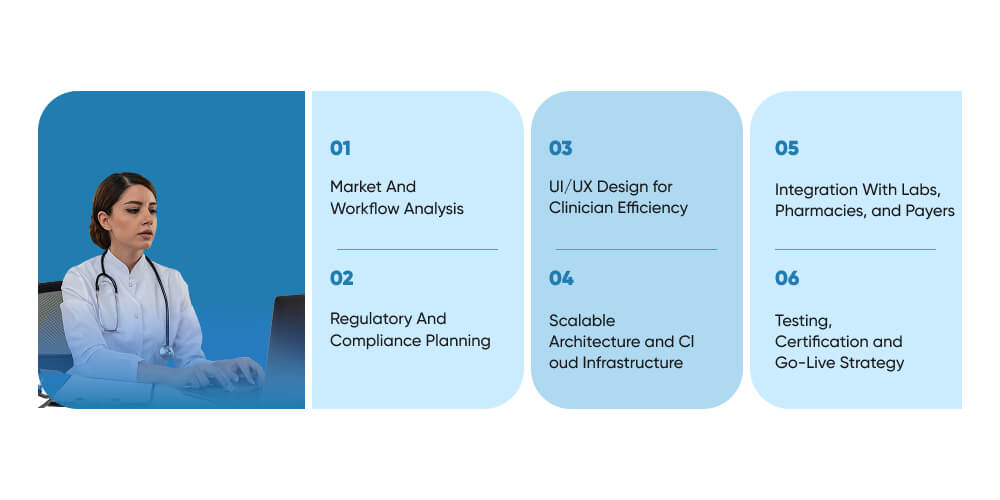
Developing specialized digital platforms for behavioral healthcare requires deep understanding of clinical workflows, regulatory frameworks, and operational realities.
Organizations planning to build scalable platforms typically follow a structured development roadmap that balances compliance, usability, and long-term scalability.
Market And Workflow Analysis
Every mental health practice operates slightly differently. A large behavioral hospital network handles workflows that look nothing like a small private therapy clinic.
The first stage focuses on analyzing operational realities such as:
- Average therapy session duration
- Documentation formats used by clinicians
- Billing structures and payer mix
- Patient intake processes
- Integration requirements with telehealth platforms
This phase often reveals hidden inefficiencies. Identifying these gaps early allows development teams to design workflows that reduce administrative burden.
This is also where organizations usually evaluate top EHR systems for mental health providers already in the market to identify strengths, gaps, and opportunities.
Regulatory And Compliance Planning
Mental healthcare software in the United States must operate within strict regulatory frameworks. Ignoring these requirements during development can create legal and operational risks.
Key compliance considerations include:
- HIPAA technical safeguards for patient data protection
- 42 CFR Part 2 compliance for substance use disorder records
- Audit logging and user access tracking
- Encryption standards for data storage and transfer
Healthcare organizations working with experienced healthcare software development partners typically navigate this phase much more efficiently.
UI/UX Design for Clinician Efficiency
Clinicians rarely have patience for complicated software. If documentation takes longer inside the system than on paper, adoption drops immediately.
Effective interface design focuses on simplifying daily tasks such as:
- Therapy session documentation
- Treatment plan updates
- Patient intake and assessments
- Medication tracking
- Insurance documentation
The goal is straightforward. A therapist should be able to complete session notes within minutes after a consultation.
Design teams often run usability testing sessions with real clinicians to ensure the interface aligns with practical workflows.
Scalable Architecture and Cloud Infrastructure
Mental health networks frequently expand quickly. A small clinic might begin with five therapists but grow into a multi-location practice within two years.
Because of that rapid growth, platform architecture must support scalability from the beginning.
Modern EHR platforms typically rely on cloud infrastructure that allows organizations to:
- Add new clinicians without system slowdown
- Manage patient data securely across locations
- Support telehealth services and remote care
- Handle large volumes of patient records
This is where strong custom software development capabilities become critical. A flexible architecture ensures the system evolves as the healthcare organization grows.
Integration With Labs, Pharmacies, and Payers
Mental health treatment often intersects with other healthcare services. Psychiatrists prescribe medications, labs monitor medication effects, and insurers process claims.
Integration capabilities usually include:
- Electronic prescribing systems
- Prescription drug monitoring programs
- Laboratory result integration
- Insurance claims management systems
- Telehealth platforms
When these integrations work smoothly, clinicians spend less time switching between systems. Administrative teams also process billing and insurance claims faster.
Testing, Certification and Go-Live Strategy
Before launching any healthcare platform, rigorous testing becomes essential. Even minor system errors can disrupt clinical operations.
The final development stages usually involve:
- Security and penetration testing
- Compliance verification against healthcare standards
- Real-world pilot testing in selected clinics
- Data migration from legacy systems
- Staff training and onboarding
A phased rollout approach works best. Instead of switching an entire network overnight, organizations typically launch the system in one department or location first. Once stability is confirmed, expansion becomes easier.
Cost Considerations for Developing Mental Health EHR
Investment requirements vary depending on system complexity, clinic size, and integration requirements. A basic solution for small therapy practices will cost far less than enterprise-level platforms serving hospital networks.
Key cost components generally include:
- Initial software development investment
- Infrastructure and cloud hosting
- Ongoing maintenance and security updates
- Regulatory compliance management
- Technical support and system upgrades
Typical Development Investment Range
| Organization Size | Estimated Development Cost | Typical Timeline | System Complexity |
| Small Therapy Clinics | $40,000 – $120,000 | 4 – 8 months | Basic platform with essential documentation |
| Multi-Location Practices | $120,000 – $350,000 | 8 – 14 months | Integrated clinical, billing, and telehealth systems |
| Hospital Behavioral Networks | $350,000 – $900,000+ | 12 – 24 months | Enterprise-grade platform with advanced integrations |
Beyond development costs, organizations should plan annual budgets for updates, compliance adjustments, and infrastructure upgrades. Healthcare technology evolves constantly, and systems must evolve alongside it.
Many healthcare leaders also benchmark their investment decisions against top EHR systems for mental health providers to understand feature gaps, scalability limitations, and long-term cost implications. This comparison often highlights the trade-off between short-term affordability and long-term operational efficiency.
Why Partner with DITS For EHR Software Development
Building secure healthcare platforms requires deep domain expertise, strong engineering capabilities, and a clear understanding of regulatory requirements in the United States.
DITS supports healthcare organizations through every stage of EHR product development, from early architecture design to long-term system scaling. Our experience includes delivering advanced Cloud-Based EMR & Behavioral Health EHR solutions that enable providers to manage distributed care environments, support telehealth services, and maintain secure access to patient records across multiple locations.
Our approach focuses on:
- Deep understanding of U.S. healthcare compliance frameworks
- Custom-built platforms tailored for behavioral health workflows
- Secure and scalable architecture for growing healthcare networks
- Seamless integrations with telehealth, pharmacies, and insurance systems
- Long-term product support and system evolution
We also integrate automation and intelligent tools into the development lifecycle, including business workflow automation capabilities that streamline clinical documentation, patient intake processes, and administrative operations.
For healthcare organizations looking to build scalable digital infrastructure, working with an experienced development partner often determines whether the system becomes a competitive advantage or just another operational burden.
Planning to Build a Future-Ready Behavioral Health Platform?
Collaborate with experienced developers to create intelligent, secure, and integration-ready EHR systems built for modern mental healthcare environments.
Conclusion
Behavioral healthcare organizations are facing increasing operational pressure as patient demand, regulatory requirements, and documentation workloads continue to grow. Generic clinical platforms rarely support the complex workflows of therapy practices, psychiatric care, and long-term behavioral treatment. That is why many providers are now shifting toward specialized EHR systems for mental health designed specifically for behavioral healthcare environments.
When built with the right architecture, compliance safeguards, and clinician-friendly workflows, these platforms reduce administrative burden, improve care coordination, and strengthen operational efficiency. For healthcare leaders, investing in the right EHR infrastructure is no longer optional. It is a strategic step toward scalable, patient-centered mental health services.
FAQs
How Long Does It Take To Build Electronic Health Record Systems For Mental Health?
Development timelines depend heavily on system complexity and integration requirements. A focused platform designed for small therapy clinics may take around 4 to 6 months, especially if the scope includes documentation templates, appointment management, and billing features. Larger systems built for behavioral health networks or hospital departments often require 12 to 18 months. These projects involve deeper compliance frameworks, integration with pharmacy and laboratory systems, and advanced reporting capabilities.
What Compliance Certifications Are Required In The U.S.?
Healthcare software operating in the United States must follow strict data protection and privacy regulations. HIPAA compliance is the most fundamental requirement, ensuring patient health information remains protected during storage and transmission. Behavioral health systems must also follow 42 CFR Part 2 regulations when handling substance use disorder records. Additional compliance frameworks such as SOC 2 readiness and audit logging capabilities are often implemented to strengthen system security and regulatory alignment.
How Much Does It Cost To Develop Behavioral Health EHR Platform?
Development costs vary widely depending on scale and feature requirements. Small therapy networks might invest between $40,000 and $120,000 for a focused platform with core documentation and scheduling capabilities. Larger organizations building enterprise-grade solutions with integrations, analytics, and multi-location infrastructure can invest several hundred thousand dollars. Healthcare organizations often partner with specialized teams offering healthcare software development expertise to control costs while ensuring regulatory compliance and long-term scalability.
Can Mental Health EHR Integrate With Telehealth And Billing Systems?
Yes, modern behavioral health platforms are designed to connect with multiple healthcare technologies. Teletherapy platforms, insurance billing systems, laboratory integrations, and prescription management tools can all operate within a unified system architecture. These integrations reduce administrative friction and allow clinicians to manage patient care more efficiently without switching between multiple software platforms.

Nidhi Thakur
With more than 19 years of experience - I represent a team of professionals that specializes in the healthcare and business and workflow automation domains. The team consists of experienced full-stack developers supported by senior system analysts who have developed multiple bespoke applications for Healthcare, Business Automation, Retail, IOT, Ed-tech domains for startups and Enterprise Level clients.
Recent Posts

Explore how intelligent document processing for insurance helps businesses automate document workflows, reduce processing costs, improve accuracy, and strengthen operational efficiency across insurance functions.

Discover how automated medical claims processing reduces delays, manual rework, claim denials, and administrative costs while improving reimbursement speed and operational efficiency.

Learn how to build medical billing software with essential features, integrations, security, and development costs.