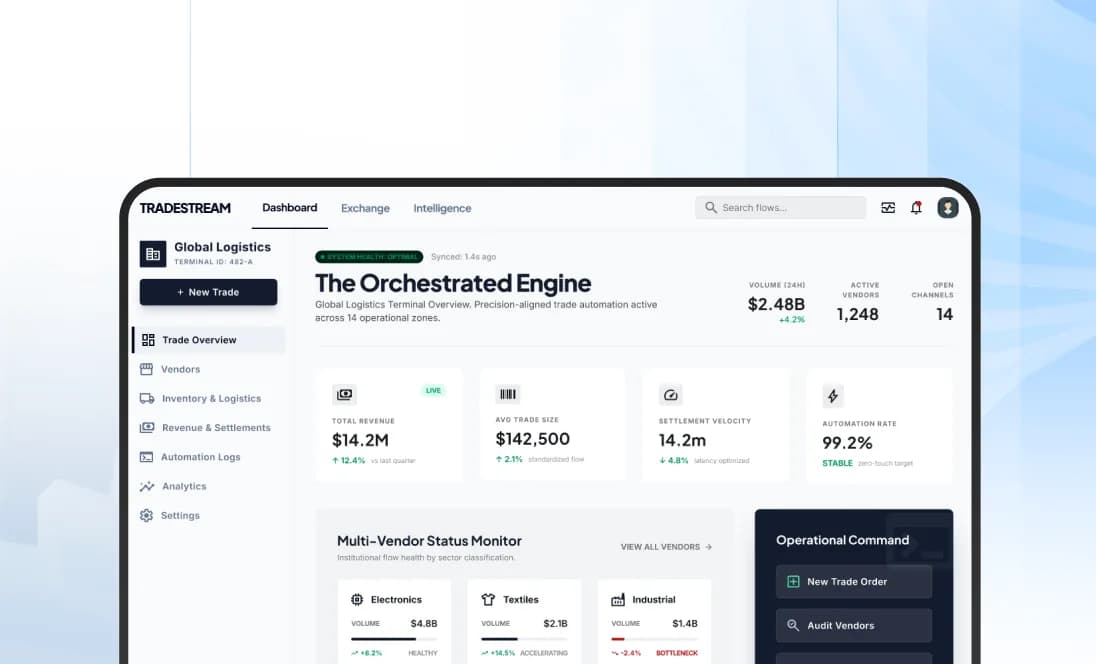


Three-Portal Role Architecture
Panel beaters create and manage claims, claim administrators approve within their threshold, and operations executives handle escalated high-value cases, each portal exposing only permitted actions.
Auto claims management software that funds car repair shops before insurers settle, centralizing the motor claim lifecycle across three role-specific portals with threshold-based authorization and embedded operational reporting for leadership.

The platform provides short-term funding to panel beaters across South Africa, letting a repair shop buy parts before the insurer settles. Around that funding sits a digital bridge connecting repair shops, parts suppliers, and insurance companies. Ditstek delivered a full revamp of this motor insurance claims software: a responsive React front end backed by a three-layer .NET architecture split into API, Core, and Repository projects. The rebuilt system centralizes the entire claim lifecycle from creation and supplier nomination through document validation and final authorization, with three portals over one shared claim record.
Disconnected processes, manual errors, and visibility gaps were undermining claims efficiency and stakeholder collaboration in automotive repairs.

The legacy database could not retrieve even 200 documents in one operation without stalling, yet document capture sits at the centre of every funded repair claim.

Every claim depends on supplier invoices and vehicle photographs being uploaded, matched to parts, and validated before funding is released, making storage a business constraint.

Leaving files in the core database meant degrading performance as volume grew, while moving them out risked document URLs falling out of sync with live claim records.

Panel beaters, parts suppliers, and insurers interacted through disconnected processes, making claim statuses hard to track and ordered parts hard to match against supplier invoices.

The business needed claims routed by financial risk depending on whether they fell above or below a defined percentage of net claim amount, validated against configured tolerances.

The legacy front end suffered bundle bloat and slow load times, hurting daily efficiency for high-volume users who search, scroll, and process large data grids continuously.
This claims platform modernization rebuilt the system on a layered architecture with role-specific workspaces, decoupled document storage from the core database entirely, and codified the financial authorization rules directly into a routing engine.

A React 18 and TypeScript front end paired with a three-tier backend separating API controllers, core entities and transfer objects, and the repository layer holding business logic.

Each user group receives its own role-specific workspace, while every action from logging a document query to linking a part lands inside one synchronized shared environment.

Azure Blob Storage now holds the files, and a background service uploads documents in stacks and updates the database asynchronously with the resulting document URLs.

Claim administrators handle standard approvals while claims exceeding the defined financial threshold escalate automatically to operations executives, removing the manual judgement that previously decided where each claim went.

RTK Query replaced plain fetch and axios calls, delivering automatic caching, request deduplication, and tag-based invalidation across the high-volume data grids that staff work inside daily.
The heavy date library was replaced with a lighter alternative, lazy loading was applied across all routes, and server-side pagination was paired with a debounced search.
The platform runs three role-scoped portals over one shared claim record, combining claims workflow automation with automated financial routing, asynchronous document handling, embedded operational reporting, and full request-level audit logging across every financial action taken.
Panel beaters create and manage claims, claim administrators approve within their threshold, and operations executives handle escalated high-value cases, each portal exposing only permitted actions.

A back-office engine routes claims by financial threshold, with higher-value claims validated by operations executives against system-configured tolerance percentages before any funding approval is finally granted.

A background service pushes supplier invoices and vehicle photographs to object storage in stacks, then writes resulting URLs back to the database without blocking the interface.

Repair shops create claims by entering insured details, vehicle information, parts, labour, paint, and excess amounts, with full draft-save managed through Redux slices across the session.

Panel beaters nominate suppliers against approved claims, and linking a supplier to multiple parts generates a unique platform reference and advances the claim lifecycle state.
Supplier invoices are captured manually or by bulk upload, with users matching invoice line items directly to claim parts and logging queries against any missing documentation.
Large datasets render through virtualized tables with server-side pagination driven by page number, page size, ordering, and direction parameters, plus virtual scrolling for long continuous lists.
Service procedures created on the cloud portal feed embedded reporting code placed into the web forms, delivering live operational workspace insights to leadership from inside the application.
Application middleware intercepts every incoming and outgoing request, capturing the URL, parameters, headers, method, and timestamps, with failed requests logging exception type, message, and source.
Automating and digitizing the entire claims journey resulted in measurable gains in approval speed, collaboration, and financial efficiency.
Decoupling documents from the core database removed the constraint that capped retrieval at roughly 200 documents, so bulk invoice uploads no longer lock the interface.
This insurance workflow automation software codified the financial threshold into a routing engine, taking a recurring manual decision out of daily processing and put high-value claims before operations executives automatically.
Three role-specific portals replaced the disconnected processes, so repair shops, parts suppliers, and insurers now work against one shared record instead of reconciling separate versions.
Caching, bundle reduction, lazy loading, and virtual scrolling made the large data grids fully workable for the high-volume staff who spend entire working days inside them.
Embedded business intelligence put live operational reporting in front of leadership from within the application itself, rather than requiring a separate tool and a separate export cycle.
Request and error logging middleware means any financial action can be traced after the fact, with full exception type, message, and source detail captured against failures.

Enterprise platform for automated trade data ingestion. Multi vendor marketplace development and service marketplace app development with Snowflake & Salesforce.
View Project