DITS Logo
Connect With Us
Customs Document Clearance Software for Freight Forwarders

Customs Document Clearance Software for Freight Forwarders

A SaaS-based customs clearance software that centralizes order management, document processing, data enrichment, and customs preparation, helping freight forwarders, importers/exporters, and customs teams reduce manual processing and manage complex clearance workflows efficiently.

Customs Document Clearance Software for Freight Forwarders

Project Overview

The business operates in the logistics and customs clearance industry, where freight forwarders, importers/exporters, and customs teams manage large volumes of shipment information and supporting documentation. DITSTEK developed Customs Compliance Software for Freight Forwarders that centralizes order management, document processing, data enrichment, and customs preparation within a unified web application. The solution combines OCR-based processing, multi-user access, role-based access management, multi-company support, multilingual functionality, subscription-based feature access, dynamic fields and tables, configurable branding, real-time tracking, and multiple channels for receiving and distributing information.

Challenges

  • Repetitive Manual Data Entry

    Repetitive Manual Data Entry

    Customs clerks repeatedly entered shipment information into customs forms, with individual forms consuming 10–15 minutes of manual effort, creating avoidable errors, slower processing, and additional operational costs.

  • Fragmented Documents and Intake Channels

    Fragmented Documents and Intake Channels

    Shipping documentation was scattered across emails, desktops, and operational channels, while orders arrived through multiple sources, creating fragmented workflows, version mismatches, retrieval difficulties, and missed deadlines.

  • Limited Clearance Progress Visibility

    Limited Clearance Progress Visibility

    Clients, brokers, port officials, and operational teams lacked a unified view of clearance progress, resulting in repeated status follow-ups, poor coordination, and slower international shipping workflows.

  • Complex Multi-Company Requirements

    Complex Multi-Company Requirements

    The application needed to support multiple companies with separate users, data, access permissions, subscriptions, branding, and configurations while maintaining appropriate separation between individual organizations.

  • Changing Data and Multilingual Requirements

    Changing Data and Multilingual Requirements

    Organizations required different fields, forms, tables, reporting structures, and languages, making static systems difficult to adapt as business, customs, and global team requirements continued evolving.

  • Customer Onboarding and Deployment Scalability

    Traditional deployments required significant manual effort and configuration, creating scalability challenges and making it difficult to establish and configure new customer environments quickly as requirements expanded.

Solution

DITSTEK developed customs clearance software solutions combining automated document processing, centralized workflows, configurable data structures, access management, multilingual functionality, company-specific configurations, integrations, subscriptions, and automated deployment capabilities.

OCR-Based Document Processing

OCR-Based Document Processing

OCR and document capture workflows extract and process information from invoices, HS codes, manifests, bills of lading, and other customs and logistics documentation.

Centralized Order and Document Workflow

Centralized Order and Document Workflow

Orders and documents received through drag-and-drop uploads, SFTP servers, email, and APIs are processed within the application and distributed through configurable output channels.

Multi-Company and Role-Based Management

Multi-Company and Role-Based Management

Each organization maintains its users, data, configurations, subscriptions, branding, and operational environment, while role-based controls restrict functionality and information according to individual user responsibilities.

Dynamic Fields and Data Tables

Dynamic Fields and Data Tables

Users configure custom text, numeric, and date fields, while reusable dynamic tables adapt columns, displayed data, formatting, filtering, sorting, and footer information according to requirements.

Multilingual, Branding and Subscription Configuration

Multilingual, Branding and Subscription Configuration

Multilingual functionality supports preferred and additional languages, while company-specific logos, dynamic color themes, and subscription-based functionality provide experiences aligned with individual organizational and operational requirements.

Automated Deployment and CI/CD

Automated deployment and CI/CD capabilities simplify application updates and reduce the effort required to establish new customer environments, improving deployment scalability and accelerating customer setup.

Features

The customs compliance software provides comprehensive functionality for customs orders, document processing, users, data structures, integrations, reporting, security, company configurations, and deployment while supporting multiple organizations within a configurable SaaS environment.

Multi-Company, Multi-User and Role-Based Access

Multi-Company, Multi-User and Role-Based Access

Supports separate company users, data, configurations, subscriptions and branding, simultaneous multi-user access, individual login credentials, and role-based controls with administrator-managed user accounts and permissions.

Order Management and Real-Time Tracking

Order Management and Real-Time Tracking

Users can create, view, manage, and process customs clearance orders, while timelines, processing status, and progress visibility help stakeholders track transactions and reduce manual status inquiries.

Multi-Channel Intake and Document Upload

Multi-Channel Intake and Document Upload

Accepts orders and documents through uploads, SFTP and email, with drag-and-drop support for PDF, JPG and PNG files, document preview, and saving within the application.

OCR, Document Management and Output Channels

OCR, Document Management and Output Channels

OCR extracts structured information from scanned and digital documents, centralized management improves document accessibility, and configurable output channels distribute processed data and documents to third-party systems.

Dynamic Fields, Tables and Advanced Search

Dynamic Fields, Tables and Advanced Search

Custom text, numeric, and date fields support forms and reports, while dynamic tables provide configurable columns, formatting, filtering, sorting, footer information, and advanced search capabilities.

Multi-Language, Branding and Subscription Access

Multi-Language, Branding and Subscription Access

Supports multiple and additional languages, company-specific logos and color themes, and subscription-based feature access, enabling organizations to maintain individual experiences within the shared freight forwarding software platform.

API Integrations, Notifications and Reporting

REST APIs exchange information and documents with external logistics and enterprise systems, while email notifications and PDF/CSV reporting support operational communication and exportable customs information.

QR Codes, Barcodes and Application Security

QR codes and barcodes support reporting and logistics documentation, while JWT-based authentication and authorization protect application functionality and enforce controlled access throughout the platform.

Validation, Logging and Automated Deployment

Server-side validation improves data consistency, application logging supports error handling and troubleshooting, while CI/CD and automated deployment simplify releases and the establishment of customer environments.


Tech Implementation

  • Angular
  • Node.js
  • AWS Cloud
  • Azure DevOps pipelines
  • Git‑Watcher auto‑deploy
  • Docker
  • PostgreSQL

Impact

80% Reduction in Data-Entry Time

80% Reduction in Data-Entry Time

OCR and automated document processing reduced manual form filling from approximately 15 minutes to under 3 minutes, decreasing repetitive and error-prone typing across customs preparation activities.

40% Shorter Clearance Cycles

40% Shorter Clearance Cycles

End-to-end workflow automation reduced average customs processing cycles from approximately 48–72 hours to 24–36 hours, resulting in shorter clearance cycles and faster cross-border shipment processing.

88% Fewer Audit Errors

88% Fewer Audit Errors

Validated data extraction and compliance logging reduced clerical mistakes from approximately 8% to less than 1%, contributing to fewer audit errors and improving customs information accuracy.

50% Reduction in Status Inquiries

50% Reduction in Status Inquiries

Real-time order tracking and status visibility reduced dependency on manual follow-ups, contributing to a 50% reduction in status-inquiry tickets throughout customs clearance operations.

85% Faster Client Onboarding

85% Faster Client Onboarding

Automated deployment and CI/CD enabled new customer environments to be established in under two days compared with weeks of traditional onboarding, significantly accelerating client setup.

Centralized Customs Preparation Workflow

The platform transformed fragmented document handling into centralized Customs Clearance Solutions for receiving information, enriching data, managing orders, tracking progress, controlling access, and distributing processed information.

More Portfolios

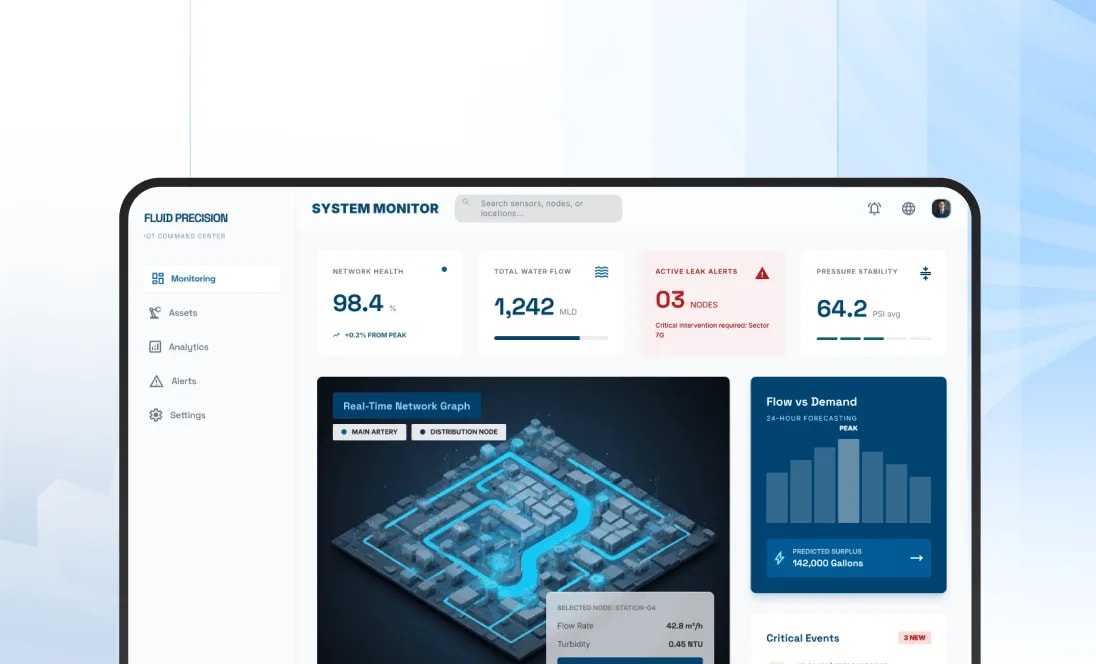
IoT Smart Water Management System Development

Discover IoT-based smart water management system development services for real-time monitoring, supply control, and scalable smart city solutions.

View Project
IoT Smart Water Management System Development

Got a Question or a Project in Mind?

Drop your query below, and let's explore how we can collaborate to drive engagement, visibility, and measurable results.

Send a Query